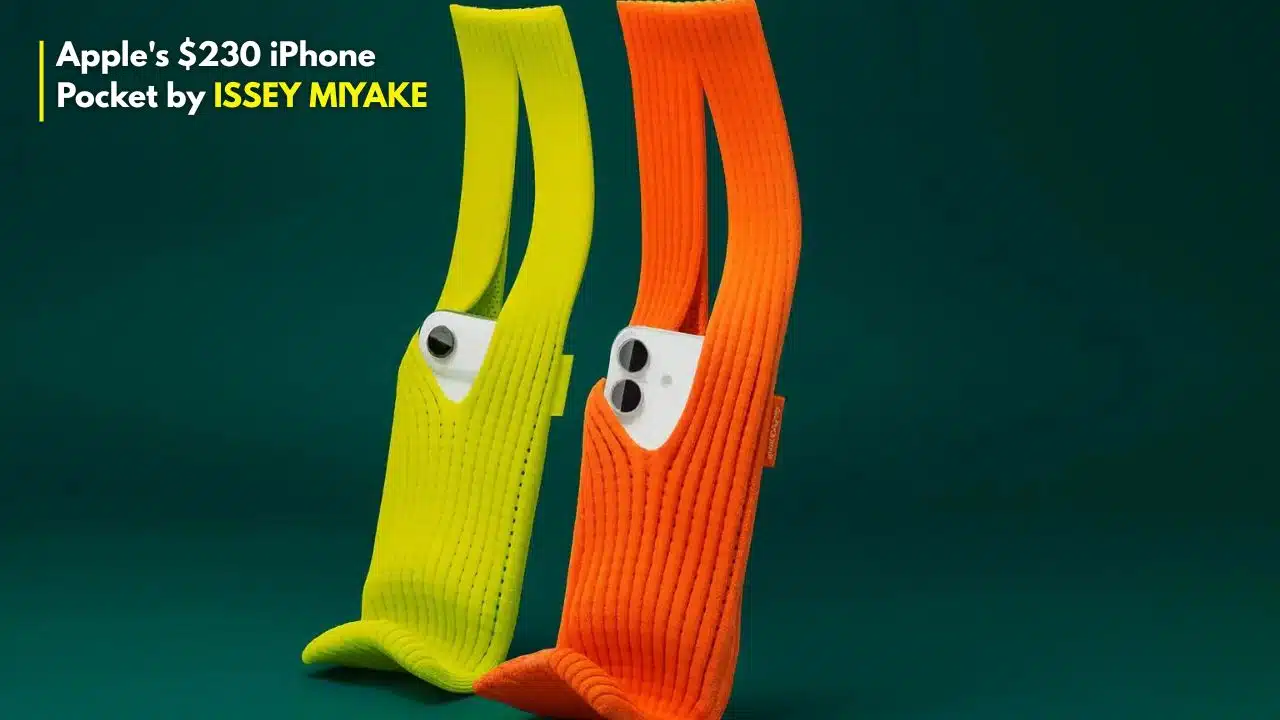
In a market move that has both baffled critics and proven the sheer, unassailable power of its brand, Apple’s $230 iPhone Pocket sold out worldwide just hours after its launch on Friday, November 14.
The product, a luxury accessory and not a phone, is a 3D-knitted sling designed in a high-fashion collaboration with ISSEY MIYAKE. Despite its premium $229.95 price tag and a wave of online mockery—with critics deriding it as a “glorified sock”—the limited-edition item was snapped up instantly by consumers, sparking a fresh, intense debate on the limits of brand loyalty and the definition of value in the tech ecosystem.
This sell-out success highlights a core paradox of Apple’s current global strategy: as the company simultaneously pushes into new markets like India with record-breaking sales of its $1,000+ premium phones, it can also market a high-margin, niche fashion item in its established markets and meet with overwhelming demand.
What Happened: An ‘Instant’ Sell-Out
The iPhone Pocket was unveiled earlier in the week, with an official announcement from Apple on November 11, 2025. The product, described as being “inspired by the concept of ‘a piece of cloth,'” was the result of a joint development process between the Apple Design Studio and MIYAKE DESIGN STUDIO.
It launched on Friday, November 14, as a “special-edition release” available only in select flagship Apple Stores—such as those in New York, London, Tokyo, and Shanghai—and on Apple’s website in the US, UK, Japan, and several other countries.
By midday in the US, the product was almost entirely unavailable. The $229.95 long-strap version, available in three colors, was listed as “Sold Out” on Apple’s US website. The $149.95 short-strap version (available in eight colors) also sold out in most, if not all, colorways. The rapid sell-out mirrors the “drop” culture playbook popularized by streetwear brands, where extreme scarcity is a key component of the marketing.
The ‘Litmus Test’: A Wave of Online Backlash
The product’s launch was met with immediate and widespread criticism, primarily centered on its price-to-perceived-value ratio.
The most prominent critique came from leading technology YouTuber Marques Brownlee (MKBHD), who took to X (formerly Twitter) to voice his disbelief.
Brownlee’s comment encapsulated the feelings of many. Commentators across social media and tech forums immediately drew comparisons to Apple’s 2004 “iPod Socks”—a $29 set of six colorful knit protectors that Steve Jobs himself introduced with a smirk as a fun, quirky accessory.
Critics in 2025, however, noted a key difference: the iPod Socks were priced as a novelty, while the iPhone Pocket is priced as a luxury fashion item. It has been called a “glorified yarn sling” and an “unholy union between a scarf and a sock.
Marketing analysis firm DesignRush noted the “friction” caused by the product’s pricing. It argued that consumers are accustomed to functional tech accessories (cases, chargers) costing $30-$50, while fashion accessories from luxury brands often cost hundreds. The iPhone Pocket exists in the uncomfortable, and apparently controversial, space between the two.
And yet, it sold out. As DesignRush concluded in its analysis, the event proves that for a brand with enough cultural pull, “backlash and demand can coexist.”
Product Deep Dive: What Exactly Is the iPhone Pocket?
Despite the prompt’s keyword, the “iPhone Pocket” is not a device but a wearable carrier for one.
The Fashion Collaboration
The product’s high price and design are explained by its co-branding. It is an official collaboration with ISSEY MIYAKE, the eponymous Japanese fashion house. The studio is famously linked to Apple’s own history; its founder, Issey Miyake, was responsible for designing the iconic black turtlenecks that became a uniform for Apple co-founder Steve Jobs.
In an official press release, Apple and MIYAKE DESIGN STUDIO explained the product’s philosophy.
Data: Pricing and Materials
The iPhone Pocket is not simple knitwear. According to Apple, it is “crafted in Japan” and features a “singular 3D-knitted construction” that creates a ribbed, pleated texture, an iconic signature of ISSEY MIYAKE’s brand.
-
Material: 85% Polyester, 14% Nylon, 1% Polyurethane.
-
Short Strap Model:
-
Price: $149.95 (US)
-
Colors: Eight options, including Lemon, Mandarin, Purple, and Black.
-
-
Long Strap Model:
-
Price: $229.95 (US)
-
Colors: Three options: Sapphire, Cinnamon, and Black.
-
The 3D-knit design is intended to be flexible, allowing the “Pocket” to expand to fit any iPhone model, from a Pro Max to an iPhone Air, as well as other small items like AirPods or keys.
Analysis: The ‘Other’ Apple Market
The launch of the iPhone Pocket creates a stark and fascinating contrast with Apple’s other major success story in 2025: its record-breaking performance in emerging, price-sensitive markets.
While a few thousand global consumers spent $230 on a “sock” on Friday, millions of new customers in markets like India are stretching their budgets to buy Apple’s core, premium-priced hardware. This simultaneous success in two opposite markets demonstrates the unparalleled power and elasticity of Apple’s brand.
Data Point 1: Record Growth in India
In the third quarter of 2025 (Q3 2025), Apple’s performance in India was staggering.
-
Apple shipped a record 5 million iPhones in India in Q3 2025, its highest-ever quarterly shipments in the country.
-
This represents a 25.6% year-over-year growth in market share.
-
Apple is now the fourth-largest smartphone brand in India, with a 10.4% market share.
Data Point 2: A Premium Phone Goes Mainstream
The most telling statistic is which phone is succeeding. It is not a hypothetical, cheap iPhone.
-
The iPhone 16 (a previous-generation model) was the single most-shipped smartphone in all of India during Q3 2025 .
-
This one model accounted for 5% of the entire Indian smartphone market.
This data confirms that Apple’s strategy is not to compete on price by releasing a cheap device, but to make its premium products accessible. Through local manufacturing (which reduces import duties), strong trade-in programs, and flexible bank financing, Apple has convinced a growing segment of the Indian market that a $1,000+ iPhone is an attainable, aspirational purchase.
The brand loyalty that Marques Brownlee questioned is the very same force that allows Apple to sell a $230 accessory in New York and a $1,000 phone in New Delhi, all on the same day.
What to Watch Next
The primary question for Apple’s most dedicated (and wealthy) fans is whether the iPhone Pocket was a one-time “special-edition” drop or if it will be restocked. Given its “limited” branding, a restock seems unlikely, which will only fuel its value on the resale market.
Observers should now watch secondary markets like eBay, where the true market value of the $230 iPhone Pocket will be determined by resellers—who may have been responsible for a significant portion of the initial sell-out.
Ultimately, the iPhone Pocket is a footnote in Apple’s Q4 2025 revenue, but it’s a headline story for brand theorists. It serves as a $230, 3D-knitted “litmus test” that Apple, and its most loyal customers, just passed with flying colors.