
Apple has taken a decisive step in the ongoing competition among music streaming services by introducing a playlist transfer feature in Apple Music. The tool allows users to bring their playlists from rival platforms—most notably Spotify—directly into Apple’s ecosystem.
For years, one of the main barriers keeping users loyal to Spotify has been the difficulty of moving playlists built up over many years of listening. Apple’s new feature removes that obstacle and appears designed to attract listeners who may be frustrated with Spotify’s policies, rising prices, or recent controversies but hesitant to abandon their personalized music collections.
From Limited Testing to Global Rollout
The feature was initially tested in Australia and New Zealand earlier this year. After positive results, Apple has now expanded access to major international markets, including the United States, United Kingdom, Canada, Brazil, France, Germany, and Mexico. By launching the tool in countries that represent the bulk of global music streaming subscriptions, Apple is signaling that it sees playlist migration as a core competitive strategy.
The timing is also noteworthy. Spotify recently faced backlash from both subscribers and artists over pricing changes, royalty issues, and CEO Daniel Ek’s investments in military artificial intelligence technology. Apple’s move coincides with these controversies, offering users an easier pathway out of Spotify.
How the Playlist Transfer Works
The tool is integrated directly into the Apple Music app and web version. Users can find it under the settings option labeled “Transfer Music from Other Music Services.”
Here’s how the process works:
-
Users sign into their existing streaming service, such as Spotify.
-
They select which playlists, albums, or tracks they want to migrate.
-
Apple Music scans the content and matches it with its own library.
-
Any songs not available on Apple Music are flagged, and users have 30 days to review or attempt a rematch.
This system is powered by SongShift, a third-party app that has specialized in playlist migration for years. Apple’s partnership with SongShift means users can now perform these transfers without leaving Apple Music, eliminating the need for external apps.
It’s important to note that only user-created playlists can be migrated. Editorial or algorithm-based playlists generated by Spotify—such as Discover Weekly or Release Radar—are not included. However, the ability to move thousands of personal playlists represents a significant breakthrough for users considering a switch.
Why This Matters for Listeners
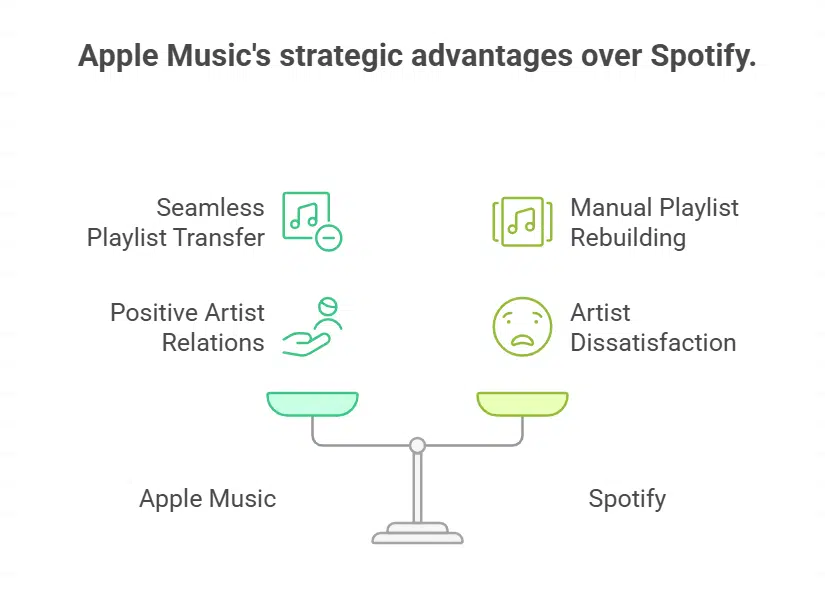
The biggest psychological hurdle for many Spotify users has always been the investment of time and energy spent curating playlists. Rebuilding years of playlists manually in a new service is impractical. By eliminating this barrier, Apple has positioned itself as a more attractive alternative to Spotify and other rivals like Amazon Music, Deezer, and YouTube Music.
Apple is also appealing to users who feel disillusioned by Spotify’s handling of royalties and artist payouts. Recently, several high-profile indie bands—including Godspeed You! Black Emperor, King Gizzard & the Lizard Wizard, Xiu Xiu, Hotline TNT, and Deerhoof—announced they were pulling their music from Spotify. Their departure highlighted growing dissatisfaction with Spotify among artists, which in turn has influenced many fans to reconsider their streaming platform loyalty.
Industry Implications
The playlist transfer tool represents more than just a convenience for users; it’s a competitive strategy aimed at undermining Spotify’s dominance. Spotify remains the world’s largest music streaming platform, with more than 600 million users, but Apple Music has been steadily gaining ground with an estimated 110–120 million subscribers worldwide.
By giving consumers an easier exit from Spotify, Apple is directly targeting one of the strongest “lock-in” effects in the music streaming market. Once a listener feels they can leave without losing their curated collections, the playing field becomes more level.
Apple also stands to gain credibility among artists and rights holders. Unlike Spotify, Apple has avoided controversies related to AI investments and has promoted itself as a platform more committed to fair compensation. Its integration with the broader Apple ecosystem—such as Siri, iPhone, HomePod, and Apple Watch—further strengthens the appeal.
Challenges and Limitations
While the feature is a significant step, it is not without limitations. Not all songs available on Spotify exist in Apple Music’s catalog, and certain regional releases may be difficult to transfer. Additionally, some tracks may transfer incorrectly or require manual editing.
Another limitation is the exclusion of algorithm-generated playlists, which many users depend on to discover new music. Still, for those who primarily use personal playlists, the tool removes the largest barrier to switching services.
The Bigger Picture in the Streaming Market
The launch of this tool underscores how streaming services are increasingly competing not only on content but also on user experience. Features like playlist transfers, integration with devices, audio quality, and pricing now play as much of a role as music catalogs.
Apple’s timing also reflects broader trends:
-
User dissatisfaction with Spotify over artist treatment and rising subscription costs.
-
Greater consumer willingness to experiment with alternative services, particularly if the migration process is seamless.
-
Artist activism, as more musicians push for transparency in royalties and fairer business practices.
Apple appears to be betting that a growing number of listeners are ready to make the jump if given the right tools.
Apple Music’s playlist import tool is more than a technical update—it is a strategic move in the battle for dominance in the music streaming industry. By removing one of the most significant barriers to switching platforms, Apple has positioned itself to capture frustrated Spotify users and strengthen its presence in the global market.
For listeners, it represents newfound freedom: the ability to take years of music curation and transfer it without hassle. For the industry, it signals a new phase of competition where user retention may depend less on exclusive catalogs and more on how easy it is for people to move between services.
The question now is whether this will trigger a larger migration away from Spotify, especially as Apple continues to highlight its ecosystem integration and growing music catalog. One thing is clear: with this new tool, the choice of which streaming service to use is no longer tied to the weight of past playlists.