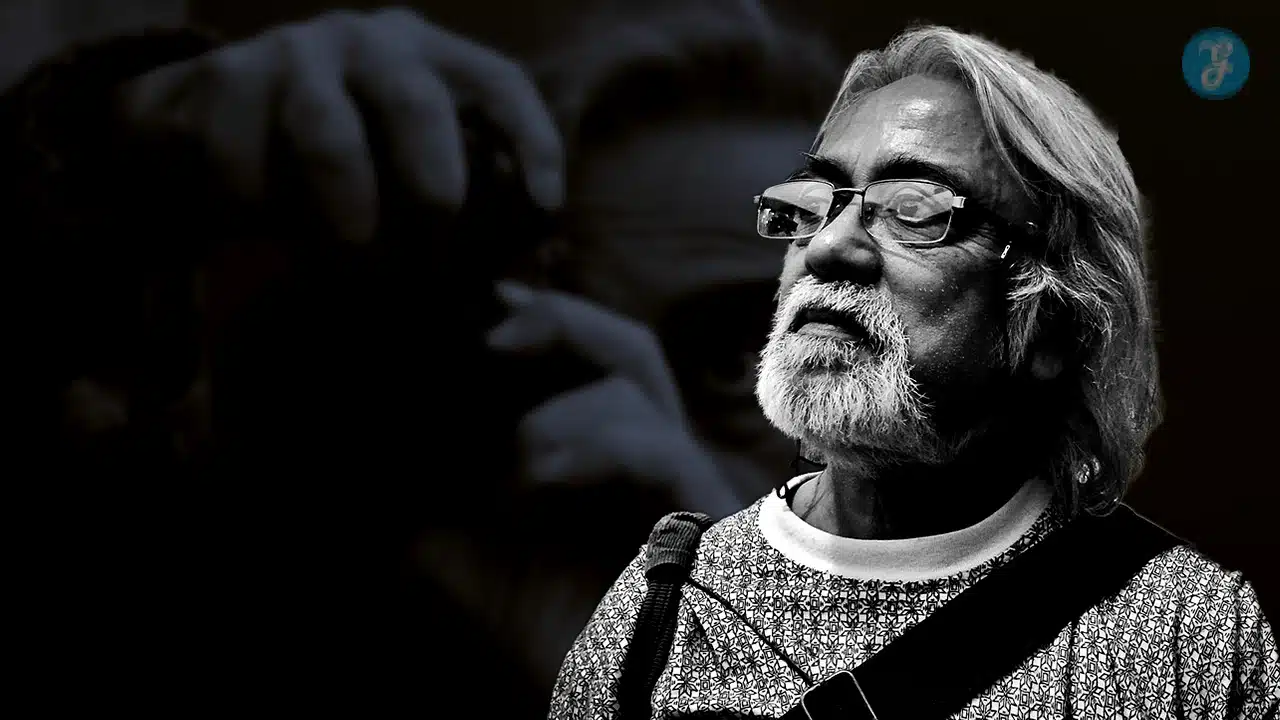
Three years have passed since Bangladesh lost Anwar Hossain — the legendary photographer and cinematographer whose work helped define the country’s visual identity. His death on 1 December 2018 left a void in both Bangladeshi photography and film that continues to be felt. Every year on this day, admirers, colleagues, students, and cultural institutions pause to remember the man who transformed photography from a niche craft into a respected artistic discipline in the country.
For many, his contributions go beyond technical skill. He introduced Bangladesh to the world through images that were honest, unfiltered, and deeply rooted in human emotion. His work chronicled history, hardship, and hope — and as a result, his legacy remains timeless.
A Childhood of Curiosity and the Early Spark of Photography
Born in 1948, Anwar Hossain grew up in a modest household where resources were limited, but imagination was not. Despite financial constraints, he developed an early fascination with visuals — light, shadows, and the storytelling potential of everyday scenes. This curiosity led him to take up photography during his student life, even though the art form was not yet mainstream in the region.
While studying architecture, he found himself increasingly drawn to the camera. With determination and self-teaching, he honed his craft quietly, often capturing the lives of ordinary people around him. His passion quickly translated into recognition. By 1968, he had already made history by winning an award as the best photographer in Pakistan, followed by a prestigious gold medal in a major photography competition in Japan that same year.
These early achievements did more than validate his talent — they signaled the arrival of a new voice in photography, someone capable of elevating Bangladeshi imagery to a global stage.
Documenting the Liberation War and Becoming a National Witness
Anwar Hossain’s artistic identity became inseparably tied to Bangladesh’s struggle for independence. When the Liberation War broke out in 1971, he joined the frontline not with a weapon, but with a camera. His photographs from this period are considered historical evidence of the brutality inflicted by the occupying forces. They also serve as a tribute to the resilience of the Bangladeshi people.
These images continue to be regarded as some of the most powerful visual records of the war. They show the cost of freedom, the courage of the fighters, and the suffering of civilians. Through his lens, the world was shown a firsthand account of a nation fighting for its birth.
Beyond the war, his work from the 1970s and 1980s helped shape international perceptions of Bangladesh. In a time when the country was often associated only with natural disasters and poverty, Anwar’s photographs told a different story — one of culture, dignity, strength, and humanity.
Beyond Photography: A Cinematographer Who Redefined Bangladeshi Films
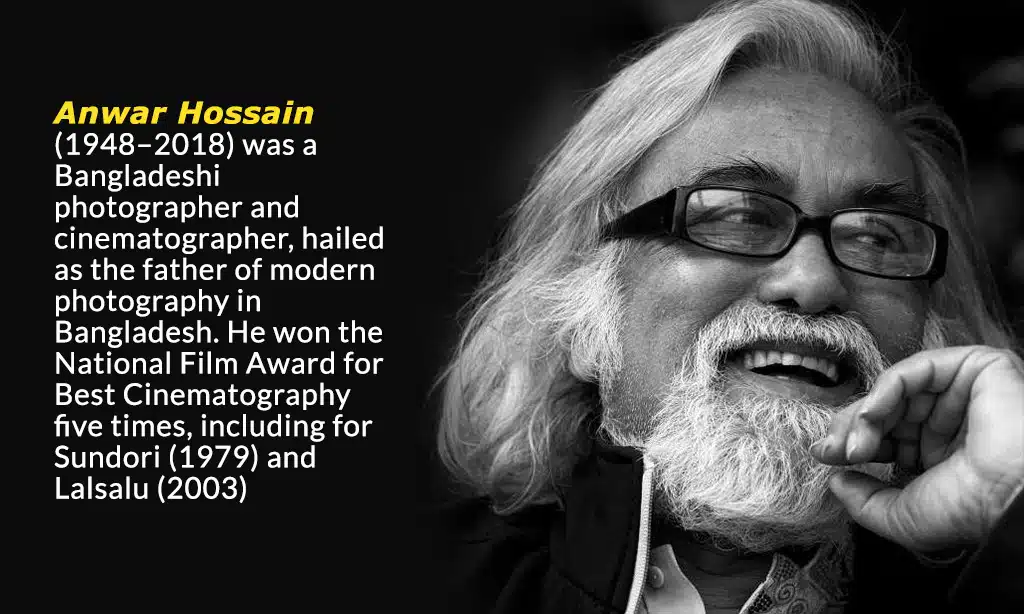
Though celebrated first as a photographer, Anwar Hossain made an equally lasting mark in cinema. His transition to cinematography allowed him to apply his unique understanding of light, mood, and composition to motion pictures.
His breakthrough came with the acclaimed film Surya Dighal Bari, directed by Sheikh Niamat Ali and Masihuddin Shaker. The film’s visual depth and emotional resonance were widely praised, and Anwar won his first National Film Award for Best Cinematography for this work.
This was only the beginning. Over the years, he contributed to some of Bangladesh’s most memorable films, including:
- Surya Dighal Bari
- Emiler Goenda Bahini
- Puroskar
- Anya Jibon
- Chitra Nodir Pare
- Lalsalu
- Lalon
- Shyamol Chhaya
His ability to elevate scripts through atmospheric visuals made him one of the most sought-after cinematographers in the industry. In total, he won five National Film Awards — a record that highlights both his versatility and mastery of the craft.
Personal Life, Exile, and His Continued Bond with Bangladesh
Anwar Hossain’s personal life was marked by both love and loss. He married Dolly Ibrahim, daughter of noted academic Neelima Ibrahim. Dolly remained his closest companion and artistic supporter until her passing in 1991. Her death profoundly affected him, prompting him to leave Bangladesh in the mid-1990s. He settled in France, married Miriam, and eventually became a French citizen.
Although he lived abroad for decades, his connection to Bangladesh never faded. He often returned to conduct workshops, teach young artists, participate in festivals, and serve on juries. His presence was always met with admiration, particularly among students who saw him as a mentor and guide in a rapidly changing creative landscape.
In his final visit to Dhaka in 2018, he came as a judge for a photography workshop competition. Just days later, he passed away quietly in a hotel room at the age of 70 — a sudden loss that shocked the artistic community.
Legacy and How Bangladesh Continues to Remember Him
Today, three years after his death, Anwar Hossain’s influence remains deeply embedded in Bangladesh’s visual culture. His photographs continue to be studied for their technical brilliance and emotional depth. Young filmmakers still look to his films for inspiration on how to use light, shadow, and silence to build meaning.
What sets his legacy apart is that he did not simply take pictures — he shaped the visual memory of a nation. His images of war, laborers, landscapes, and everyday life form a collective archive that future generations will inherit.
Every year, commemorations, exhibitions, and tributes highlight his contributions. His students share memories of his teachings; institutions revisit his work; and admirers reflect on the depth he brought to Bangladeshi art. In photography clubs, film circles, and classrooms, his name continues to be spoken with admiration and respect.