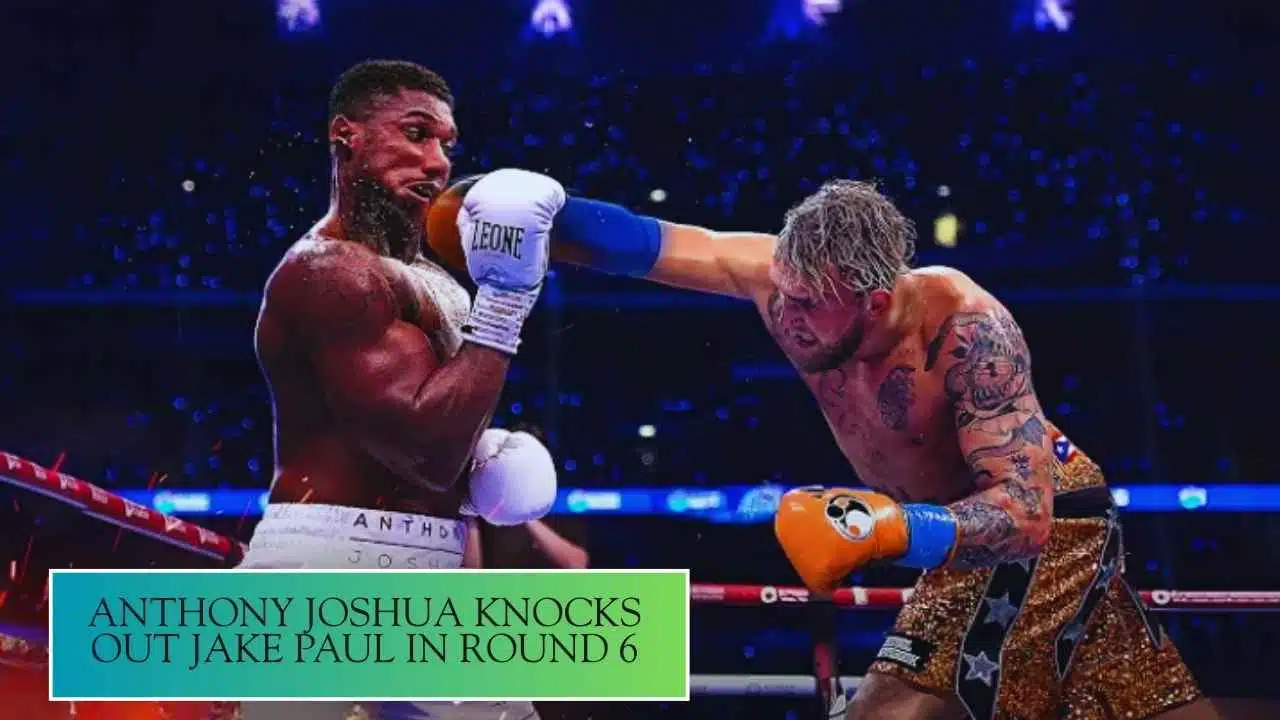
Anthony Joshua knocked out Jake Paul in the sixth round on Dec. 19, 2025, at Miami’s Kaseya Center, dropping him four times and ending their Netflix-streamed heavyweight bout at 1:31 of Round 6; Paul later said he suffered a double broken jaw.
Fight night recap: knockdowns pile up before the Round 6 finish
The heavyweight bout unfolded like a gradual takeover. Joshua stayed patient early, kept his balance, and used a steady jab to control distance. Paul tried to circle, reset, and look for openings, but Joshua’s size and timing made clean entries difficult.
The momentum shifted sharply late in the fight. Joshua accelerated in Round 5, when he began landing heavier shots and scored two knockdowns. By then, the pattern was clear: Joshua was finding Paul with straight punches and forcing him to react defensively instead of building offense.
Round 6 ended the contest. Joshua dropped Paul again, the fourth knockdown of the fight, and referee Christopher Young issued a count that reached ten. The stoppage came at 1:31 of the sixth round, ending the scheduled eight-round match in front of a crowd reported at 19,600.
Key fight facts
| Item | Detail |
|---|---|
| Date | Dec. 19, 2025 |
| Venue | Kaseya Center, Miami, Florida |
| Result | Anthony Joshua def. Jake Paul (KO) |
| Round / time | Round 6, 1:31 |
| Referee | Christopher Young |
| Knockdowns | Paul knocked down four times |
| Scheduled rounds | 8 |
How the matchup came together and why it became a global event?
The fight was billed as a major crossover moment a former two-time heavyweight champion facing a YouTuber-turned-boxer who had built a pay-per-view and streaming audience. The promotion framed it as a clash between elite heavyweight fundamentals and an ambitious challenger stepping well outside his usual comfort zone.
It was also a significant test for live boxing on a mass-market streaming platform. The main card streamed globally on Netflix, with a “big-night” structure designed to keep casual viewers engaged: a headline spectacle supported by a multi-fight lineup and a co-main event featuring a championship-level women’s bout.
The bout itself was treated as a professional heavyweight match scheduled for eight three-minute rounds. It was also promoted with a contracted weight limit that Joshua met comfortably, reinforcing that the main event was built around a clear and measurable physical dynamic as well as name value.
What “Judgment Day” looked like on paper
| Card element | What it signaled |
|---|---|
| Global Netflix stream | Aiming for mainstream reach beyond traditional boxing buyers |
| 8-round heavyweight main event | Designed for action and urgency rather than a 12-round grind |
| High-profile co-main and recognizable names | Built to retain viewers and widen the audience |
The numbers behind the mismatch: weight, height, reach, and what it meant in the ring
The official weigh-in captured the central storyline: Joshua entered significantly heavier than Paul. Paul weighed in at about 216.6 pounds, while Joshua came in around 243.4 pounds—nearly a 27-pound gap. The physical differences extended beyond the scale. Joshua also held clear advantages in height and reach.
Those numbers mattered once the bell rang. Joshua could touch Paul from safer range, and his jab set the rhythm. When Paul tried to close distance, he often had to cross a longer “danger zone” to reach Joshua, which increased the risk of being caught cleanly—especially by straight shots down the middle.
Paul’s approach relied on movement, timing, and picking moments to exchange. Joshua’s approach relied on structure: jab first, then heavier punches as Paul slowed and openings appeared. The late knockdowns suggested Joshua’s power carried through even after several rounds, while Paul’s ability to escape damage reduced as the fight progressed.
Tale of the tape snapshot
| Fighter | Weight | Height | Reach |
|---|---|---|---|
| Jake Paul | 216.6 lbs | 6’1″ | 76″ |
| Anthony Joshua | 243.4 lbs | 6’6″ | 82″ |
| Difference | 26.8 lbs | 5 in | 6 in |
Aftermath: Paul’s broken jaw, surgery, and what recovery can look like?
After the knockout, Paul shared that his jaw was broken in two places. He later said surgery went smoothly and described a painful first phase of recovery that included a liquid-only diet for about seven days. He also stated that surgeons used two titanium plates and that some teeth were removed as part of treatment.
Jaw fractures are treated based on location and severity. In many cases, doctors stabilize the bone and protect alignment while healing occurs. Diet restrictions are common early on, because chewing can stress the injury and slow recovery. A typical healing timeline for jaw fractures is measured in weeks, not days, and return to contact sports usually requires clearance after the bone has had enough time to stabilize.
The injury adds a practical pause to Paul’s next steps. Even if he wants to return quickly, jaw healing, pain management, and dental follow-up can dictate when normal training resumes—especially sparring, where contact and head movement can aggravate the injury.
Reported recovery details
| Item | Reported detail |
|---|---|
| Injury | Jaw broken in two places |
| Treatment | Surgery with two titanium plates |
| Diet restriction | Liquids for about seven days (early phase) |
| Additional note | Some teeth removed as part of treatment |
What comes next for Joshua and Paul after a decisive stoppage?
For Joshua, the win strengthens his position as a major heavyweight draw and reinforces his identity as a power finisher. The manner of victory—multiple knockdowns followed by a clean count-out—creates a straightforward narrative heading into 2026: Joshua remains dangerous, disciplined, and capable of ending fights suddenly.
For Jake Paul, the loss is both competitive and medical. The result ends the bout in the clearest way possible, and the injury forces a reset. If Paul returns, the next decision is likely to revolve around weight class and opponent selection. A move back toward cruiserweight would reduce the size gap and may better fit his recent boxing pattern, while still allowing high-profile matchups.
The larger takeaway is about risk and matchmaking. Crossing into heavyweight against a proven elite puncher compresses the margin for error. Small tactical mistakes can become fight-ending moments. That dynamic became more pronounced as the rounds progressed, when fatigue and accumulated damage made defense harder to maintain.
Event timeline
| Date | Moment |
|---|---|
| Dec. 18, 2025 | Official weigh-in completed in Miami |
| Dec. 19, 2025 | Fight held at Kaseya Center; main card streamed on Netflix |
| Dec. 19, 2025 | Joshua wins by KO (Round 6, 1:31) after four knockdowns |
| Dec. 20–22, 2025 | Paul posts updates describing double broken jaw and surgery details |