
For years, a stigma has existed around watching anime. Critics often dismiss it as a lazy pastime or pure escapism. But if you look closer, the medium is built on themes of relentless discipline, strategic thinking, and emotional resilience. Anime is not just something you watch and forget.
The characters we admire don’t just win because of magic powers; they win because of their daily routines and mindset. By adopting specific anime habits for self-improvement, you can transform passive entertainment into a blueprint for success. It is not about pretending to be a ninja; it is about applying the “shonen spirit” to your career, health, and relationships.
Anime Habits for Self Improvement: What They Are and Why They Work
Anime habits for self-improvement are small daily routines inspired by the discipline, growth, and emotional strength seen in anime. Instead of feeling motivated for a moment and then stopping, you turn that inspiration into repeatable actions like short workouts, focused study sessions, simple journaling, or calming evening rituals.
When you view your life like an anime series, every day becomes one scene in your training arc, and every small action moves your story forward. Anime becomes a source of motivation rather than escape. A character reminds you to keep trying, a soundtrack signals focus, and a powerful scene helps you see challenges as part of your development. Over time, these tiny habits build real confidence, discipline, and long-term growth.
Quick Snapshot of How Anime Habits Influence Life Areas.
| Area of life | Example anime-inspired habit | Long-term payoff |
| Focus and study | Episode-length deep work sessions | Better grades and productivity |
| Mental health | Journaling is like an “episode recap.” | More clarity and emotional balance |
| Physical health | Short “training arc” workouts | Higher energy and improved fitness |
| Relationships | Regular “guild meetings” with friends | Stronger support network and confidence |
| Creativity and skills | Daily fan work or skill practice | Better skills, portfolio, and opportunities |
The “Protagonist Mindset”: Mental Shifts for Success
The biggest difference between a main character and a background character is how they handle adversity. A protagonist views a problem as a plot point, not a dead end.
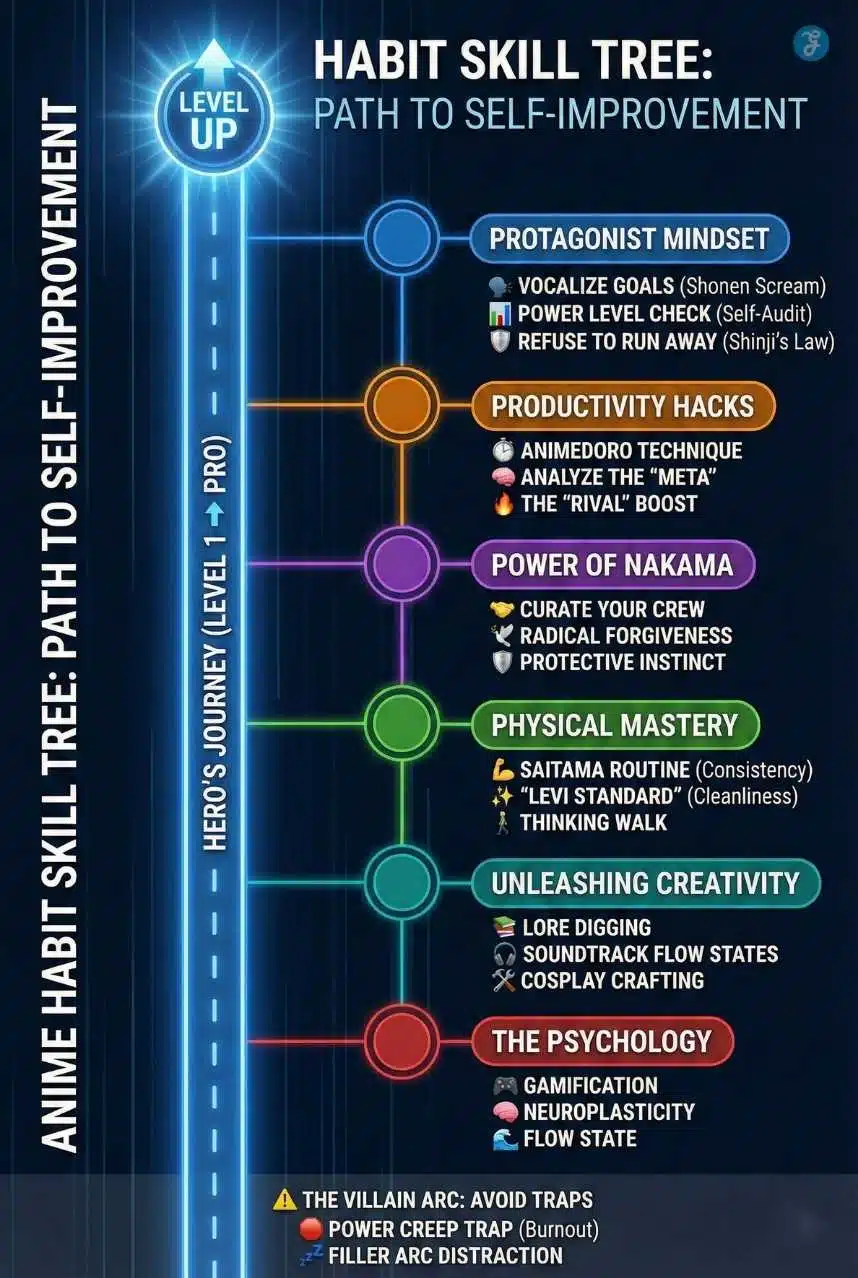
1. Vocalize Your Goals (The Shonen Scream)
In anime, characters like Naruto or Luffy shout their goals constantly. This isn’t just for drama. Psychologically, vocalizing your ambitions acts as a strong affirmation. It holds you accountable and clarifies your vision. Don’t whisper your dreams; state them clearly to yourself and others.
2. Embrace the “Training Arc.”
Every hero goes through a boring, repetitive phase to get stronger. In real life, this is the “grind”—studying late, gym reps, or entry-level work. Stop resenting the boredom. View it as your necessary training arc before the big payoff.
3. The Power Level Check (Self-Audit)
You cannot improve if you don’t know your stats. Protagonists constantly analyze their weaknesses after a loss. Perform a regular SWOT analysis (Strengths, Weaknesses, Opportunities, Threats) on your own career or skills. Be honest about where your “power level” is lacking.
4. Refuse to “Run Away” (Shinji’s Law)
In Evangelion, the mantra “I mustn’t run away” is iconic. Procrastination is just running away from discomfort. Build the habit of doing the hardest task first thing in the morning. Face the robot.
5. Find Your “Nindo” (Ninja Way)
A “Nindo” is a personal code of ethics that never bends. Whether it is “always be on time” or “never lie to a client,” having non-negotiable values simplifies decision-making and builds trust.
6. Empathy as a Weapon (Talk-no-Jutsu)
The best heroes try to understand the villain before fighting. In the workplace, this is conflict resolution. Listen to the opposing side. Understanding someone’s motivation is often more effective than attacking their argument.
| Anime Concept | Real-World Application | Benefit |
| Shonen Scream | Goal Affirmations | Increases accountability and focus. |
| Training Arc | Deliberate Practice | Reframes boring work as progress. |
| Talk-no-Jutsu | Active Listening | De-escalates conflict and builds rapport. |
Productivity Hacks: Work Like a Hero
How do you stay productive without burning out? You need a strategy. This is where anime habits for self-improvement transition from mindset to actionable technique.
7. The Animedoro Technique
This is a modification of the standard Pomodoro method, popular among students. The standard 5-minute break is often too short to truly relax.
- The Method: Work for 40–60 minutes (deep work).
- The Reward: Watch exactly one episode of anime (approx. 20 minutes).
This cycle keeps your brain engaged and provides a substantial reward to look forward to.
8. Analyze the “Meta.”
In gaming anime like No Game No Life, the “meta” refers to the most effective tactics available. In real life, hard work is often wasted if it is not strategic. Don’t just type faster; look for the “meta” of your industry. Can you automate a task? Is there a software shortcut? Winning isn’t about grinding the hardest; it’s about finding the most efficient path to the objective.
9. The “Rivalry” Boost
Vegeta needs Goku. A rival isn’t an enemy; they are a benchmark. Identify a peer in your field who is slightly better than you. Watch their progress. When they succeed, let it trigger your competitive spirit rather than envy. This “healthy rivalry” forces you to break through your own plateaus just to keep up.
10. The “Deku” Notebook
Midoriya (My Hero Academia) was born powerless, so he studied everyone else. Start keeping a physical notebook. Do not just write to-do lists; write observations. When a colleague gives a great presentation, write down how they did it. When a project fails, write down why. Treat your career like a subject to be studied.
11. Flashback Visualization
In anime, right before a hero gives up, they have a flashback to their origin story. This is a powerful psychological anchor. When you are burnt out at 2 PM, take 60 seconds to visualize your “Why.” Are you working this hard to buy a house? To support your family? Reconnecting with your core motivation provides a burst of “second wind” energy.
12. Passive Immersion
Characters often learn through osmosis. Many fans learn Japanese just by listening. You can do the same. Turn your “dead time”—commuting, washing dishes, folding laundry—into “training time.” Listen to educational podcasts, audiobooks, or language lessons. If you do this for one hour a day, that is 365 hours of extra learning per year—equivalent to 9 full work weeks.
| Technique | Work Interval | Break Interval | Best Used For |
| Pomodoro | 25 Minutes | 5 Minutes | Quick tasks, admin work. |
| Animedoro | 40-60 Minutes | 20 Minutes (1 Episode) | Creative projects, studying, and deep work. |
The Power of Nakama: Social Habits

In the anime world, the “loner” character eventually learns a hard truth: you cannot save the world by yourself. Building your “Nakama” (crew) is essential for emotional resilience and professional growth.
13. Curate Your Crew
An anime crew usually has a balanced mix: a leader, a strategist, a heavy hitter, and a healer. Look at your five closest friends. Do they all think exactly like you? Or do they challenge you? Curate a circle of friends who possess skills you lack. You need people who will push you to grow, not just people who are fun to drink with.
14. Radical Forgiveness
Protagonists often forgive their enemies to focus on the bigger threat. Holding a grudge is like carrying a heavy stone in your backpack—it slows you down. Practice radical forgiveness. This doesn’t mean you let people hurt you; it means you refuse to let anger rent space in your head. Release the bitterness so you can move forward faster.
15. “Itadakimasu” (Gratitude)
The phrase “Itadakimasu” literally means “I humbly receive.” It creates a moment of mindfulness before consumption. In a fast-paced world, pausing for three seconds to appreciate your food, your coffee, or your resources lowers cortisol levels. Saying “Itadakimasu” before a meal acknowledges the plants, animals, and farmers involved. Practicing daily gratitude lowers stress and keeps you grounded. It centers you in the present moment before you rush back to work.
16. The Protective Instinct
Heroes instinctively move to shield the weak. In a professional setting, this means practicing ethical leadership. If a junior team member is being unfairly criticized, speak up. If someone is struggling, offer help. Cultivating this protective instinct builds natural authority and trust. People follow those who make them feel safe.
17. Emotional Release
Anime characters aren’t afraid to cry, scream, or laugh loudly. Modern society teaches us to suppress emotion, which leads to burnout. Allow yourself to feel. If you are stressed, watch a sad or war movie and let the tears flow. It is a biological reset button for your nervous system, allowing you to return to a baseline of calm.
18. Honor Your Sensei
Every great hero—from Naruto to Tanjiro—bows to a teacher. You are never too smart for a mentor. Actively seek out people who are further along the path than you. Drop your ego, ask for feedback, and actually listen to it. Being “coachable” is the fastest way to level up.
| Habit | Social Benefit |
| Curate Your Crew | Creates a support network for growth. |
| Radical Forgiveness | Frees up mental energy for productivity. |
| Honor Your Sensei | Accelerates learning through expert feedback. |
Physical & Lifestyle Mastery: Body Habits
You cannot have an “S-Rank” mind in a “C-Rank” body. Anime characters treat their bodies as the vessel for their ambition. These habits focus on energy management and longevity. Adopting physical anime habits for self-improvement ensures you have the stamina to reach your goals.
19. The Saitama Routine (Consistency)
Saitama’s power came from a simple workout done every single day for three years. The lesson? Intensity is overrated; consistency is king. Do not try to run a marathon on day one. Commit to a 15-minute workout that you will actually do 7 days a week. The habit of showing up is more important than the exercise itself.
20. Mindful Cooking
In Food Wars, cooking is an expression of love and skill. Stop viewing food as just fuel or a chore. Take time to cook simple, healthy meals. The act of chopping vegetables and seasoning food is a meditative practice that disconnects you from screens and reconnects you with your senses.
21. Walking to Think
Many anime intros feature the protagonist walking while deep in thought. Neuroscience supports this: walking puts your brain in a “diffuse mode,” allowing it to connect unrelated ideas. If you are stuck on a coding bug or a writing block, stop staring at the screen. Go for a 20-minute walk. The solution often appears when you stop forcing it.
22. Cleanliness (The Levi Standard)
Captain Levi from Attack on Titan is famous for his obsession with cleaning. A chaotic environment triggers low-level anxiety in the brain. Adopt the “Levi Standard”: spend the first 10 minutes of your day organizing your physical and digital workspace. A clean desk invites a clear mind.
23. Appreciate Nature
Studio Ghibli films are famous for their focus on nature—clouds, rain, and grass. This is a grounding technique. Modern life is full of pixels; your eyes need organic shapes. Make a habit of looking at the sky or a tree for five minutes a day. It reduces eye strain and reminds you that the world is bigger than your to-do list.
24. The Early Riser
The trope of “secret morning training” exists for a reason. Waking up one hour before the rest of the world gives you a tactical advantage. There are no emails, no calls, and no noise. Use this “Golden Hour” for your most important work or your side hustle.
| Habit | Focus Area | Result |
| Saitama Routine | Fitness | Builds discipline and baseline health. |
| Levi Cleaning | Environment | Reduces anxiety and distractions. |
| Morning Training | Time Management | Creates “bonus” hours for personal goals. |
Unleashing Creativity: Skills That Transfer
Creativity isn’t a magic power given to a chosen few; it is a muscle that anime fans exercise constantly. These hobbies are actually secret training for real-world soft skills.
25. Daily Sketching/Doodling
You don’t need to be an artist to benefit from drawing. Sketching forces you to observe the world closely—to see light, shadow, and shape. This improves your attention to detail in everything from formatting a document to arranging a room. It trains your brain to notice what others miss.
26. Cosplay Crafting (DIY Spirit)
Cosplayers are the ultimate engineers. They have to figure out how to make gravity-defying armor out of foam and glue on a budget. This is the “Maker Mindset.” It teaches you resourcefulness: how to take raw materials and solve complex structural problems. This “figure-it-out” attitude is highly valued in any workplace.
27. Lore Digging (Research Skills)
Anime fans will spend hours researching the history of a fictional kingdom. This is a transferable hard skill. It teaches you how to cross-reference sources, find obscure information, and synthesize data. Apply this same obsessive curiosity to your job or market research, and you will become the expert in the room.
28. Reviewing and Critiquing
Writing a review for a show forces you to articulate your opinion. You can’t just say “it was good.” You have to explain why the pacing worked or why the character arc failed. This builds critical thinking and persuasive writing skills, essential tools for negotiation and leadership.
29. Soundtrack Flow States
Anime soundtracks (OSTs) are composed specifically to drive emotion without distracting you with lyrics. Create a “Work Playlist” of high-energy battle themes or calm slice-of-life tracks. Over time, your brain will form a Pavlovian response: when the music starts, the focus turns on.
30. Wear Your Fandom (Authenticity)
In the past, people hid their love for anime. Now, wearing it is a sign of confidence. It signals that you are passionate and unashamed of your interests. Being authentic attracts other passionate people to you. Don’t hide who you are; “cringe” is dead. Embracing your interests is a form of self-respect.
Cheat Sheet: The 30 Anime Habits
| Category | Habit Name | Quick Action / Benefit |
| Mindset | 1. The Shonen Scream | Vocalize goals daily to build accountability. |
| 2. The Training Arc | Reframe boring, repetitive work as “leveling up.” | |
| 3. Power Level Check | Perform regular self-audits (SWOT) to find weaknesses. | |
| 4. Talk-no-Jutsu | Listen to understand enemies/peers to resolve conflict. | |
| 5. Refuse to Run Away | Tackle the hardest task first; stop avoiding discomfort. | |
| 6. Find Your Nindo | Establish non-negotiable personal values. | |
| Productivity | 7. Animedoro | Work 40–60 mins, reward with 1 anime episode. |
| 8. Passive Immersion | Listen to educational audio during chores/commute. | |
| 9. Analyze the Meta | Find the most efficient strategic shortcuts in your job. | |
| 10. Rivalry Boost | Use a peer’s success as fuel for growth, not envy. | |
| 11. Deku Notebook | Keep physical notes on successful people’s tactics. | |
| 12. Flashback Visual | When stuck, visualize your “origin story” (your Why). | |
| Social | 13. Curate Your Crew | Surround yourself with people who have diverse skills. |
| 14. Radical Forgiveness | Let go of grudges quickly to save mental RAM. | |
| 15. Itadakimasu | Pause for gratitude before meals or consumption. | |
| 16. Protective Instinct | Stand up for juniors/others to build leadership. | |
| 17. Emotional Release | Cry or feel deeply to prevent emotional burnout. | |
| 18. Honor Your Sensei | Actively seek mentorship and drop your ego. | |
| Physical | 19. Saitama Routine | Prioritize daily consistency over sporadic intensity. |
| 20. Mindful Cooking | Treat preparing food as a craft and an act of self-care. | |
| 21. Walking to Think | Take walks without a phone to solve complex problems. | |
| 22. The Levi Standard | Clean your workspace daily to reduce mental clutter. | |
| 23. Nature Gaze | Look at the sky/nature for 5 mins to reset dopamine. | |
| 24. The Early Riser | Wake up early for distraction-free “secret training.” | |
| Creativity | 25. Daily Sketching | Doodle to improve hand-eye coordination/observation. |
| 26. Cosplay Crafting | Build things from scratch to learn resourcefulness. | |
| 27. Lore Digging | Deep dive into research to train information synthesis. | |
| 28. Reviewing | Write critiques to sharpen critical thinking skills. | |
| 29. Soundtrack Flow | Use instrumental OSTs to trigger focus states. | |
| 30. Wear Your Fandom | Be authentic about interests to attract your tribe. |
Why Anime Habits for Self-Improvement Work (The Psychology)
These habits aren’t just cartoons; they are backed by behavioral science.
Gamification & Dopamine
Anime structures progress clearly: training leads to power, which leads to winning. This is gamification. When you apply this to life (e.g., tracking your “stats” or “leveling up” a skill), you trigger the brain’s reward system. Tracking small wins releases dopamine, keeping you motivated through the boring parts of the journey.
Neuroplasticity and Active Engagement
Watching anime actively (analyzing plots, learning Japanese words, and understanding cultural nuance) is a cognitive workout. It stimulates neuroplasticity—the brain’s ability to form new connections. Unlike mindlessly scrolling social media, engaged fandom keeps the mind sharp and adaptable.
The Flow State
In sports anime like Haikyuu!! or Blue Lock, characters enter “The Zone.” Psychologists call this the Flow State. It occurs when a task is difficult enough to be challenging but not so hard that it causes anxiety. Habits like the “Animedoro” technique and “Deep Work” are designed to trigger this state of peak performance, where hours pass like minutes.
The “Villain Arc”: 3 Traps to Avoid
Even the best heroes can fall into darkness. As you adopt these anime habits, watch out for these common “Villain Arcs” that can derail your progress.
1. The “Power Creep” Trap (Burnout)
In anime, if a character unlocks too much power too quickly, it usually destroys their body (like Deku using 100% One For All too early).
- The Mistake: Trying to adopt all 30 habits at once.
- The Fix: Start with one habit from each pillar. Do not overhaul your entire life overnight. Consistency beats intensity.
2. Main Character Syndrome (Arrogance)
While having a “Protagonist Mindset” is good for confidence, taking it too far leads to arrogance. You are the protagonist of your life, but you are a supporting character in everyone else’s.
- The Mistake: Treating others as NPCs (Non-Playable Characters) or refusing to do “unglamorous” teamwork.
- The Fix: Remember that the strongest characters (like Luffy or Tanjiro) are often the most humble. True strength lifts others up.
3. The “Filler Arc” Distraction
Sometimes, it feels like you are working, but you are actually just spinning your wheels.
- The Mistake: Spending hours organizing your “Deku Notebook” or perfect playlist without actually doing the work. This is productive procrastination—a “filler episode” in your life.
- The Fix: Focus on shipping work. If your preparation takes longer than the task itself, you are in a filler arc. Cut to the action.
7-Day Pilot Episode Challenge
Don’t wait for Season 2. Start your arc this week:
- Day 1: Clean your room (The Levi Standard).
- Day 2: Write down your 1-year goal (The Shonen Scream).
- Day 3: Try the “Animedoro” technique for 2 hours.
- Day 4: Take a 30-minute “Thinking Walk” without your phone.
- Day 5: Reach out to a “Nakama” (friend) just to check in.
- Day 6: Wake up 30 minutes early for a side project.
- Day 7: Rest and say “Itadakimasu” (Gratitude) before every meal.
Frequently Asked Questions (FAQs)
Can anime really help with productivity?
Yes. By using techniques like the Animedoro method and adopting a “growth mindset” (common in Shonen anime), you can structure your work more effectively.
What is the Animedoro technique?
It is a productivity cycle: 40–60 minutes of focused work followed by one 20-minute episode of anime. It balances deep work with a high-value reward.
Which anime characters have the best work ethic?
Characters like Rock Lee (Naruto), Asta (Black Clover), and Soma Yukihira (Food Wars) are excellent examples of resilience and constant improvement.
Is watching anime bad for mental health or just escapism?
It depends on how you consume it. While excessive binge-watching can be a form of avoidance, intentional viewing turns anime into a tool for emotional regulation and inspiration. This is the difference between “passive consumption” and the active anime habits for self-improvement discussed in this guide.
I’m not an anime fan; will these habits still work for me?
Absolutely. You don’t need to watch anime to benefit from its philosophies. Concepts like Kaizen (continuous improvement), Ikigai (reason for being), and Stoicism are universal principles that anime simply visualizes. You can apply the “Protagonist Mindset” to your life regardless of your entertainment preferences.
What are the best anime series for motivation and productivity?
If you need a push to start working, try shows that focus on mastering a craft. Blue Period (art), Haikyuu!! (volleyball/teamwork), and Dr. STONE (science/problem-solving) are excellent for sparking the urge to learn and improve.
Final Words: Anime Habits for Self-Improvement
You don’t need to be bitten by a radioactive spider or born with magic to be extraordinary. The secret to the success of your favorite characters lies in their daily routine. They show up, they fail, they learn, and they try again.
By integrating these anime habits for self-improvement into your life, you bridge the gap between fantasy and reality. Start small. Pick one habit, maybe the “Saitama” consistency or the “Animedoro” timer, and start your own pilot episode today.