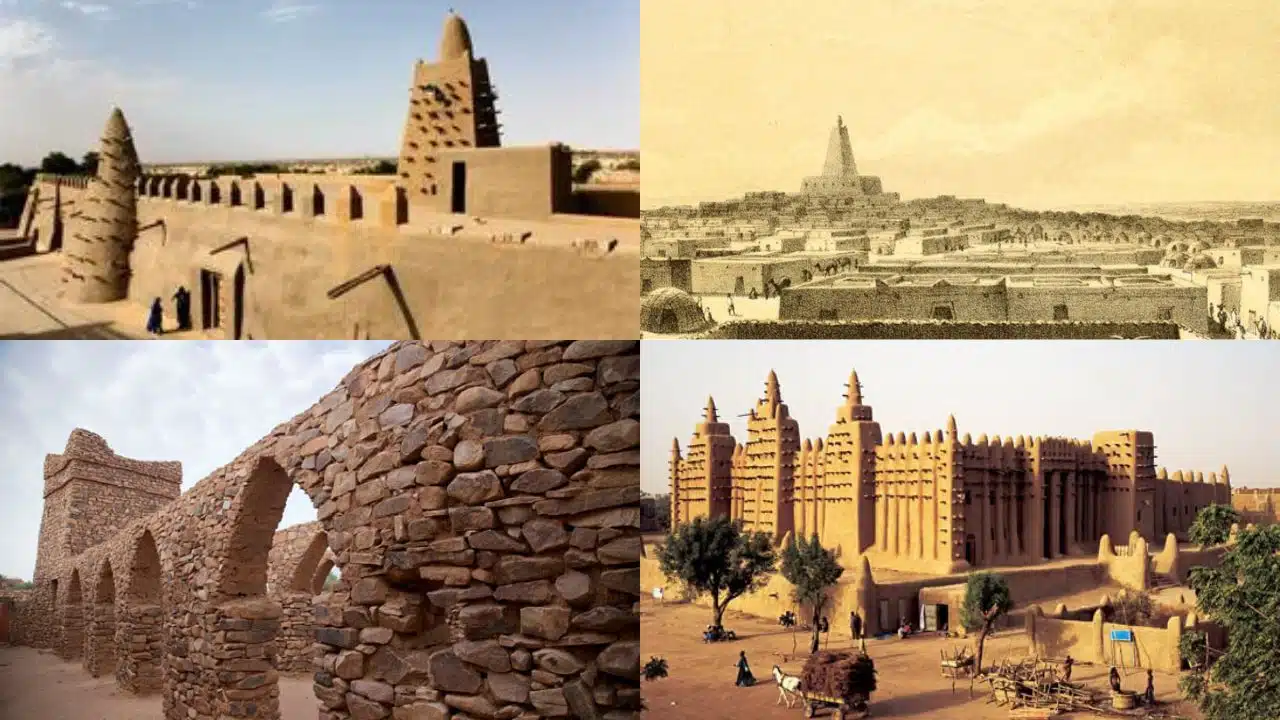
The early great civilizations of Africa were, in many ways, on par with the mighty empires of Rome and Persia that dominated the Mediterranean and Middle East. Yet the rich histories and cultural achievements of advanced African kingdoms are too often downplayed or left out of textbooks.
While largely forgotten today, these six sophisticated powers of ancient Africa commanded sprawling domains, engineered monumental architecture, fostered vibrant trade, and drove technological and cultural progress for their era. Some remained intact for over a millennium. Let’s uncover why they deserve recognition alongside more well-known Western and Eastern contemporaries.
Content Highlights
- Ancient African kingdoms like Aksum, Mali and Songhai built trade fortunes rivaling their Western and Eastern contemporaries using military strategy and cultural diplomacy.
- Quintessential African metropolises such as Timbuktu, Kerma and Benin City evolved into distinguished global centers of wealth, discovery and craftsmanship during Europe’s Middle Ages.
- Lasting for over a thousand years, the ancient Nubian civilization critically blocked foreign conquests of Africa while conquering and ruling Egypt itself for decades.
- Recognizing the parity and shared world history connections of great African empires helps build an accurate global understanding of human civilization.
6 Mighty Ancient African Kingdoms That Rivaled Rome and Persia
The mighty kingdoms of ancient Rome and Persia enjoy widespread name recognition as influential civilizations that laid the foundations to the modern world. But less mainstream attention gets paid to formidable African empires that not only co-existed with Rome and Persia but often rivaled their economic might, military prowess, cultural sophistication, and political dominance. Explore 6 mighty ancient African kingdoms that rivaled Rome and Persia.
1. Aksum: A Cosmopolitan Hub With Global Reach
By the 3rd century CE, the Aksumite kingdom, based in what is now northern Ethiopia and Eritrea, encompassed a multicultural domain stretching across the Red Sea. Its vibrant capital hosted merchants from Greece, Rome, and India to trade ivory, exotic animals, gold, and more. Aksum minted its own currency, engraved with its rulers. Impressive stone obelisks dotted towering church-like structures inspired by the architecture of Southern Arabia.
At its height under King Ezana in the 4th century, Aksum claimed one of the first official Christian conversions by an African state. Military conquests spanned modern-day Yemen, Eritrea, Sudan, Somalia, and Djibouti as Aksum projected power abroad through its navy. Their recorded kingdom lasted over a millennium, until around 950 CE.
2. Mali: Extraordinary Wealth Built Legendary Learning Capital
By absorbing nearby Ghana as it expanded across West Africa during the 13th century, the Empire of Mali reached a peak size rivaling all of Western Europe. The legendary Mandingo warrior Sundiata Keita established Mali’s golden age under Musa I. Mansa Musa’s celebrated hajj to Mecca saw him dispense so much gold along the way that he caused economic inflation in Egypt!
Musa poured Mali’s fortunes from booming trans-Saharan trade into Timbuktu, making it Africa’s greatest center of Islamic art, education, and culture. Home to the distinguished Sankore University, this illustrious city drew students and scholars from across Africa and the Middle East under the emperor’s patronage. Mali’s territories later splintered, but its cultural legacy endures. Additionally, you can also read about- The World’s First 6 Ancient Civilizations: Mesopotamia to Mesoamerica
3. Songhai: A Groundbreaking Center of Discovery
[Video Credits @weloveafrica]
Formed along the twisting Niger River in the 14th century and lasting over 200 years, the Songhai Empire absorbed Mali’s territories and exceeded them through luck and strategy. Sonni Ali forged Songhai into a formidable fighting force, conquering more lands than any prior West African ruler. He also attacked Timbuktu after the city resisted occupation.
Askia Mohammad I then launched radical policies, elevating his society to new heights after Ali’s death. He sponsored a “brain gain” migration of Muslim scholars to the acclaimed Sankore University. In a pioneering move for the era, Mohammad also appointed highly skilled cabinet advisors based solely on merit instead of family ties. Songhai governed trade, dispersed specialized farms, rationed harvests in case of famine, and supported advances in math, astronomy and medicine until Morocco invaded in 1591.
4. Benin: An Exemplar of Artistry and Urban Planning
In what is present-day Nigeria, the kingdom of Benin was launched around the 11th century and endured for over half a millennium until 1897. Early traditions speak of the god Ogisos sending a son down from the skies to found a royal dynasty—one that would spawn 38 successive Obas, or kings, of the diverse Edo peoples.
The kingdom saw two golden ages, first under Oba Ewuare the Great in the 15th century, then under Oba Esigie in the 16th, when Benin prospered from commerce with Portuguese traders. More than any other African civilization, Benin achieved peerless mastery of bronze and brass smithing, as seen in the Benin Bronzes. Meticulous palace plans, complete with moats and walls, point to the urban sophistication of a prosperous, complex kingdom to rival the great European capitals of the era.
5. Wagadu/Ghana, Mother Culture of West Africa
While details of the Ancient Ghana Empire (300 BCE–1200 CE) remain enigmatic, its mother culture seeded agrarian societies and trans-Saharan commerce networks that nourished West Africa for centuries. Medieval Arab scholars referenced its northern state’s capital, Koumbi Saleh, as an eminent yet secretive trading entrepôt full of gold. Judging from the beautiful stone ruins discovered at Koumbi Saleh, the Ghanaian civilization was indeed quite advanced.
As the primary middlemen funneling Saharan salt and Mediterranean horses south in exchange for forests of gold dust gleaned from local mine slaves, ancient Ghana’s fortunes were tied to secrecy around the precious metal’s distant sources. Alas, the kingdom ultimately declined after initial contact with invading Almoravid Muslim Berbers. But Ghana’s early achievements and influence earned it fame as the legendary Land of Gold.
6. Nubia: Guardians of Ancient African Grandeur
Overshadowed by its Egyptian neighbor yet mirroring and ruling it at times, the culture of ancient Nubia occupied a fertile section of northeast Africa home to Egypt’s tributaries starting in 5000 BCE. Millennia-old Nubian metropolises like Kerma and Napata north of the fourth cataract grew rich from trade in exotic incenses, iron tools, ebony wood, and gold sourced from deeper in Africa and the Red Sea region. The first verifiable Nubian king was buried atop 60 human sacrifices around 2200 BCE.
Nubia’s crowning Pharaonic conquest occurred when its 25th Kush dynasty intermittently conquered all of Egypt for 60 years until 1077 BCE. The cultures deeply influenced each other as Nubia selectively adopted Egyptian customs. Later Christian Nubian kingdoms like Alodia, Nobatia and Makuria built churches resembling Egyptian temples and repelled attempted Muslim conquest until 1317 CE—far longer than any Roman or Persian territory of the era. If you want you can also read- The Forgotten Ancient Greek Medicinal, Nutritional, and Birth Control Plant
Takeaway
What made these realms comparable to any renowned Eurasian civilization of their day? Sophisticated statecraft and military, monumental architecture, complex spirituality, major urban centers, specialized industries, trade reach, abundance and concentration of resources and wealth, humanitarian and technological advances, and use of writing—to name just a few measures.
By resisting external influence for centuries longer than Rome itself, mighty Nubia in particular underscores Africa’s self-determination and gumption. Exploring civilizations like these compels the expansion of historical perspectives to recognize their formidable agency alongside other prominent world powers of their age. Reshaping curriculums for accuracy allows us all to better understand humanity’s shared progress through the ages.
Frequently Asked Questions (FAQs)
Check related answers to some common questions regarding ancient African kingdoms.
How did these African kingdoms earn global power and wealth?
They occupied strategic trade zones and controlled lucrative natural resources like gold while mastering organization and defense to remain independent.
What lasting cultural impacts did they have?
Inventions like Nubian iron weapons spread worldwide, while universities like Sankore disseminated invaluable written knowledge across continents.
Where can we see evidence of their achievements today?
Majestic relic sites with monumental architecture still stand in places like Axum and Mali. Exquisite artworks like the Benin Bronzes reside in museums globally.