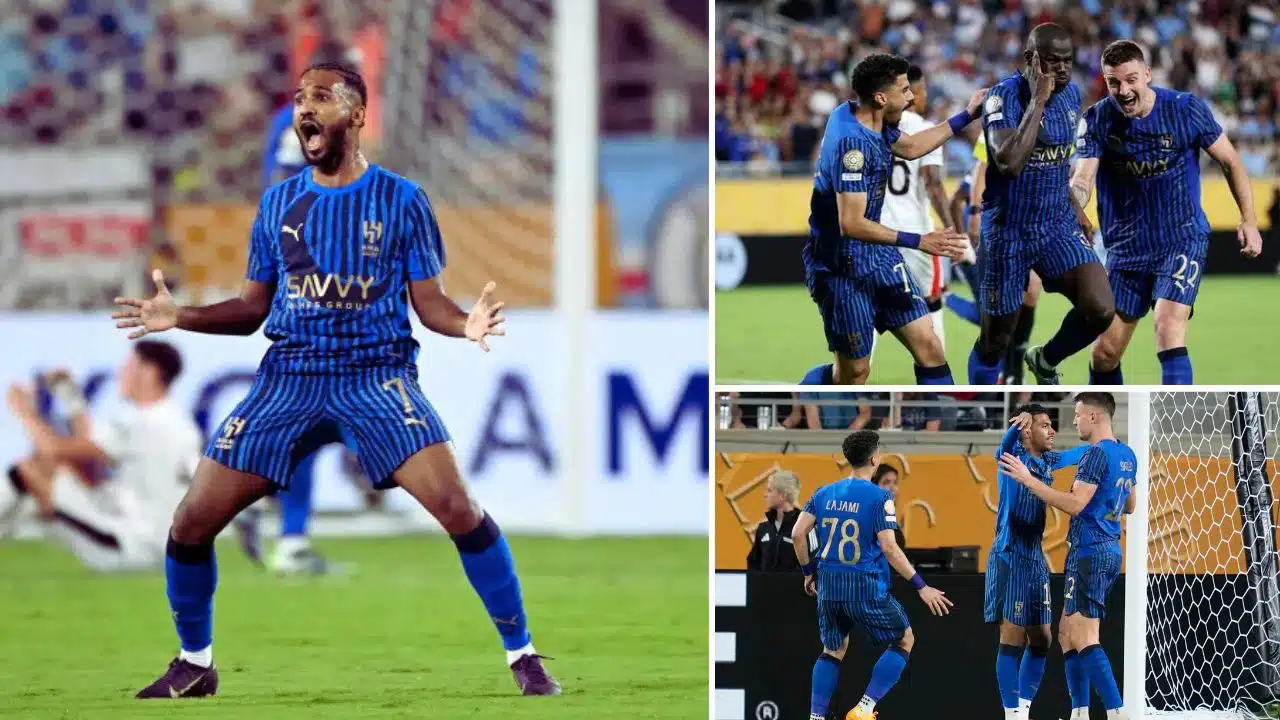
In a historic Club World Cup match that stunned football fans around the world, Saudi Arabian giants Al Hilal eliminated Premier League champions Manchester City with a thrilling 4–3 extra-time win. The game, held in Orlando, Florida, delivered the tournament’s biggest upset so far and highlighted the growing strength of Middle Eastern football.
With this victory, Al Hilal advanced to the quarter-finals, where they will take on Fluminense, the Brazilian side that recently defeated Inter Milan. This guarantees that a non-European team will reach the semi-finals, marking a significant shift in the global football landscape.
First Half: Controversial Goal and Missed Chances
Manchester City opened the scoring early in the 9th minute. The goal came after Rayan Aït-Nouri delivered a cross from the left side, which Bernardo Silva finished clinically. However, Al Hilal players immediately protested, claiming that Aït-Nouri had controlled the ball with his arm before the assist. Despite the protests, the referee allowed the goal to stand after a VAR check, which ruled that there was no clear handball.
City dominated possession throughout the first half and created several scoring chances. Jeremy Doku had a chance to double the lead but hit his volley straight at Al Hilal’s goalkeeper Yassine Bounou, who was in outstanding form. Moments later, Bounou again denied Bernardo Silva from close range.
City could have easily gone into halftime with a bigger lead, but poor finishing combined with brilliant saves from Bounou kept the score 1–0. Al Hilal showed flashes of danger on the counterattack, but City’s defensive structure held firm — at least for the moment.
Second Half: Al Hilal’s Stunning Comeback
As soon as the second half began, Al Hilal shifted gears. Within the first minute of the restart, they drew level. A low cross from João Cancelo, who once played for City, was spilled by Ederson. The rebound fell to Malcom, whose shot was blocked by Rúben Dias — but the ball looped into the air and Marcos Leonardo reacted quickest, heading in the equalizer.
Al Hilal’s confidence soared. Just six minutes later, they took the lead with a textbook counterattack. João Cancelo launched a long ball behind City’s high defensive line, which Malcom chased down. Displaying both pace and composure, he outran the defenders and slotted the ball past Ederson into the bottom corner to make it 2–1.
City manager Pep Guardiola reacted immediately, making a triple substitution. He brought in midfield anchor Rodri and defenders Nathan Aké and Manuel Akanji to restore control and solidity to the back line.
The changes had an immediate impact. City began to press higher with urgency, and eventually, the breakthrough came. From a corner delivered by Bernardo Silva, Al Hilal’s defense failed to clear. The ball fell kindly to Erling Haaland, who bundled it home to equalize at 2–2.
City now had momentum and pushed hard for the winner. Haaland, Akanji, and Dias all had opportunities, but once again, Yassine Bounou was nearly unbeatable in goal. He made another crucial save from Akanji and was aided by Ali Lajami, who cleared a Haaland attempt off the goal line.
Extra Time: Drama and Decisive Moments
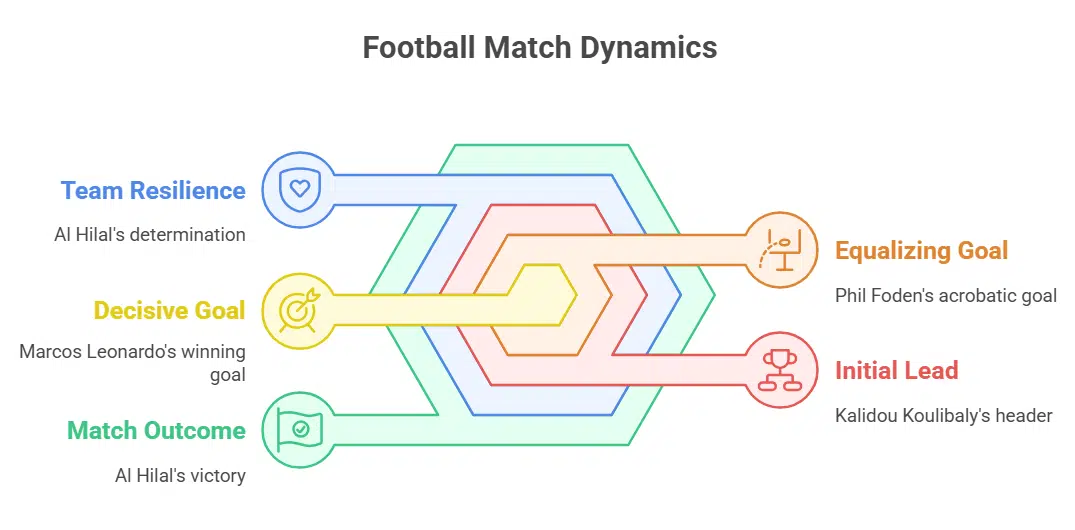
As the match went into extra time, both teams appeared exhausted but determined. Despite Manchester City having greater squad depth, Al Hilal showed remarkable resilience and heart.
Just four minutes into extra time, Kalidou Koulibaly, the Senegalese center-back, put Al Hilal ahead again. Rising highest at a corner from Rúben Neves, he delivered a thunderous header that beat Ederson and made it 3–2.
Manchester City refused to go down without a fight. In the 104th minute, Rayan Cherki — a bright young talent — delivered a perfectly placed lofted pass to Phil Foden. From a tight angle, Foden acrobatically poked the ball past Bounou to level the score once more at 3–3.
But the night belonged to Al Hilal. In the 112th minute, Sergej Milinković-Savić headed a powerful effort at Ederson, who managed a save. However, Marcos Leonardo, showing his poacher’s instinct, pounced on the rebound and bundled the ball over the line to give his team the decisive 4–3 lead.
City’s Frustration and Al Hilal’s Emotional Win
Despite having 70% of the possession and generating more chances, Manchester City were unable to stop Al Hilal’s swift and clinical counterattacks. Guardiola later admitted his team struggled to contain the Saudi side’s transitions, saying that when his players lost the ball, they failed to track runners and prevent quick breaks.
City captain Bernardo Silva acknowledged that his team had created enough chances to win — but couldn’t finish them. He emphasized that Al Hilal’s ability to launch devastating attacks with just one or two passes consistently caused problems.
For Al Hilal, the win was deeply emotional. Marcos Leonardo, the two-goal hero, dedicated the victory to his mother, who had recently spent 70 days in intensive care. Now recovered, she was able to watch the match live. The striker couldn’t hold back tears after scoring the winning goal and celebrated passionately with fans.
What This Win Means for Football
Al Hilal’s triumph is more than just a Club World Cup shock — it reflects the growing ambition and investment of clubs in the Middle East, especially in the Saudi Pro League. With top international stars, experienced coaches like Simone Inzaghi, and improved tactical discipline, Saudi clubs are no longer just participants — they are contenders.
The win also carries financial significance. According to reports, Manchester City’s early elimination could cost the club up to £9 million in potential prize money and commercial bonuses.
With their place in the quarter-finals secured, Al Hilal will now face Fluminense, who stunned Inter Milan. A win there would put the Saudi club in the semi-finals, breaking more ground for Asian football on the global stage.
This seven-goal thriller is already being hailed as one of the greatest matches in Club World Cup history. Al Hilal’s spirited performance, defensive grit, and attacking precision proved too much even for a world-class side like Manchester City.
The result sends a strong message: the global football hierarchy is shifting. And with clubs like Al Hilal rising fast, fans should expect more thrilling encounters and fewer predictable outcomes in the world’s biggest tournaments.
The Information is Collected from ESPN and Yahoo.