You know the feeling: staring at a mountain of paperwork with no clear end in sight. For procurement teams, this is not an occasional challenge—it is a daily reality. Hours are lost to repetitive tasks like matching invoices, reviewing contracts, and searching for reliable suppliers. Manual processes create bottlenecks, increase the risk of errors, and quietly drive up costs.
At the same time, expectations continue to rise. Businesses need faster decisions, tighter cost control, and smarter sourcing strategies. Traditional procurement methods are struggling to keep up with the pace of modern operations.
This is where artificial intelligence is changing the landscape. An April 2025 study by Ardent Partners, based on insights from nearly 400 procurement leaders, found that 62% believe AI will have a transformational impact on procurement within the next two to three years. That statistic signals a major shift already underway.
Across industries, organizations are beginning to realize tangible value from AI adoption. Experts like Philip Ideson highlight that AI in procurement is no longer just a buzzword—it is becoming an integral part of daily operations.
Understanding this shift is essential. From automating routine tasks to unlocking deeper insights, AI is reshaping procurement strategies from the ground up. Key applications include spend analysis, supplier risk management, and contract lifecycle management—all designed to reduce costs and improve performance.
The future of procurement is not about working harder. It is about working smarter, with AI leading the way.
What is AI in Procurement and Sourcing?
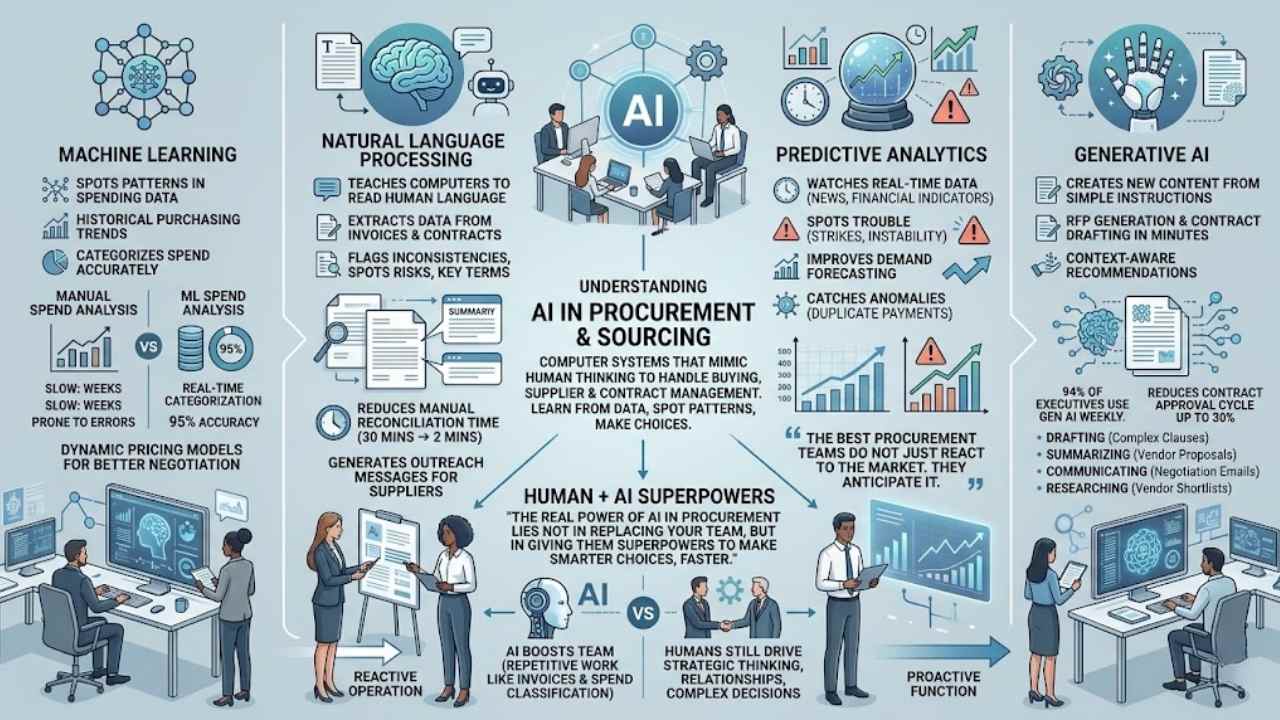
Artificial intelligence (AI) in procurement refers to computer systems that mimic human thinking to handle buying tasks, supplier management, and contract management. These smart machines learn from data, spot patterns, and make choices that help your team work faster.
AI automates repetitive work like invoice processing and spend classification. This frees your team to focus on strategy. Machine learning algorithms study past buying patterns and supplier performance data to predict future trends.
Natural language processing reads contracts and documents without human effort. Generative AI creates new content from simple instructions. This speeds up tasks like RFP/RFQ generation and contract drafting.
A 2026 study by AI at Wharton found a massive shift in adoption. They reported that 94% of procurement executives now use generative AI at least once a week. This shows that top professionals actively rely on these AI-enabled tools right now.
Rather than replacing people, AI boosts what your procurement team can do. Humans still drive strategic thinking, build supplier relationships, and tackle complex decisions. Machines cannot handle those nuanced relationships alone.
AI transforms procurement from a reactive operation into a proactive function. Your organization feeds these systems large volumes of high-quality data. The systems then learn to flag supplier risks before problems arise.
Spend analytics tools powered by AI reveal where your company wastes money. Predictive analytics forecasts demand and prices so you buy at the right time.
Robotic process automation handles routine tasks like requisitioning and ordering without human hands. SAP, Ivalua, and modern platforms like Levelpath now embed AI agents that guide buying decisions.
“The real power of AI in procurement lies not in replacing your team, but in giving them superpowers to make smarter choices, faster.”
Types of AI Used in Procurement
Different AI technologies power modern procurement systems. Machine learning, natural language processing, predictive analytics, and generative AI each solve specific sourcing problems.
Machine Learning
Machine learning powers procurement by spotting patterns in your spending data. These algorithms dig through historical purchasing information and identify trends that humans might miss.
ML tools analyze what you bought, when you bought it, and how much you paid. They then recommend sourcing strategies that cut costs and boost efficiency. Companies use machine learning to classify spending accurately across different categories.
This data analytics approach reveals where your money goes. Ivalua and other platforms recognized by Gartner apply machine learning to transform how teams make sourcing decisions. Coupa BSM uses these algorithms to surface optimization signals and risk flags automatically.
Your suppliers carry risk. Machine learning catches problems before they explode. ML-driven risk scoring flags potential disruptions early, letting your team act fast.
These algorithms examine supplier performance history, financial stability, and market conditions. They calculate a risk score for each vendor. Your procurement team gets alerts when scores spike.
Dynamic pricing models powered by machine learning help you negotiate better deals. Spend inefficiencies surface through ML analysis, giving you leverage in conversations. This proactive approach to supply chain risk management keeps your operations running smoothly.
| Process | Manual Spend Analysis | Machine Learning Analysis |
|---|---|---|
| Speed | Weeks of spreadsheet formatting | Real-time categorization |
| Accuracy | Prone to human entry errors | Over 95% classification accuracy |
| Fraud Detection | Often caught after payment | Flags anomalies before payment |
Natural Language Processing (NLP)
Natural language processing (NLP) teaches computers to read human language the way people do. This technology powers chatbots and virtual assistants that help procurement teams work faster.
NLP tools extract data from invoices and contracts without manual typing. They flag inconsistencies, spot risks, and pull out key terms automatically.
Ivalua’s Intelligent Virtual Assistant uses NLP to let users ask questions about contracts or policies. You get context-aware responses instantly.
Contract review cycles move quicker because NLP summarizes complex documents. It highlights obligations and translates them into multiple languages. A 2026 report on accounts payable benchmarks shows NLP reduces manual statement reconciliation time from 30 minutes to just two minutes.
Supplier assessment improves dramatically through NLP monitoring. The technology extracts key data on demand, giving you summaries of supplier performance.
NLP also generates outreach messages for supplier interactions. Instead of writing the same email fifty times, procurement professionals let NLP handle the heavy lifting.
Optical character recognition (ocr) works alongside NLP to pull information from documents at lightning speed. This combination transforms how teams manage spend and build stronger supplier relationships.
Predictive Analytics
Predictive analytics gives your procurement team superpowers. This technology watches real-time data, including news reports and financial indicators, to spot trouble before it hits.
Your team can predict potential risk events like labor strikes or supplier financial instability. Spend management becomes smarter when you track market shifts as they happen.
Demand forecasting gets more accurate, which means real cost savings. Fraud detection improves too. Predictive analytics catch anomalies that signal duplicate payments in your invoicing workflows.
Procurement moves from firefighting to planning ahead. Experts like Robert Waalder confirm that predictive analytics evaluate options and stop problems before they happen. Category intelligence reports give you research-driven insights about market impact.
Tools like Copilot provide these predictions automatically. Your chief procurement officer gets faster decision-making support.
Guided buying becomes more effective when staff see predicted outcomes. This shift transforms how companies handle strategic sourcing.
“The best procurement teams do not just react to the market. They anticipate it.”
Generative AI
Generative AI has transformed procurement since ChatGPT launched. This technology creates new content from simple user instructions. RFP generation, contract clauses, and outreach messages now take minutes instead of hours.
Ivalua’s platform powers over 25 use cases across supplier management, sourcing, and procure-to-pay operations. The system generates or expands contract clauses to meet specific legal requirements.
It delivers context-aware recommendations throughout the source-to-pay lifecycle. Generative AI shortlists suppliers, drafts RFPs, and creates new business processes based on what users need.
According to recent industry benchmarks, utilizing generative AI reduces the contract approval cycle by up to 30 percent. This ensures critical compliance clauses are never missed.
Organizations save substantial time on content-heavy tasks. Employees stop writing the same contract language repeatedly. Summaries of lengthy documents appear instantly.
Compliance and governance remain strong because the system learns your company’s rules. Agentic AI systems work independently to complete sourcing workflows. Companies report faster sourcing cycles and stronger supplier diversity programs through platforms like Tough Leaf.
- Drafting: Automatically writes complex legal clauses that adhere to local laws.
- Summarizing: Condenses 50-page vendor proposals into clear bullet points.
- Communicating: Generates polite, context-aware negotiation emails to vendors.
- Researching: Scours the web to build vendor shortlists based on strict parameters.
Key Applications of AI in Procurement
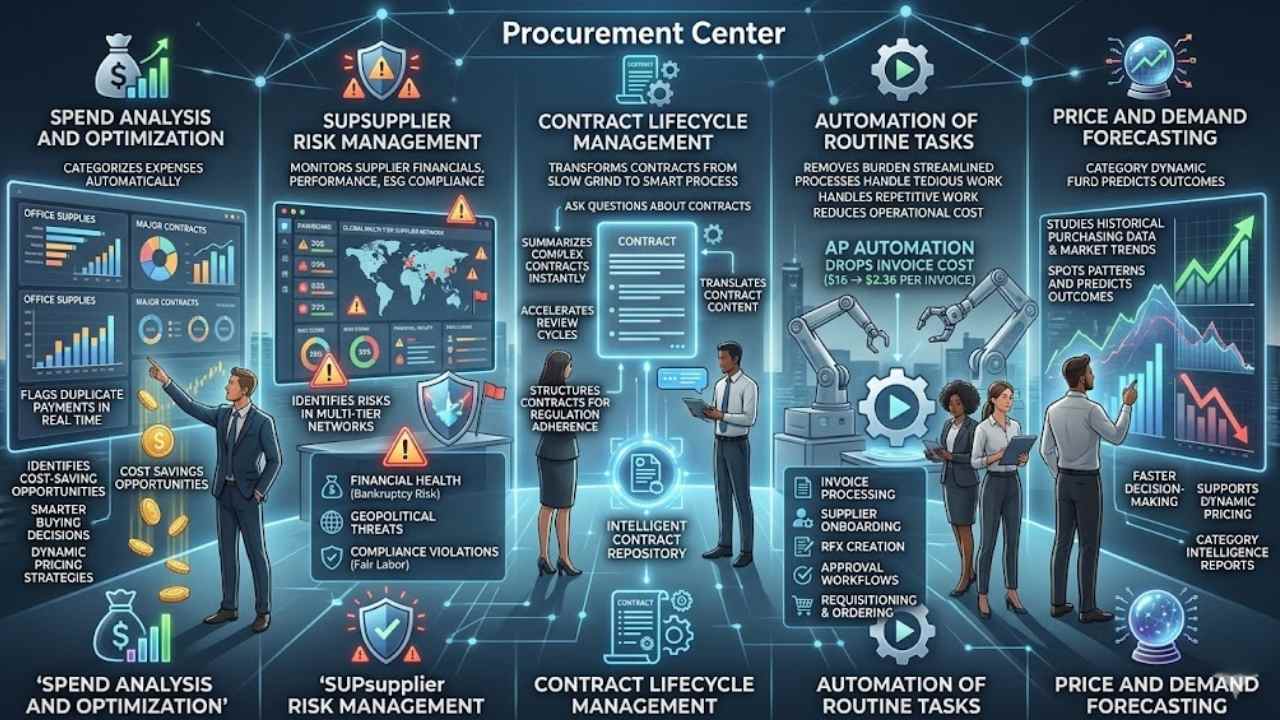
AI tools reshape how companies analyze spending patterns, manage supplier risks, and handle contracts. These applications cut through manual work and help teams make smarter decisions faster.
Spend Analysis and Optimization
AI-powered spend classification systems sort through your company’s expenses rapidly. They flag cost-saving opportunities you might miss. These tools examine every purchase, from office supplies to major contracts.
Ivalua’s platform includes built-in tools for spend analysis. Modern systems function as continuous financial monitors. They automatically categorize spend data and identify duplicate payments in real time.
Deloitte’s 2025 Global CPO Survey shows that better management of spend is a top priority for nearly 32% of procurement leaders. They see this as a primary driver for adopting new technology.
This real-time tracking means your team catches waste before it becomes a budget problem. The technology analyzes global expenses comprehensively. Businesses consolidate purchasing power and negotiate better deals.
Procurement professionals gain actionable insights into spending patterns. Advanced spend analysis reveals inefficiencies hiding across your supply chain management operations.
AI supports dynamic pricing strategies that put more money back in your pocket. Smarter buying decisions lead to increased bottom-line savings without requiring staff to work longer hours.
Your organization consolidates vendors, reduces maverick spending, and strengthens relationships with key suppliers.
Supplier Risk Management
Supplier risk management stands as one of the most powerful tools in modern procurement. AI systems analyze data points like financials, performance history, and news mentions to flag potential risks early.
These systems monitor supplier performance, finances, and ESG compliance in real time. Vishal Patel, Alexia Cooley, and other procurement leaders recognize that AI detects suspicious transactions quickly. This strengthens internal controls and reduces regulatory risk.
Organizations following global sourcing strategy frameworks leverage optical character recognition to scan documents instantly. Real-time monitoring transforms how companies protect themselves from supply chain disruptions.
AI analyzes external data for risk identification in multi-tier supplier networks. Procurement teams identify supplier risk early, enabling proactive measures.
Socially responsible purchasing (SRP) and ESG compliance monitoring run automatically. Contract deviations get flagged for compliance and governance purposes.
- Financial Health: AI tracks public filings and market signals to warn you of a vendor’s bankruptcy risk.
- Geopolitical Threats: Systems monitor global news for tariffs or strikes that could delay your shipments.
- Compliance Violations: AI scans databases to ensure your partners adhere to fair labor standards.
- Performance Dips: Automated tracking flags when a supplier starts missing delivery windows consistently.
Contract Lifecycle Management
AI transforms contract management from a slow grind into a fast, smart process. Ivalua’s technology shortens contract review cycles through key term extraction and inconsistency flagging.
Teams no longer spend weeks hunting for critical details buried in dense documents. Instead, AI summarizes complex contracts instantly.
The tool generates or expands contract clauses to meet specific terms, expediting contract creation. AI also structures contracts and invoices to verify adherence to regulations.
Your procurement team catches problems before they become expensive headaches. Wissam Akra and leaders at major organizations recognize this speed advantage gives companies a competitive edge.
Contract visibility improves dramatically when teams use AI-powered solutions. Users can ask questions about contracts and receive immediate answers.
For global procurement operations, AI translates contract content into multiple languages. This capability matters especially for companies working with real estate developers in NAREIT or managing complex development through the collaborative real estate development and solutions (creds) consortium.
“A centralized, AI-powered contract repository means you never miss a renewal deadline or a volume discount opportunity again.”
Automation of Routine Tasks
Procurement teams spend countless hours on repetitive work that slows down sourcing and payments. Artificial intelligence removes this burden by handling routine tasks that drain time and resources.
Industry data from 2026 shows a stark difference in accounts payable. The average cost to process an invoice manually sits around $16. AI-powered AP automation drops that cost to just $2.36 per invoice. That is a massive operational win.
Here are the top tasks you should automate immediately:
- Invoice Processing: AP automation eliminates manual data entry, identifies discrepancies, and routes payments instantly.
- Supplier Onboarding: Systems process vendor information, tax forms, and compliance documents without human bottlenecks.
- RFX Creation: Automated tools generate RFPs and RFQs based on historical data, saving days of drafting time.
- Approval Workflows: Smart routing sends purchase requests directly to the right decision-maker based on your company’s hierarchy.
- Requisitioning and Ordering: Routine purchases trigger automatic purchase orders when inventory hits a certain threshold.
Price and Demand Forecasting
AI-powered predictive analytics transform how your team forecasts prices and demand. These tools study historical purchasing data and market trends to spot patterns.
Ivalua’s platform uses AI to produce category intelligence reports. Machine learning supports dynamic pricing, helping procurement teams pick the right suppliers.
Real-time insights into spending patterns speed up your decision-making process. Your team responds to demand changes fast and catches price inefficiencies.
AI identifies risks tied to market conditions and regulatory changes. Predictive analytics evaluate options and stop problems before they happen.
Change management experts at firms like Deloitte and McKinsey confirm that companies using AI forecasting tools gain a real advantage. Your procurement team gets accurate predictions instead of guesses.
Benefits of AI in Procurement and Sourcing
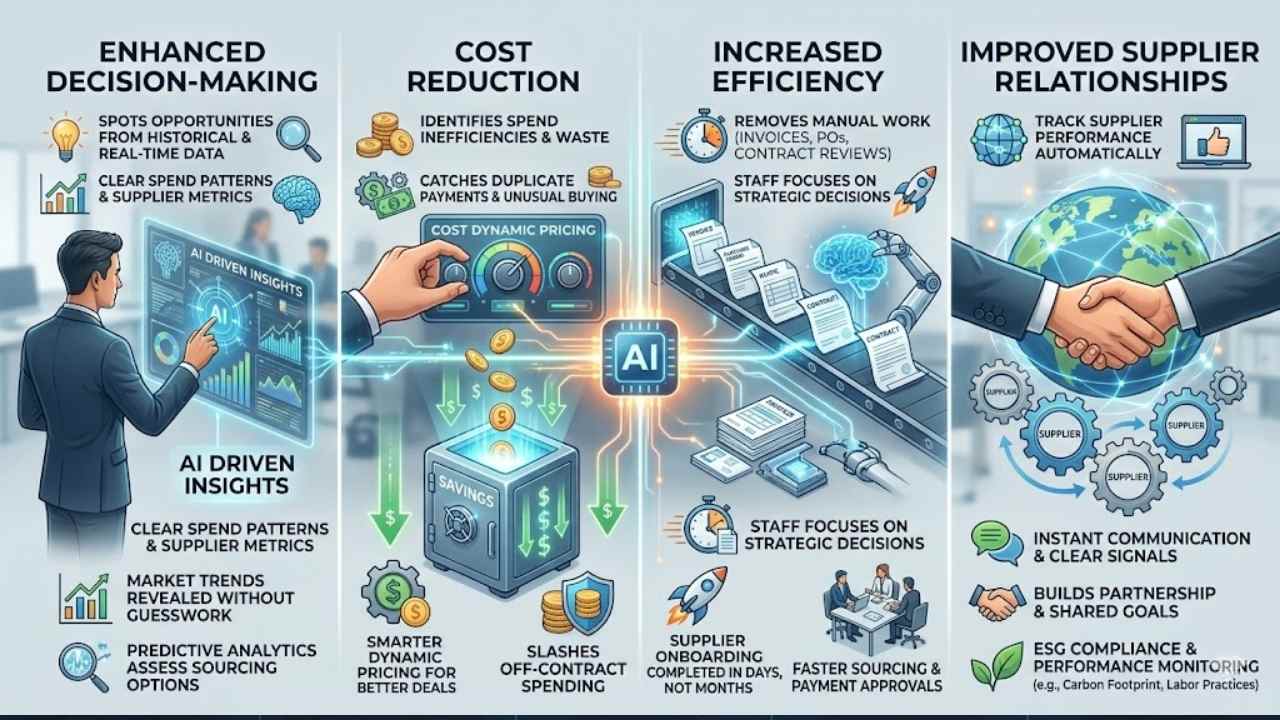
AI transforms how procurement teams make decisions, cut costs, and work faster. Smart systems help companies build stronger supplier partnerships while spotting problems early.
Enhanced Decision-Making
Procurement teams make smarter choices when they tap into data-driven suggestions from intelligent systems. These tools pull insights from historical and real-time data.
Spend patterns become crystal clear. Supplier performance metrics jump off the dashboard. Market trends reveal themselves without guesswork.
CPOs and procurement leaders now rely on these systems to spot opportunities. The Hackett Group research shows that teams using these tools catch supply chain issues earlier than competitors.
The 2025 Global CPO Survey by Deloitte notes that 67% of leaders prioritize enhanced decision-making as their top generative AI value driver. Real-time monitoring and predictive analytics transform how teams work.
Predictive analytics help assess multiple sourcing options with precision. Documentation stays audit-ready because intelligent systems handle compliance checks.
RFP and RFQ generation speeds up dramatically when systems suggest the right suppliers. Teams become more proactive and agile.
This shift matters because it frees up your best people. They focus on big-picture decisions instead of drowning in spreadsheets.
Cost Reduction
AI cuts costs incredibly fast. Ivalua customers achieved nearly 400% return on investment through process automation. They saw an average Net Present Value of $25.5 million over three years.
McKinsey research shows that AI-driven automation cuts operational procurement costs by up to 20%. AI spots spend inefficiencies hiding in your data.
It identifies duplicate payments before they slip away and catches unusual buying patterns. These tools prevent financial waste by flagging problems humans miss.
Dynamic pricing gets smarter too, helping you negotiate better supplier deals. Your sourcing process transforms when AI takes the wheel.
The system identifies preferred suppliers automatically. It aligns your purchases with negotiated contracts and slashes off-contract spending.
Automation handles routine tasks that used to consume hours. AP automation platforms work alongside business intelligence tools to streamline purchasing decisions.
| Metric | Manual AP Process | AI-Automated Process |
|---|---|---|
| Cost per Invoice | $15 to $26 average | $2.00 to $5.00 average |
| Processing Time | 10 to 30 minutes | 1 to 2 seconds |
| Error Rate | High (human data entry) | Less than 1% |
Increased Efficiency
Procurement teams save massive amounts of time when artificial intelligence handles the heavy lifting. Invoice processing, purchase order creation, and contract reviews no longer demand hours of manual work.
Staff members shift their focus to strategic decisions. Guided implementation from solutions like Ivalua help organizations hit the ground running.
Teams complete supplier onboarding in days rather than months. Immediate, context-aware answers to user inquiries reduce time spent searching through emails.
Routine supplier communications happen automatically. Faster sourcing and payment approvals mean your business keeps pace with demand.
Your procurement department becomes leaner and sharper. Organizations using artificial intelligence solutions witness their teams accomplish more with the same headcount.
“The goal is not to do more work. The goal is to do the right work, and AI gives your team the time to figure out what that is.”
Improved Supplier Relationships
AI transforms how companies work with their suppliers. Tools like mithra-ai and akirolabs help teams track supplier performance automatically.
Companies monitor renewal dates and performance metrics without lifting a finger. This stops missed renegotiation opportunities dead in their tracks.
Instant communication flows between your team and suppliers. Suppliers get clear signals about what you need, and you get quick responses back.
Real partnership grows when companies use AI to support long-term value creation. Intelligent tools build improvement plans with detailed KPIs.
Your team watches ESG compliance, including carbon footprints and labor practices. Continuous performance monitoring replaces guesswork with data-driven insights.
Transparent communication builds trust between your organization and vendors. This approach turns vendors into true partners who work toward shared goals.
Challenges in Implementing AI in Procurement
Getting AI into your procurement system hits real obstacles that companies must face head-on. Here is what stands in the way and how to overcome it.
Data Quality Issues
Your procurement data sits in different places. Some lives in spreadsheets. Some hides in email attachments. Some gets stuck in old systems nobody uses anymore.
These data silos create massive problems for AI tools. Artificial intelligence needs clean, structured information to work properly.
When your data spreads across multiple platforms, AI algorithms struggle to find patterns. Poor data quality leads to incorrect risk assessments and bad sourcing suggestions.
A major insider tip from implementation experts is to standardize your vendor naming conventions before turning on any AI tool. If you have “Amazon”, “Amazon.com”, and “business.amazon.com” listed as three different vendors, the AI will fail to calculate your true spend accurately.
Sensitive supplier information requires serious protection. Many organizations lack the right data governance systems to keep everything secure.
Integration with procurement analytics software helps build a strong foundation. Centralized data transforms how your sourcing decisions get made.
Business Prime, KPMG, and data governance experts such as Charmaine Brown and Elizabeth Brown stress this point repeatedly. Companies that fix their data problems first see the biggest wins from their AI initiatives.
Resistance to Change
Staff members often push back against AI tools because they lack the skills to use them. Many workers worry that artificial intelligence will replace their jobs.
Companies like Connexions Consulting Inc. and NAIOP see this pattern play out frequently. Industry analysts like Kathryn Hamilton and Allison Anderson note that people resist what they do not understand.
Procurement teams built their careers on doing things one way. AI asks them to learn new systems and new ways of thinking. Without clear communication, staff members will slow down adoption efforts.
The 2026 Hackett Group study highlights a stark reality. While 43% of organizations actively pursue AI deployment, only 12% report large-scale implementation. Most get stuck in the pilot phase due to internal friction.
Organizations fight back by showing that AI augments human workers. Start small with pilot programs to prove AI actually works.
Bring in key stakeholders early, including procurement, finance, and IT teams. Assign an executive sponsor to show that leadership believes in this change.
Training procurement staff on new tools matters too. When you tackle change management head-on, you build internal confidence.
High Initial Investment Costs
Picking the right AI tools requires serious money upfront. Your organization needs to invest in procurement technology that grows with your business.
Integration with existing ERP systems and procurement software demands middleware and customization work. Data security and encryption measures add more costs to your setup.
Compliance certifications become non-negotiable when you select AI procurement software. Training your procurement professionals takes additional budget.
However, that initial spending pays off in the long run. Advanced AI features increase licensing expenses, but they deliver real value.
Evaluating your software’s integration capabilities helps justify the costs to your leadership team.
- Software Licensing: Monthly or annual fees for platforms like SAP or Coupa.
- Implementation Services: Paying external consultants to map your data and configure the system.
- Employee Training: The cost of lost productivity while your team learns the new interface.
- Maintenance: Ongoing fees for tech support and system upgrades.
Future Trends in AI for Procurement
Procurement teams will soon harness autonomous sourcing tools that handle vendor selection without human intervention. AI-powered intelligence systems will transform how companies evaluate risk and build stronger partnerships.
Autonomous Sourcing Tools
Autonomous sourcing tools shift procurement from reactive to strategic functions. These systems automate supplier discovery, RFP/RFQ generation, and shortlisting.
Platforms like Levelpath and Ivalua support guided implementation for autonomous sourcing. Generative AI enables machines to autonomously create new procurement processes.
The technology handles repetitive tasks that once consumed hours of your team’s time. Agentic AI tools act as autonomous digital workers, executing tasks across systems without waiting for human approval.
AI-driven sourcing strategies use data to recommend cost-saving opportunities automatically. Sourcing Champions uses Copilot technology to enhance planning and contract sourcing.
These tools transform vendor selection and relationship management. Your team receives intelligent recommendations without drowning in spreadsheets.
Artificial intelligence at Wharton and consultancy.eu highlight how forward-thinking organizations deploy these solutions. Your procurement department drives competitive advantage through smarter supplier partnerships.
Cognitive Supplier Intelligence
Cognitive supplier intelligence uses artificial intelligence to watch supplier data in real time. AI systems monitor news, weather patterns, and financial indicators.
These tools track supplier performance, finances, and ESG compliance without stopping. They work like a security camera for your supply chain, catching problems early.
Advanced risk scoring helps you see which suppliers might face labor strikes or money troubles. AI-powered platforms from companies like akirolabs bring category intelligence to your team.
These systems review assessments and build supplier improvement plans with clear KPIs. You get research-driven reports that evaluate market impact.
AI systems spot unusual buying patterns or supply disruptions the moment they happen. Multi-tier supplier networks get analyzed for vulnerabilities you might miss otherwise.
Supplier risk management through artificial intelligence protects your business. Your procurement team gets the intelligence needed to make smarter decisions.
AI-Driven Sustainability Initiatives
Sustainability matters more than ever, and artificial intelligence makes it happen. AI systems track the environmental impact of products across your supply chain.
They analyze suppliers’ carbon footprints and labor practices automatically. Ivalua’s platform includes built-in tools that monitor supplier sustainability in real time.
These tools help procurement teams assess suppliers’ ESG credentials. Companies can now demonstrate ethical sourcing practices that match their sustainability commitments.
AI clarifies and enforces sustainability requirements in RFPs and contracts. The technology reports on sustainability metrics for decision-making without delays.
“You cannot manage what you do not measure. AI gives you the measurement power to finally enforce your green initiatives across every vendor tier.”
Sustainability directors like Ayris Scales use AI to shift toward responsible sourcing. Platforms scan suppliers’ practices and flag risks before they become problems.
Your team gets clear data on which suppliers meet sustainability standards. AI helps companies meet their targets while building stronger relationships based on shared values.
Final Thoughts
AI transforms procurement from slow, manual work into fast, smart strategy. Procurement leaders across industries report that 62% expect AI to reshape their field significantly within two to three years. Companies using AI solutions see incredible returns on their investments.
Your team can automate supplier onboarding, contract reviews, invoice matching, and risk monitoring right now. This frees up time for real strategic work. Start small with one process, measure your results, and expand from there.
The path forward is straightforward and proven by thousands of organizations already winning with these tools. The future belongs to procurement teams that act today.
Grab this opportunity to transform your sourcing operations and compete at a higher level than ever before.