
Stepping out on your own forces you to make a fundamental choice about how you want to work, grow, and earn. Many independent professionals start by flying solo, enjoying the sheer simplicity of managing their own time and their own client roster. But eventually, a common question pops up: does it make more financial sense to stay small and specialized, or should you hire a team and build a firm?
If you want to survive and thrive, you have to understand the mechanics behind agency vs freelance profitability. One path offers incredibly high margins but places a hard cap on your total revenue. The other path offers unlimited revenue potential but comes heavily weighed down by complex overhead, payroll stress, and much thinner margins. In this guide, we break down the exact financial realities of both models to help you figure out which one aligns with your bank account and your lifestyle.
Decoding the Freelance Financial Structure
Operating as a solo professional means you are the undisputed engine driving the entire operation. You wear every single hat, jumping from lead generation and client communication to project delivery and tax planning. This solo structure heavily influences how money flows in and out of your bank account every month. Because you have total control, your profit margins look entirely different from a standard corporate setup.
| Financial Factor | Freelance Reality | Impact on Your Business |
| Gross Margins | 70% to 90% | Extremely high; most revenue is kept as profit. |
| Overhead Costs | Under $500/month | Low barrier to entry; mostly software and internet. |
| Revenue Ceiling | Capped by hours | You can only earn what you can physically work. |
| Cash Flow Risk | Moderate | Missing a client payment hurts, but no payroll to cover. |
The Power of Solo Margins
-
Best for: individuals who prioritize high personal control, schedule flexibility, and low operational risk.
-
Why We Chose It: this model reliably delivers the highest profit margins possible for digital service providers.
-
Things to consider: your time is a finite resource, meaning you cannot easily scale beyond your own physical limits.
When you do not have a payroll to meet or expensive office space to lease, almost every dollar that comes into your business stays in your pocket. A solo writer, designer, or consultant really only needs a laptop, an internet connection, and a handful of software subscriptions to generate serious revenue. This incredibly low overhead makes freelancing the safest and leanest way to enter the market.
The Hard Ceiling on Revenue
The biggest tradeoff to those massive profit margins is the revenue ceiling. Your income is directly tied to the hours you can work and the premium you can charge for those specific hours. Once you hit your maximum weekly capacity—usually around 30 to 40 billable hours—you hit a wall. The only way to increase your profits at that point is to raise your rates. While raising rates is always a good idea, eventually, you will hit a market ceiling where clients will simply refuse to pay more for a single individual.
Breaking Down the Agency Financial Structure
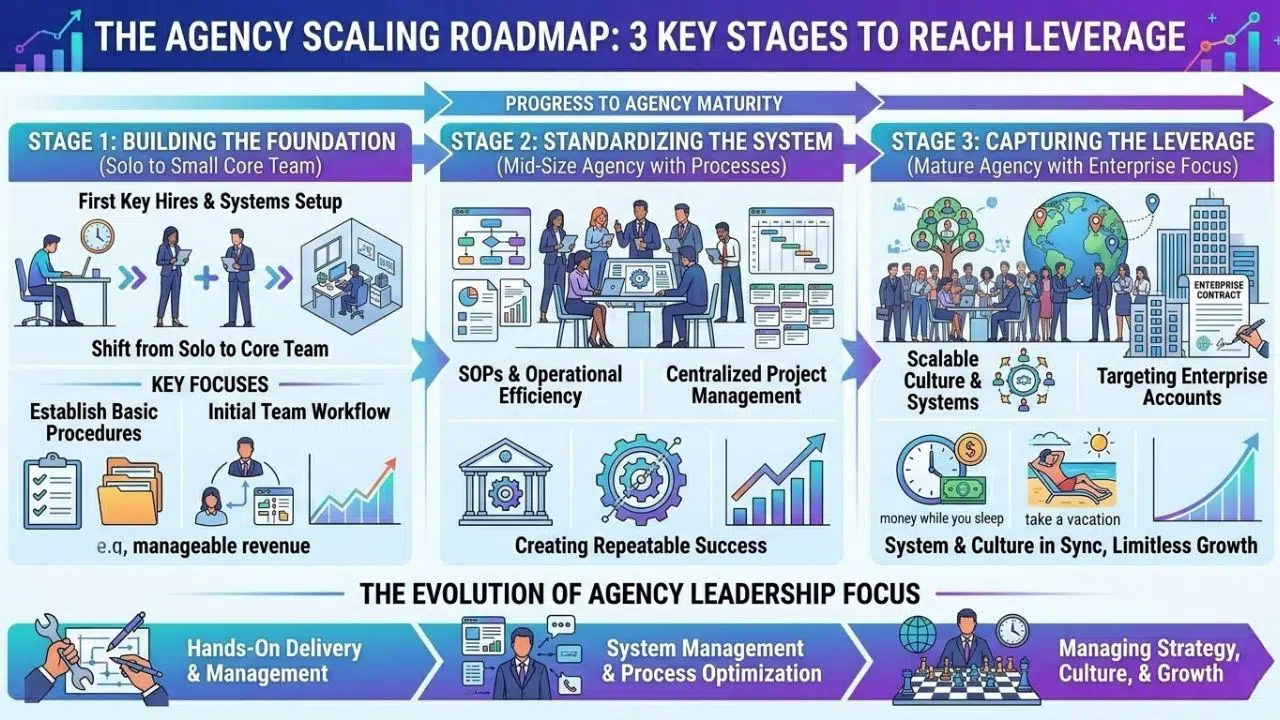
Moving from a solo operation to a multi-person firm completely flips the financial equation on its head. You transition from selling your own time to selling the output of a system you built. This means you spend less time doing the actual client work and more time managing the people who do it. It is a completely different game with totally different financial stakes.
| Financial Factor | Agency Reality | Impact on Your Business |
| Gross Margins | 15% to 30% | Much lower; heavily diluted by team salaries. |
| Overhead Costs | Tens of thousands | High fixed costs; payroll, benefits, and office space. |
| Revenue Ceiling | Uncapped | You can scale infinitely by hiring more people. |
| Cash Flow Risk | High | Payroll must be met regardless of client payments. |
Scaling Through Leverage
-
Best for: natural leaders who prefer managing systems, building teams, and closing massive enterprise accounts.
-
Why We Chose It: a team structure allows you to take on dozens of concurrent projects, completely removing the solo income ceiling.
-
Things to consider: you have to trade doing the work you love for doing the work of managing human beings.
When you run a larger operation, your business gains leverage. This leverage allows your company to make money while you sleep, take a vacation, or focus purely on closing new deals. You can land much larger, highly lucrative contracts that require multiple disciplines. For example, a $50,000 website build usually requires a dedicated copywriter, a frontend developer, an SEO specialist, and a project manager—something a solo worker just cannot provide alone.
The Overhead Squeeze
The tradeoff for this limitless revenue potential is a massive increase in complexity, overhead, and risk. You now have fixed monthly expenses that must be paid out no matter what happens. Payroll is relentless. A bad month for a solo worker just means putting less money into savings. A bad month for an operation with a full-time payroll can threaten the entire survival of the business.
Comparing Core Drivers of Agency vs Freelance Profitability
To truly grasp agency vs freelance profitability, we have to look closely at how client acquisition and market shifts affect your bottom line. Earning money is one thing, but keeping it consistently flowing requires different strategies depending on your business size. What works for a solo creative will actively harm a large firm.
| Growth Driver | Freelance Strategy | Agency Strategy |
| Lead Generation | Referrals, personal branding, freelance platforms. | Outbound sales teams, paid ads, SEO, RFPs. |
| Sales Cycle | Fast (days to weeks). | Slow (months to quarters). |
| Client Type | Small to mid-size businesses, startups. | Enterprise, mid-market, funded startups. |
| Agility | Can pivot services instantly. | Slow to pivot due to staff skillsets. |
Lead Generation and Sales Cycles
Solo professionals often find it easier to land smaller, fast-moving projects. Clients love communicating directly with the person who is actually doing the work, which keeps the sales cycle incredibly short. You can pitch a client on Monday and start billing by Wednesday.
Firms, however, target larger corporate clients who require the safety, insurance, and bandwidth of a full team. Selling a massive corporate contract involves pitching to procurement departments, navigating long chains of command, and waiting out slow legal reviews. The contracts are much larger, but you have to float your business expenses while you wait for the deal to close.
Risk Tolerance and Market Shifts
When the economy tightens, large firms often scramble. If client retainers dry up, the firm still has to pay its massive staff, burning through cash reserves rapidly. This often leads to painful layoffs. Solo workers, on the other hand, are incredibly agile. If the market shifts, a solo worker can completely rebrand their services over a weekend, drop their software subscriptions, and pivot to a new industry without needing to fire anyone or hold an all-hands meeting.
When to Make the Leap (Or Stay Small)
Deciding which route is more profitable depends entirely on how you define profit and what kind of daily life you actually want to lead. Neither path is objectively better than the other, but picking the wrong one for your personality will lead to massive burnout. You need a brutally honest assessment of your leadership style and your tolerance for financial risk.
| Readiness Factor | Stay Solo If… | Build a Team If… |
| Work Preference | You love doing the actual craft (writing, coding, designing). | You love managing, optimizing, and building systems. |
| Stress Tolerance | You hate the idea of being responsible for someone else’s rent. | You thrive under pressure and can handle fixed overhead. |
| Financial Goal | You want a high-margin, low-stress six-figure income. | You want to build a multi-million dollar sellable asset. |
| Client Demand | You have just enough work to stay busy. | You turn down work daily because you lack capacity. |
Building a Roster of Contractors
If you are on the fence, there is a lucrative middle ground. You can run a “drop-servicing” or collective model using specialized contractors instead of full-time employees. This keeps your overhead relatively low because you only pay your team when a client pays you. It allows you to take on more work and test the waters of management without committing to the heavy burden of a salaried payroll.
Selling the Business Down the Line
If your ultimate goal is to sell your business and retire early, you must build a team. A solo freelance business has zero enterprise value; if you stop working, the revenue stops immediately, so no one will buy it. A well-run firm, however, operates independently of the founder. Buyers will pay a massive multiple for an operation that has consistent recurring revenue, strong management systems, and a recognizable brand.
Frequently Asked Questions (FAQs)
Do freelancers actually make a higher profit than agency owners?
On a percentage basis, absolutely. As a solo worker, your gross profit margins often hover around 70% to 90% because your overhead is essentially just a laptop, Wi-Fi, and a few software subscriptions. Firm owners might only see 15% to 30% profit margins because they have to pay salaries, benefits, and massive operational bills. However, because a team can take on infinitely more work, a 20% margin on a million dollars puts a lot more cash in the bank than an 85% margin on a hundred grand.
Is it harder to get clients as a solo freelancer or a full agency?
It completely depends on who you are pitching. I’ve found it’s generally much faster and easier to land small-to-medium clients as a solo professional. Clients love talking directly to the person doing the actual work, and you can often close a deal in a single Zoom call. Firms, on the other hand, go after massive corporate accounts. Those deals take months of pitching, proposals, and legal reviews, but the final contract payout is significantly higher.
Can I build an agency using freelancers instead of hiring employees?
Yes, and it’s a brilliant way to test the waters of management. This is often called a “drop-servicing” or collective model. You act as the account manager and bring in specialized independent contractors to execute the deliverables. You only pay them when a client pays you, which keeps your overhead incredibly low and protects your cash flow while you scale up.
When is the exact right time to transition from freelance to agency?
You should only start building a team when three specific things happen: you consistently have more work than you can physically handle, you are already charging the absolute highest rates your market will bear, and you have enough cash saved up to float the business through the messy transition period. If you don’t have all three of those boxes checked, stay solo a little longer.
Final Thoughts
At the end of the day, understanding agency vs freelance profitability comes down to recognizing the difference between a high-margin lifestyle business and a scalable enterprise. If your goal is to take home the highest percentage of your revenue with the absolute least amount of stress, staying solo is the undisputed winner.
You can easily build a highly lucrative business without ever having to manage another human being. But if you want to build a multi-million dollar asset that operates without your daily labor, you must build a team. You will trade those easy margins for high volume, stepping away from the tools of your trade to become a full-time leader.