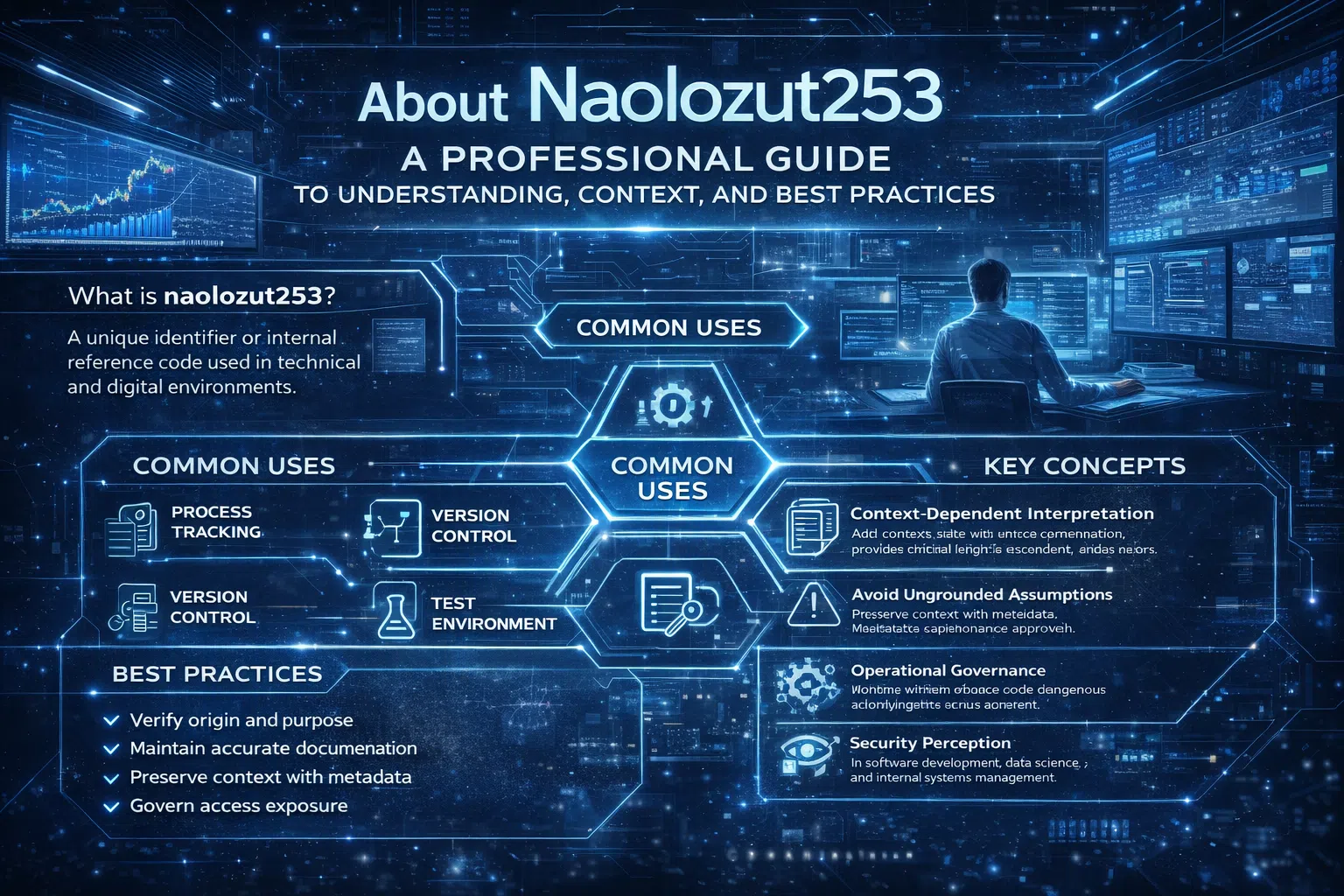
In today’s complex digital and technical landscape, professionals routinely encounter unique identifiers, internal reference codes, and system-specific labels that lack immediate public documentation. One such term that has recently surfaced in technical discussions and online forums is about naolozut253. Despite growing curiosity, the available information remains fragmented, speculative, and often contradictory.
This guide provides a clear, evidence-informed examination of naolozut253. Rather than amplifying unverified claims, we focus on what is currently understood about this identifier, its functional context, associated considerations, and practical protocols for engagement. Whether you are a systems analyst, developer, or decision-maker evaluating unfamiliar references, this article equips you with the frameworks needed to proceed with clarity and confidence.
What Is Naolozut253? Defining an Ambiguous Identifier
Naolozut253 is best understood as a unique identifier or internal reference code rather than a commercially available product, regulated substance, or formally standardized technology . Its structure combining an alphanumeric stem with a numerical suffix strongly suggests a versioned or sequentially assigned label commonly found in proprietary systems, experimental environments, or developmental workflows.
At present, naolozut253 does not possess a universally recognized definition. This absence of formal standardization is not inherently problematic; many legitimate technical identifiers operate within closed systems without public exposure. However, it does necessitate a context-dependent approach to interpretation. The meaning and function of naolozut253 can shift significantly depending on the system architecture, documentation practices, and governance frameworks in which it resides .
Professionals should therefore resist the impulse to assign definitive meaning to the identifier in isolation. Instead, naolozut253 is best approached as a variable whose significance is determined by its operational environment, a distinction that separates disciplined technical analysis from speculation.
Contextual Uses and Functional Roles
Understanding where and how naolozut253 appears provides critical insight into its purpose. Based on observed references and analogous identifier behavior, the term is most commonly situated within technical, analytical, or development-oriented environments .
Typical Environments and Applications
Identifiers of this nature serve essential functions in systems where precision, traceability, and isolation are paramount. Naolozut253 may function in one or more of the following capacities:
- Process or entity tracking: Assigning a unique label to a specific dataset, workflow iteration, or system component to enable monitoring and accountability.
- Version control: Distinguishing between successive iterations of a software module, configuration, or experimental condition.
- Test environment isolation: Tagging a controlled instance or sandbox to prevent interference with live production systems.
- Temporary placeholder: Serving as an interim reference awaiting formal nomenclature or classification.
- Audit and compliance reference: Providing a traceable point of origin for internal reviews or forensic analysis .
These roles are neither exotic nor inherently sensitive. They reflect routine practices in software engineering, data science, quality assurance, and systems administration. The key variable is not the identifier itself, but the quality of the documentation and governance surrounding it.
Why Context Determines Meaning
A fundamental principle in technical communication is that identifiers without context invite misinterpretation. Naolozut253 may be entirely benign, a forgotten test label from a deprecated project or it may be actively maintained within a controlled access system. Without visibility into the originating environment, external observers cannot reliably distinguish between these states.
This ambiguity underscores why professional disciplines emphasize documentation, metadata, and change management. A well-governed identifier is accompanied by lineage records, ownership attribution, and lifecycle status. When such information is absent, the identifier becomes a source of entropy rather than clarity .
Risks and Considerations in Practice
The risks associated with naolozut253 are not intrinsic to the identifier itself, but rather emerge from how it is interpreted, shared, or operationalized without adequate context. Professionals should be aware of several distinct risk categories.
1. Interpretive Risk
The most immediate risk is erroneous assumption. When team members or external parties infer meaning without verification, they may misclassify the identifier, apply incorrect processing logic, or propagate inaccuracies across dependent systems. In algorithmically driven environments, such errors can cascade rapidly.
2. Operational Risk
If naolozut253 is implemented in automation, reporting, or security-adjacent functions without proper validation, it may produce incorrect outputs or degrade system reliability. This is particularly relevant in environments where identifiers are ingested from external sources or legacy repositories.
3. Reputational and Compliance Risk
Sharing or referencing poorly understood identifiers in client communications, public documentation, or regulatory submissions can undermine perceived competence and diligence. Stakeholders reasonably expect that referenced entities are verifiable and meaningfully described. Ambiguous identifiers erode that trust .
4. Security Perception Risk
While there is no evidence that naolozut253 represents a vulnerability or threat, ambiguous identifiers can be misread as exposed internal assets, hidden backdoors, or unpatched components. This perception alone may trigger unnecessary scrutiny or defensive posturing.
Best Practices for Engaging with Naolozut253
Organizations and individuals who encounter unfamiliar identifiers benefit from structured engagement protocols. The following practices are adapted from established information governance and systems management disciplines.
Verification Before Utilization
No identifier should be operationalized based solely on its existence. Verification entails confirming the identifier’s origin, intended purpose, current validity, and any constraints on its use. This may require consulting system owners, reviewing design documentation, or examining audit logs .
Context Preservation
When naolozut253 is shared across teams, systems, or organizational boundaries, its contextual metadata should accompany it. At minimum, this includes the date of creation, responsible party, functional role, and lifecycle status. Context preservation transforms an opaque string into actionable information.
Documentation Discipline
If naolozut253 is actively maintained, its documentation should be living rather than static. Periodic reviews ensure that the identifier remains relevant, accurately described, and appropriately classified. Deprecated identifiers should be retired according to formal sunset protocols.
Access and Exposure Governance
Not every identifier requires public visibility. Organizations should evaluate whether internal references like naolozut253 need to appear in external-facing materials. Controlled exposure reduces the risk of misinterpretation by audiences who lack the necessary contextual framework .
Frequently Asked Questions
What is naolozut253 exactly?
Naolozut253 is a unique identifier or internal reference code, not a standardized commercial product or regulated technology. Its exact meaning depends entirely on the specific system or environment in which it is used .
Is naolozut253 dangerous or a security threat?
No. There is no evidence that naolozut253 itself poses any inherent security risk. Concerns arise only when the identifier is used without proper context, verification, or documentation .
Where is naolozut253 most commonly found?
It typically appears in technical environments such as software development, data analysis, testing frameworks, and internal system audits. It is not a consumer-facing term .
How should I respond if I encounter naolozut253 in my work?
Begin by verifying its origin and purpose. Consult available documentation, speak with system owners if possible, and avoid making assumptions based solely on the identifier’s name or structure.
Can naolozut253 be safely used in my organization?
Yes, provided that its function is clearly documented, its usage is governed by standard information management practices, and personnel are trained to interpret it correctly.
Why is there so little public information about naolozut253?
Many technical identifiers are intentionally internal and never intended for public documentation. Their appearance in external discussions often reflects curiosity about ambiguous references rather than formal disclosure .
This guide is deliberately written to serve an international readership. The principles discussed identifier governance, contextual interpretation, risk mitigation are universal across jurisdictions and regulatory regimes. No location-specific laws, cultural references, or region-bound platforms are assumed. The terminology reflects global professional standards in information technology, systems engineering, and data management.
Professionals in all markets face the common challenge of maintaining clarity amid growing technical complexity. The frameworks presented here are adaptable to any organizational or national context.
Clarity as a Professional Discipline
The discussion surrounding about naolozut253 is ultimately not about a single alphanumeric string. It is about how professionals navigate ambiguity in environments where information is incomplete, context is fragmented, and the cost of misinterpretation is high.
Naolozut253 is a reminder that identifiers are not self-explanatory. They are placeholders whose value is unlocked through documentation, governance, and disciplined inquiry. By treating such references as variables requiring definition rather than as facts demanding acceptance organizations can reduce operational friction, enhance credibility, and maintain control over their technical ecosystems.
If your organization manages internal identifiers or encounters unfamiliar references in your systems, consider reviewing your documentation protocols and access governance. A small investment in clarity today prevents significant remediation effort tomorrow.