Have you ever felt like your own software systems are working against you? Old code breaks the moment you add something new. Teams step on each other’s work. Scaling one part of your system means scaling everything, even the parts that are running just fine.
The gap between your legacy infrastructure and what your business needs today feels impossible to close.
Here’s the good news. SOA OS23 can change that. According to the 2024 CNCF Annual Survey, 80% of organizations already run Kubernetes in production, and they’re using it to power modern service-oriented architecture patterns that actually deliver results.
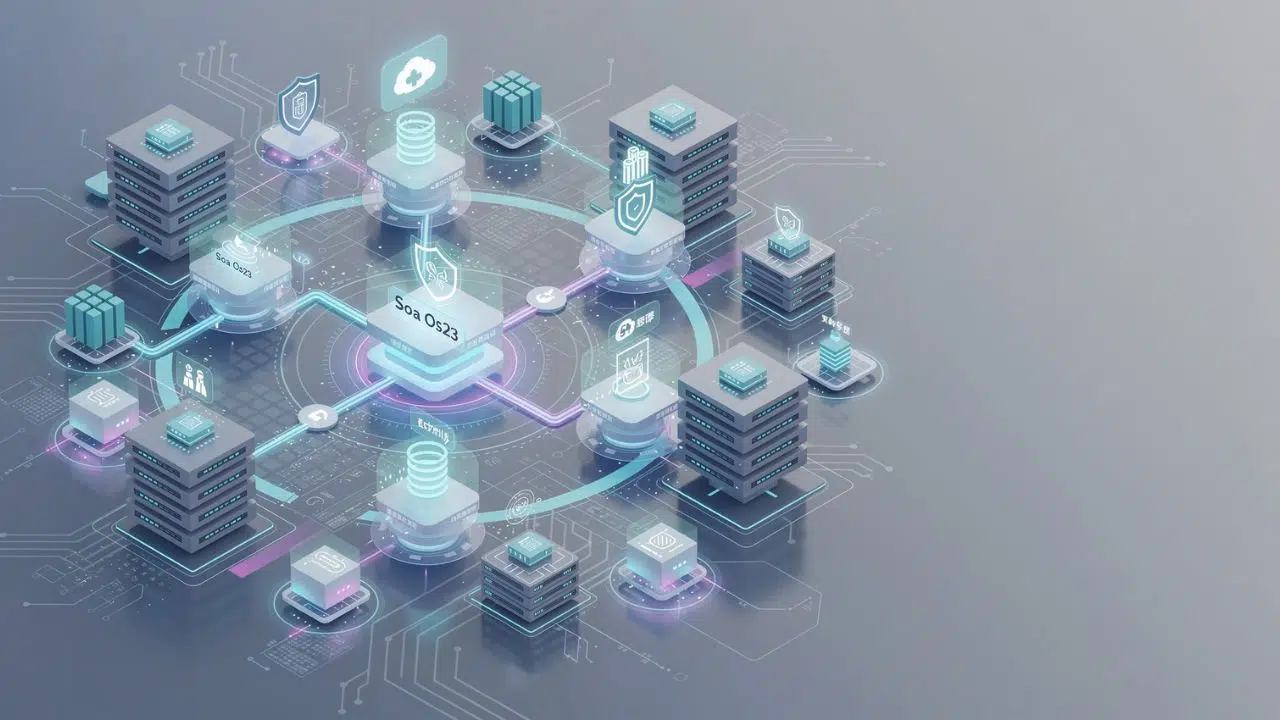
SOA OS23 is a 2023 update to Service-Oriented Architecture. It brings together reusable services, API-first contracts, containers, Kubernetes, and zero-trust security into one practical framework.
This article walks you through how it works. You’ll learn what makes it different, what key features it offers, and how to decide if it fits your organization’s needs.
What is SOA OS23
SOA OS23 stands for Service-Oriented Architecture Open Standard 23, a modern framework that builds reusable services with API-first contracts at its core. It integrates containers, Kubernetes, and zero-trust security to create systems that work together smoothly.
Unlike traditional SOA, which often got stuck in monolithic designs, SOA OS23 promotes loose coupling and event-driven architecture. This means your teams can deploy faster and adapt to change without being locked into one giant codebase.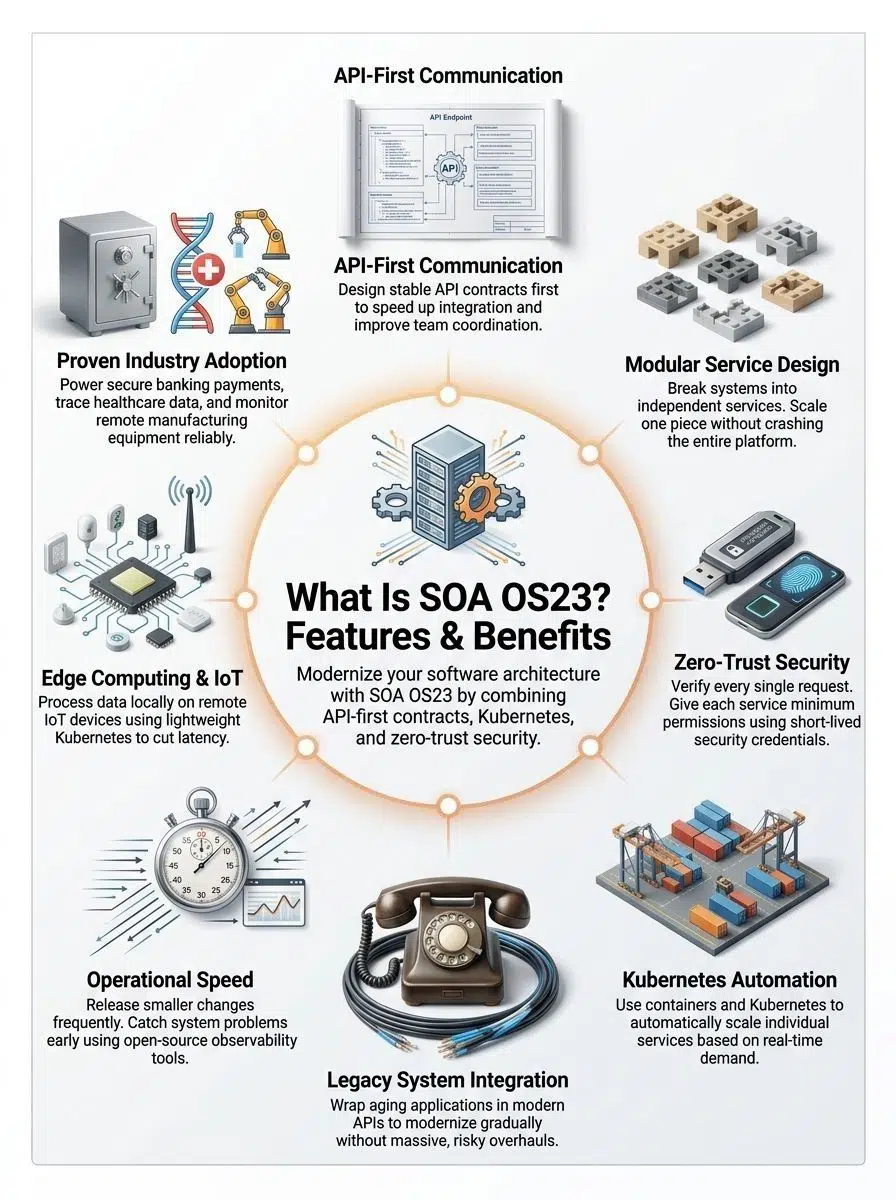 The framework uses REST for broad compatibility and GraphQL for efficient data retrieval across multiple services. Docker containers make it easy to package and run each service anywhere you need it.
Cloud-native compatibility is one of the biggest differences from older SOA approaches. It emphasizes infrastructure automation from the start, so your teams can build systems that scale up or down based on real demand.
The Tools That Power SOA OS23
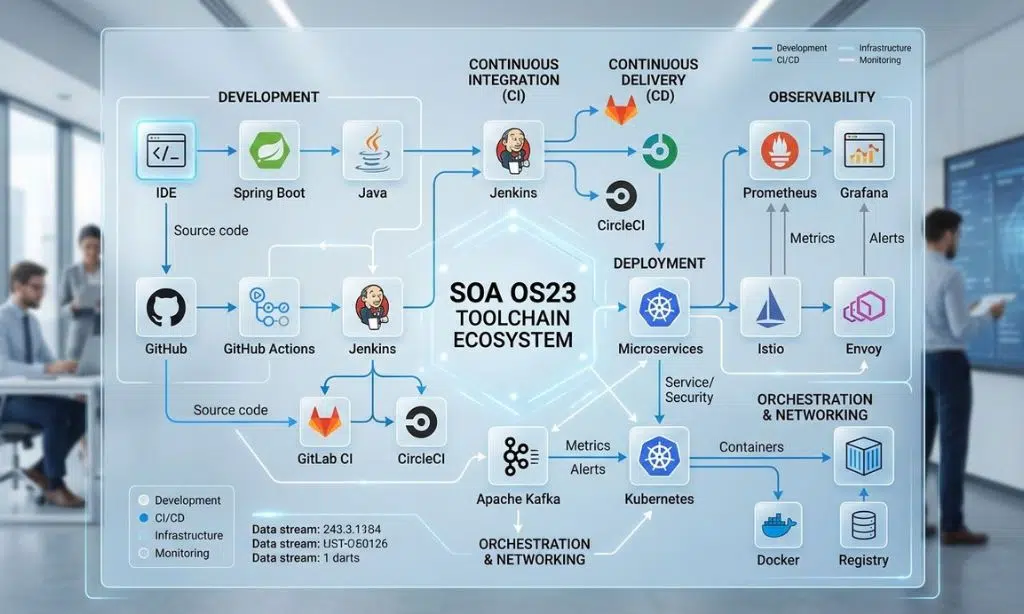
SOA OS23 uses a specific set of tools to handle different parts of your system. Some handle development, others manage communication, and some focus on monitoring and automation.
- Spring Boot handles application development
- Jenkins and GitHub Actions manage continuous integration and automation workflows
- Apache Kafka streams events across services
- Istio manages service communication in containerized environments
- Prometheus and Grafana track system performance metrics
OpenTelemetry collects data from distributed systems, giving your team visibility into how everything fits together. According to a 2026 report by Enterprise Management Associates, 48.5% of organizations now use OpenTelemetry, and 81% consider it production-ready. That’s not a niche tool anymore. It’s practically an industry standard.
OAuth 2.0 and OpenID Connect secure API access, protecting sensitive data at every layer. SOA OS23 also supports microservices architecture, so your teams can build, test, and deploy services independently.
Fault isolation is built into this design. A failure in one service won’t crash your entire platform. Legacy system integration becomes possible through smart API design, so you can modernize existing applications without starting from scratch.
Key Features of SOA OS23
SOA OS23 breaks free from old-school service architecture by putting modularity and flexibility at the center. Your services talk to each other through APIs, making your whole system more adaptable and easier to scale.
Contrasting Traditional SOA with SOA OS23
Traditional SOA and SOA OS23 run on completely different foundations. Understanding these differences helps you pick the right architecture for your organization.
Traditional SOA feels like driving with a single control center making every decision. Everything flows through the Enterprise Service Bus, which becomes a bottleneck as your organization grows. You wait for release cycles that span months. Your security model assumes everyone inside the network is trustworthy, which feels outdated in today’s threat environment.
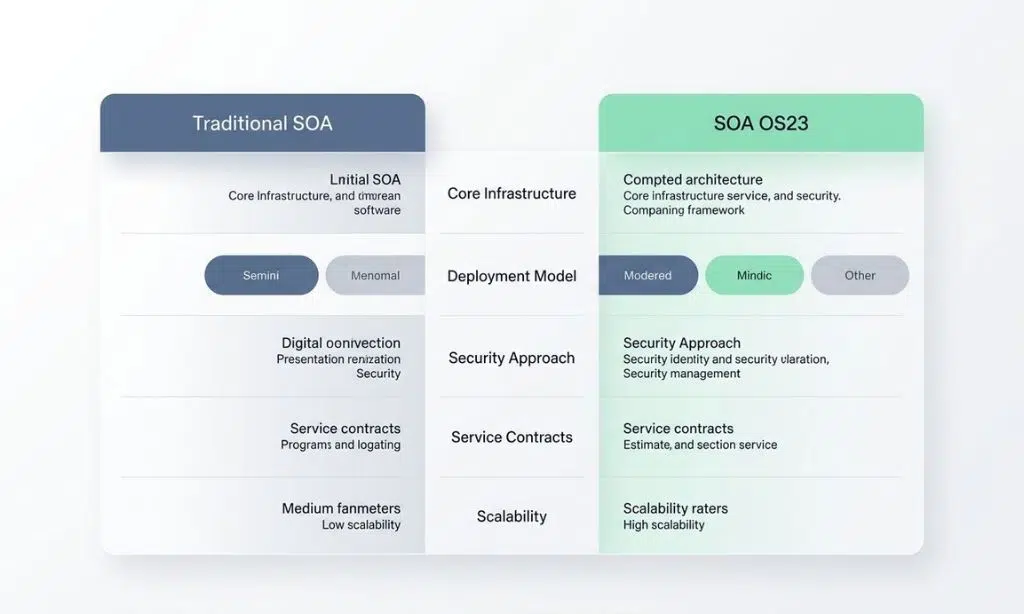
SOA OS23 takes a different approach. Each service acts like an independent operator that makes its own calls. Containers mean you deploy code in minutes, not quarters. Kubernetes orchestrates everything, rolling out updates smoothly while keeping systems running. If something breaks, you roll back instantly.
The security shift matters most. Zero-trust security means you verify every single request. Nobody gets a free pass just because they’re internal.
API gateways replace the centralized control of the ESB. Event streams let services communicate without waiting on each other. Services stay smaller and more focused, and they change independently without dragging the entire architecture along.
Modular Service Design and Flexibility
Modular service design breaks your system into smaller, focused services. Think authentication, billing, inventory, and search, each one operating on its own.
You can update or deploy one service without touching the others. This also limits the impact of failures. A problem in your billing service won’t crash your entire platform.
Your development teams move faster because they own their services and release on their own schedules. Containers hold each service in its own image, making deployment straightforward and predictable.
Flexibility is a natural result of this approach. You scale specific services that need more resources, rather than scaling everything at once. Domain-driven design principles guide how you divide your system into logical pieces, giving DevOps teams real control over infrastructure automation and deployment pipelines.
- RESTful endpoints connect services through clean communication paths
- gRPC handles high-performance, low-latency service calls
- Kubernetes orchestrates the whole system at scale
- Edge computing scenarios fit naturally with this modular structure
Legacy system integration also becomes manageable. You can wrap older systems in service interfaces and modernize them piece by piece, without risking your core operations.
Implementation of SOA OS23
Building SOA OS23 starts with clear goals and a solid map of your current systems. You move through stages like setting up APIs, connecting services, and testing everything to make sure it holds together.
Steps to Implement SOA OS23
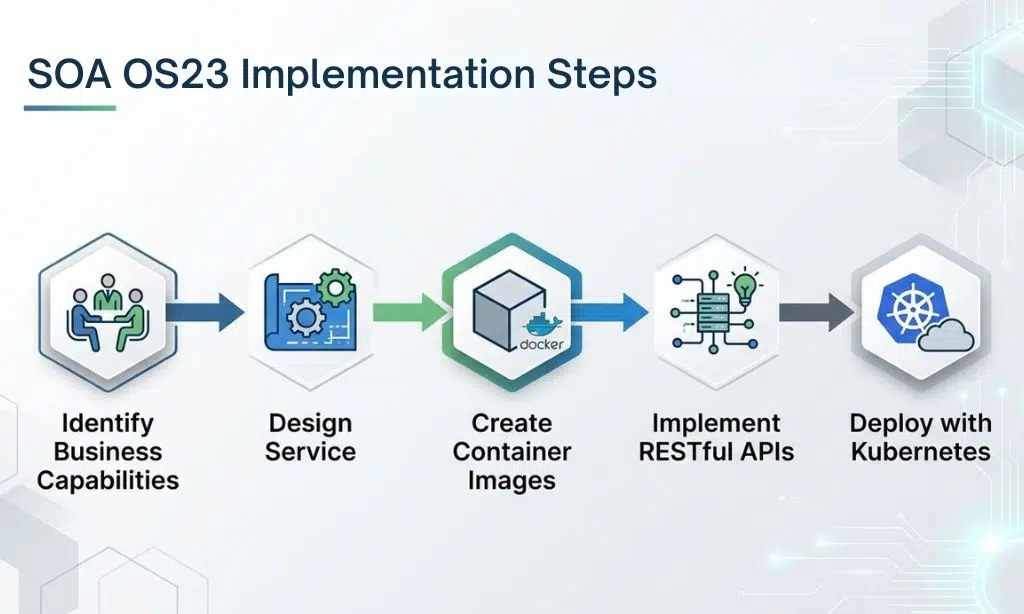
A structured approach breaks your software into manageable services. Start by identifying your core business capabilities, then move forward with deliberate steps that follow industry best practices.
- Identify specific business capabilities like authentication, checkout, catalog, notifications, and reporting that your system needs to handle independently.
- Design each service to handle one business function, keeping service contracts stable and documented using OpenAPI standards.
- Create separate container images for each service, allowing independent deployment and release schedules across your infrastructure.
- Implement RESTful APIs as your primary communication method, enabling services to talk to each other without tight coupling.
- Apply OAuth2 for authentication across services, securing your API endpoints and controlling access to sensitive operations.
- Deploy services using Kubernetes, which orchestrates containers and manages scaling automatically as demand changes.
- Establish observability tools like Jaeger to trace requests across services, helping you spot problems before users notice them.
- Adopt zero-trust security principles, granting each service only the permissions it absolutely needs to function properly.
- Integrate with cloud platforms such as Google Cloud Platform or Azure API Management for centralized API governance and monitoring.
- Connect legacy systems gradually to your new architecture, modernizing your enterprise architecture without disrupting current operations.
- Monitor compliance controls and data security measures throughout deployment, following NIST guidelines for protection standards.
API-First Communication and Its Positive Influence
API-first communication changes how teams build software. Instead of writing code first and figuring out how services talk later, teams design the API contract before touching any service logic.
This approach pushes developers to think about stability and reusability from day one. Postman’s research shows that 82% of organizations practiced some form of API-first approach by 2026, with 25% fully adopting it across their digital transformation efforts.
According to 2026 industry data published in SQ Magazine, API-first approaches can reduce system integration time by 40%. That’s a meaningful gain when you’re trying to ship faster and stay competitive in the software industry.
Teams that embrace this strategy focus on creating stable, reusable contracts, which cuts down integration friction significantly. The API gateway then enforces security policies and manages traffic, keeping everything running smoothly.
API contracts get documented and versioned, so everyone knows exactly what they’re working with. This clarity speeds up development cycles across the board.
- Legacy systems integrate more easily when APIs serve as the bridge between technologies
- Teams can add artificial intelligence capabilities without breaking existing workflows
- Internet of Things devices connect through standardized APIs
- Components can be swapped without disrupting the rest of the system
Developers spend less time fighting integration battles and more time solving real problems. That shift drives real performance gains throughout your digital transformation journey.
Current Trends and Industry Adoption
Companies across industries now adopt API-first strategies, making SOA OS23 a go-to choice for modern digital transformation. Machine learning systems and IoT devices integrate well with these architectures, letting organizations build smarter applications that respond to real-time data streams.
The Rise of API-First Approach
Organizations across the globe have shifted toward API-first design. By 2026, 82% of organizations practiced some form of API-first approach, with 25% fully adopting it as their core strategy.
APIs now serve as the central product for integration and automation. Teams create the API contract first, version it carefully, and enforce security and traffic policies through the gateway. This method creates stable, well-documented contracts that improve team coordination and speed up development cycles.
AI and machine learning integration tools rely heavily on API-first foundations to function properly. According to the 2026 Gartner CIO and Technology Executive Survey, 84% of enterprise IT executives plan to increase generative AI funding in 2026. This makes API-first architectures a practical necessity for any organization deploying intelligent systems at scale.
IoT devices connect through standardized APIs, making data flow seamless across networks. Teams that adopt API-first design early gain real competitive advantages.
- They scale faster and adapt to market changes more quickly
- They integrate legacy systems with modern infrastructure more effectively
- They build connected, intelligent systems that power future innovations
Increasing Importance of APIs and Their Diverse Use
APIs have become the backbone of modern software systems. Organizations now treat APIs as critical products, not just technical tools. Companies use them for reuse, automation, and AI integration across their operations.
Azure API Management shows this shift clearly by supporting REST, GraphQL, SOAP, gRPC, and OData protocols. Each protocol serves different needs and different industries.
- Healthcare: HL7 FHIR standards let providers share patient data safely through APIs
- Financial services: ISO 20022 standards power secure transactions
- IoT: MQTT protocols send real-time data across connected devices
MuleSoft’s API-led connectivity approach breaks down system interactions into three layers. System APIs connect to legacy applications and older infrastructure. Process APIs handle orchestration and business logic between different systems. Experience APIs shape data specifically for what users need to see.
This layered strategy lets companies modernize gradually without ripping out old systems. APIs bridge the gap between new cloud applications and legacy software that still runs the business.
Organizations in healthcare, finance, and IoT sectors gain real advantages from this connectivity. They reduce integration costs, speed up development cycles, and create pathways for machine learning tools to access the data they need.
Compatibility and Security in SOA OS23
SOA OS23 runs smoothly with cloud systems and automates your infrastructure without skipping a beat. Your data stays protected through zero-trust security models that verify every single request.
Cloud-Native Compatibility and Infrastructure Automation
Cloud-native systems work best with SOA OS23 because they speak the same language. According to the 2024 CNCF Annual Survey, Kubernetes powers 80% of organizations in production today, and that number keeps climbing.
Infrastructure automation handles the heavy lifting, so your team can focus on building features instead of managing servers. Helm packages applications for Kubernetes in 75% of organizations, making deployments smooth and repeatable.
AI and ML integration thrives in this environment because automated systems scale resources up or down based on real-time metrics. The Horizontal Pod Autoscaler adjusts pod counts automatically, responding to CPU usage, queue depth, or custom metrics your business tracks.
- Rolling updates and quick rollbacks mean you ship code safely without crossing your fingers
- Lightweight Kubernetes distributions like K3s open doors for IoT devices and remote locations
- Edge computing lets you process data closer to where it originates, cutting latency and bandwidth costs
- Your infrastructure adapts to demand without manual intervention, saving time and reducing errors
This compatibility layer transforms how teams deploy, scale, and manage services across complex distributed systems environments.
Zero-Trust Security Model and Its Implementation
SOA OS23 moves away from protecting network segments and focuses on securing resources directly. This aligns with NIST guidance and represents a real shift in how security actually works at the service level.
Security decisions happen per request, enforcing the principle of least privilege across your entire system. According to the 2025 Zscaler ThreatLabz VPN Risk Report, 81% of organizations are actively planning to implement zero-trust strategies within a 12-month window, largely to replace vulnerable legacy VPNs. This isn’t a trend for the future. It’s happening right now, across US enterprises of every size.
Each service receives only the minimum permissions it needs to do its job. Short-lived credentials replace long-term tokens, cutting down risk from leaked passwords. OAuth 2.0 and OpenID Connect manage user identities, with scoped claims like JWTs handling service-to-service calls.
This approach works well for IoT devices and edge computing setups, where security can’t take a back seat. Your security team gains real visibility into everything happening in the system. Traceable calls, integrated logs, and distributed traces let you track exactly where each request goes.
- Policy enforcement applies to every request, not just entry points
- Identity management covers both user-to-service and service-to-service traffic
- Auditing creates a clear record of every interaction across the architecture
This comprehensive approach stops attackers from hiding behind network walls. Security transforms from a checkpoint at the gate into a continuous conversation between every component in your system.
Benefits of SOA OS23
SOA OS23 transforms how systems perform, making applications faster and more responsive to real business needs. Your infrastructure scales with ease, while Kubernetes handles the heavy lifting of managing containers across cloud environments and edge computing setups.
Operational Performance Improvements
Your teams move faster with SOA OS23. They release smaller, more manageable changes instead of massive updates that break things. Developers fix problems quickly and push solutions to production without waiting weeks.
IoT devices connected to your systems benefit from this too. They get updates and patches faster, keeping your network secure and running smoothly.
- Downtime drops as isolated services contain failures before they spread
- Costs shrink as resources get used more efficiently
- Each service does one job well, instead of one giant system trying to handle everything
Better visibility into your systems transforms how you respond to failures. Enhanced observability shows you exactly what went wrong and why it happened. Tools like OpenTelemetry, Prometheus, and Grafana give you clear pictures of what your services are doing right now.
OpenTelemetry’s support from over 90 vendors means you won’t get locked into one monitoring solution. You can switch tools without starting from scratch. Your team catches problems before customers do.
Integration of old and new systems happens with less friction. Your legacy applications work alongside modern services without creating bottlenecks. This combination of speed, visibility, and smooth integration means your business runs leaner and responds faster to what customers need.
Improved Scalability and Flexibility
SOA OS23 lets you scale services the way a chef adjusts heat on different burners. Your checkout service gets slammed during holiday sales? Scale just that service. Your reporting system runs fine? Leave it alone.
This targeted approach saves money and keeps things running smoothly. Kubernetes makes this happen through the Horizontal Pod Autoscaler, which watches your service metrics and adds or removes pods as needed.
Services replicate independently, so scaling checkout does not affect reporting or administration. You stop fighting fires and start planning ahead with proactive scaling strategies instead of reactive crisis management.
- IoT devices send data to edge computing nodes using lightweight Kubernetes distributions like K3s
- Edge systems buffer data locally when connections drop, holding information safe until the network comes back
- Upstream summaries transmit only the data that matters for central analytics or compliance requirements
- Services work independently, talk through APIs, and scale exactly when you need them to
Your architecture bends and stretches to fit different business needs without breaking. Your system grows with your business, not against it.
Kubernetes Support and Edge Computing Capabilities
Kubernetes powers modern app scaling effectively. Eighty percent of organizations run Kubernetes in production right now, and that number keeps climbing. The platform’s Horizontal Pod Autoscaler scales your applications based on custom metrics like queue depth, so your systems respond to real demand.
Lightweight Kubernetes distributions like K3s fit perfectly into IoT environments where space and power matter. These distributions handle resource-constrained settings, remote locations, and edge devices without the heavy overhead of a full Kubernetes setup.
Edge computing processes data where it starts. AWS IoT Greengrass lets your components run locally and handle data streams right on the device, cutting latency and boosting responsiveness. MQTT, an OASIS standard, supports lightweight communication across edge projects, making it ideal for IoT deployments.
Standardized logic gets reused across multiple sites, which reduces maintenance work and keeps costs down. Your infrastructure stays lean, responsive, and efficient from the edge all the way back to your core systems.
Legacy System Integration and Modernization Efforts
Old systems don’t need to disappear. SOA OS23 lets you wrap legacy applications in APIs without tearing everything down and starting fresh.
Your customer databases, order systems, payment processors, and inventory records stay put. Instead, you expose these stable business records through modern interfaces. Apache Camel orchestrates the heavy lifting, transforming data and connecting old SOAP services to new REST or event-driven systems.
Your team can modernize gradually, piece by piece, rather than risking a massive overhaul that could crash your operations. IoT devices and edge computing open new doors for aging infrastructure. Your legacy systems can now take part in IoT workflows through adapters and APIs.
MuleSoft’s API-led connectivity model divides system interactions into three layers:
- System APIs expose your core data from legacy sources
- Process APIs orchestrate business logic between systems
- Experience APIs serve your customers and partners in the format they need
This structure lets you translate formats at the edge, making old and new technologies talk to each other smoothly. Your investment in existing systems becomes an asset rather than a burden, and modernization happens at your pace, not some vendor’s timeline.
Real-world Applications and Use Cases
Companies across healthcare, finance, and manufacturing now run IoT devices through SOA OS23 to collect real-time data and make faster decisions. Banks connect legacy payment systems with modern mobile apps, while factories deploy it to monitor equipment and prevent costly breakdowns before they happen.
Industry-Specific Use Cases and Tools
Different industries use SOA OS23 through specialized tools and applications that solve real problems in their sectors.
| Industry | Primary Use Cases | Key Tools & Standards | Business Impact |
|---|---|---|---|
| Financial Services |
|
|
Reduces fraud by enabling traceable payment services. Improves compliance speed across payment channels. |
| Healthcare |
|
|
Standardizes clinical data access across providers. Increases patient care coordination without security risks. |
| Internet of Things (IoT) and Edge Computing |
|
|
Reduces bandwidth costs through local processing. MQTT supports communication over unreliable networks with small data footprints. |
| Legacy System Modernization |
|
|
Apache Camel connects legacy SOAP services to REST or event-driven systems. MuleSoft avoids direct wiring to legacy databases through layered API approach. |
Financial institutions apply event streaming patterns similar to Kafka for payment and fraud services, creating full transaction traces. Healthcare organizations connect patient systems through HL7 FHIR with OAuth 2.0 and OpenID Connect, protecting sensitive clinical information. IoT deployments use MQTT for lightweight, reliable communication across devices and sensors in the field.
Success Stories and Applications in Various Sectors
Manufacturing plants have transformed their operations by connecting old machinery with modern monitoring systems through SOA OS23. A logistics company integrated legacy equipment into a real-time tracking network, cutting delivery delays by forty percent.
These businesses applied modular service design to link outdated systems with new software. The result is faster operations and fewer costly breakdowns.
Healthcare organizations adopted HL7 FHIR standards to manage patient data across multiple hospitals. According to recent healthcare interoperability data highlighted by Co-Desion, the HL7 FHIR standard has reached an 85% adoption rate among US healthcare institutions, driven largely by regulations like the ONC Cures Act. That’s a clear signal that SOA OS23 concepts are already the dominant reality in US healthcare.
Financial institutions strengthened their defenses using SOA OS23’s layered security approach. They applied identity checks, policy controls, and audit trails at every service level, meeting PCI DSS v4.0 requirements that expanded multi-factor authentication needs.
Edge computing with AWS IoT Greengrass lets companies process data locally on devices, then send only essential information upstream. A shipping company deployed IoT sensors across its fleet, processing data at the edge to detect problems before they became expensive disasters.
These real-world applications show that SOA OS23 serves industries from healthcare to finance to supply chains, making systems faster, safer, and smarter.
Final Words
SOA OS23 transforms how organizations build software systems. It combines services, APIs, and containers into one practical approach that actually scales.
Docker, Kubernetes, and tools like Prometheus work together to create systems that adapt and stay secure without constant rebuilds. Companies across IoT, healthcare, payments, and manufacturing already see real results with faster deployments and lower costs.
Your team can start small. Wrap existing systems in APIs and gradually move toward this modern architecture. The shift from old service buses to API gateways and zero-trust security puts you in control of what comes next.
Frequently Asked Questions (FAQs) on SOA OS23
1. What is SOA OS23?
SOA OS23 is a software architecture that organizes applications into smaller, independent services that communicate through standard protocols like REST. You can update or replace one service without disrupting the rest of your system.
2. How does SOA OS23 connect with IoT (Internet of Things)?
SOA OS23 acts as a middleware layer that links IoT hardware to your core business systems. It connects smart devices, sensors, and gateways through lightweight web services for fast data sharing. This setup can handle thousands of IoT devices communicating simultaneously in real time.
3. What are the key benefits of SOA OS23?
It makes your software flexible, scalable, and much easier to maintain. Companies using SOA typically cut development costs by 30% because services can be reused across different projects instead of rebuilding each time.
4. Is SOA OS23 good for large businesses?
Yes, it’s perfect for enterprises managing hundreds of interconnected applications daily. SOA keeps IoT networks, cloud platforms, and legacy systems running smoothly together without compatibility headaches.