When we peel back the layers of the calendar, we often find that certain dates possess an inexplicable gravity. They are days when the fabric of human history is stretched, torn, and beautifully rewoven. April 12 is undeniably one of these days. It is a date that witnessed the dawn of the deadliest conflict on American soil, the eradication of a terrifying childhood disease, the triumphant entry of humanity into the cosmos, and the delivery of long-awaited political justice in the heart of Bangladesh.
History is far more than a static archive of the past; it is an active, ongoing dialogue that informs our present and shapes our future. By understanding the monumental events, the brilliant minds born, and the legendary figures we lost on this exact day, we gain a deeper appreciation for the complex global landscape we navigate today. In this comprehensive historical exploration, we will dive deep into the archives to unearth the political revolutions, cultural milestones, and scientific breakthroughs that define the legacy of April 12.
Our journey through time begins in the vibrant and historically dense Indian subcontinent, where cultural renaissances, the rise of powerful empires, and crucial diplomatic ties have left an indelible mark on this specific date.
The Bangalee Sphere
The history of the Indian subcontinent on this day is marked by pivotal academic shifts, the consolidation of royal power, and profound moments of modern justice and diplomacy.
Looking further back into the colonial archives, April 12 marks a massive turning point in the linguistic and educational landscape of Bengal. In 1801, the British missionary William Carey was officially appointed as the Professor of Bengali Language at Fort William College in Calcutta (Kolkata). This was a monumental step in the formal documentation, standardization, and academic promotion of the Bengali language within the East India Company. Carey’s rigorous work laid the foundational grammar and translated countless texts, which inadvertently fueled the fires of the Bengal Renaissance, giving the Bangalee people modern tools to express their rich, centuries-old literary heritage.
On this exact same day in 1801, but far to the west of Bengal, the young and fiercely ambitious Ranjit Singh proclaimed himself the Maharaja of Punjab. By successfully uniting the fragmented Sikh misls (factions), he established the formidable Sikh Empire. This empire stood as a powerful, culturally rich bastion against British expansionism for decades, fundamentally altering the geopolitical map of 19th-century South Asia.
To help you absorb these regional milestones easily, the following table breaks down the key historical events in the subcontinent.
Subcontinent Historical Milestones at a Glance
| Year | Event | Historical Significance |
| 1801 | William Carey appointed Professor at Fort William College. | Standardized the Bengali language and contributed heavily to the Bengal Renaissance. |
| 1801 | Ranjit Singh crowned Maharaja of Punjab. | Unified Sikh factions and established the powerful Sikh Empire in the subcontinent. |
| 1978 | Indian Railways launches the “Sinhagad Express.” | Marked the introduction of the first double-decker train in India, revolutionizing transit. |
| 2017 | Bangladesh honors 1971 Indian Armed Forces martyrs. | A major diplomatic gesture recognizing the joint sacrifices made during the Liberation War. |
| 2020 | Execution of Captain Abdul Majed in Dhaka, Bangladesh. | Brought long-awaited justice for the 1975 assassination of Bangabandhu Sheikh Mujibur Rahman. |
Moving beyond the borders of South Asia, we find that the rest of the world was simultaneously experiencing tectonic shifts in warfare, medicine, and space exploration.
Global Historical Milestones: The World on April 12
When viewing April 12 through a global lens, it becomes overwhelmingly clear that this date is synonymous with both devastating conflict and unparalleled human achievement. From the battlefields of the Americas to the political purges in Asia and the dawn of spaceflight in Russia, the world has rarely stood still on this day.
The Americas: Civil War and Medical Miracles
In the United States, April 12, 1861, is etched in stone as the day the nation tore itself apart. In the early hours of the morning, Confederate artillery forces commanded by General P.G.T. Beauregard opened fire on Fort Sumter, a Federal outpost situated in the harbor of Charleston, South Carolina. Following decades of simmering, irreconcilable tension over states’ rights and the abhorrent institution of slavery, these cannons fired the opening salvos of the American Civil War. The bombardment lasted 34 hours, ultimately forcing the Union garrison to surrender and plunging the United States into four years of bloody, brother-against-brother warfare that would claim hundreds of thousands of lives and forever alter the country’s social fabric.
Nearly a century later, April 12 transformed into a day of global salvation. In 1955, Dr. Thomas Francis Jr. stepped up to a podium at the University of Michigan and delivered news that parents around the world had been desperately praying for: the polio vaccine developed by Dr. Jonas Salk was officially declared “safe, effective, and potent.” Polio had been a terrifying scourge, paralyzing or killing tens of thousands of children annually. When the announcement was made, church bells rang across American towns, people wept in the streets, and Salk instantly became an international hero. He famously refused to patent the vaccine, ensuring it could be distributed to the masses freely and affordably.
Europe and Russia: Empires, Crusades, and the Cosmos
Perhaps the most awe-inspiring event of April 12 occurred high above the clouds. In 1961, the Soviet Union launched the Vostok 1 spacecraft from the Baikonur Cosmodrome, carrying a 27-year-old cosmonaut named Yuri Gagarin. In a flight that lasted a mere 108 minutes, Gagarin orbited the Earth, becoming the first human being to journey into outer space. His flight shattered the boundaries of human limitation and drastically accelerated the Cold War space race. Interestingly, the Soviet Union initially covered up the fact that Gagarin ejected from the capsule and parachuted to the ground separately, fearing the flight wouldn’t be officially recognized by international aeronautics bodies if he didn’t land inside the craft.
Centuries earlier, Europe experienced a much darker April 12. In 1204, the armies of the Fourth Crusade achieved what was previously thought impossible: they breached the massive seawalls of Constantinople. Originally intended to recapture Jerusalem from Muslim control, the Crusader army became embroiled in Byzantine politics. The resulting Sack of Constantinople was brutally violent, leading to the fracturing of the Byzantine Empire and creating a permanent, bitter schism between the Eastern Orthodox and Roman Catholic churches.
Asia and Africa: Political Upheaval
In China, April 12, 1927, marks a bloody turning point known as the Shanghai Massacre. Forces allied with Kuomintang (Nationalist) leader Chiang Kai-shek violently purged thousands of Communist Party members and labor unionists in Shanghai. This brutal crackdown abruptly ended the First United Front and fully ignited the Chinese Civil War, a conflict that would rage for decades and eventually lead to the establishment of the People’s Republic of China in 1949.
In Africa, April 12, 1980, saw the violent overthrow of the Liberian government. Master Sergeant Samuel K. Doe led a military coup that assassinated President William R. Tolbert Jr., ending over a century of continuous political dominance by the Americo-Liberian elite and plunging the West African nation into a turbulent era of military rule and eventual civil war.
Below is a curated timeline of these massive international shifts to help you navigate this incredibly busy day in history.
Global Events at a Glance
| Year | Region | Event | Historical Impact |
| 1204 | Europe | Crusaders breach Constantinople. | Led to the tragic sacking of the Byzantine capital and fractured the Christian world. |
| 1606 | United Kingdom | King James I adopts the Union Jack. | Fused the flags of England and Scotland into one of the world’s most recognizable banners. |
| 1861 | United States | Confederate forces fire on Fort Sumter. | Officially ignited the American Civil War over the dispute of slavery and states’ rights. |
| 1927 | China | The Shanghai Massacre occurs. | Kuomintang forces purge Communists, sparking the long and bloody Chinese Civil War. |
| 1937 | United Kingdom | First jet engine is successfully tested. | Sir Frank Whittle’s invention ushered in the modern era of high-speed global aviation. |
| 1955 | United States | Salk’s Polio Vaccine is declared safe. | Effectively eradicated one of the 20th century’s most terrifying childhood diseases. |
| 1961 | Russia (USSR) | Yuri Gagarin becomes first human in space. | Initiated the era of human spaceflight and escalated the technological battle of the Cold War. |
| 1980 | Liberia | President Tolbert is violently deposed. | Ended Americo-Liberian political dominance and initiated decades of instability. |
| 1981 | United States | First flight of the Space Shuttle Columbia. | Launched a 30-year era of reusable spacecraft and deep-space satellite deployment. |
The massive events of history are driven by the people who inhabit it, and April 12 has introduced the world to some truly extraordinary minds across various disciplines.
International Observances & Holidays on April 12
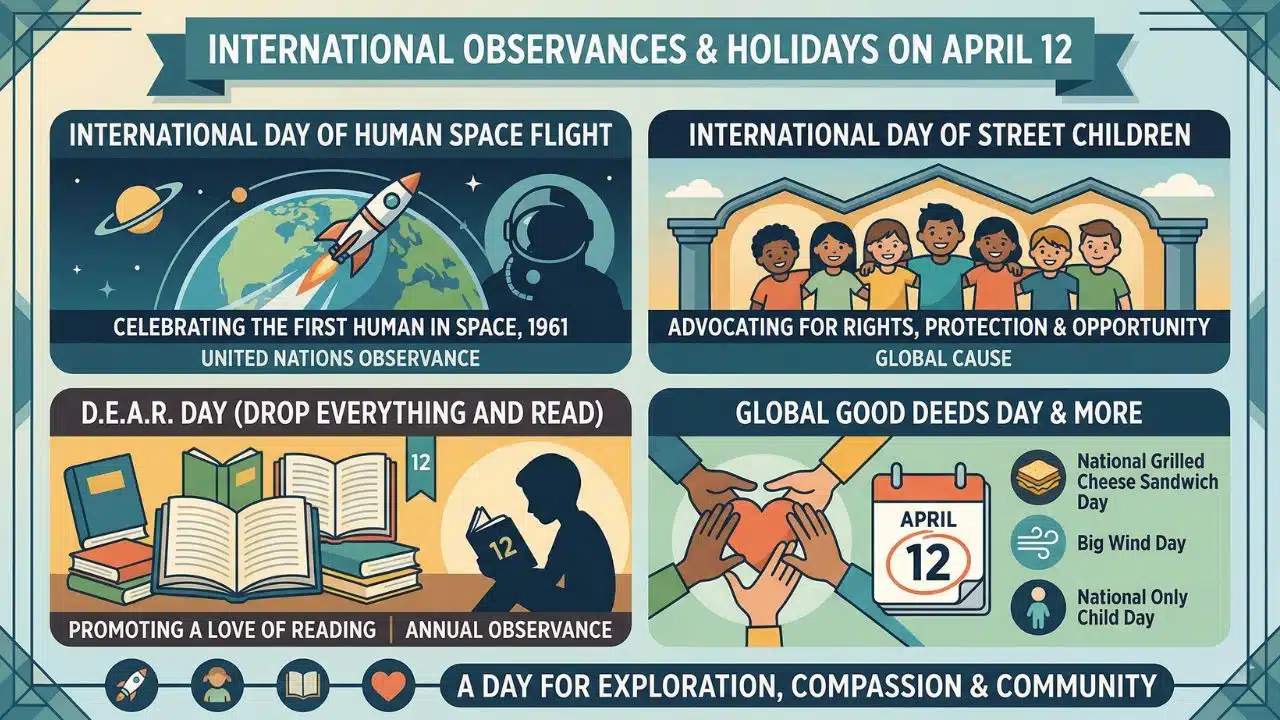
Around the globe, April 12 is a day reserved for recognizing monumental human courage, advocating for the vulnerable, and preparing for spiritual and cultural renewal.
-
International Day of Human Space Flight: Declared by the United Nations General Assembly in 2011, this global observance celebrates the anniversary of Yuri Gagarin’s pioneering journey. It serves to reaffirm the vital contribution of space science and technology in achieving peaceful, sustainable development goals for all of humanity.
-
Cosmonautics Day (Russia): While the UN observes spaceflight globally, Russia holds a specific, deeply patriotic holiday to honor their homegrown hero, Gagarin, and the continued achievements of the Russian space program.
-
Halifax Resolves Day (United States – North Carolina): This localized but historically massive holiday commemorates April 12, 1776, when North Carolina became the very first American colony to officially authorize its delegates to the Continental Congress to vote for full independence from Great Britain.
-
Children’s Day (Bolivia): In Bolivia, this day is dedicated entirely to the youth. It is a day of vibrant celebration, but also a crucial day of national advocacy, focusing attention on the educational, medical, and emotional welfare of children across the country.
-
Eve of Chaitra Sankranti / Boisabi Preparations: In the Bangalee calendar, April 12 often falls on the final days leading up to Pohela Boishakh (the Bengali New Year). In the Chittagong Hill Tracts of Bangladesh, it is a bustling day of preparation for the Boisabi festival, a deeply vibrant celebration that unites the Tripura, Marma, and Chakma ethnic communities in shared cultural joy and water-throwing festivities.
If you thought you knew everything there was to know about April 12, the historical archives still have a few bizarre secrets waiting to be uncovered.
Notable Births: Legends Born on April 12
The maternity wards of April 12 have given us groundbreaking historians, literary giants, talk-show revolutionaries, and musical prodigies who have shaped global culture.
In the Bangalee sphere, April 12, 1885, marks the birth of Rakhaldas Bandyopadhyay (often known as R.D. Banerji) in Murshidabad, Bengal. As an eminent Indian historian and archaeologist, his life’s work fundamentally shifted our understanding of human civilization. In 1922, while working for the Archaeological Survey of India, Bandyopadhyay discovered the ancient ruins of Mohenjo-Daro. His meticulous excavations unearthed the Indus Valley Civilization, proving beyond a doubt that the Indian subcontinent possessed an advanced, highly sophisticated urban culture that rivaled, and in some ways surpassed, ancient Egypt and Mesopotamia. His birth on this day gave the world a man who quite literally dug up a forgotten past.
In the realm of modern entertainment and literature, the date is equally prolific. In 1947, the United States welcomed two cultural titans on the exact same day: bestselling author Tom Clancy and legendary television host David Letterman. Clancy would go on to define the modern military-techno thriller genre. With incredibly detailed, technically accurate novels like The Hunt for Red October and Patriot Games, he permanently influenced how modern espionage fiction is written and consumed. Letterman, on the other hand, revolutionized late-night television. Armed with his deeply ironic, offbeat, and often self-deprecating humor, Letterman deconstructed the traditional, polished talk show format. He influenced an entire subsequent generation of comedians, proving that late-night TV could be unpredictable and weirdly brilliant.
The musical world also celebrates the birth of Herbie Hancock in 1940. A true titan of jazz, Hancock’s innovative use of electronic synthesizers and his bold willingness to blend funk, soul, and pop with traditional jazz created groundbreaking soundscapes. His masterpieces, such as “Watermelon Man” and the album Head Hunters, earned him an astonishing 14 Grammy Awards and an Academy Award, solidifying his status as a musical pioneer.
For a quick reference of the brilliant minds who share this birthday across different eras, consult the comprehensive table below.
Famous Birthdays at a Glance
| Year | Name | Nationality | Claim to Fame |
| 1577 | Christian IV | Danish | King of Denmark and Norway whose 59-year reign heavily influenced Scandinavian politics. |
| 1724 | Lyman Hall | American | Founding Father and a signer of the United States Declaration of Independence. |
| 1885 | Rakhaldas Bandyopadhyay | Indian (Bengali) | Brilliant archaeologist who famously discovered the ancient city of Mohenjo-Daro. |
| 1917 | Vinoo Mankad | Indian | Legendary cricket all-rounder who famously opened both the batting and bowling for India. |
| 1940 | Herbie Hancock | American | Pioneering jazz pianist and composer known for breaking genre boundaries. |
| 1946 | Ed O’Neill | American | Beloved television actor best known for Married… with Children and Modern Family. |
| 1947 | Tom Clancy | American | Bestselling author of complex, highly realistic military and espionage novels. |
| 1947 | David Letterman | American | Iconic, long-running late-night television host and highly influential comedian. |
| 1956 | Andy Garcia | Cuban-American | Acclaimed Hollywood actor known for defining roles in The Godfather Part III and Ocean’s Eleven. |
| 1971 | Shannen Doherty | American | Prominent television actress famous for starring in Beverly Hills, 90210 and Charmed. |
| 1979 | Claire Danes | American | Multi-award-winning actress celebrated for her intense leading role in the series Homeland. |
| 1994 | Saoirse Ronan | Irish-American | Critically acclaimed actress known for Lady Bird, Atonement, and Little Women. |
While we celebrate those who arrived on this day, we must also pause to honor the incredible luminaries who took their final breath on April 12, leaving behind legacies that refuse to fade.
Famous Deaths: Saying Goodbye on April 12
The roster of historical figures who passed away on April 12 includes a deeply impactful American President, a pioneering battlefield nurse, and a dazzling entertainer who moonlighted as a World War II spy.
The most globally impactful death on this date occurred in 1945, with the sudden passing of Franklin D. Roosevelt, the 32nd President of the United States. Having guided America through the darkest, most desperate days of the Great Depression with his sweeping New Deal policies, and having led the Allied forces to the very brink of victory in World War II, FDR’s body finally gave out. He suffered a massive cerebral hemorrhage while sitting for a portrait in Warm Springs, Georgia. His death sent profound shockwaves of grief across a war-torn world and thrust a relatively unprepared Vice President Harry S. Truman into the Oval Office just weeks before the final surrender of Nazi Germany.
Decades earlier, in 1912, the world lost Clara Barton at the age of 90. Known as the “Angel of the Battlefield” for her fearless, frontline nursing during the horrific American Civil War, Barton’s greatest legacy was the founding of the American Red Cross. Her relentless, stubborn advocacy ensured that disaster relief and medical aid would become structured, permanent fixtures of modern society, saving countless millions of lives in the century following her death.
In 1975, the world bid farewell to Josephine Baker. Born in poverty in the United States, she moved to France and became one of the most celebrated dancers and entertainers in Europe during the Roaring Twenties. However, Baker was far more than a dazzling stage performer. During World War II, she served as a highly decorated spy for the French Resistance, smuggling highly classified military intelligence written in invisible ink on her sheet music past Nazi checkpoints. Later in life, she returned to the US to fiercely advocate for the Civil Rights Movement, famously becoming the only woman to speak at the 1963 March on Washington alongside Dr. Martin Luther King Jr.
The boxing world also mourns deeply on this day, having lost two of its greatest titans. Joe Louis, the legendary heavyweight champion who defended his title a staggering 25 times and became a national hero for defeating Max Schmeling, passed away in 1981. Just eight years later, in 1989, Sugar Ray Robinson, widely considered the greatest pound-for-pound boxer in the history of the sport, also died on April 12.
To pay respects to those who left their indelible mark and departed on this day, please review the memorial table below.
Notable Departures at a Glance
| Year | Name | Nationality | Legacy Left Behind |
| 1555 | Queen Joanna of Castile | Spanish | Known historically as “Joanna the Mad,” she was the nominal queen of Castile from 1504. |
| 1878 | William M. Tweed | American | Infamous “Boss Tweed,” the corrupt political machine leader of New York’s Tammany Hall. |
| 1912 | Clara Barton | American | Visionary battlefield nurse and the dedicated founder of the American Red Cross organization. |
| 1945 | Franklin D. Roosevelt | American | 32nd U.S. President who navigated the nation through the Great Depression and WWII. |
| 1975 | Josephine Baker | American-French | World-famous entertainer, decorated WWII resistance spy, and fierce civil rights activist. |
| 1981 | Joe Louis | American | Legendary heavyweight boxing champion and an early, vital African American cultural hero. |
| 1989 | Sugar Ray Robinson | American | Widely considered one of the greatest and most fluidly talented boxers in history. |
| 2020 | Stirling Moss | British | Formula One legend, widely regarded as the greatest driver never to win the World Championship. |
| 2022 | Gilbert Gottfried | American | Distinctive stand-up comedian and voice actor known for his uniquely shrill, grating persona. |
Beyond births and deaths, April 12 is also a day marked by several nations and international bodies for specific observances and festivals that bring communities together.
“Did You Know?” Fascinating April 12 Trivia
Historical narratives are often woven with bizarre, serendipitous, and highly unusual footnotes. Here are a few lesser-known facts about this day that highlight the strange and wonderful nature of human history.
- The President’s Unfinished Portrait: When President Franklin D. Roosevelt suffered his fatal stroke on April 12, 1945, he was in the middle of sitting for a watercolor portrait painted by artist Elizabeth Shoumatoff. Due to his sudden collapse, the painting was never completed. Known today simply as the “Unfinished Portrait,” it remains entirely blank on the right side. It is currently displayed at FDR’s Little White House Historic Site in Georgia, serving as a haunting, literal representation of a life, and a monumental presidency, cut short.
- The Bill Clinton Contempt Citation: The messy political drama of the 1990s reached a unique legal milestone on April 12, 1999. President Bill Clinton became the first sitting U.S. President in history to be cited for contempt of court. Federal Judge Susan Webber Wright issued the citation, ruling that Clinton had given “intentionally false” testimony under oath regarding his relationship with Monica Lewinsky during a sexual harassment lawsuit filed by Paula Jones.
- An Oscar Clean Sweep: The Academy Awards are notoriously competitive, making sweeps incredibly rare. Yet, on April 12, 1988, director Bernardo Bertolucci’s epic biographical drama, The Last Emperor, managed a flawless cinematic victory. Out of the nine categories it was nominated for—including Best Picture, Best Director, and Best Original Score—the film won all nine. It was a breathtaking achievement that beautifully celebrated the opulent, tragic story of Puyi, the final sovereign of the Qing dynasty in China.
Final Thoughts
As we close the history books on April 12, it is impossible not to be deeply moved by the sheer scale of human experience encapsulated in a single 24-hour cycle. From the righteous closure delivered in Dhaka for the assassination of a nation’s founder, to the roaring jet engines designed by Sir Frank Whittle; from the deafening cannons of Fort Sumter tearing a country apart to the silent, weightless awe of Yuri Gagarin floating above the Earth—today is a day of incredible extremes.
It is a date that reminds us that human progress is rarely linear. It is punctuated by devastating wars, political purges, and miraculous medical vaccines. We lose great, guiding leaders like FDR, and on the same day, new, brilliant minds like Tom Clancy and David Letterman enter the world to redefine our culture and how we tell stories. As we navigate our own April 12 today, we carry the weight and the wonder of all these historical ghosts with us, knowing with absolute certainty that the actions we take right now are actively writing the history of tomorrow.