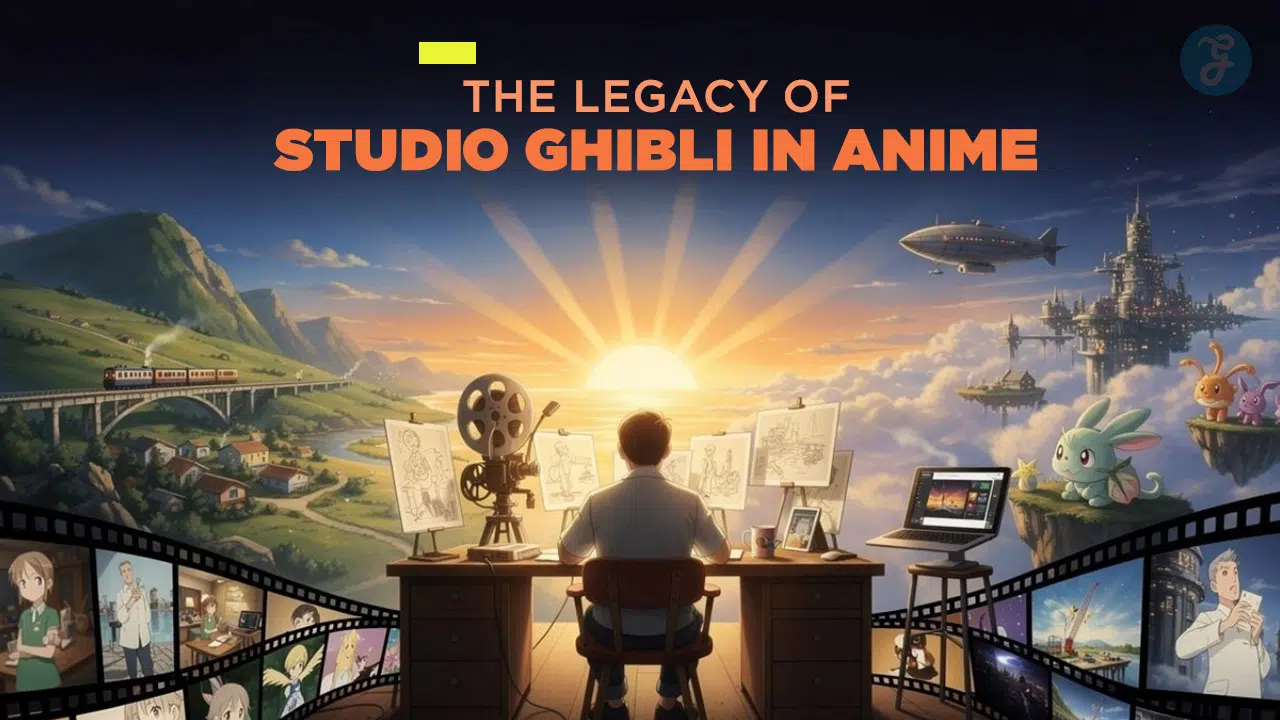
Have you ever watched an animated movie and felt like the world on screen was more real than the one outside your window? Maybe it was the way a simple meal looked delicious enough to eat, or how a quiet moment of wind blowing through grass made you hold your breath. You aren’t alone; millions of fans feel that same specific magic, but few know exactly where it comes from.
Studio Ghibli didn’t just make cartoons; they fundamentally changed how we tell stories. With the 2024 Oscar win for The Boy and the Heron, they proved that their hand-drawn heart still beats strong in a digital world.
The Birth of Studio Ghibli
It all started with two artists who shared big dreams and a love for stories. Their small studio faced rough waters, yet they pushed forward, shaping a new path in animation.
Founding by Hayao Miyazaki, Isao Takahata, and Toshio Suzuki
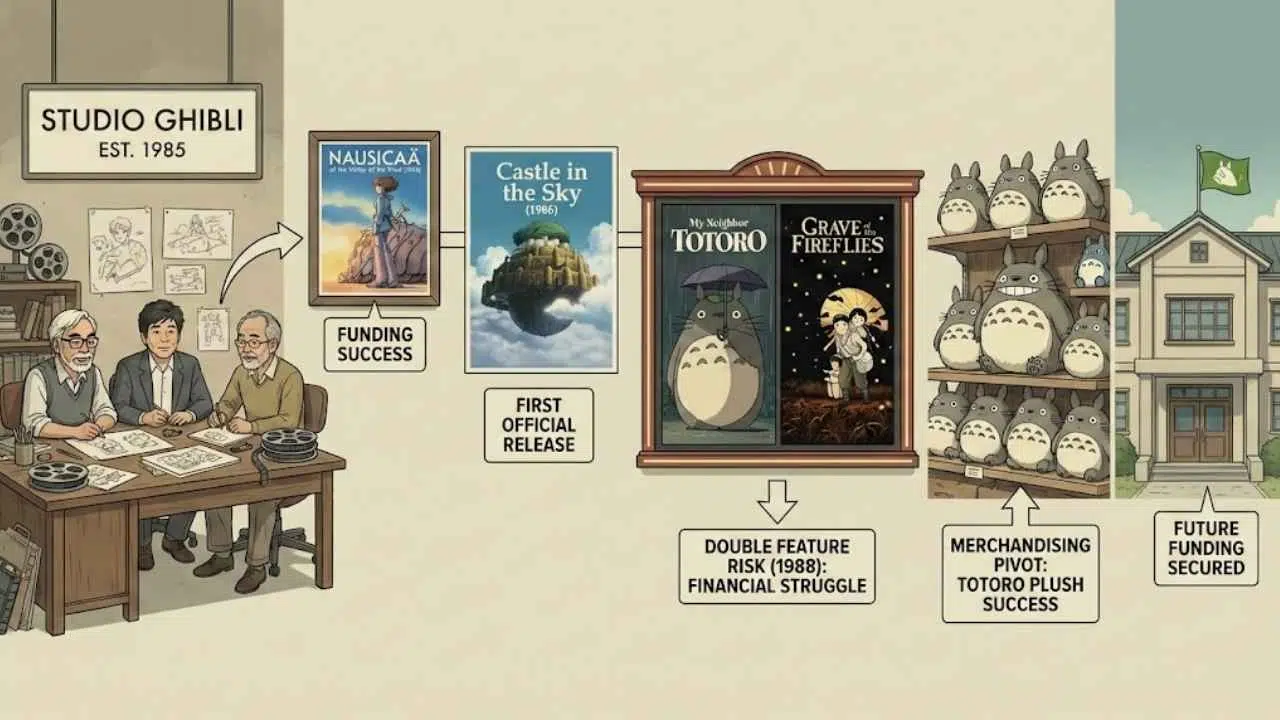
Hayao Miyazaki and Isao Takahata started Studio Ghibli in 1985, but they didn’t do it alone. Their producer, Toshio Suzuki, was the business mastermind who made their wild artistic visions possible. While Miyazaki and Takahata focused on the art, Suzuki fought the financial battles.
Both directors had worked together on Nausicaä of the Valley of the Wind (1984). While often mistaken for a Ghibli film, Nausicaä was actually the success that allowed them to fund the studio’s creation. Their first official studio release was Castle in the Sky in 1986.
They faced a massive gamble early on that almost bankrupted them.
The “Double Feature” Risk
In 1988, the studio made a decision that sounds crazy today. They released two films on the same day as a double feature: the gentle, cuddly My Neighbor Totoro and the devastatingly sad war tragedy Grave of the Fireflies.
Financially, it was a disaster. Audiences were confused by the tonal whiplash, and box office numbers were low. But this failure led to a brilliant pivot. Suzuki realized that while the movie tickets weren’t selling, people loved the character designs.
“To save the studio, they started selling Totoro plush toys. These stuffed animals became a massive hit, funding the studio’s future projects and allowing them to keep making high-art films without compromising.”
How Studio Ghibli Redefined Anime
Studio Ghibli shook up anime by making each frame feel alive and full of feeling. Their stories touch the heart, sparking wonder while showing life’s ups and downs in bold color.
The “Ma” Technique (The Art of Emptiness)
One of the biggest secrets to Ghibli’s emotional impact is a Japanese concept called “Ma” (emptiness). In Western animation, something is always moving or someone is always talking to keep your attention. Miyazaki does the opposite.
He intentionally inserts quiet pauses—a character staring at a stream, a cloud drifting by, or someone simply sighing. As Miyazaki once explained, if you clap your hands, the time between the claps is “Ma.” It gives you a moment to breathe and feel the scene, making the action that follows much more powerful.
The “Yasuda Color” Palette
The vibrant, specific look of these films comes largely from Michiyo Yasuda, the studio’s legendary color designer. She didn’t just pick colors; she used them to tell the story.
For Ponyo, she used a specific pastel palette to mimic children’s crayon drawings. In Spirited Away, she used deep reds and shadows to create the bathhouse’s mysterious atmosphere. Her insistence on using specific, hand-mixed paints rather than standard digital colors is why older Ghibli films have a warmth that modern digital anime often lacks.
Comparison: Western vs. Ghibli Storytelling
To understand why these films feel different, look at how they handle their heroes and villains compared to traditional Hollywood animation.
| Feature | Traditional Western Animation | Studio Ghibli Style |
|---|---|---|
| Villains | Clear “bad guys” with evil plans (e.g., Jafar, Scar) | Complex antagonists who believe they are right (e.g., Lady Eboshi) |
| Pacing | Fast, joke-heavy, constant movement | Uses “Ma” (quiet pauses) to let scenes breathe |
| Conflict | Good vs. Evil battles | Man vs. Nature or Internal Self-Growth |
The Global Impact of Studio Ghibli
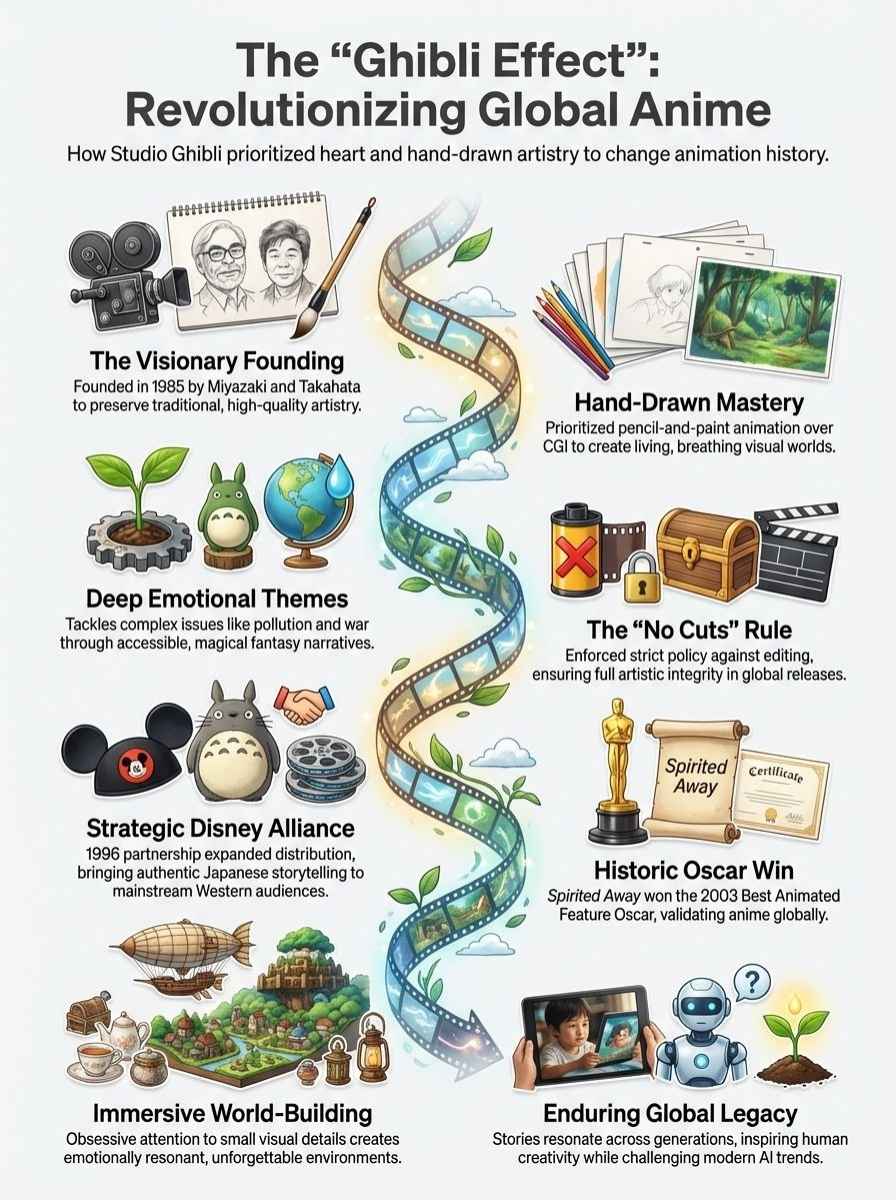
Ghibli films crossed borders and won hearts from Tokyo to Texas. Their touch changed how people everywhere see anime, sparking fresh ideas for artists around the globe.
Disney Partnership and International Recognition
In 1996, Disney signed a deal to distribute Ghibli films internationally. This was huge because it put movies like Kiki’s Delivery Service and Princess Mononoke into Blockbuster video stores across America. Disney provided high-quality English dubs using famous actors, making the stories accessible to people who wouldn’t normally watch subtitled anime.
Two Oscars, Two Decades Apart
Most fans know that Spirited Away won the Academy Award for Best Animated Feature in 2003, putting Japanese animation on the map. But the studio proved it wasn’t a one-hit wonder.
In 2024, The Boy and the Heron won the studio’s second Oscar in the same category. This win was historic for two reasons:
- It made Hayao Miyazaki the oldest winner of the award at age 83.
- It was the first PG-13 rated animated film to ever win the category, proving that animation is a medium for mature storytelling, not just a “children’s genre.”
The Legacy of Nausicaä of the Valley of the Wind
Nausicaä of the Valley of the Wind sparked a new era for anime, and there’s much more to its story if you keep reading.
The “Warriors of the Wind” Disaster
Before Ghibli was a household name, Nausicaä was released in the US under the title Warriors of the Wind. The American distributors butchered it. They cut over 20 minutes of the film to “speed it up,” removed the environmental themes, and changed the character names.
Miyazaki was horrified. He felt his work had been disrespected and ruined. This experience led to one of the most famous policies in film history.
The “No Cuts” Policy and the Katana Sword
Years later, when Harvey Weinstein (then head of Miramax) wanted to release Princess Mononoke in the US, he demanded severe edits to shorten the runtime. Studio Ghibli refused.
To make the message clear, producer Toshio Suzuki sent a package to Weinstein’s office in New York. Inside was a genuine samurai katana sword with a simple note attached to the blade:
“No cuts.”
The message was received. Princess Mononoke was released in its full, unedited glory, establishing a standard that artists should never have to compromise their vision for foreign markets.
The Distinctive Ghibli Style
Ghibli’s style pops with bright colors, rich worlds, and characters you can’t forget—keep reading to see why their look stands out like a fox in a henhouse.
The “Ghibli Food” Phenomenon
You can’t talk about Ghibli style without talking about the food. Whether it’s the sizzling bacon and eggs in. Howl’s Moving Castle or the giant onigiri in Spirited Away, the food always looks better than real life. This is intentional; the animators focus on the texture and weight of the food to evoke a sensory memory, making you feel the comfort of the meal along with the characters.
Attention to Detail in Animation
Hayao Miyazaki, Isao Takahata, and their team spend years perfecting every frame. They use a technique called “full animation” for background elements that most studios ignore. In My Neighbor Totoro, each blade of grass was individually hand-painted to move differently in the wind.
Background artist Kazuo Oga is the genius behind these lush environments. His ability to paint light filtering through trees (a distinct style now often copied) gives the films their dreamlike, yet grounded, quality.
The Cultural Significance of Studio Ghibli
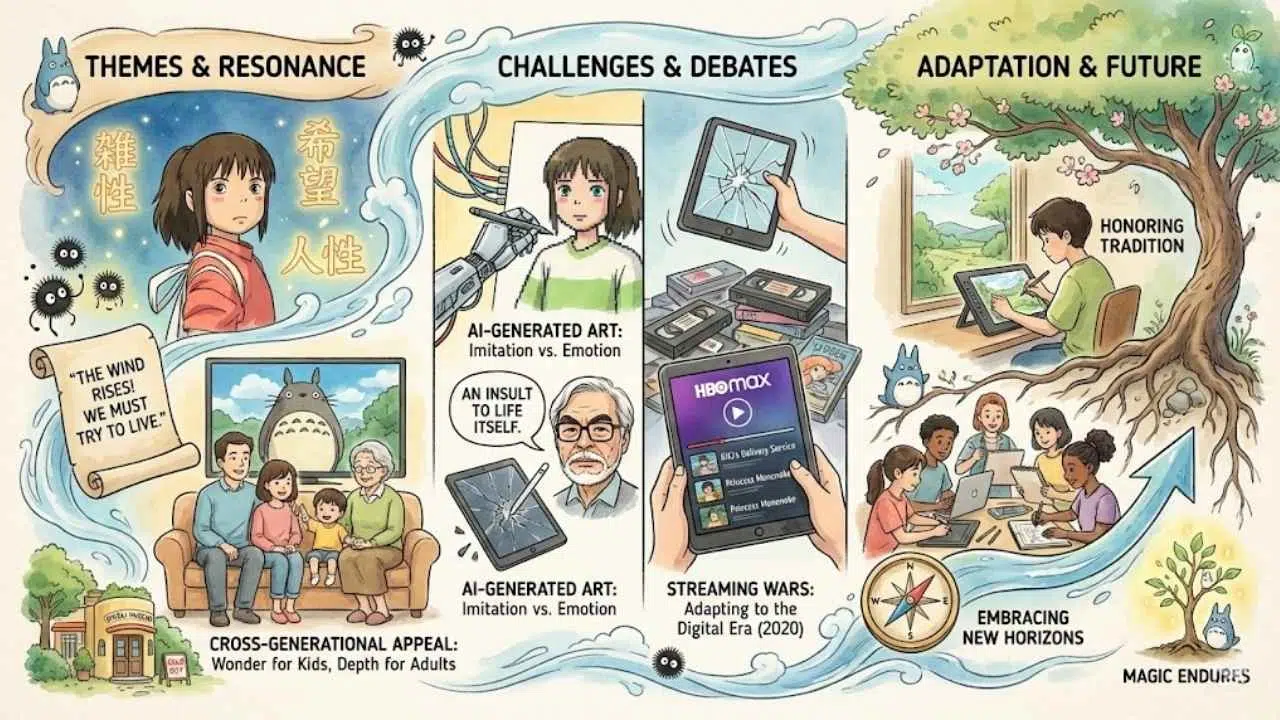
Studio Ghibli’s stories touch hearts, spark hope, and stick with people of all ages—keep reading to find out what makes their magic last.
Themes of Resilience, Hope, and Humanity
Chihiro in Spirited Away keeps pushing forward, even when the world around her turns upside down. She shows heart and courage, finding hope even in shadowy places. Ghibli heroes like Nausicaä fight to heal broken lands instead of giving up.
These films teach us that strength isn’t about physical power; it’s about endurance. In The Wind Rises, the characters live by the line, “The wind rises! We must try to live.” It’s a philosophy that resonates deeply in a world often filled with uncertainty.
Why Ghibli Resonates Across Generations
Studio Ghibli brings families together. Kids find wonder in giant cats and flying castles, while adults notice deep themes about loss and environmental destruction. Because the studio treats its audience with intelligence, you never “age out” of a Ghibli movie.
This cross-generational appeal is physically real at the Ghibli Museum in Tokyo and the new Ghibli Park in Aichi. Tickets for these locations often sell out within minutes of release, proving that people don’t just want to watch these worlds; they want to step inside them.
Challenges and Controversies
Even the brightest studios face rough skies, and Ghibli’s journey has sparked debate on translation blunders and new tech in animation—curious about the drama? Keep reading!
The Debate on AI-Generated Art
In recent years, fans have debated the rise of AI tools that can mimic the “Ghibli style” in seconds. While some see it as a harmless tribute, the studio’s leadership has been famously opposed to artificial shortcuts.
In a 2016 documentary, a team of engineers presented an AI-generated animation to Hayao Miyazaki. The AI created a grotesque, zombie-like creature that moved by dragging its body. Miyazaki was not impressed. He critiqued it harshly, saying the movement reminded him of a disabled friend who struggled with pain every day.
“I strongly feel that this is an insult to life itself.”
His point was clear: art requires human experience, empathy, and pain. A machine can copy a visual style, but it cannot understand the feeling behind the movement.
Streaming Wars
For decades, Ghibli refused to put their movies on streaming services, believing they should only be seen in theaters or on physical media. They finally adapted to the modern era in 2020, signing a massive deal with HBO Max (now Max) for exclusive US streaming rights. This move introduced their entire catalog to a new generation of Americans who had never stepped foot in a Blockbuster.
Final Thoughts
From humble beginnings and financial failures, Studio Ghibli grew into a powerhouse of animation. They showed us that a simple hand-drawn line can carry more emotion than a million computer pixels. Their legacy is built on the belief that we should respect nature, find magic in the quiet moments, and never compromise our vision.
Have you ever wondered how your own ideas could change the world? If these stories inspire you, don’t just watch them—learn from them. Try exploring the “Art of Ghibli” books to see their process, or just take a moment today to sit quietly and observe the world like a Miyazaki character.
Every small effort adds to something grand. I still recall the first time I watched Totoro under a blanket fort; it felt like magic was possible everywhere. Go find yours.