I remember when I first heard a founder say that they did not need to raise money because their customers were already paying them. This really made me think about what a startup booted fundraising strategy is about. Of looking for venture capital from the start founders use their own money, early revenue and funding that does not dilute their ownership to grow their business slowly and carefully. For startups that offer software as a service and tech startups this approach is a practical way to deal with high valuations long fundraising cycles and the pressure that comes with external capital.
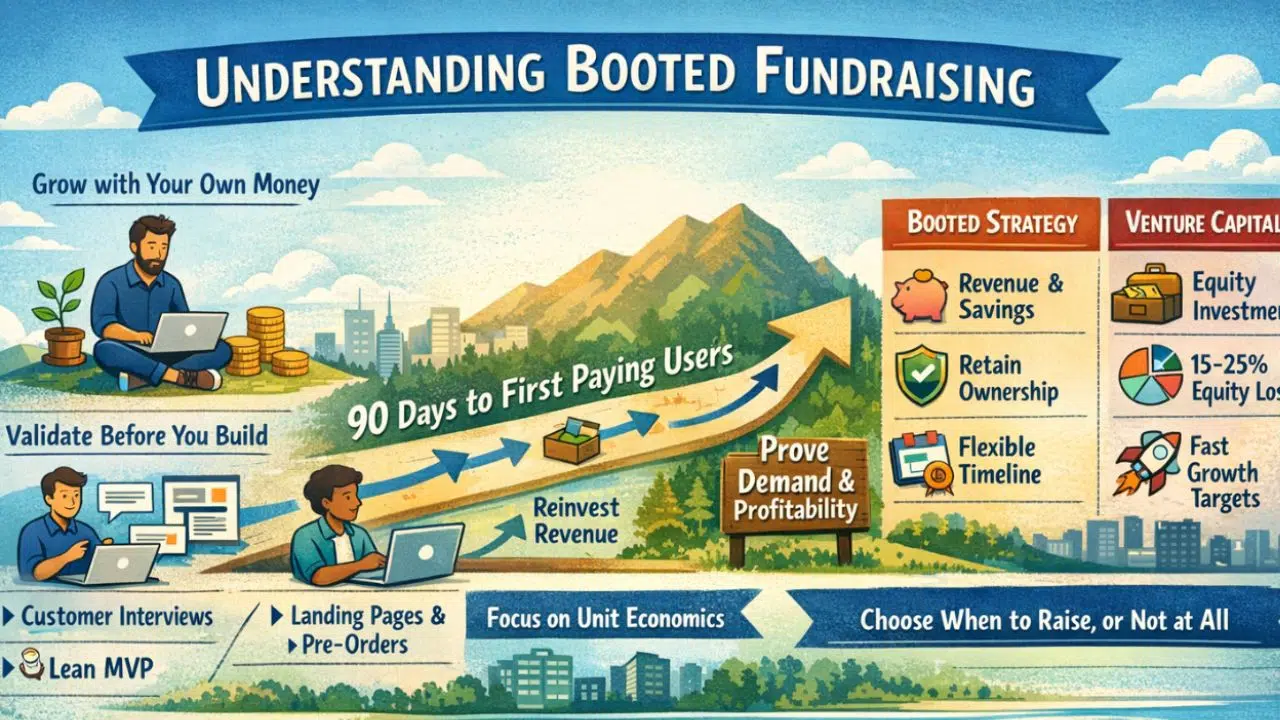
In the hundred days of using a booted strategy the goal is not to grow as fast as possible. It is to prove that there are customers that a problem is being solved and that people are willing to pay for it. I have seen that this model really works for founders who want to be in control of their business and its pace in high-margin software businesses where being efficient with capital is more important than just being fast.
A startup booted fundraising strategy combines traditional bootstrapping with ways of validating business ideas. Founders talk to customers launch versions of their products and put revenue back into the product. This creates a loop where growth is earned not bought. It also changes the way risk is seen. Of betting everything on a pitch to investors founders bet on executing their plan and building trust with customers.
As venture capital becomes more selective this approach is no longer seen as unusual. It is an often better way to build sustainable companies that can later choose to raise funding from a position of strength or never raise funding at all.
Understanding the Core Concept of Booted Fundraising
I often describe a booted fundraising strategy as a revenue- discipline. Founders use their savings, small grants and early customer payments to fund their operations. Because capital comes from operations and not from giving up ownership equity is preserved. This model forces founders to be clear about their pricing and value from the start.
Unlike bootstrapping modern booted strategies use digital tools to validate ideas faster. Tools like landing pages, pre-orders and paid pilots replace development cycles. The focus is on unit economics before growth metrics. If customer acquisition costs cannot be recovered quickly the model fails early which is a thing because it helps founders avoid wasting time and money.
This discipline is especially good for SaaS businesses. Software margins allow small teams to become profitable faster than hardware or biotech startups. In these environments booted fundraising aligns the interests of founders and customers from the beginning.
Validating Demand Before Building
I have seen many startups fail because they built something before listening to their customers. In a booted fundraising strategy validation is the big milestone. Founders do twenty or more customer interviews, not to sell, but to understand the customers pain points. What matters most is seeing patterns not just hearing opinions.
These conversations reveal what users already pay for and what frustrates them enough to switch. The strongest signals come from existing budgets. If a customer is already spending money to solve a problem that problem is real. Validation often includes pre-orders or letters of intent which create accountability on both sides.
Launching a Lean MVP in 90 Days
Once demand is clear it is time to start executing. A lean MVP focuses on one core job to be done. I have seen founders limit themselves to one or two features and resist the urge to impress. The goal is to get ten to twenty paying users within ninety days.
No-code tools, concierge services and manual workflows are common. Automation comes later. What matters most is whether users come back and pay again. Early revenue is put directly back into improving the product or acquiring customers.
Reinvesting Revenue to Create Momentum
Revenue in a booted startup is like oxygen. Of just sitting there it is put back into what works. I often see founders put their earnings into customer acquisition channels that show payback within six months. Anything that takes longer is questioned.
This reinvestment loop creates growth that builds on itself. Each dollar earned funds the experiment. Over time this builds resilience. The company can survive changes in the market because it understands its economics very well.
Booted Strategy Versus Traditional Venture Capital
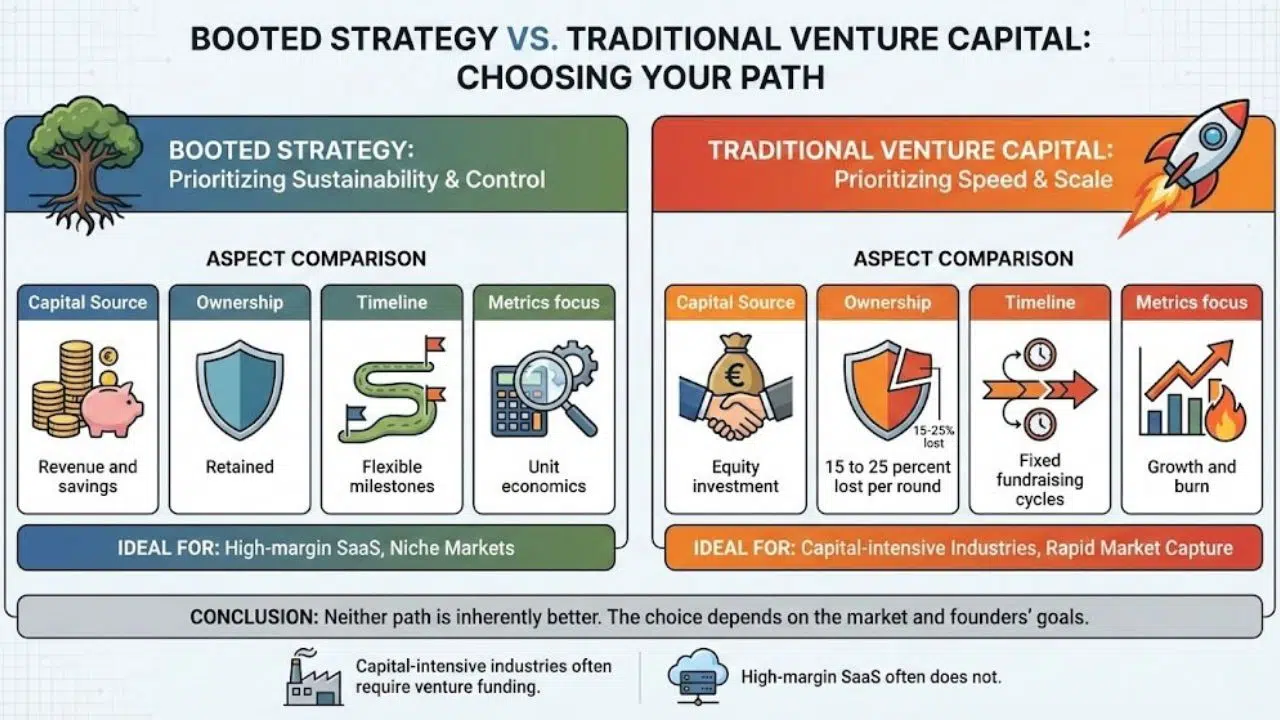
The difference between booted fundraising and venture capital is clear. Venture capital prioritizes speed and scale at the expense of profitability. Booted strategies prioritize sustainability and control.
Aspect Comparison
- Booted Strategy: Capital source = Revenue and savings
- VC Path: Capital source = Equity investment
- Booted Strategy: Ownership = Retained
- VC Path: Ownership = 15 to 25 percent lost per round
- Booted Strategy: Timeline = Flexible milestones
- VC Path: Timeline = Fixed fundraising cycles
- Booted Strategy: Metrics focus = Unit economics
- VC Path: Metrics focus = Growth and burn
Neither path is inherently better. The choice depends on the market and the founders goals. Capital-intensive industries often require venture funding. High-margin SaaS often does not.
The Psychological Trade-Offs for Founders
Beyond finances the emotional experience is different. Bootstrapped founders take on personal risk, especially early on. Their savings and time are on the line.. They avoid the pressure of external expectations.
Venture-backed founders share risk. Accept accountability. Board meetings, growth targets and dilution can erode autonomy. For some that structure is motivating. For others it is constraining.
I have noticed that booted founders often report a connection to their customers. Because survival depends on them feedback is taken seriously. This can create company cultures.
Real-World Proof From Bootstrapped Giants
There are examples of successful bootstrapped companies. Basecamp began in 1999 as a side project within a web design firm. Its founders focused on simplicity and profitability avoiding venture capital entirely. Today it remains profitable and influential.
Mailchimp launched in 2001 as a side project. By prioritizing businesses and affordable pricing it grew to over twelve million users. In 2021 Intuit acquired it for twelve billion dollars.
Atlassian started in Sydney in 2002 selling developer tools like Jira. It bootstrapped for years reaching scale before any secondary funding.
These stories show that external capital is not necessary for success.
MVP Validation as Risk Management
Validating an MVP is not about making it perfect. It is about getting evidence. Booted founders define success metrics before launch as twenty percent signup conversion or thirty-day retention above ten percent.
Tools like Stripe payment links allow founders to test willingness to pay before building. This reduces the risk of sunk costs.
Startup investor Naval Ravikant has said that leverage comes from code, media and capital. Bootstrapped founders lean heavily on code and media first adding capital only if necessary.
Metrics That Matter in a Booted Model
Metrics guide decisions. What matters is cash flow and retention.
- Signup conversion: 20 percent or more — Demand signal
- Retention D30: 10 to 30 percent — Product value
- NPS score: 40 or higher — Satisfaction
- CAC payback: Under 6 months — Sustainability
When these numbers work growth becomes optional than desperate. When they fail founders pivot early.
When Venture Capital Becomes the Right Next Step
Booted fundraising does not reject venture capital outright. It delays it. When a startup reaches unit economics and clear demand venture funding can accelerate growth without dictating survival.
At this stage founders negotiate from strength. Valuations improve. Dilution decreases. Capital is used to expand, not to find a business model.
Takeaways
- Booted fundraising prioritizes revenue over investment.
- Early customer validation reduces risk.
- SaaS startups benefit due to high margins.
- Ownership and control remain with founders longer.
- Venture capital becomes optional not necessary.
- Discipline replaces hype as the growth engine.
I see the startup booted fundraising strategy as a correction in an industry long obsessed with speed. It asks founders to earn growth than borrow it. By focusing on customers this approach aligns incentives, in a way venture capital often cannot.
Booted startups grow with scars. Those scars teach resilience. They understand their numbers, respect cash flow and listen closely to users. When they succeed it is not because money arrived early. Because value did.
In a world where money’s easy to find but people do not trust each other it might be a good idea to let customers pay for the things you need to do.
FAQs
What is a startup bootstrapping plan?
It is a way for companies to grow by using the money they make and what the founders have of getting money from investors right away.
Is bootstrapping for companies that make software?
No,. It works really well for companies that make a lot of money from each sale like software companies and businesses that sell to other businesses.
Can a company that uses bootstrapping get money from investors?
Yes. A lot of companies do this after they have shown that people want their product and that they can make money from it.
What are the biggest problems, with bootstrapping?
You might not have money your company might not grow as fast and you might have to spend your own money.
How long should the people who start a company use bootstrapping before they try to get money?
They should do it until they can see that people really want what they are selling and that they have a chance to grow their company.