Freelancers, self-employed folks, and remote workers often hit a wall with visa headaches. You might want to live in Spain or Italy, but the rules can feel confusing and stressful. How can you keep working for your clients while enjoying life in Europe? It’s tough trying to figure out which permits fit your work style.
Here’s some good news: Both Spain and Italy now offer special visas just for freelancers and digital nomads. These visas make it possible for you to legally live, work, and pay taxes in these sunny countries.
This guide will break down everything you need, from income details to application tips, to help make things simple. Want an easier way through Spanish or Italian red tape?
Below are the exact steps that have worked for others. Grab a coffee and follow along step by step.
What is a Freelancer Visa?

A freelancer visa gives remote workers and self-employed professionals official permission to live and work in another country. Spain and Italy now offer these visas for digital nomads, freelancers, and those who want to run their own businesses.
Think of it as your golden ticket to bypass the strict “90 days out of 180” rule that limits most tourists in the Schengen Area. With this visa, you become a legal resident rather than just a visitor.
You need to show stable income, such as the minimum required for Spain’s Digital Nomad Visa or Italy’s new program. Both countries require you to pay local tax on your earnings, and the application process usually happens through the Consulate or Immigration Office.
This permit allows you to stay long-term while working with clients from different places. Families can sometimes join you under this type of visa too, making it a viable option for a full lifestyle change.
Why Choose Spain or Italy for Freelancing?

Spain and Italy both draw people from all over the globe, each for their own magic. Many freelancers pack their bags for these countries, chasing freedom, flavor, and a touch of sunshine in their daily grind.
Popularity Among Remote Workers
Remote work fans flock to Italy and Spain. These countries rank high for digital nomads wanting a visa, stable income, and pleasant weather. In 2023, thousands sought the Digital Nomad Visa in both nations.
The Spanish Digital Nomad Visa currently asks for a monthly income of roughly €2,850. Italy’s freelancer visa options open doors for self-employed pros from around the world.
Many freelancers love the chance to live where locals stroll by beaches or sip coffee at piazzas after long video calls. Fast internet is a huge plus here; Spain, for instance, has one of the most extensive fiber optic networks in Europe, with providers like Movistar and Digi offering 1Gbps speeds even in smaller towns.
Cities like Barcelona, Madrid, Rome, and Milan buzz with coworking spaces. Both countries roll out new residency permits that welcome remote professionals into their communities every year.
Cultural and Lifestyle Benefits
Spain and Italy light up your daily life with long lunches, vibrant street festivals, and friendly faces at every corner café. Life feels slower, even as you work on exciting gigs for clients in Madrid or Milan.
Locals value family meals and afternoon breaks, so it’s not all about the grind. Join city parades, try tasty foods like tapas or gelato, or just stroll ancient streets that whisper stories from hundreds of years ago while sending emails.
Both countries welcome digital nomads through special self-employment visas and new Digital Nomad Visa programs rolled out after 2022. Picture working afternoons by a Roman fountain or watching the sunset over Barcelona rooftops after finishing reports.
Public transport runs well, social life buzzes late into the night, and many small towns offer strong internet plus quieter rhythms if cities ever get too busy for comfort.
Overview of the Spain Freelancer Visa
Spain has a clear path for people who want to work for themselves. Find out what you need to live and freelance in sunny Spain, with the right paperwork at your side.
Key Eligibility Criteria (Spain)
To get the Spain Freelancer Visa, applicants must meet strict rules. The authorities want to confirm you can support yourself and follow Spanish immigration laws.
- Income Threshold: You need proof of consistent monthly income. For the Digital Nomad Visa in 2026, this is tied to 200% of the Minimum Interprofessional Salary (SMI), which comes out to approximately €2,850 per month.
- Contract Duration: A valid work contract or evidence of ongoing remote freelance projects must be presented. This shows you have actual clients or steady self-employment for at least three months prior to applying.
- Education or Experience: Proof of higher education or three years’ relevant work experience in your field is required. Diplomas, transcripts, or official letters from previous employers all help.
- Tax Commitment: Personal income tax payments are necessary while living in Spain. You’ll likely interact with the “Agencia Tributaria” often.
- Health Coverage: Private health insurance from a provider recognized in Spain (like Sanitas or Adeslas) is needed. The policy should cover your entire stay with no copays.
- Background Check: A clean criminal record certificate from your home country and any country lived in during the last five years is mandatory. This must be “Apostilled” (an international form of notarization) to be valid.
- Passport: Valid passport with at least one year of validity left must be shown before applying.
- Business Plan: A detailed business plan outlining your freelance activity helps show intent, market research, and projected earnings to the Immigration Office.
- Accommodation: Proof of a place to stay in Spain must also be provided; rental agreements or property deeds are accepted as evidence.
- Fees: Payment of visa application fees completes the requirements list for submission.
Required Documents (Spain)
Getting a Spain Freelancer Visa calls for clear paperwork. Each paper proves you meet the visa requirements as a remote worker or self-employed professional.
- Valid passport, with at least one year on it before expiry, and copies of every page.
- Passport-sized photos, usually two, recent and showing your full face.
- Completed visa application form, filled out in Spanish with no errors.
- Proof of enough income, showing around €2,850 per month for Spain’s Digital Nomad Visa option; bank statements or work contracts count.
- Health insurance covering medical care in Spain through private plans accepted by Spanish authorities.
- Clean criminal record certificate from your country and any country lived in during the last five years; must be issued within three months before applying.
- Proof of address for where you will live in Spain; this can be a rental agreement or letter from a property owner.
- Business plan describing how you will freelance or do remote work in Spain; name clients if possible and explain services offered.
- Tax registration documents proving you’ll pay personal income tax in Spain.
- Professional qualifications or degrees related to your line of freelancing; show proof of skills with certificates or diplomas if needed.
- Work authorization for remote employment if employed by a foreign company; include contracts confirming legal working status outside Spain if required.
Each document supports your shot at living and freelancing under Spanish law as an expat or digital nomad seeking residency and work authorization rights.
Application Process (Spain)
Spain makes it simple for self-employed people and remote workers to apply for a Freelancer Visa. Here are the main steps so you can start working in Spain.
- Check if you meet all visa requirements, such as the income threshold and proof of health insurance.
- Prepare key documents like your completed application form, valid passport, proof of qualifications, and that Apostilled criminal record.
- Collect evidence showing you can support yourself financially; bank records or signed contracts with clients work well.
- Write a simple business plan that explains your freelance activities; Spanish authorities want to see how you plan to succeed.
- File your visa application at the nearest Spanish Consulate in your home country. Alternatively, if you are already in Spain as a tourist, you can apply directly through the UGE-CE (Unit of Large Companies) online portal for a 3-year permit.
- Pay the required government fee at submission; fees usually range from €60 to €100 depending on your nationality.
- Wait for processing; this takes about 20 business days for the UGE-CE, though Consulates may take two to three months.
- After approval, you’ll need to register your fingerprints for a physical residency card (TIE) at a local police station.
- Start paying personal income tax in Spain; rates vary, but special regimes exist for new residents.
- If needed, bring family members along; Spain’s Freelancer Visa allows family reunification, though you must show extra income (75% of SMI for a spouse).
Overview of the Italy Freelancer Visa
Italy opens its doors to self-employed pros with a welcoming visa, so if you dream of working and sipping espresso in Rome or Milan, keep reading. Your next big move may start here.
Key Eligibility Criteria (Italy)
Italy welcomes self-employed workers and digital nomads. Strong financial proof and a clean record open doors for many.
- Applicants must be at least 18 years old to apply for the Italy Freelancer Visa.
- Proof of relevant professional skills or qualifications is needed, such as university degrees or certificates.
- Evidence of sufficient income is vital; for the new Digital Nomad Visa, you must show annual earnings of roughly €28,000.
- The applicant must not have a criminal record in either Italy or their home country.
- Private health insurance coverage valid in Italy for the duration of the stay is required before submitting the visa application. coverage should be at least €30,000.
- Italian authorities demand a detailed business plan that explains how the applicant will find clients and earn income.
- Registration with an Italian Chamber of Commerce may be necessary for the standard “Lavoro Autonomo” visa, though not always for the Digital Nomad Visa.
- A confirmed place to live in Italy must be shown; this could be a rental contract or an invitation letter from a host.
- All documents requested by immigration offices need to be provided in Italian or translated by a certified translator.
- You must not have been convicted of any crimes within the last 5 years.
These conditions help make sure freelancers contribute positively while enjoying residency permit rights in Italy’s freelance-friendly environment.
Required Documents (Italy)
Getting a freelancer visa for self-employment in Italy means gathering several key documents. Each paper shows you meet the visa requirements set by Italian immigration laws.
- Passport: Valid passport with at least two blank pages and an expiry date no sooner than three months after your planned return.
- Photos: Recent passport-sized photos that follow Schengen visa photo standards.
- Accommodation: Proof of available housing in Italy, such as a rental contract (“contratto di affitto”) registered with the Agency of Revenue.
- Business Plan: A clear plan showing how you will work as a freelancer in Italy’s economy.
- Nulla Osta: For the standard self-employed visa, you often need a “Nulla Osta” (Certificate of No Impediment) from the local Italian police (Questura).
- Qualifications: Proof of professional qualifications or licenses needed for your field.
- Income Proof: Evidence of sufficient income; usually annual earnings above €28,000 for the Digital Nomad path.
- Insurance: Health insurance valid in Italy covering all medical costs during your stay.
- Background Check: Police clearance certificate from every country where you lived during the last five years.
- Fee Receipt: Proof of payment for the visa application fee, which is around €116.
- Travel History: Copies of all previous visas held within the past five years to support your travel history and intent.
Application Process (Italy)
Applying for the Italy Freelancer Visa is a clear process but takes attention to detail. Self-employed workers and digital nomads can start planning with these steps.
- Determine if you qualify for the Digital Nomad Visa (quota-exempt) or the standard Self-Employment Visa (subject to “Decreto Flussi” quotas). The Digital Nomad path is generally faster.
- Fill out the visa application form, known as the “visto per lavoro autonomo.”
- Gather needed documents such as your passport, proof of income, health insurance, and business plan.
- Show proof of an annual income that meets Italy’s set minimum requirements for freelancers.
- Submit your application and paperwork at your nearest Italian consulate or embassy outside of Italy.
- Prepare to show evidence that you have a place to live in Italy.
- Pay the required visa fees which may change each year; double-check with the consulate for up-to-date costs.
- Wait while the Immigration Office reviews your application; this step often takes several weeks or even months.
- Collect your entry visa from the consulate once approved; it allows you to travel into Italy.
- Once in Italy, apply for a residency permit (“Permesso di Soggiorno”) at your local post office using the “Kit Postale” within eight days of arrival.
Benefits of Freelancing in Spain
Spain welcomes freelancers with open arms and a sunny smile. Many find new chances, fresh faces, and a pace of life that feels just right.
Tax Advantages (Spain)
Self-employed workers in Spain pay personal income tax, but there’s a special trick for new arrivals. Under the famous “Beckham Law,” qualifying Digital Nomad Visa holders can pay a flat tax rate of 24% on their income up to €600,000 for their first six years.
This is a huge deal compared to the standard progressive rate, which can climb much higher. To get this, you must not have been a tax resident in Spain for the last five years.
“The Beckham Law can save you thousands, but you have strictly 6 months from arriving to apply for it. Don’t miss that window.”
For some freelancers, this means less paperwork and faster processing since social security payments are often fixed monthly amounts. Keeping clear records helps you claim deductions easily.
Access to Spanish Clients and Markets
Holding a Spain Freelancer Visa lets you work for both Spanish and foreign clients. Many companies in Spain seek skilled remote workers and self-employed experts for short or long-term projects.
Local businesses welcome freelancers who speak English or other languages, not just Spanish. This can boost your client list fast if you network well.
Spain’s economy includes busy cities like Madrid and Barcelona, where tech startups and creative agencies look for digital nomads. The visa allows legal work with Spanish entities thanks to proper residency permits and work authorization.
Family Inclusion Options (Spain)
Spain’s Freelancer Visa lets you bring your immediate family. This includes your spouse and children under 18 years old. Family members can apply for residency as dependents once you secure your own visa.
The Spanish government wants to see that you earn enough to support everyone. For the Digital Nomad Visa, you generally need to show an additional 75% of the SMI for your spouse (about €1,069/month) and 25% for each child.
Your family can live, study, or even work in Spain after approval.
Benefits of Freelancing in Italy
Italy welcomes creative minds with open arms, making work feel less like a chore and more like an adventure. Find hidden opportunities at every turn, from small towns to buzzing cities.
Strong Support for Creative Professionals
Self-employed artists, designers, and digital nomads find plenty of help in Italy. Support services guide freelancers through rules and paperwork for the visa application.
One of the biggest perks is the Regime Forfettario. This tax scheme allows freelancers with revenue under €85,000 to pay a flat 5% tax rate for their first five years if they are starting a new business.
Digital Nomad Visa programs launched recently make it easier to work with local companies or foreign clients from Italian soil. Creative hubs keep popping up in major cities like Rome (check out the Trastevere area) and Milan (look for the Isola district).
With clear immigration laws and a growing freelance economy, many creators choose Italy as their base for self-employment adventures.
Opportunities in Italy’s Growing Freelance Economy
Italy’s freelance economy is on the rise. Creative professionals, tech experts, and digital nomads are flocking here for work opportunities. The Italy Freelancer Visa gives remote workers and self-employed people a real chance to build their careers while living in Italy.
This visa suits those who offer services across borders or want to work for clients both inside and outside of Italy.
Many expats see Milan as an innovation hub, while Rome offers strong markets for writers, translators, artists, and engineers. Demand grows each year as Italian businesses need more freelancers for projects big and small.
Family Inclusion Options (Italy)
Italy’s Freelancer Visa opens doors for family too. Spouses and kids of self-employed workers can apply for residency permits as dependents (“Coesione Familiare”). The visa process covers not just you but your loved ones as well.
Each family member must file a separate application for their permit, but the main applicant’s approved status makes it much easier.
Proof of income is vital; authorities want to see you can support every dependent joining you in Italy. If you apply for the Digital Nomad Visa, the income requirement increases for each family member you add.
Health insurance applies to all dependents from day one. Kids get access to schools while spouses may even gain work authorization during their stay.
Tips for a Successful Freelancer Visa Application
Getting your freelancer visa takes more than luck. Read on for simple tips that can help you stand out.
Preparing a Detailed Business Plan
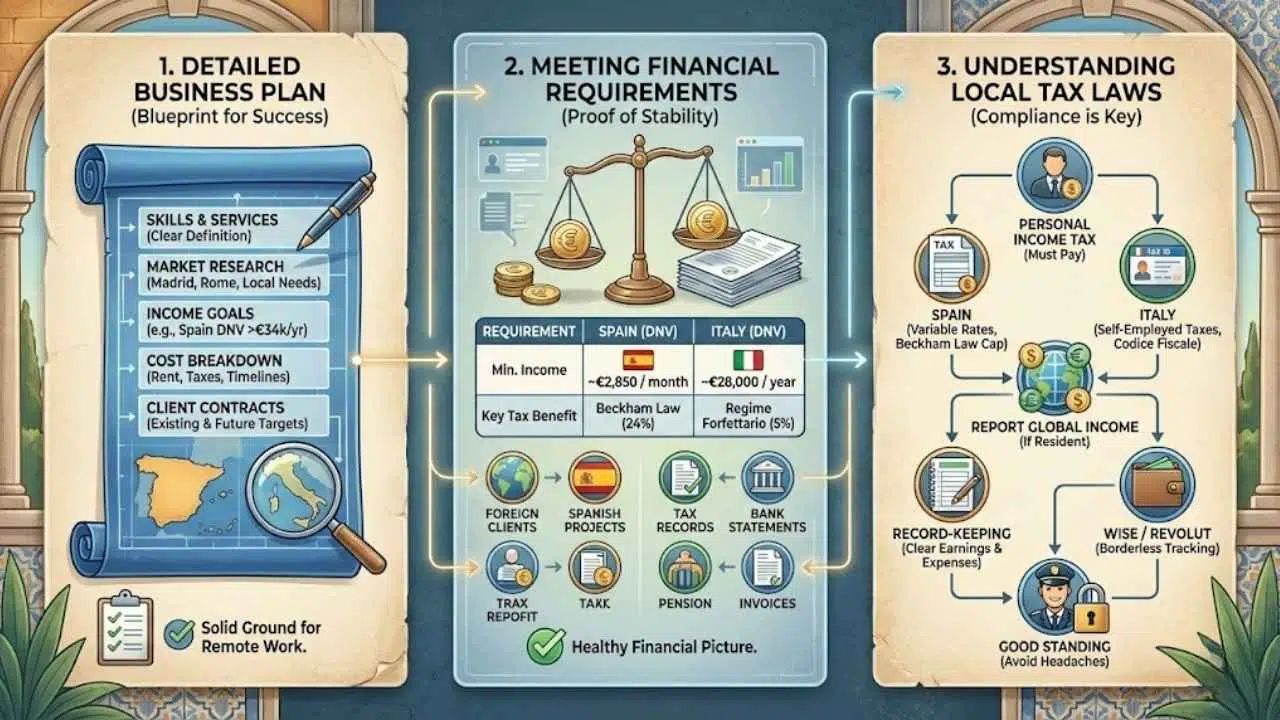
A good business plan packs a punch for your freelancer visa application in Spain and Italy. Both countries want to see what you plan, how you will work, and who your target clients are.
List your skills, describe the services you offer, and show research about local markets like Madrid or Rome. Spell out income goals. For Spain’s Digital Nomad Visa, aim to show contracts totaling over €34,000 annually to be safe.
Break down costs such as rent or taxes. Use clear numbers and timelines for growth. Detail if you already have Spanish or Italian clients lined up or aim to get new ones fast.
This shows both nations that your remote work plans rest on solid ground, and that self-employment is no shot in the dark here!
Meeting Financial Requirements
Applicants must prove stable income before getting a Spain or Italy freelancer visa. For Spain’s Digital Nomad Visa, the rule is clear: show at least 200% of the SMI in steady earnings.
| Requirement | Spain (DNV) | Italy (DNV) |
|---|---|---|
| Min. Income | ~€2,850 / month | ~€28,000 / year |
| Key Tax Benefit | Beckham Law (24%) | Regime Forfettario (5%) |
This can come from foreign clients, Spanish projects, or a mix of both. Tax records and recent bank statements work well as proof.
Italy sets its own minimums for self-employment visas too. Pension statements, client contracts, or invoices help paint a healthy financial picture.
Understanding Local Tax Laws
Paying personal income tax is a must for freelancers in Spain. Rates vary based on your earnings, but the Beckham Law can cap it. In Italy, self-employed workers pay taxes as well, often needing a “Codice Fiscale” (tax ID) immediately upon arrival.
Both countries require you to report global income if you become a resident there.
You should keep clear records of your freelance earnings and expenses from day one. Using a borderless bank account like Wise or Revolut can make tracking these international payments much easier.
Good record-keeping makes sure you stay in good standing with local tax offices and avoid headaches down the road.
Final Thoughts
Spain and Italy make freelancing feel like a walk in the park with their visa options for remote workers. You now know about key requirements, important documents, and clear steps to apply for each country’s freelancer visa.
These tips save time, cut down stress, and help you focus on building your freelance career fast. Check official immigration websites or talk with expat groups if you want more details or real stories.
Grab your laptop, pack your bags, and start planning your new freelance life. Sunny workdays are waiting for you!