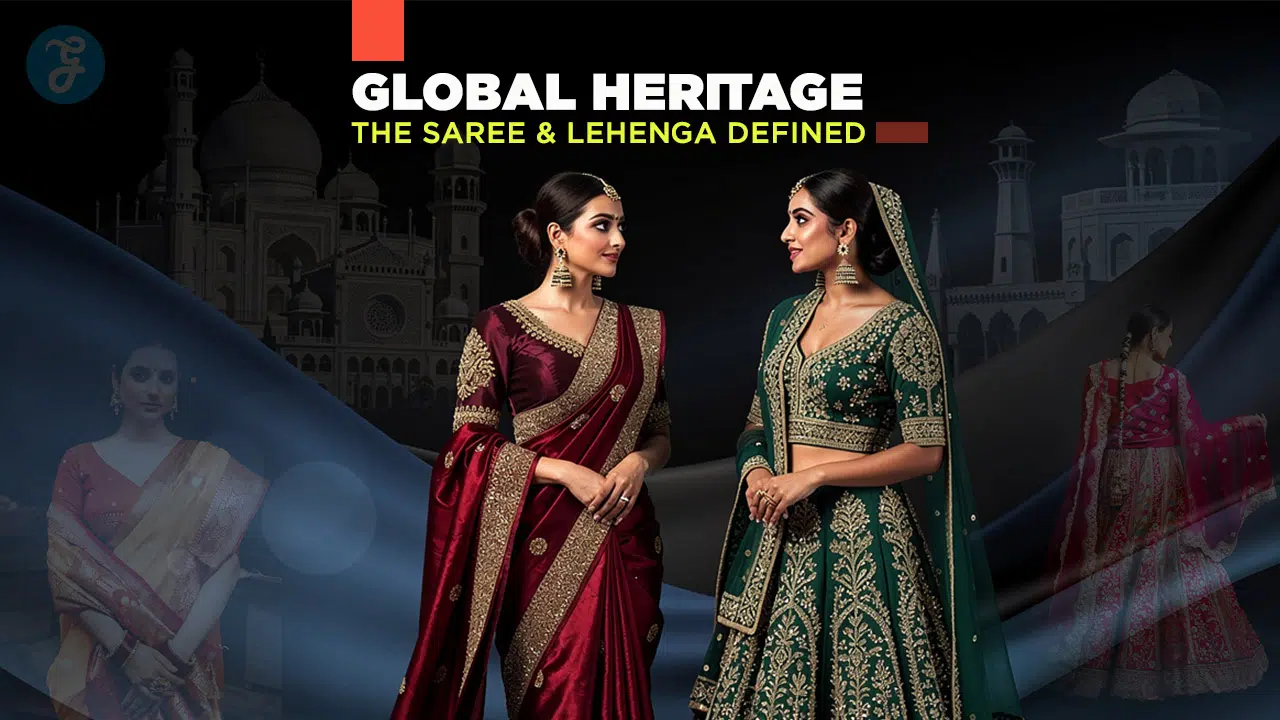
The morning of a South Asian wedding is a symphony of high stakes and heavy fabrics. From sunlit suites in London and Delhi to the artisanal boutiques of Dhaka and Kolkata, a bride stands before a mirror caught between two worlds. In one corner lies the ancestral weight of a Banarasi saree; in the other, the architectural majesty of a lehenga. This decision is the heartbeat of South Asian bridal fashion.
It is no longer a simple choice dictated by a grandmother’s birthplace or a regional map. Instead, the modern bride treats her attire as a definitive declaration of identity. She is negotiating her history while claiming her place on a global stage.
The Global Rise of South Asian Bridal Fashion
The journey of these garments is a masterclass in cultural endurance. These silhouettes have migrated far beyond the narrow weaving gullies of Varanasi and the heritage looms of Dhaka. They have travelled in suitcases to the United Kingdom and the United States, evolving from immigrant nostalgia into mainstream luxury. Today, you are just as likely to see a hand-woven drape on a New York runway as you are at a traditional ceremony in Sylhet.
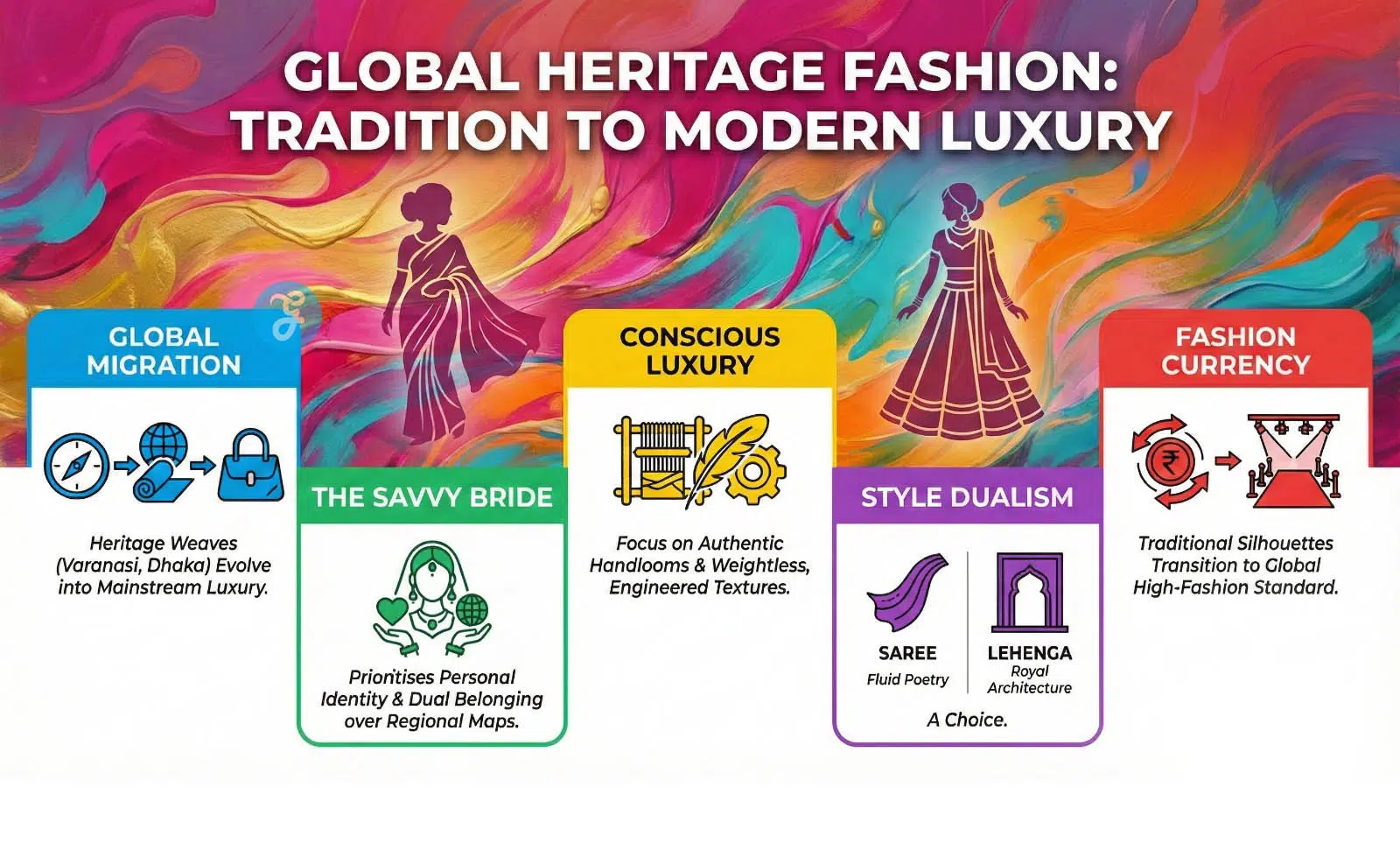
Migration and digital media have collapsed the distance between the local artisan and the international consumer. A bride in Toronto now sources her ensemble with the same scrutiny as a fashion editor. She seeks more than just a beautiful outfit. She wants a garment that speaks to her dual belonging. Whether she chooses the fluid grace of the saree or the cinematic drama of the lehenga, she is participating in an international fashion movement. This is not just about a wedding day. It is about how a deep rooted tradition became a powerful currency in the world of high fashion.
The Saree as a Living Habit: A Personal Perspective
My elderly neighbour, a school principal in Delhi, once asked me why I wouldn’t wear a Banarasi saree to go shopping at the mall. Her logic was simple: throw an overcoat on in winter to conceal the “jazzy” gold thread and you look like an enthusiastic, classy shopper. Her advice stayed with me because it challenged the modern notion that the saree is a costume reserved for the wedding stage. In reality, the saree is the backbone of the industry precisely because it is so stubborn in its survival.
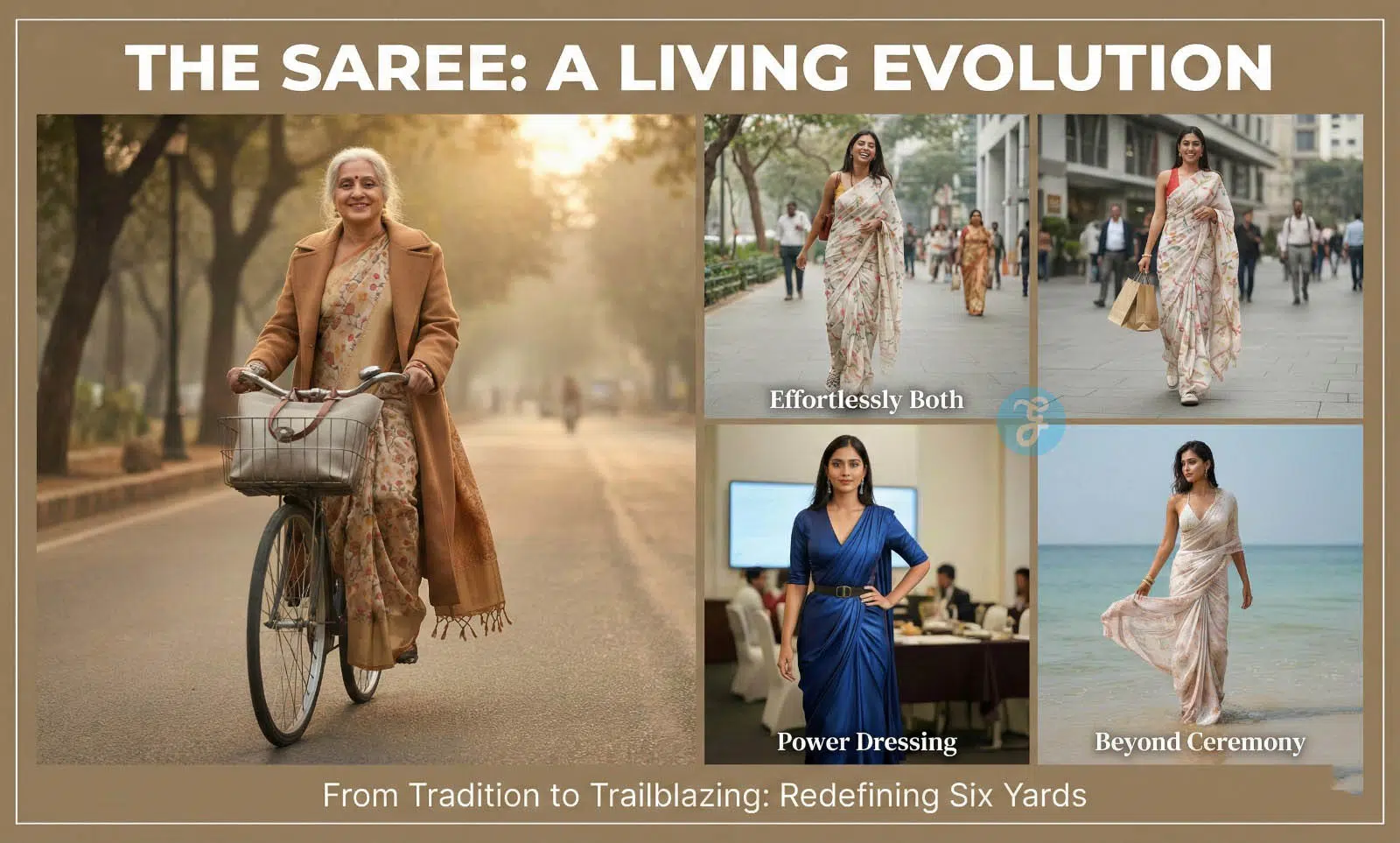 Inside almost every Indian woman’s wardrobe lies this long, colourful piece of cotton or silk, yet many of my peers now view it as a logistical challenge rather than a staple. We forget that our mothers rode bicycles and went boating in these six yards. While urban younger women often fret over the complexity of the drape, the garment itself is evolving to meet them halfway. From bikini sarees designed for the beach to the students at IIM Ahmedabad reclaiming the drape as power dressing for business interviews, the saree is shedding its “ceremony only” label.
Whether you pair it with heels for posture, or stylish flats for a long day, the trick is to stop being conscious of the garment. When you stop fretting about the pleats and treat it as everyday wear, you tap into its true potential. After all, a woman should be two things: classy and fabulous. In a saree, she is effortlessly both.
The Saree: The Ancestral Soul
To wrap oneself in a saree is to participate in an ancient ritual of draping. As an unstitched length of fabric, its beauty lies in its fluidity. There are no zippers or seams to dictate where the body ends and the garment begins.
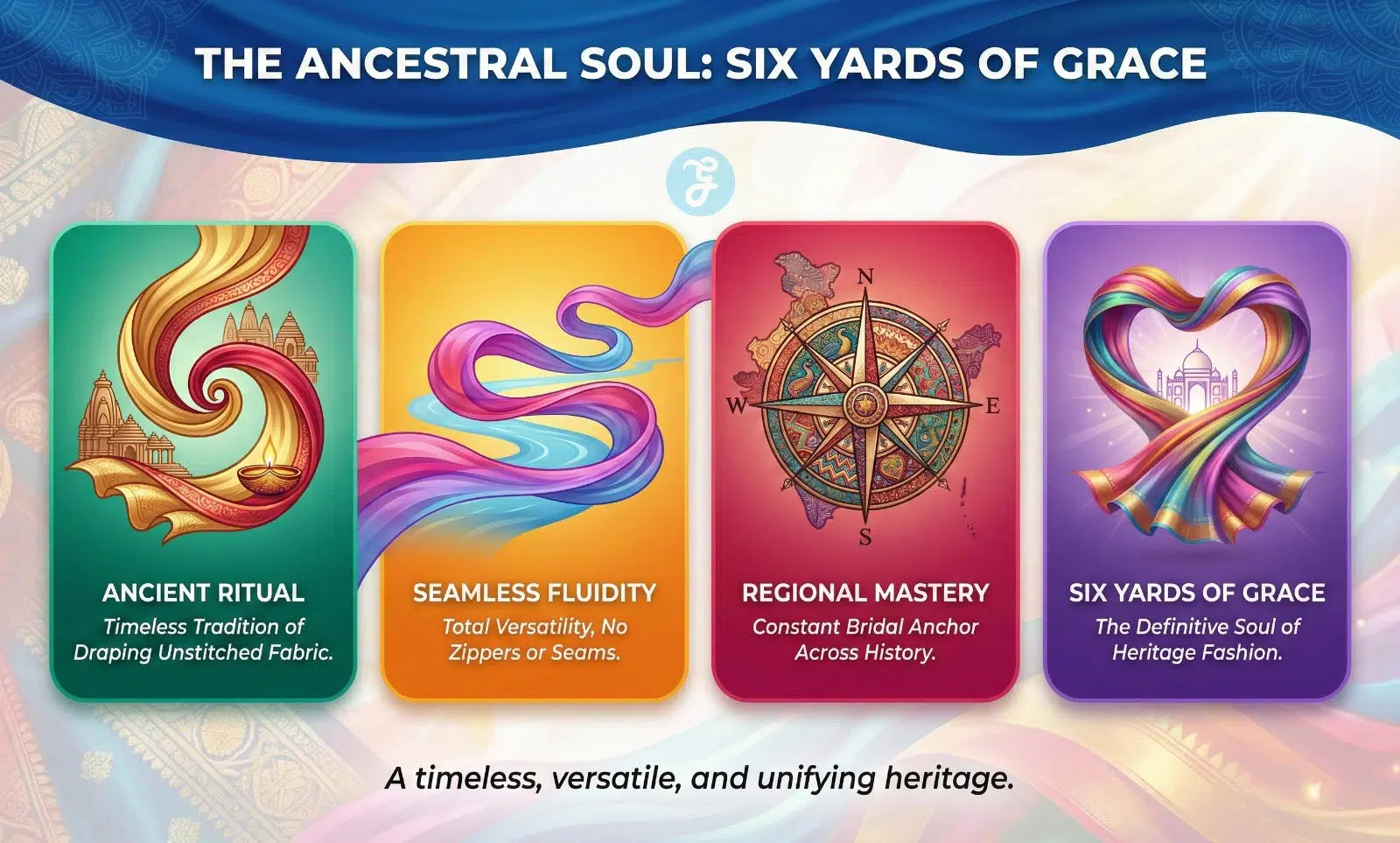
This versatility has allowed the saree to remain the definitive ancestral soul of South Asian bridal fashion for centuries. While trends in silhouettes come and go, the “six yards of grace” remains a constant, anchored by regional mastery.
Regional Sovereignty and the Handloom Heritage
Across South Asia, the saree is a map of local history. In India, the Kanjeevaram and Banarasi remain the undisputed gold standards. A Kanjeevaram from the south is architectural in its strength, woven with heavy mulberry silk and metallic threads that catch the temple light. In the north, the Banarasi is the poetic counterpart. Its Mughal-inspired floral motifs and soft, shimmering drape offer a regal elegance that has dressed generations of brides.
Beyond the borders of India, the saree holds equal sovereign weight. In Bangladesh, the Dhakai Jamdani is more than just a wedding outfit.
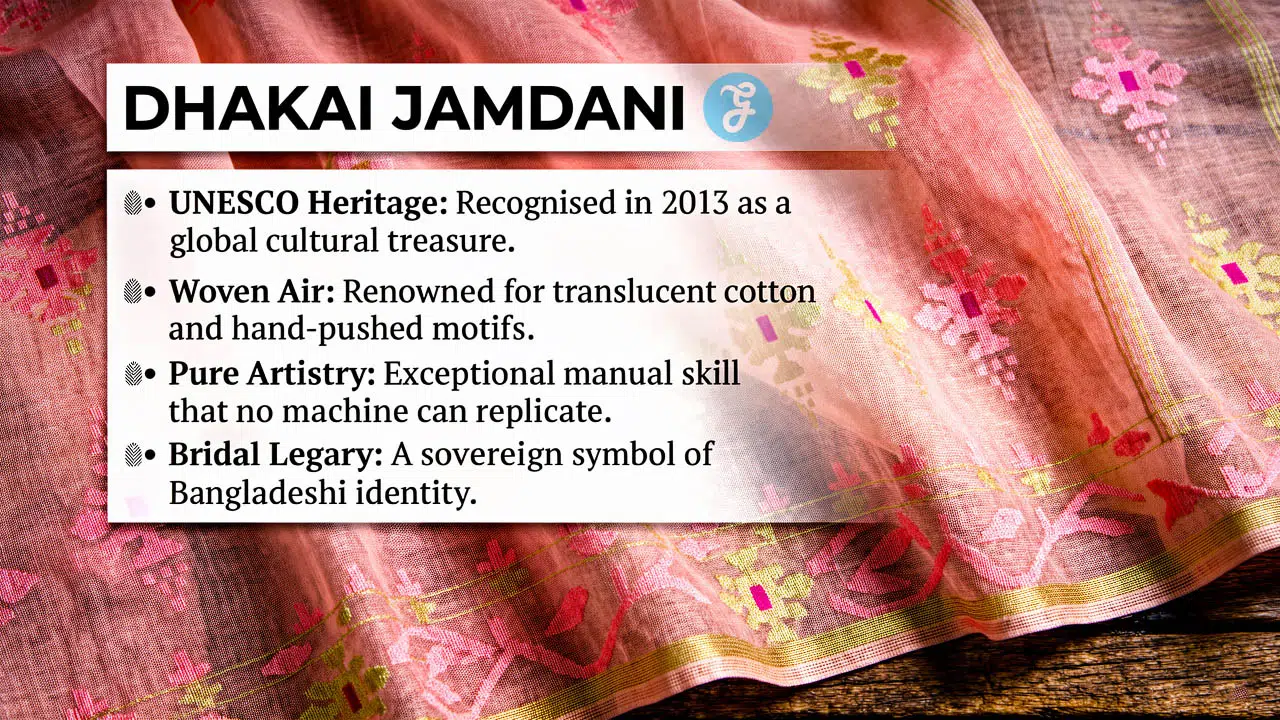
Recognised by UNESCO in 2013 as an Intangible Cultural Heritage of Humanity, this “woven air” is a marvel of translucent cotton and hand-pushed motifs. It represents a level of patience and skill that no machine can replicate.
Further south, the Sri Lankan bride claims her identity through the Kandyan drape, or Osariya. This style is distinct for its frilled waist and elegant shoulder wrap, often paired with an intricate array of traditional necklaces and headpieces, including the ceremonial seven necklaces (Mal Malaya). In Nepal, the Haku Patasi tells a story of the Kathmandu Valley. This black saree with its striking red border is central to Newari culture, symbolizing the fertile earth and the life force of the bride. Each regional variation is a marker of belonging that connects the modern woman to her lineage.
The 2026 Shift toward Conscious Luxury
As we move through 2026, a significant shift is occurring in the bridal market. The era of over-the-top, mass-produced bling is fading. In its place, “Conscious Luxury” has taken the lead. Modern brides are increasingly snubbing fast-fashion replicas in favour of authentic handloom pieces. They are asking about the weaver, the dye process, and the time taken to create the textile.
This movement is bringing the handloom saree back to the main wedding altar. A bride today views her wedding saree as an investment or a future heirloom rather than a one-time costume. The trend for 2026 is “Weightless Grandeur.” Brides are opting for tissue silks and organzas that provide the shimmer of gold without the physical burden of heavy embroidery. They want to move, to dance, and to breathe. By choosing heritage weaves, they are ensuring that their global bridal statement is rooted in sustainability and soul.
The Lehenga: The Royal Architecture
If the saree is a fluid poem, the lehenga is a feat of royal architecture. Its three piece structure of the long skirt, the fitted blouse, and the flowing veil offers a sense of ceremony that few other garments can match.
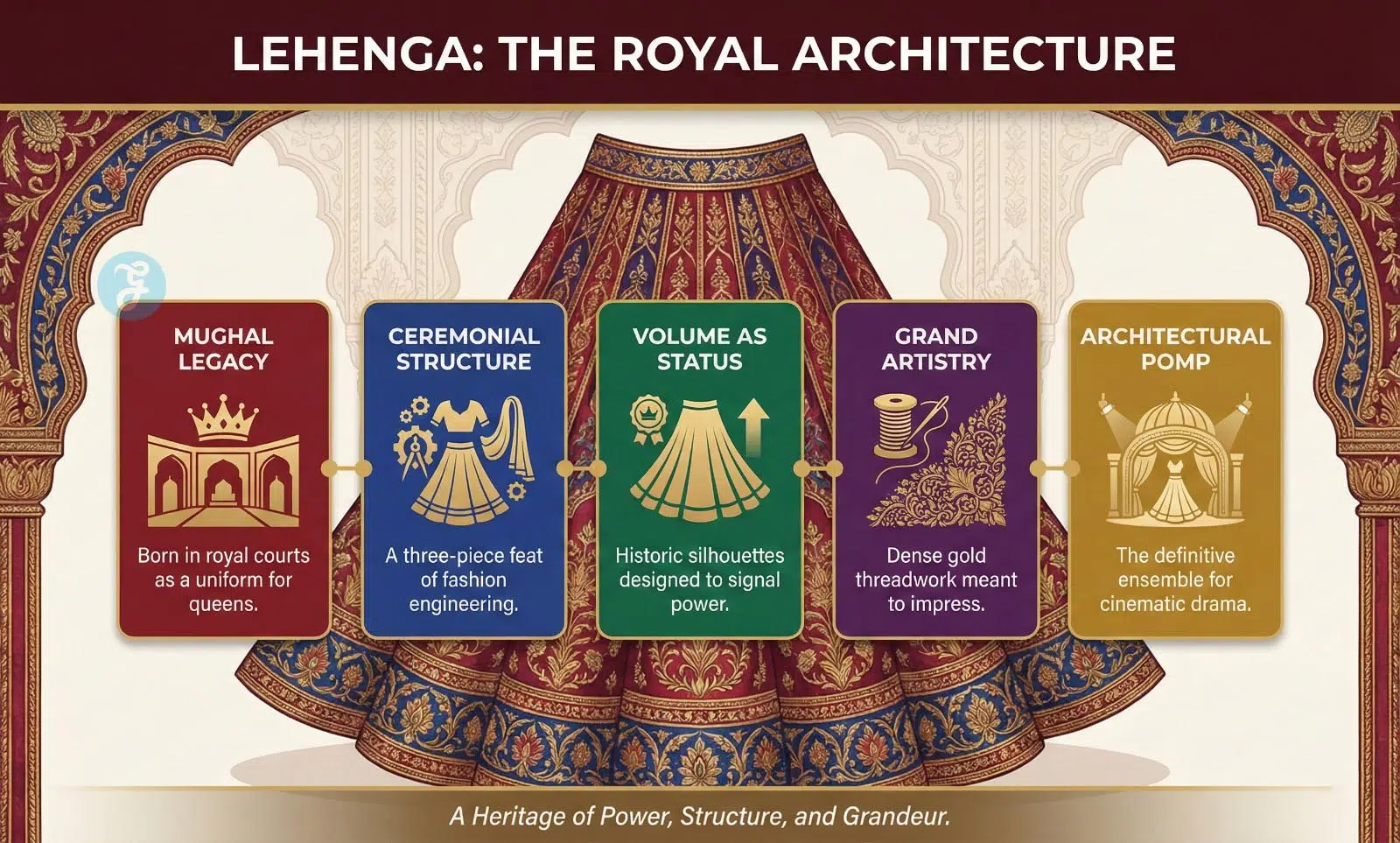
This ensemble has deep roots in the Mughal courts of North India, where it served as the official uniform of royalty. In those marble halls, the volume of a skirt was a direct indicator of status. The sheer yardage of silk and the density of real gold threadwork created a silhouette that was designed to intimidate and impress. It was an outfit built for queens.
The Rise of the Cinematic Bride
While history gave the lehenga its prestige, cinema gave it its global reach. The “Bollywood Effect” cannot be overstated when discussing why this garment dominates the dreams of brides worldwide. On screen, the lehenga became the visual shorthand for the ultimate wedding fantasy. Large scale musical numbers and high definition close ups of swirling skirts turned the North Indian silhouette into a universal aspiration.
Today, regional boundaries have blurred. A South Indian bride might choose a lehenga for her reception, or a Bengali bride might swap her traditional red saree for a flared skirt for her Sangeet. This cinematic influence has travelled through the diaspora, making the lehenga the most recognisable symbol of South Asian bridal fashion in cities like Birmingham and Houston. It is no longer about where you are from. It is about the drama you wish to create.
Modern Engineering and the Weightless Wonder
In the past, the beauty of a bridal lehenga came with a physical cost. It was common for a heavily embellished skirt to weigh upwards of fifteen kilograms, making it difficult for a bride to walk or even stand for long periods. By 2026, fashion technology has staged a quiet revolution. We have entered the era of the “Weightless Wonder.”
Designers are now using structural engineering to create volume without the bulk. Instead of layers of heavy metal wire, they use 3D textures and laser cut fabrics to mimic the look of traditional embroidery. These modern techniques allow for intricate patterns that are feather light. The silhouette is also shifting. While the classic A line remains popular, the fish cut silhouette is the trend of the year. This mermaid style hugs the frame before flaring at the knees, offering a red carpet look that feels more like a gown than a traditional garment.
Practicality Meets Global Pomp
For the diaspora bride, the preference for a lehenga often comes down to simple practicality. Draping a saree is a skill that requires years of practice or a professional assistant. In contrast, the lehenga is remarkably user friendly. It is essentially a skirt and a top. This “ready to wear” ease is a major selling point for women living in the UK or the US who may not have a village of aunts nearby to help them get dressed.
The lehenga offers a sense of security. There are no pleats to come undone on the dance floor and no worry about the length of the pallu. It provides the pomp of royalty with the convenience of a modern dress. This balance of ease and extravagance is exactly why the lehenga continues to hold its ground. It allows the modern bride to look like a princess while moving with the freedom of a woman who is ready to celebrate her own story.
The Technical Divide: Saree versus Lehenga
| Feature | The Bridal Saree | The Bridal Lehenga |
| Silhouette | Fluid and Unstitched | Structured and Voluminous |
| Historical Roots | Ancient Indus Draping and Regional Roots | Mughal Royal Courts |
| Draping Style | Skilled Hand Draping (Requires Precision) | Ready-to-Wear Skirt (with Draped Dupatta) |
| 2026 Trend | Heirloom Handlooms & Tissue Silks | Weightless 3D Textures |
| Movement | Graceful and Controlled | Dramatic and Cinematic |
The Global Stage: Beyond Borders
The map of South Asian bridal fashion is no longer confined by the borders of the subcontinent. In the living rooms of London, Toronto, and New Jersey, a new type of wedding aesthetic is being forged. This is the era of the diaspora bride, a woman who views her wardrobe as a fluid collection rather than a strict set of regional rules. In these global hubs, the old divisions of ancestry are dissolving.
The Diaspora and the Blurred Line of Tradition
Migration has acted as a catalyst for a beautiful kind of cultural confusion. A Punjabi bride in the United Kingdom may choose to walk down the aisle in a heavy Kanjeevaram silk saree from Tamil Nadu. Meanwhile, a Bengali bride in Canada might push aside her traditional red Banarasi in favour of a voluminous pastel lehenga. This mixing of styles is a byproduct of a shared South Asian identity that thrives abroad. When you are far from home, every thread of the subcontinent feels like it belongs to you.
This cross cultural exchange is not just about aesthetics. It is about a sense of community. In the diaspora, wedding boutiques carry a curated mix of every regional craft. This accessibility allows brides to experiment with silhouettes that their mothers might never have considered. The result is a wedding landscape that is diverse and unpredictable. It is a celebration of a broader heritage that refuses to be pigeonholed by a single city or state.
The Saree as a Cultural Passport
While the lehenga dominates the dramatic heights of the wedding ceremony, the saree remains a powerful cultural passport in Southeast Asia. In nations like Malaysia and Singapore, the saree is a vital marker of a transnational Indian heritage. It is worn with a specific kind of pride at formal events and state functions. For the Tamil and Malayalee communities in these regions, the saree is a bridge between their current reality and their historical roots. It signals a sophisticated belonging that is both local and international.
From the Red Carpet to the Wedding Aisle
The influence of South Asian bridal fashion has reached the most prestigious stages in the world. We are seeing a significant moment where traditional silhouettes are claiming space at the Met Gala and the Cannes Film Festival. When a global icon walks a red carpet in a hand draped saree or an intricately embroidered jacket, the world takes notice.
These high fashion moments trickle down to the mainstream bridal market. Mainstream designers in the West are now looking at the construction of the lehenga and the drape of the saree for inspiration. This visibility has validated the garment for a new generation. It has transformed what was once seen as “ethnic wear” into a celebrated luxury standard. The modern bride is no longer just wearing a costume from her culture. She is wearing a piece of art that the entire world now recognises and respects.
The 2026 Bridal Negotiation
In 2026, the bridal dressing room has become a laboratory for personal expression. We are seeing a historic shift where the rigid lines between the saree and the lehenga are finally dissolving.
The modern bride is no longer choosing between tradition and innovation; she is negotiating a space where both exist simultaneously. This has led to the rise of the hybrid bride, a woman who demands the grace of a drape with the structural ease of a gown.
The Rise of the Saree-Gown and Hybrid Fits
The “Saree-Gown” and the “Lehenga-Saree” are the breakout stars of this season. These garments are engineered for the woman who loves the aesthetic of a pallu but refuses to spend her wedding morning wrestling with safety pins. These pre-draped, stitched silhouettes allow a bride to step into her outfit and zip it up in minutes. They offer the cinematic swirl of a lehenga with the elegant, diagonal lines of a saree. It is South Asian bridal fashion at its most pragmatic. These hybrid fits are particularly popular for receptions and cocktail nights, where movement and “dance-ability” are as important as the embroidery itself.
A New Palette: Digital Lavenders and Neo-Neutrals
We are also witnessing a quiet rebellion against the mandatory bridal red. While deep crimsons and maroons remain sacred for the main ceremony, the 2026 palette is leaning into “Neo-Neutrals” and tech-inspired hues. Sage green, warm champagne, and “Digital Lavender” are the colours defining the year. Digital Lavender, now a staple of the tech-inspired palette, offers a smoky, cool-toned version of purple that continues to provide a high-fashion edge in 2026. These muted tones allow the texture of the fabric, the grain of the silk or the shimmer of the tissue, to take centre stage. It is a move toward a “Quiet Luxury” aesthetic, where the richness is felt in the quality of the weave rather than the brightness of the dye.
De-colonised Styling and the Customisation Factor
Perhaps the most exciting development is the “de-colonised” approach to styling. Modern brides are stripping away the Victorian-era modesty standards that were once imposed on South Asian attire. We see sarees paired with structured leather belts, corset blouses, or even sleeveless jackets.
There is also a playful embrace of comfort. It is no longer unusual to see a bride lift her heavy silk hem to reveal a pair of custom-embroidered sneakers. This customisation goes beyond footwear. It is about a woman reclaiming her individual self-expression. Brides are now embedding personal “Easter eggs” into their outfits, such as wedding dates, names of loved ones, or meaningful mantras stitched into the veil. This level of personalisation ensures that the tradition remains a living, breathing part of her life, rather than a costume from the past.
The Future of Tradition
Whether a bride chooses the unstitched grace of a saree or the regal architecture of a lehenga, she is stepping into a vessel for history. These garments are more than just items of clothing; they are repositories of skill, geography, and memory.
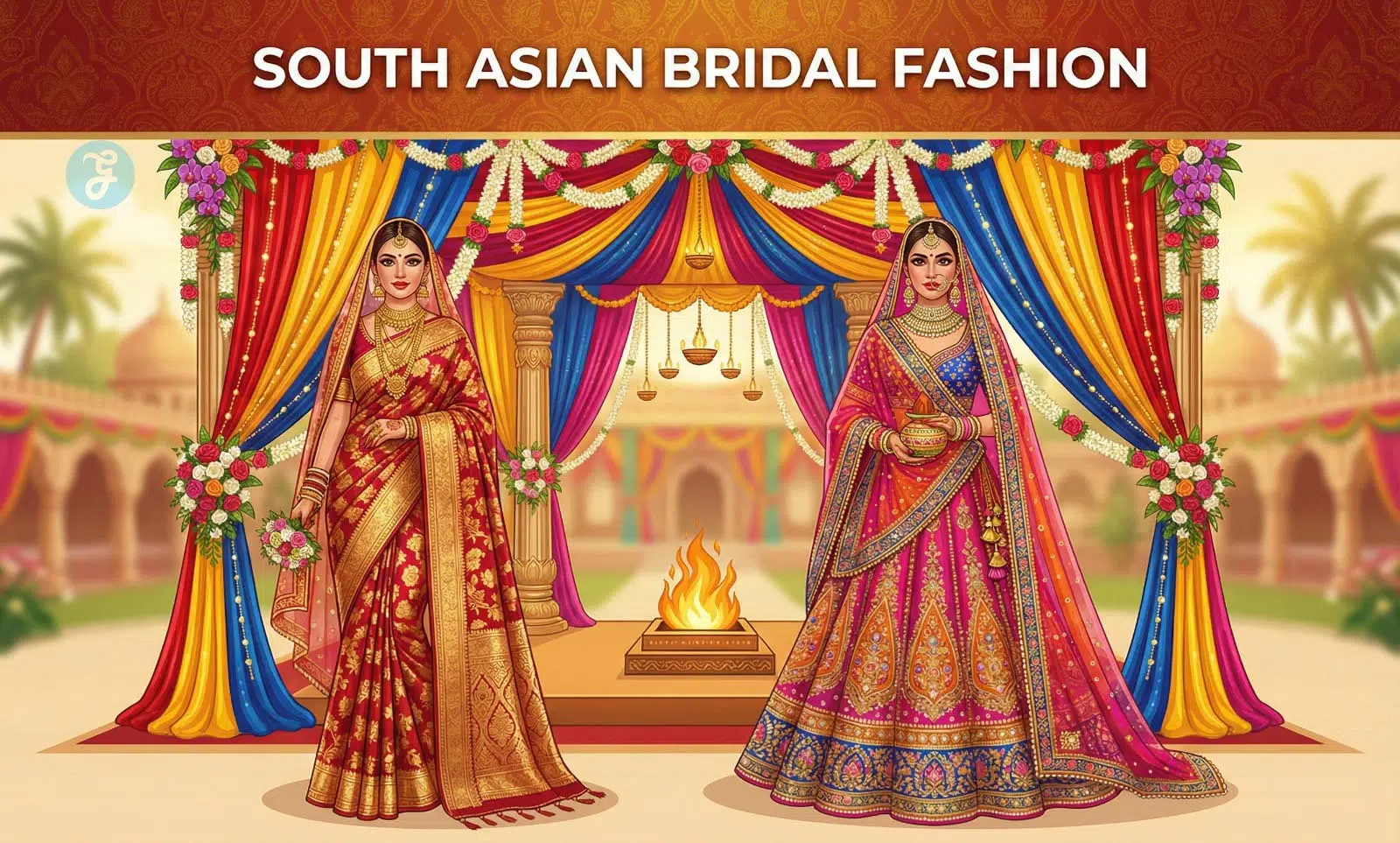
In every thread of a hand-woven Banarasi or every structural fold of a modern lehenga, there is a pulse of the past meeting the ambition of the future. The choice between them is a rare moment where a woman can physically wrap herself in her heritage while standing firmly in her present.
The Verdict: A Global Bridal Statement of Freedom
The most significant takeaway from the current landscape of South Asian bridal fashion is the newfound freedom of the bride. This pan-Asian aesthetic is no longer about choosing one tradition over another or sticking to the scripts of a previous generation. Instead, it is about the fluidity to move between both.
Today’s bride might wear a saree for her ceremony to honour her ancestors and a lehenga for her reception to celebrate her own sense of drama. She is the creative director of her own personal narrative, navigating a world where “South Asian” is a global aesthetic that belongs on every stage.
A Living Evolution
Traditional attire is often mistaken for a static costume, but the evolution of the saree and lehenga proves otherwise. These silhouettes are living, breathing entities that refuse to be sidelined or relegated to the back of a wardrobe. They continue to adapt, absorbing new colours, lighter fabrics, and global influences without losing their soul.
As migration and media continue to blur borders, these garments remain the definitive markers of a culture that is both ancient and incredibly modern. To wear them is to carry a legacy forward, ensuring that the story of South Asian craftsmanship continues to be told, one drape at a time.