Have you felt a pinch at the gas pump lately? Or maybe you’ve seen headlines about the Middle East that sound alarming but feel a bit vague? You aren’t the only one wondering what is going on. News outlets are buzzing about “Maximum Pressure 2.0,” but they rarely explain what that actually means for your daily life. You might be asking if these high-stakes talks and sanctions will keep us safe or just stir up more trouble.
Here is the reality. Since the United States brought back tough rules on Iran, global markets have been on a rollercoaster. I want to help you make sense of this. We are going to break down exactly what this strategy is, how it impacts your wallet, and why leaders choose financial pressure over peace talks.
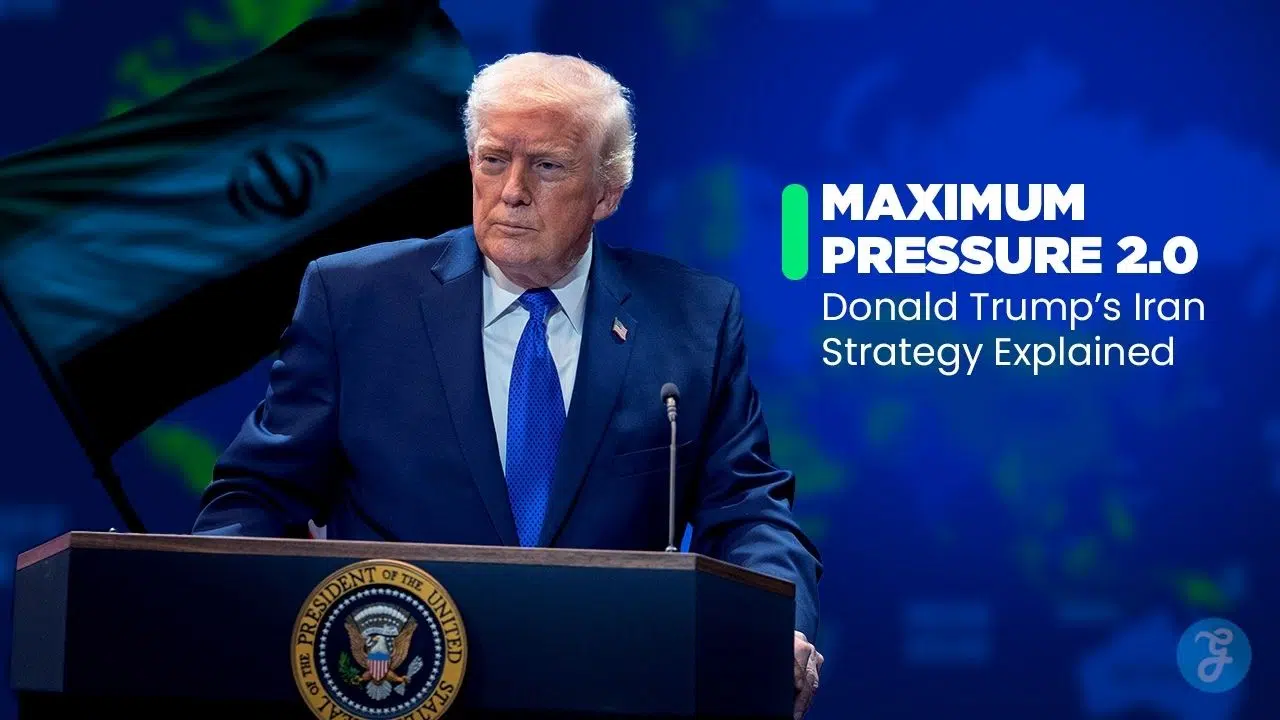
A Brief History of Trump’s Maximum Pressure 2.0
To understand where we are going, we have to look at where we started. Donald Trump pulled the United States out of the Iran nuclear deal, formally known as the JCPOA, in May 2018.
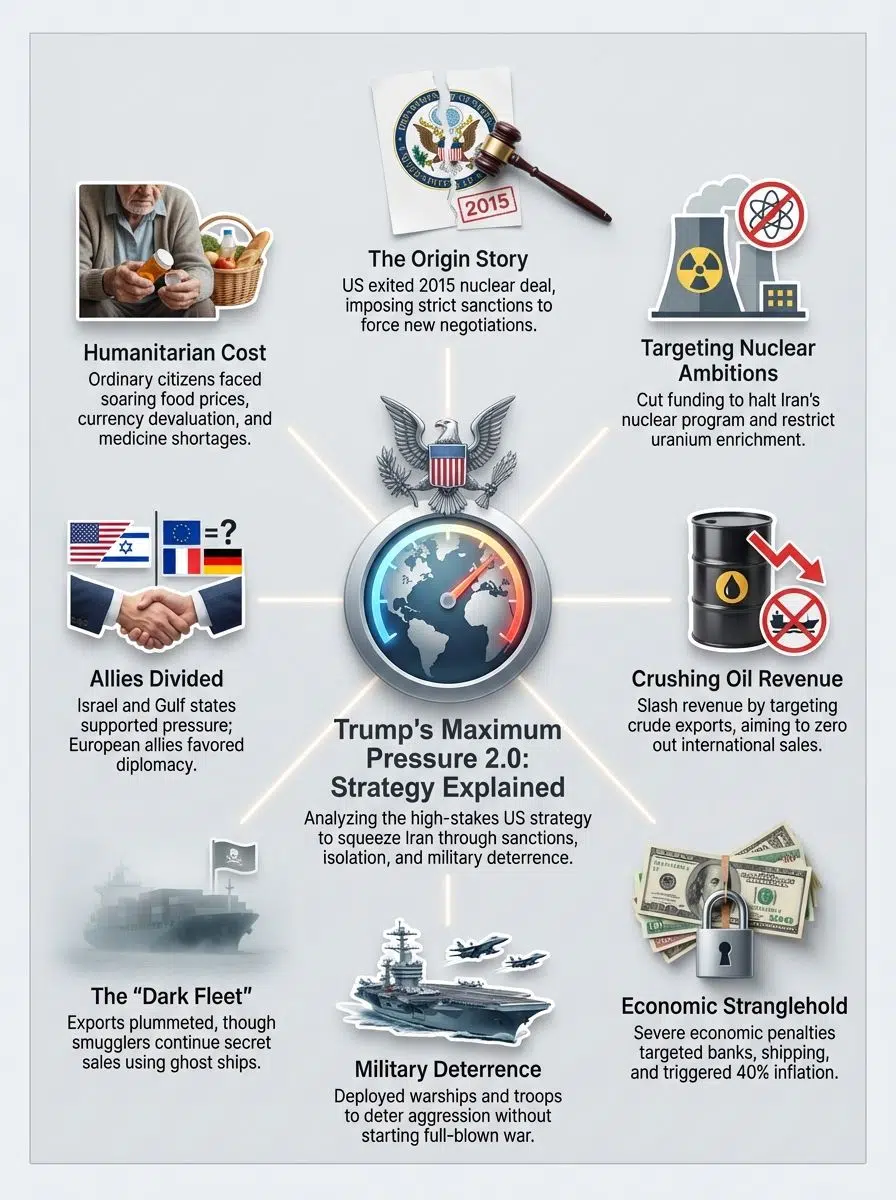
He called it a “bad deal” because he felt it gave Iran too much cash without enough restrictions.
His plan was straightforward. He wanted to squeeze Tehran’s finances until they agreed to a stricter deal. The White House called this “Maximum Pressure.” Mike Pompeo, who was Secretary of State at the time, listed twelve specific demands.
These demands weren’t small asks. They covered everything from stopping nuclear enrichment to ending support for groups like Hamas and Hezbollah.
The immediate impact was intense:
- Oil Sales Crashed: Before sanctions, Iran shipped about 2.5 million barrels per day. That number fell to less than 500,000 barrels within a year.
- Currency Collapse: The Iranian rial lost huge value, making imported goods almost impossible for locals to buy.
- Corporate Exodus: Major companies like Total and Siemens rushed out of Iran to avoid U.S. penalties.
Tensions climbed fast. American warships moved closer to the Persian Gulf, and the threat of conflict felt very real. This strategy set off sparks in diplomatic circles worldwide. Some allies in Europe were frustrated, while partners in the Middle East quietly cheered for the tougher stance.
Historical Overview of Sanctions Against Iran
It is important to know that Trump’s strategy didn’t appear out of nowhere. The United States and Iran have been in a financial tug-of-war for over forty years.
This economic wrestling match started way back in 1979. After Iranian students took American hostages at the US Embassy, President Carter froze about $12 billion in Iranian assets. That was the first major financial hit. Since then, different presidents have added their own layers of restrictions.
In the mid-1990s, President Clinton signed the Iran-Libya Sanctions Act. This law made it risky for foreign companies to invest more than $20 million in Iran’s energy sector. It was a clear message that doing business with Tehran came with a price tag.
Things heated up again in 2006. The United Nations grew worried that Iran was building nuclear bombs rather than power plants. They joined the U.S. in slapping penalties on Iran.
By 2012, under the Obama administration, the pressure peaked again. New measures targeted Iran’s central bank and cut it off from the SWIFT banking system. This made it nearly impossible for Iran to get paid for the oil they did manage to sell.
“These cumulative sanctions cut Iran’s oil exports by 50% between 2011 and 2013, forcing them to the negotiating table for the original nuclear deal.”
This history laid the groundwork for Maximum Pressure 2.0. The toolkit was already there; the new strategy just used every tool at once.
The Core Objectives of Maximum Pressure 2.0
Think of this strategy like a game of dominoes. The goal is to push one piece and make a whole series of things happen. Let’s look at the three main targets.
Countering Iran’s nuclear ambitions
The biggest fear for U.S. policymakers is a nuclear-armed Iran. Maximum Pressure 2.0 aimed to stop Iran from getting the bomb by cutting off the money needed to build it.
When the U.S. left the nuclear deal in 2018, sanctions snapped back into place. This cut off billions of dollars in revenue. Washington wanted Iran to stop enriching uranium and open up all their facilities to inspectors from the IAEA (International Atomic Energy Agency).
Did it work perfectly? Not exactly. Iranian leaders pushed back hard. By late 2024, reports showed Iran had enriched uranium to near 60% purity. That is a short technical step away from the 90% needed for weapons.
It turned into a high-stakes standoff. Diplomats traded threats while scientists worked behind closed doors. It is a fragile situation that keeps security experts awake at night.
Targeting Iranian oil exports
Oil is Iran’s economic lifeline. The strategy was to cut that lifeline. Washington threatened “secondary sanctions” on any country that bought Iranian oil. This means if a Chinese or Indian bank processed a payment for Iranian crude, they could be banned from the U.S. financial system.
This was a huge risk for foreign banks, so most stopped processing these deals. Tehran lost an estimated $50 billion in annual revenue.
Smugglers tried every trick in the book to keep the oil flowing. They used fake ship names and turned off GPS transponders. But for a long time, tankers just sat at sea with nowhere to go.
Restricting the regional influence of the Iranian regime
The third goal was to limit Iran’s power in the neighborhood. Iran supports various groups across the Middle East, often called the “Axis of Resistance.”
Key groups Iran funds include:
- Hezbollah in Lebanon
- Hamas in Gaza
- The Houthis in Yemen
- Shia Militias in Iraq and Syria
By squeezing the Iranian economy, the U.S. hoped to dry up the cash flow to these groups. It became much harder for Tehran to send suitcases of cash or fund weapons shipments.
Some regional partners helped by sharing intelligence on smuggling networks. This made it tougher for Iran to project power beyond its borders, though they certainly haven’t stopped trying.
Key Strategies in Maximum Pressure 2.0
Trump’s playbook is bold. It mixes aggressive financial moves with military signaling. The idea is to box Iran in until it has no choice but to talk.
Reimplementation of harsh economic sanctions
After leaving the nuclear deal, the White House didn’t just bring back old sanctions. They added new ones targeting specific sectors like steel, aluminum, and copper.
They also designated Iran’s elite military force, the IRGC (Islamic Revolutionary Guard Corps), as a Foreign Terrorist Organization. This was a first. It meant that any business touching the IRGC could face criminal charges in the U.S.
The economic impact on everyday Iranians was severe:
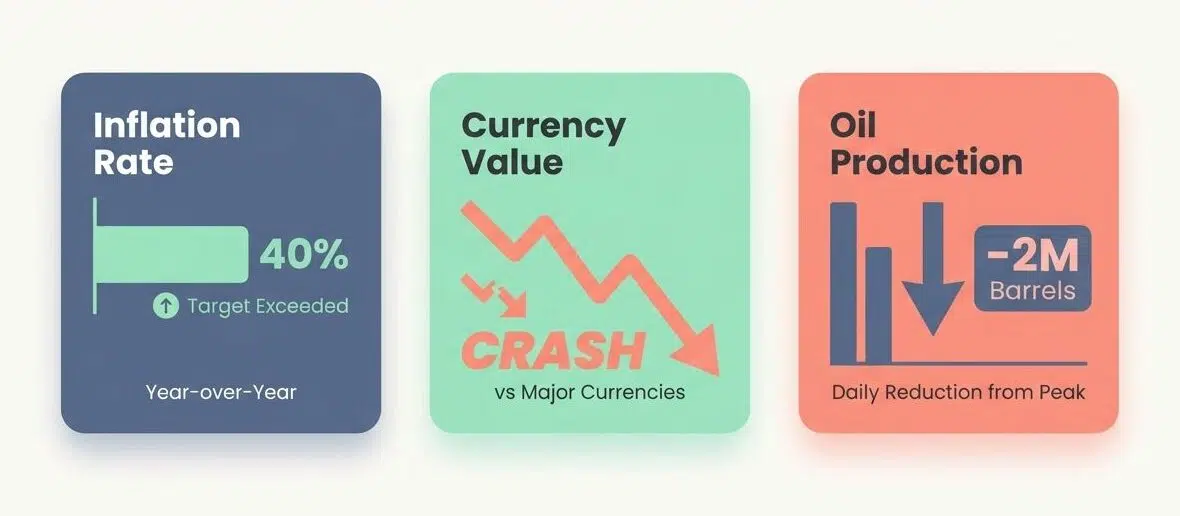
| Economic Indicator | Impact of Sanctions |
|---|---|
| Inflation Rate | Soared above 40%, making groceries unaffordable. |
| Currency Value | The Rial crashed, wiping out life savings. |
| Oil Production | Dropped by over 2 million barrels per day at peak pressure. |
Families struggled to put food on the table. A simple loaf of bread became a luxury for many. Leaders in Washington believed this domestic pressure would force the Iranian government to change course.
Diplomatic isolation of Iran
The U.S. worked hard to make Iran a pariah on the global stage. They pressured allies like Britain, France, and Germany to stop encouraging trade with Tehran.
It worked to a large degree. European banks, fearing U.S. fines, severed ties with Iranian clients. Washington also organized conferences, like the Warsaw Summit, to build a global coalition against Iran.
Iran found itself shut out of major security meetings. Their diplomats faced closed doors. With fewer friends to rely on, Iran had a hard time defending its policies or finding support for its nuclear program.
Military posturing and strategic deterrence
Diplomacy works better when you have a big stick. In 2019 and 2020, the U.S. moved aircraft carrier strike groups into the Persian Gulf. They flew B-52 bombers over the region as a show of force. The message was clear: “We are watching you.”
The most dramatic moment came in January 2020 with the targeted strike that killed Qasem Soleimani, a top Iranian general. This showed that the U.S. was willing to take direct military action, not just apply sanctions.
Both sides used strong language. They warned of “red lines” that shouldn’t be crossed. The goal was to scare Iran into compliance without actually starting a full-scale war.
Patterns in Iranian Oil Exports and Sanctions Evasion
You might wonder how Iran survives at all with these restrictions. The answer lies in a high-stakes game of cat and mouse on the high seas.
The role of Iran’s “Dark Fleet”
Iran relies on a “Dark Fleet” or “Ghost Armada.” These are hundreds of aging tankers that operate in the shadows to keep oil money flowing.
These ships use clever tactics to hide. They turn off their Automatic Identification System (AIS) transponders so they vanish from tracking screens. They often engage in “ship-to-ship” transfers in the middle of the ocean, usually off the coast of Malaysia or Singapore.

By moving oil from one ship to another at sea, they mix it with other blends. This disguises the origin, allowing them to sell it as “Malaysian” or “Omani” crude.
Experts estimate this fleet has grown to over 400 vessels. It allows Iran to export over 1.5 million barrels a day despite the bans, mostly to private refineries in China known as “teapots.”
Impact on global oil markets
This hidden trade creates a headache for global markets. When sanctions hit hard, official supply drops, and prices at your local gas station usually go up.
In 2018, the initial shock sent prices climbing. Traders scrambled to find new sources of oil. Countries like Saudi Arabia had to pump more to fill the gap.
But the “Dark Fleet” muddies the waters. Because this oil is sold secretly, often at a steep discount of $10 to $15 per barrel, it creates a two-tier market. China gets cheap oil, while the rest of the world pays full price.
This uncertainty makes the market jittery. Any rumor of a crackdown on these ghost ships can send oil prices spiking overnight.
Potential Responses From Iran
We shouldn’t expect Iran to sit on its hands while this happens. History shows they respond to pressure with pressure of their own.
Escalation in regional proxy conflicts
When Iran feels squeezed, they often lash out through their friends. We have seen a rise in attacks by Iranian-backed militias.
In Iraq and Syria, these groups launch rockets and drones at U.S. military bases. In Yemen, Houthi rebels attack commercial ships in the Red Sea, disrupting global trade.
These aren’t random acts. They are calculated moves to show the U.S. that maximum pressure comes with a cost. Iran aims to make the situation so chaotic that the U.S. is forced to back off.
Strategic partnerships with other global powers
Since it cannot trade with the West, Iran has pivoted East. They have built much tighter relationships with Russia and China.
This partnership has three main pillars:
- Energy Sales: China buys the vast majority of Iran’s oil.
- Military Tech: Iran supplies Russia with Shahed-136 drones for use in Ukraine.
- Political Cover: Russia and China use their veto power at the UN to protect Iran from further international resolutions.
Moscow and Tehran recently signed a 20-year cooperation agreement. This alliance makes it much harder for U.S. sanctions to isolate Iran completely.
Domestic implications within Iran
While the regime finds ways to survive, regular people pay the price. The internal situation in Iran is tense. Prices for basics like chicken and dairy have skyrocketed. The middle class is shrinking. This economic pain fuels anger against the government.
We saw this boil over in the “Woman, Life, Freedom” protests that swept the country recently. While the government cracked down hard, the underlying frustration hasn’t gone away.
U.S. strategists hope this internal pressure will force the regime to compromise. However, it also risks pushing the country toward instability or total collapse.
The Role of US Regional Allies
The United States isn’t acting alone. Key partners in the Middle East play a huge role in making this strategy work.
Cooperation with Gulf countries
Gulf nations like Saudi Arabia and the UAE have their own worries about Iran. They have supported the Maximum Pressure strategy because they see Iran as a direct threat to their security.
The U.S. works with them to monitor shipping lanes in the Persian Gulf. They share intelligence on missile threats and drone launches. Recently, there has been a push to build an integrated air and missile defense system across the region.
This cooperation helps enforce sanctions. Gulf countries help track suspicious money flows and stop smugglers from using their ports.
Implications for US-Israel relations
Israel is perhaps the biggest supporter of Maximum Pressure 2.0. For Israel, a nuclear-armed Iran is an existential threat.
Israeli leaders, particularly Prime Minister Netanyahu, have consistently pushed for tougher sanctions. Intelligence sharing between the U.S. and Israel is at an all-time high. They often coordinate on covert operations to delay Iran’s nuclear progress.
This shared enemy has also brought Israel closer to its Arab neighbors. The Abraham Accords, which normalized relations between Israel and several Arab states, were partly driven by the need for a united front against Iran.
Challenges and Criticisms of Maximum Pressure 2.0
This strategy is not without its critics. There is a heated debate about whether it actually achieves its goals.
Economic and humanitarian consequences in Iran
Critics argue that sanctions hurt ordinary people more than the government. While food and medicine are technically exempt from sanctions, banks are too scared to process the payments.
This leads to shortages of critical drugs for cancer and epilepsy. Humanitarian groups report that preventable deaths have risen because hospitals cannot get parts for equipment. Many argue that this suffering alienates the Iranian people. Instead of blaming their government, they might blame the U.S. for their hardships.
Straining US-EU relations over Iran policy
Europe generally prefers diplomacy over pressure. Leaders in France and Germany tried hard to keep the nuclear deal alive. When the U.S. threatened secondary sanctions on European companies, it caused a rift. Europe tried to create a workaround payment system called INSTEX to allow trade with Iran, but it largely failed.
This disagreement makes it harder to present a united global front. When allies aren’t on the same page, sanctions are easier to evade.
Long-term feasibility of the strategy
Finally, there is the question of endurance. Can this pressure be maintained forever? Sanctions fatigue is real. Over time, countries find workarounds. Iran’s economy, while battered, has adapted to a “resistance economy.” They rely more on domestic production and trade with neighbors.
If the goal is “strategic submission,” it hasn’t happened yet. Iran has actually accelerated its nuclear program since sanctions returned. This leads some experts to question if a different approach is needed.
The Bottom Line
Maximum Pressure 2.0 is a high-stakes gamble. The Trump team believes that extreme economic pain is the only language Tehran understands. The data show a mixed bag. Oil exports did crash initially, but they have slowly crept back up thanks to the “Dark Fleet.”
For you, this matters because it directly affects global stability and energy prices. A flare-up in the Gulf can send gas prices soaring overnight.
Supporters say it limits Iran’s ability to fund terror. Critics say it punishes civilians without changing the regime’s behavior. As this geopolitical chess match continues, the world watches to see if the pressure will lead to a new deal or a dangerous breaking point.