
Does the thought of sitting in a quiet room with a Number 2 pencil make your stomach turn? You are definitely not the only one feeling that way. College admissions have changed drastically in the last few years. You might be wondering if the SAT or ACT still matters for your dream school. Here is the reality for the Class of 2026. While many schools are test-optional, some top-tier universities are actually bringing the tests back.
This guide will walk you through the Standardized Testing Debate. We will look at why this is happening, the new digital formats, and what you actually need to do to get accepted.
Evolution of Standardized Testing
Standardized tests have shifted shapes many times. They started as exclusive gatekeepers and morphed into the national rituals we know today. The story of these exams is full of surprises. It explains a lot about the pressure you might feel right now.
Origins and Early Methods
In the early days, getting into college was not about filling in bubbles. Admissions often relied on intense oral exams in Latin or Greek.
This system mostly benefited students from wealthy families who could afford private tutors. Schools like Harvard and Yale ran their own specific exams. It was confusing and disorganized.
Then came the College Entrance Examination Board in 1901. They introduced written tests to create a common standard.
“The original goal of the SAT in 1926 was to identify talented students from public schools who might not have the right family connections.”
By 1926, the SAT arrived. It aimed to measure aptitude rather than just memorizing facts. This shift helped open doors for students from public schools across the United States. It was the first step toward a more unified system.
Growth of Modern Testing Systems
Fast forward to the mid-20th century, and testing became a massive industry. The ACT launched in 1959 as a competitor to the SAT. It focused more on what you learned in high school classes rather than abstract logic.
Universities loved these scores. They provided a single number to compare a student from rural Kansas with a student from downtown New York City.
By the 1960s, millions of students were spending their Saturdays taking these exams. The University of California system became a major driver of this growth when it started requiring SAT scores in 1968. This decision cemented the test as a mandatory part of the college path for decades.
Effects of Educational Policies
Government rules have also played a huge role. The No Child Left Behind Act of 2001 mandated annual testing in grades 3-8. This created a culture where testing data drove everything from school funding to teacher evaluations.
However, the pendulum has swung back recently. The Every Student Succeeds Act (ESSA) of 2015 gave states more flexibility. This loosened the grip of federal mandates.
Now, we are seeing new players like the Classic Learning Test (CLT). Florida recently approved the CLT for university admissions, challenging the long dominance of the College Board and ACT, Inc. These policy shifts are rewriting the rules for the Class of 2026.
Analyzing the SAT/ACT Controversy
You now face a confusing landscape. Should you take the test? Should you skip it? The answer depends entirely on where you apply.
The field is split. Most schools are optional, but the most competitive ones are changing their minds again.
Reduced Importance in University Admissions
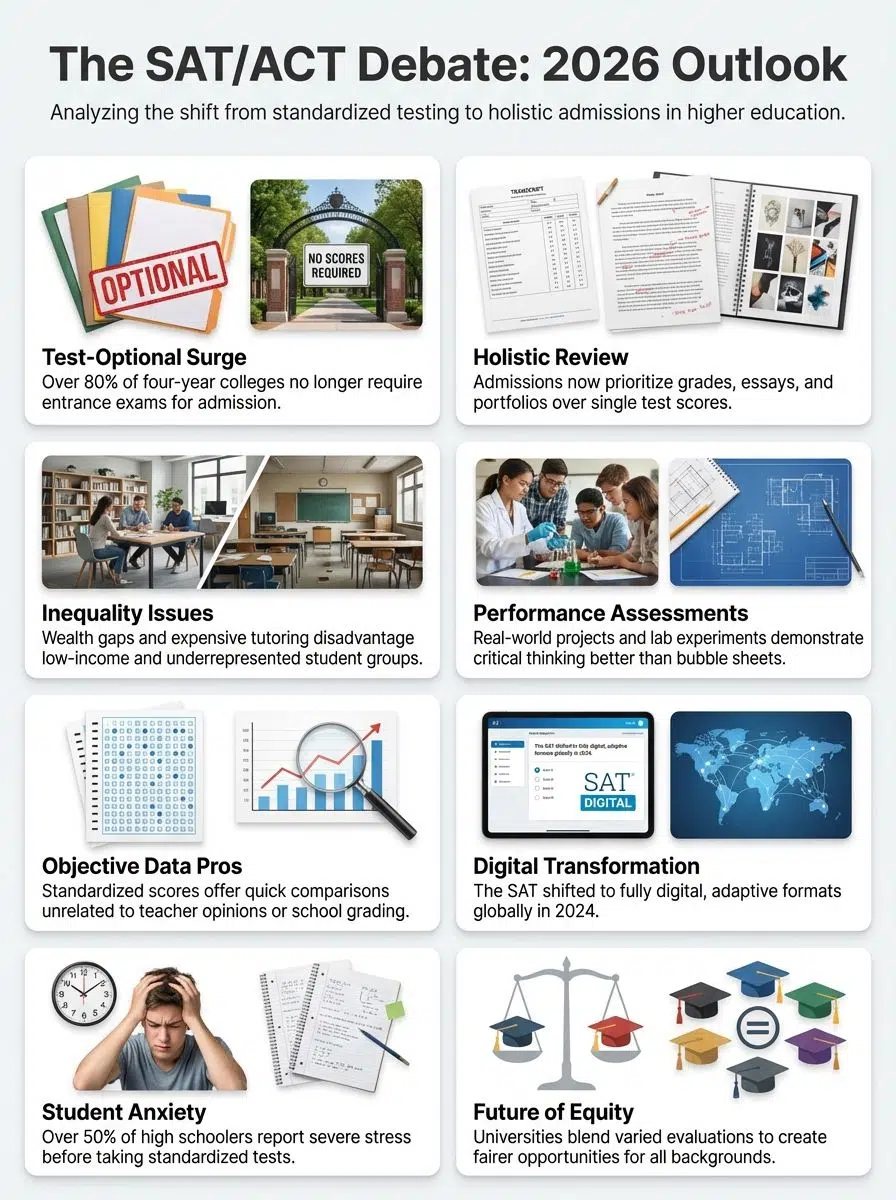
It is true that the majority of colleges do not require tests today. According to the organization FairTest, over 1,800 colleges are test-optional or test-free for the 2025-2026 cycle.
State universities in places like California have gone “test-blind.” This means the University of California system will not look at your SAT score, even if you send it.
Admissions officers are looking at other things instead:
- Rigor of Curriculum: Did you take AP, IB, or Dual Enrollment classes?
- Personal Essays: Can you tell a compelling story about your life?
- Extracurricular Impact: Did you lead a club or just join it?
The Return of Required Testing
Here is the twist that catches many students off guard. While most schools are optional, a small group of elite schools has reinstated the requirement.
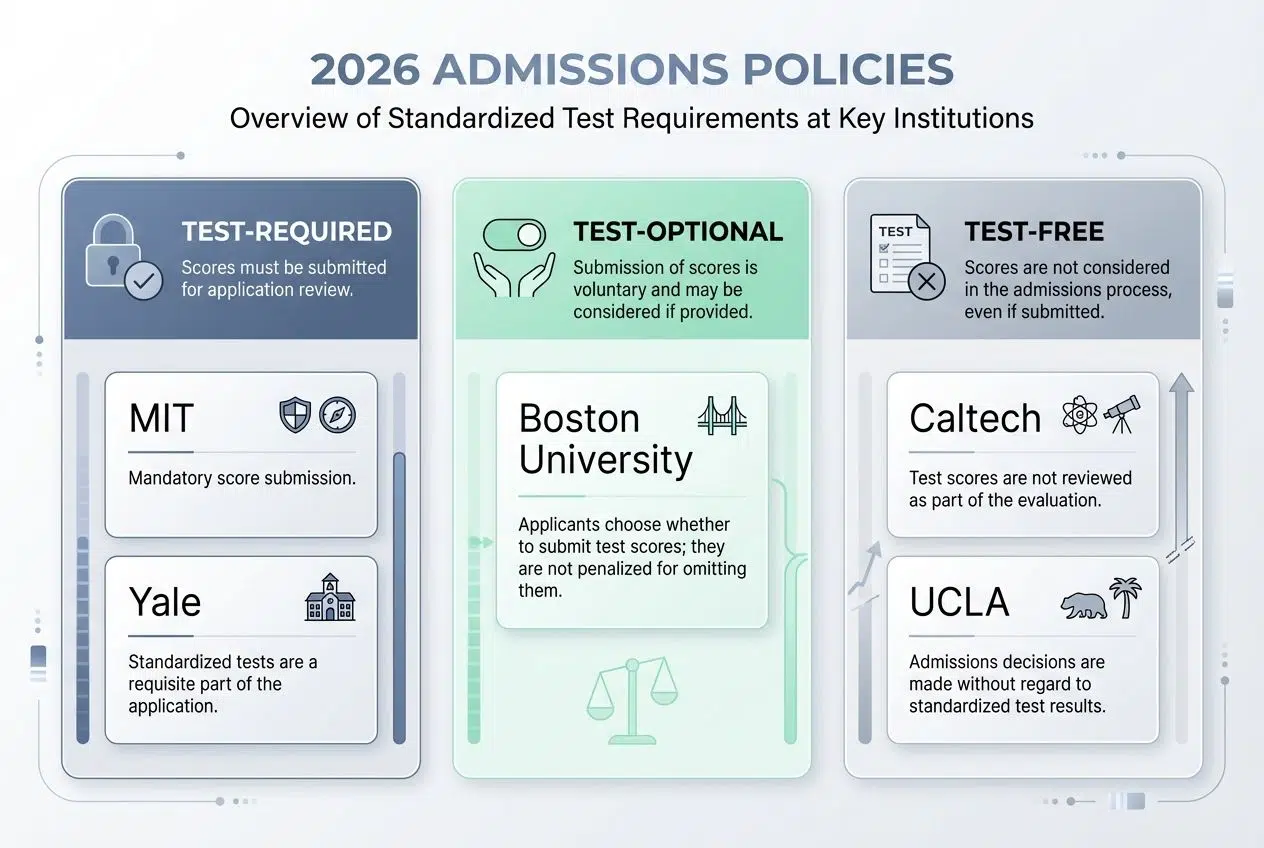
Dartmouth, Yale, Brown, MIT, Caltech, and UT Austin now require standardized tests again. They found that test-optional policies actually hurt some low-income students who had high scores but slightly lower grades due to life circumstances.
You need to know exactly what the policy means for your target school. Here is a quick breakdown:
| Policy Type | What It Means For You | Example Schools (2026) |
|---|---|---|
| Test-Required | You must submit an SAT or ACT score. No exceptions. | MIT, Georgetown, Georgia Tech, Yale |
| Test-Optional | You choose. Submit if your score helps your application. | Boston University, Virginia Tech |
| Test-Free/Blind | Do not send scores. They will not be reviewed. | Caltech, UC Berkeley, UCLA |
Changes in Testing Since the Pandemic
The pandemic forced schools to go virtual, but it also forced the tests to modernize. The biggest change is the Digital SAT. As of 2024, the paper SAT is gone in the US. The new test is taken on a laptop or tablet using the Bluebook app.
This new format is different in key ways:
- It is adaptive: If you do well on the first section, the second section gets harder (and is worth more points).
- It is shorter: The test is now just over 2 hours instead of 3 hours.
- Faster results: You get your scores in days, not weeks.
Benefits of Standardized Tests
Why do schools like MIT and UT Austin still want these scores? They argue that tests provide value that high school grades cannot.
Provide Objective Data
High school grading standards vary wildly. An “A” at a private prep school might mean something different than an “A” at a large public high school.
Standardized tests offer a common yardstick. A 1300 on the SAT represents the same performance regardless of where you live.
Grade inflation is a major reason for this. A 2024 study by the ACT organization found that the average high school GPA has risen to 3.36, while test scores have remained flat or dropped. When everyone has an “A” average, colleges need another way to distinguish academic readiness.
Detect Educational Disparities
This sounds contradictory, but tests can sometimes help spot overlooked talent. Admissions officers use tools like the College Board’s Landscape dashboard.
This tool places a student’s test score in the context of their high school and neighborhood. If you score a 1200, but the average at your school is 900, you stand out as a high achiever.
Without this data, admissions officers might just look at your extracurriculars. Wealthier students often have better access to expensive sports or travel experiences, which can create a different kind of unfairness.
Maintain School Accountability
Tests also serve as a check on high schools. If a school gives out straight As but its students consistently score low on national exams, it signals a gap in the curriculum.
States use this data to identify which districts need more funding or support. It acts as an early warning system for educational quality.
Drawbacks of Standardized Tests
Of course, the critics have strong points too. These tests can feel like a barrier rather than a bridge.
Encourage Teaching to the Test
When high stakes are attached to a single exam, the classroom suffers. Teachers may spend weeks drilling multiple-choice tricks instead of fostering deep critical thinking.
This narrows the curriculum. You might spend less time on creative writing or science labs because those subjects are harder to test with a bubble sheet. It turns learning into a game of memorization.
Causes Student Stress and Anxiety
The pressure is real. A recent survey by The Princeton Review found that over 70% of students reported “high” or “very high” stress regarding college applications and exams.
This anxiety can affect performance. Some brilliant students simply freeze up under timed conditions. Their scores do not reflect their actual potential or work ethic.
Disadvantage of Underrepresented Groups
The “wealth gap” in testing is well-documented. Wealthy families can afford expensive advantages that others cannot.

- Private Tutoring: Specialized coaching can cost upwards of $200 per hour.
- Multiple Attempts: Taking the test 3 or 4 times to “superscore” costs money and time.
- Diagnosis for Accommodations: Getting extra time often requires expensive private psychological evaluations.
While free resources like Khan Academy have helped level the playing field, the gap in average scores between high-income and low-income students remains significant.
Alternative Assessment Methods
If we move away from tests, what comes next? Schools are experimenting with new ways to measure your potential.
Implementing Performance-Based Assessments
Some innovative coalitions are ditching the test entirely. The New York Performance Standards Consortium is a group of schools that use in-depth projects instead of standardized Regents exams.
Students there might write a literary analysis paper or conduct a chemistry experiment to graduate. Data shows these students often have higher college persistence rates than their peers who took traditional tests.
Using Portfolios and Projects
Imagine applying to college with a portfolio, just like an artist. This is becoming more common. The Mastery Transcript Consortium is a network of schools that has created a new kind of high school transcript. Instead of listing grades, it highlights specific skills and mastery credits.
Admissions officers can click through to see actual evidence of your work. This might include:
- A video of a speech you gave.
- The code you wrote for a computer science project.
- A research paper you published in a local journal.
Adopting Comprehensive Admission Approaches
This is often called “Holistic Review.” It means the admissions team looks at you as a whole person.
They review your letters of recommendation to see what kind of community member you are. They look at your part-time job to see your work ethic. In this model, a lower test score can be balanced out by strong leadership in your community or resilience in the face of hardship.
Future Directions in Educational Assessment
The debate isn’t ending; it’s just getting more sophisticated. The future of testing looks smarter and more flexible.

Achieving Equity Through Balanced Evaluation
The goal for 2026 and beyond is balance. Colleges want the data point of a test score, but they don’t want it to dominate the decision.
We will likely see more “Test-Flexible” policies. This is where you can choose which test to submit. Maybe you could send an AP Psychology score or an IB diploma result instead of an SAT score.
NYU and Middlebury College have used this approach successfully. It lets you show your strength in the areas where you shine.
Trends and Innovations in Testing
Technology is changing the exams themselves. The move to digital testing allows for new types of questions. We are seeing the rise of AI-scored assessments. ETS (the company behind the GRE and TOEFL) is already using AI to help grade essays alongside human raters. This speeds up the process and could lower costs.
Additionally, Game-based assessments are being tested. Imagine playing a strategy game on an iPad that measures your problem-solving skills in real-time. Companies like Imbellus have developed these assessments for employers like McKinsey, and they could eventually reach college admissions.
Final Words
The SAT and ACT are not disappearing, but their role is definitely shrinking. For the Class of 2026, the landscape is a mix of test-optional freedom and renewed requirements at elite schools.
Standardized tests serve a purpose for data and accountability, but they are no longer the only ticket to a degree. Schools are getting better at seeing the whole you, through portfolios, projects, and digital platforms.
So, check the specific requirements for your list of colleges. Focus on your grades and your story first. Those are the things that truly stay with you long after the bubbles are filled.