Ever feel like the summers are just getting too intense? You are not the only one. Hot days keep getting hotter, and wild weather seems to hit us from every angle. It makes you wonder if there is a way to just turn down the thermostat. Many people ask if we can fix this mess by changing the climate on purpose. It sounds bold, but some scientists now talk about big ways to cool our planet or suck up carbon pollution using technology.
Did you know that one plan involves spraying tiny particles into the sky to reflect sunlight away from Earth? These wild ideas fall under geoengineering. This blog will break down the ethics of Geo-Engineering and what these plans mean, who they might help or hurt, and if it is even fair to use them at all.
Curious how far humans should go in trying to hack nature? Keep reading for answers you will want to hear!
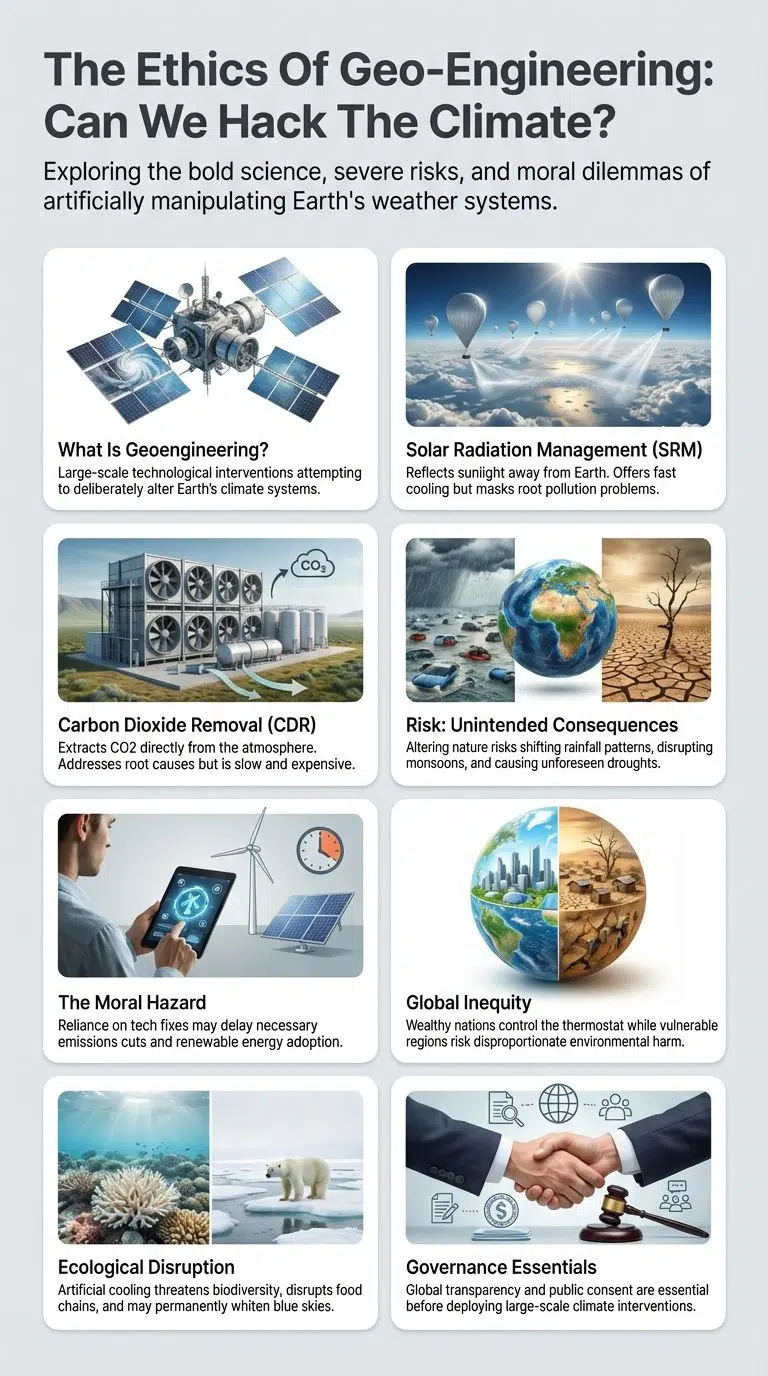
What Is Geoengineering?
Geoengineering means using big science projects to change Earth’s climate. Some people call it “hacking the sky,” but the risks and benefits need a closer look.
Definition and Scope
Geoengineering means using science and new technology to change the Earth’s climate. People often call it climate engineering or climate intervention. The goal is simple but huge: try to slow down global warming by directly changing parts of nature on a massive scale.
This idea covers many methods. The two main categories are Solar Radiation Management (SRM) and Carbon Dioxide Removal (CDR). These tools aim to lower greenhouse gases or keep sunlight from warming Earth too much. Some ideas sound straight out of science fiction, yet experts from the White House Office of Science and Technology Policy are now researching them seriously.
Many worry about risks and fairness with these approaches. Others see hope for our future if traditional climate solutions fall short. Let’s look at some leading types of geoengineering next. Each brings its own mix of promise and concern.
Types of Geoengineering
From blocking sunlight to pulling carbon from the air, there are several standout ways scientists try to tweak Earth’s weather. Each has its own twist and challenge, so keep reading for the scoop.
Solar Radiation Management (SRM)
Solar radiation management, or SRM, tries to reflect some sunlight away from Earth. One popular idea is Stratospheric Aerosol Injection. This involves planes spraying tiny reflective particles, like sulfur dioxide, high into the atmosphere.
Scientists think this could cool the planet fast. It mimics what happens when a volcano erupts. For instance, Mount Pinatubo in 1991 shot clouds of ash and gas into the sky. This single event dropped global temperatures by about 0.5°F for nearly two years.
However, SRM is not a cure. It acts more like a bandage than a fix; it masks symptoms instead of solving root problems like carbon pollution.
“Solar geoengineering is not a substitute for decarbonization. It is a potential supplement to buy time.” – Union of Concerned Scientists
Some people worry that messing with sunlight could harm crops or weather patterns. There is also the fear of “termination shock.” If we start spraying and then suddenly stop, the Earth could heat up rapidly, causing more damage than if we had done nothing.
Carbon Dioxide Removal (CDR)
Unlike solar radiation management, carbon dioxide removal targets the root cause of climate change. Machines and trees can both help pull CO2 from the air. Direct Air Capture (DAC) technology uses huge fans to suck in air and trap carbon using chemical filters. Companies like 1PointFive are building massive plants in Texas to do exactly this.
Trees do this naturally through photosynthesis, which is why forests matter so much. But machines can work faster and in places where trees cannot grow. Removing carbon is slow and expensive. For example, Climeworks’ newer “Mammoth” plant in Iceland is designed to capture 36,000 tons of CO2 per year. That sounds like a lot, but we emit over 36 billion tons annually.
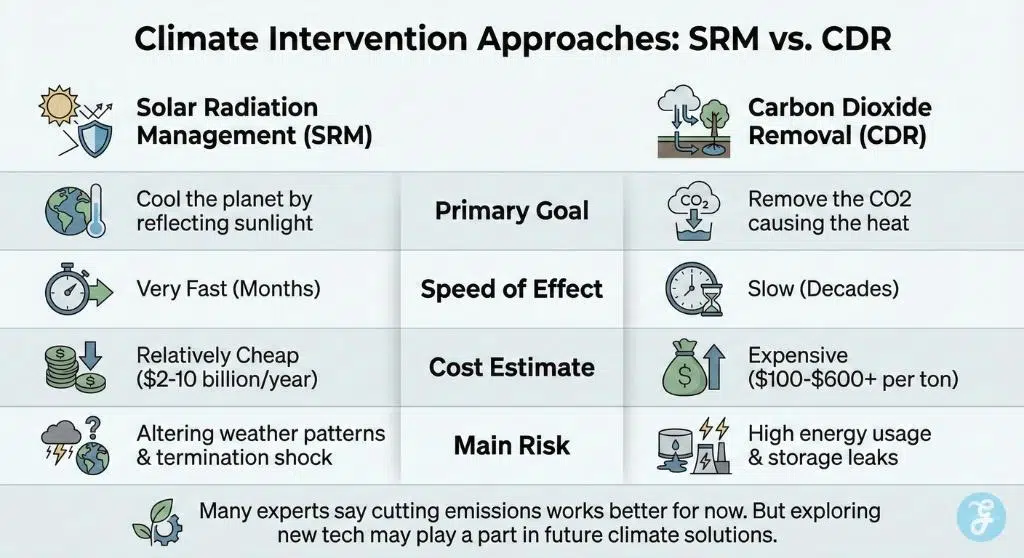
Here is a quick comparison of how these two approaches stack up:
| Feature | Solar Radiation Management (SRM) | Carbon Dioxide Removal (CDR) |
|---|---|---|
| Primary Goal | Cool the planet by reflecting sunlight | Remove the CO2 causing the heat |
| Speed of Effect | Very Fast (Months) | Slow (Decades) |
| Cost Estimate | Relatively Cheap ($2-10 billion/year) | Expensive ($100-$600+ per ton) |
| Main Risk | Altering weather patterns & termination shock | High energy usage & storage leaks |
Many experts say cutting emissions works better for now. But exploring new tech may play a part in future climate solutions.
Ethical Considerations in Geoengineering
The Ethics Of Geo-Engineering: Can We Hack The Climate? This question challenges our sense of right and wrong. The answers might surprise you, so stick around and see where the debate leads.
Moral Responsibility to Address Climate Change
Many people feel a strong duty to help stop global warming. Our everyday actions, like burning fossil fuels or using electricity from coal plants, add dangerous gases to the air.
The planet faces stronger storms, rising seas, and disappearing animal habitats because of these choices. In fact, the National Oceanic and Atmospheric Administration (NOAA) reported that the U.S. experienced a record number of billion-dollar weather disasters in recent years.
Kids born after 2010 will see twice as many wildfires and floods if we do not act now. This puts a heavy weight on our shoulders to find a solution.
Climate change does not affect everyone the same way. Poorer places suffer more damage even though rich countries caused most of the pollution in history. Groups like the United Nations urge all countries to work together for climate justice and sustainable solutions instead of just quick fixes.
The Risk of Unintended Consequences
Tinkering with climate engineering can go sideways fast. Changing sunlight levels or pulling carbon from the air could spin off problems nobody predicted. Clouds may move. Rainfall could shift. Crops might fail in places that rely on specific weather seasons, like the monsoon in India.
In 1991, Mount Pinatubo cooled the Earth, but scientists also noticed a drop in precipitation over land. This suggests that blocking sunlight could lead to droughts in the Amazon or Sub-Saharan Africa.
Geoengineering projects look powerful on paper, but nature loves to throw curveballs. One wrong tweak could hurt fragile species without warning. Risks like these make risk assessment crucial before large-scale actions begin on climate intervention or solar radiation management SRM plans.
The Potential for Moral Hazard
After exploring the risks of unintended consequences, another key issue steps into the spotlight. This is called “moral hazard.” Moral hazard happens when people take bigger risks because they feel protected. In this case, if politicians believe we can just “hack the climate” later, they might stop trying to cut emissions now.
Consider these dangerous possibilities:
- Reduced Funding: Money meant for renewable energy, like wind and solar, might get shifted to geoengineering research.
- Delayed Action: Governments might push back deadlines for net-zero goals, thinking technology will save us.
- Continued Pollution: Oil and gas companies could use carbon capture as an excuse to keep drilling.
The idea sounds tempting: hack the climate and keep our old habits. Still, this mindset risks making climate change worse in the long run. Heavy reliance on technology might lead to short-term fixes but delay real progress for sustainability and environmental ethics. It is like putting a bandage on a broken leg instead of going to the doctor. It is quick, but it is not smart for lasting health.
Justice and Equity in Geoengineering
Some people could gain, while others might lose out in this big experiment. Fairness matters, and everyone deserves a real say before any switch gets flipped.
Addressing Global Inequities
Geoengineering can change the climate for everyone, but risks and benefits may not be shared in a fair way. Wealthy nations hold more power over decisions about solar radiation management or carbon capture.
Small island countries like Tuvalu face rising seas yet often lack a strong voice in global talks. Some experts warn that large projects could make tropical storms worse in Africa or Asia while helping Europe cool down. Poor communities often suffer most from pollution and drought, yet they have less say on climate policies. People living near forests depend on healthy land for food and water; sudden changes may hurt their crops or homes.
If one country starts a geoengineering project without working with others, it could spark fights. Imagine if a private company in the U.S. changed the weather in Mexico. In fact, a startup called Make Sunsets tried launching sulfur balloons in Mexico in 2022, causing the Mexican government to ban such experiments swiftly.
Fair rules must give all people a say in how technology shapes our future. It does not matter where they live or how much money they have.
The Role of Public Participation in Decision-Making
People should have a say in climate intervention decisions. Voices from different places matter since these actions affect everyone. In 2021, the United Nations said that public input is needed to build fair policies and trust. People, not just experts or rich countries, deserve a seat at the table.
A great example of this power is the Saami Council in Scandinavia. They successfully halted a Harvard-led experiment called SCoPEx because they felt it violated their relationship with nature. This proves that local voices can stop global projects.
Fairness calls for open talks with many groups:
- Indigenous Leaders: Who have stewarded the land for centuries.
- Farmers: Who depend on predictable weather for our food.
- Scientists: Who understand the technical limits.
- Youth: Who will live with the long-term results?
Public discussions can spot problems early and help avoid mistakes that hurt vulnerable groups most. Strong public participation makes climate justice real instead of just an idea on paper.
Environmental Risks of Geoengineering
Changing the climate can shake up nature in ways we do not expect. Plants and animals may face new threats, leaving us with bigger issues than before.
Ecological Disruptions
Geoengineering can upset the balance of nature. Spraying chemicals into clouds or blocking sunlight with tiny particles might help cool Earth, but these acts can change rainfall patterns. Some places could get too much rain. Others might face long droughts. Fish and plants may struggle as oceans become more acidic from carbon dioxide removal efforts.
Small creatures like bees and butterflies also suffer when habitats shift quickly. Studies show that changing the amount of sunlight reaching Earth could hurt crops in Asia and Africa by 10 to 20 percent.
One specific risk is “sky whitening.” Injecting aerosols could turn our deep blue sky into a hazy white. This would reduce the efficiency of solar panels, ironically hurting our clean energy production.
Local animals may migrate or disappear if their homes change too fast for them to adapt. Climate intervention always carries risks for biodiversity and sustainability, no matter how careful we try to be.
Long-Term Impacts on Biodiversity
Changes in weather patterns can confuse animals and plants. Birds might lose their nesting sites or miss the right time to migrate. Some fish, such as salmon, could struggle if rivers change temperature or flow due to solar radiation management projects. Small bugs and wildflowers may vanish from areas where they once thrived.
The loss of these species upsets food chains. Mixing chemicals into clouds or removing carbon dioxide at a large scale can hurt tiny life that supports larger animals. This kind of climate intervention risks reducing the variety of living things on Earth.
Fewer kinds of plants and animals make forests, fields, and oceans weaker during future changes. These questions spark debate about how we govern new technology for climate control.
Governance and Regulation of Geoengineering
Rules and laws must guide any climate hacking so that no one acts alone or without clear limits. People need to ask big questions about who decides, who benefits, and who pays the price.
The Need for International Collaboration
Geoengineering does not respect country borders. If one nation cools the sky or removes carbon, every other place can feel the change. Disputes may break out if giant volcano-like projects are used without talking to others first. Climate interventions stretch across continents and oceans like ripples in a pond.
Countries must work together with honesty and clear rules. The London Protocol represents one of the few global agreements we have. It currently restricts dumping materials into the ocean, which limits ocean fertilization projects.
Global warming affects rich and poor nations, but some will carry heavier burdens than others. No single nation should decide for all people everywhere. International policies give everyone a voice before technology changes our shared planet forever. Next, it is time to explore how policies can be transparent for public trust and better choices for our future.
Developing Transparent Policies
Clear rules help build trust in climate engineering. Open policies let people see how choices about solar radiation management or carbon capture get made. Everyone, from scientists to citizens, should have access to information and a say in decisions that affect the planet. For example, making all data public can stop secret testing and help prevent harm.
To ensure safety, experts propose several key principles for governance:
- Public Consent: No experiments should happen without the approval of the people living there.
- Open Data: All research findings must be shared globally, not hidden by private companies.
- Independent Review: Third-party scientists must check the safety of any project before it starts.
- Liability Rules: If a project causes a drought or flood, there must be a plan for who pays for the damage.
Simple language keeps these rules easy for everyone to understand. Regular reviews hold leaders accountable if plans go wrong. Climate justice needs transparency so no group is left behind or ignored during climate intervention talks.
Strong, open policy gives voice to people who often get overlooked in global discussions about our future on this warming Earth.
The Future of Climate Intervention
Scientists weigh choices with heavy hearts, knowing each step could change the Earth in big ways. People everywhere ask if we can fix our mistakes without making new ones.
Balancing Risks and Benefits
Geoengineering can slow global warming, but it comes with big risks. Changing how the planet works is scary because we do not know every effect. For example, Solar Radiation Management might lower temperatures fast. But it could also disrupt rainfall and harm crops in Africa or Asia. Some experts worry about moral hazard since relying on tech fixes might make people care less about cutting carbon pollution.
Trying to fix climate change needs a strong risk assessment plan. Good policies must weigh quick relief against long-term ecological impact. Smart leaders ask tough questions before making decisions that affect everyone, everywhere.
Thinking ahead matters most as people look for ways to mix new technology with old-fashioned sustainability methods like planting trees and using renewable energy sources. Public participation will play a key part in shaping these choices next.
Integrating Geoengineering with Traditional Climate Solutions
Planting more trees, using renewable energy, and cutting pollution all help fight climate change. Tools like carbon capture or solar radiation management must work side by side with these classic solutions.
Solar panels on rooftops can lower the need for fossil fuels while new tech tries to cool the planet safely. Caring for nature means mixing old habits like conserving water with bold steps such as climate engineering.
The U.S. Department of Energy has launched the “Carbon Negative Shot” initiative. This program aims to lower the cost of carbon removal to under $100 per ton. This shows a commitment to making these tools practical, not just theoretical.
Local farms may plant cover crops to keep soil healthy even as scientists test ways to pull carbon from the air. No single answer fits all. Teamwork matters; blending new ideas with proven methods builds a safer future for everyone.
Final Thought: Who Do We Want To Be?
We explored how geoengineering could change our climate, from blocking sunlight to pulling carbon from the air. These ideas seem huge, but each comes with real risks and tough choices. Is tweaking Earth’s weather a shortcut or another mess waiting to happen? Think about your part in this story. Should we use quick fixes or focus on proven solutions like clean energy and planting trees?
Now is the perfect time to ask yourself what kind of future you want for the planet.