The white dress is still there. The champagne is still cold. But at a wedding in 2026, the vows have undergone a quiet, radical surgery. Instead of “to the exclusion of all others,” the couple promises “to the inclusion of radical honesty.” They don’t swear to be each other’s everything until death. Instead, they pledge “conscious evolution.” If the relationship stops serving their individual growth, they agree to redesign it rather than endure it.
This is the face of a new era. Monogamy isn’t dying, but its monopoly has collapsed. As millions prepare for Valentine’s Day, the conversation has shifted; this is the year When Monogamy Meets Reality, and the results are written in the data rather than on greeting cards.
For decades, monogamy was the “default setting”: the only socially acceptable operating system for a life together. In 2026, it is just one choice in a growing menu of partnership models. We have shifted from Default Monogamy to Designated Partnership. People are no longer stumbling into exclusivity; they are negotiating it, or opting out of it entirely.
The cracks in the pedestal are partly psychological, but they are mostly practical. The “Soulmate” burden has reached a breaking point. We expect one person to be our lover, best friend, co-parent, and therapist. Human beings are living longer and working harder. Expecting one person to satisfy every need for 60 years is increasingly viewed as a statistical impossibility.
Economic reality has accelerated this shift. The “Dual-Income, No Kids” (DINK) lifestyle is no longer a niche choice; it is a survival strategy. In a volatile 2026 economy, the traditional nuclear family is expensive and fragile.
As a result, people are “diversifying their emotional portfolios.” Just as they wouldn’t put all their savings into a single stock, they are hesitant to put their entire social and emotional well-being into one person. Marriage was once an economic necessity for survival. Today, it is a lifestyle luxury. And when survival isn’t the primary goal, the rules of the game change.
Reality has finally caught up with the ritual. The pedestal is cracking because we have realized that a relationship’s strength isn’t measured by its exclusivity, but by its transparency.
When Monogamy Meets Reality: Two Tales of One Truth

The Guwahati Blueprint: Sulakshana and Jyotipriyo
In the hills of Guwahati, where tradition usually sits heavy on the mist, Sulakshana Medhi and Jyotipriyo Gogoi are living a quiet revolution. Married for eight years, they look like the quintessential Assamese couple to their neighbours. They host Bihu dinners and share a mortgage. But inside their home, the “default” model has been dismantled.
Sulakshana, a high-performing architect, found herself hitting a wall of emotional invisibility three years ago. The routine was killing the relationship. Instead of seeking a divorce or drifting into a silent affair, they sat down at a small cafe in Pan Bazar and rewrote their vows.
They adopted a monogamish structure. Jyotipriyo, who travels frequently for his tea consultancy, and Sulakshana agreed that their home is their “primary anchor,” but they no longer demand sexual or emotional monopoly. For them, the 86% acceptance rate in Guwahati isn’t a statistic. It is the air they breathe. They stay together not because they have to, but because they have the freedom to be themselves.
The New York Experiment: William and Anna
Six thousand miles away in a sun-drenched loft in Brooklyn, William and Anna are practising what they call Relationship Anarchy. Unlike the Guwahati couple, they have stripped away the hierarchy of “husband” and “wife” entirely.
William is a software developer; Anna is a freelance curator. They have been “partners” for five years, but they do not use the term to imply exclusivity. In New York, where 38% of singles have tried non-monogamy, William and Anna are the extreme edge of the trend.
Their reality is built on a “Village” concept. Anna has a deep, semi-romantic bond with a friend in Berlin, while William shares a domestic life with Anna but maintains a separate dating roster. They don’t see this as a lack of commitment. They see it as a higher form of it. They check in every Sunday night for a “State of the Union” meeting to discuss boundaries, health, and emotional vibes.
The Human Commonality: Transparency Over Tradition
Despite the distance, these couples are solving the same problem: protecting the relationship from the rot of secrecy. Sulakshana and Jyotipriyo use their model to prevent stagnation, while William and Anna use theirs to protect their individual identities from being swallowed by a “couple” brand.
In both cases, the driver is not a desire for “more” sex. It is a desire for more honesty. They have realized that the traditional pedestal was a cage. By stepping off it, they have found a ground that is more stable because it is real. In 2026, these couples are the new reality: they are choosing clear communication over comfortable illusions.
The Science of the Shift
The Death of the “Happiness Gap”
For a century, society operated under the assumption that monogamy was the only path to a stable, happy life. The turning point came in March 2025, when the data finally dismantled that monopoly.
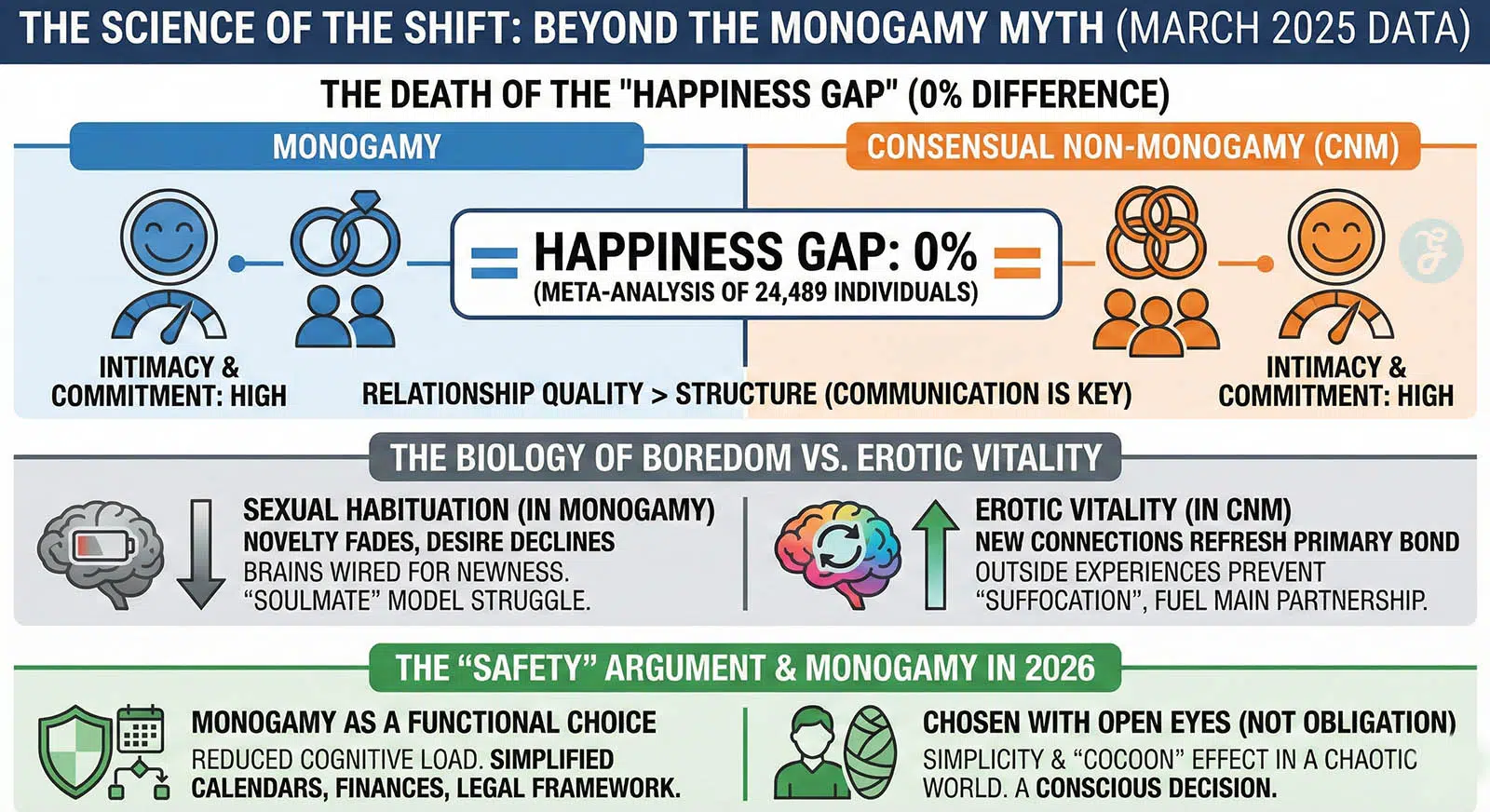
Published in March 2025, a landmark meta-analysis in The Journal of Sex Research effectively reset the global conversation. Analyzing data from 24,489 individuals across the US, Europe, and Australia, researchers looked for the long-assumed “happiness penalty” in non-traditional couples.
They found a literal 0% Happiness Gap. The findings proved that by the mid-2020s, the structure of a relationship had become secondary to its quality.
Lead researcher Dr. Joel Anderson famously used this data to debunk the “Monogamy-Superiority Myth.” The study confirmed that Consensual Non-Monogamy (CNM) couples reported levels of intimacy and commitment identical to their monogamous neighbours. The data proved that relationship success is not a matter of head-counts, but the quality of the communication.
The Biology of Boredom
Science is also shedding light on why the “Soulmate” model often feels like a struggle. It’s called Sexual Habituation.
Our brains are wired for novelty. In long-term monogamy, the “newness” of a partner fades. This often leads to a sharp decline in desire, even when the love remains strong.
CNM couples often report higher levels of “Erotic Vitality.” By allowing outside experiences, they prevent the “suffocation” of the primary bond. They use the energy from new connections to fuel their main partnership. They aren’t replacing their partner; they are refreshing the relationship’s air supply.
The “Safety” Counter-Argument
If the happiness gap is zero, why does monogamy still exist? Because it is efficient.
Monogamy offers reduced cognitive load. You don’t have to manage multiple calendars, emotional triggers, or health screenings. It provides a clear legal and financial framework that the world is already built for.
In 2026, monogamy is being reclaimed as a functional choice. It is no longer a moral obligation. Many choose it for the simplicity and the “cocoon” effect it provides in a chaotic world.
The difference now is that people are choosing it with their eyes open. They aren’t doing it because they have to. They are doing it because they want to.
From Shame to Self-Awareness: Reclaiming the Neglected Self
Sybil Shiddell, Head of Asia-Pacific at Gleeden, observes:
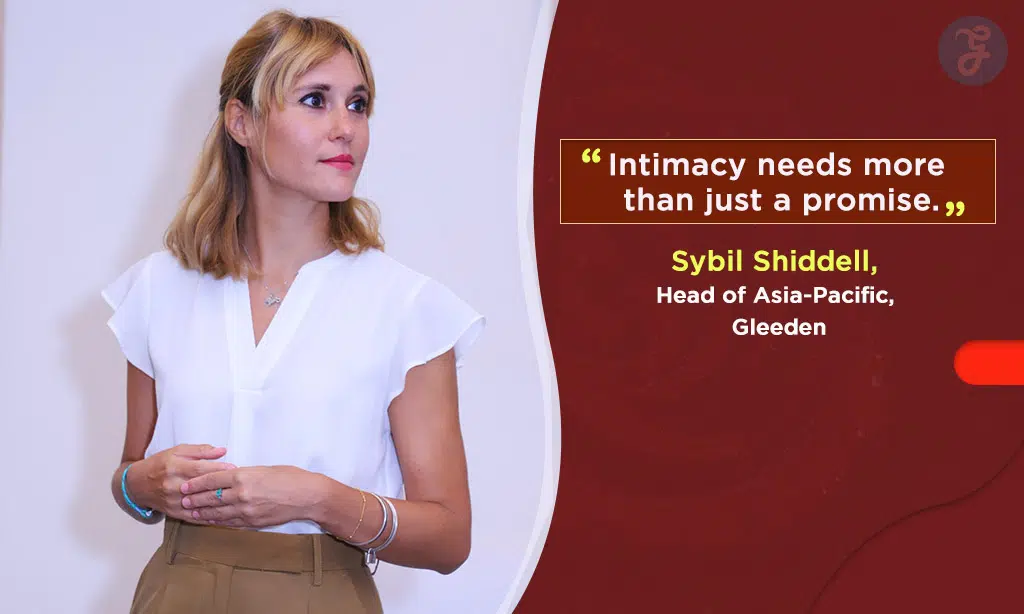
“The dissatisfaction users express with monogamy today often has less to do with sex and everything to do with emotional invisibility. In long-term relationships, many describe feeling unseen, trapped in routines dictated by responsibility, caregiving, and social pressure. While monogamy promises fulfillment, it often lacks the tools to sustain intimacy over decades. What creates distance isn’t always a single betrayal; it is the silence surrounding unmet needs that are rarely acknowledged, let alone addressed.
In 2026, the emotional landscape of secrecy has shifted. And this Valentine’s Day, it’s impossible to ignore. Secrecy remains, but guilt has evolved. For many, the dominant feeling is no longer moral conflict, but emotional justification. Modern affairs are less about impulsive desire and more about conscious responses to prolonged emotional deprivation. People do not necessarily feel proud of these choices, but they feel honest about why they made them.
This marks a transition in how we understand accountability. Affairs are no longer framed solely as moral failures; they are signals of unresolved gaps within rigid relationship structures. The narrative has shifted from shame to self-awareness. People seek outside connections not to escape commitment, but to reclaim the parts of themselves that have been emotionally neglected. In this light, modern infidelity reflects a re-evaluation of how emotional needs are recognized and sustained in long-term partnerships.”
The Global Ripple Effect
The India Pivot: A Cultural Shockwave
In 2026, the most surprising shift in relationship dynamics isn’t happening in Berlin or Brooklyn. It is happening in India.
The Gleeden-IPSOS 2025 study sent shockwaves through the subcontinent. It found that 69% of Indians now believe non-monogamy is socially acceptable. Even more startling: 35% of respondents admitted they are already in an open relationship.
This isn’t just a trend for the “metropolitan elite.” The data reveals a fascinating anomaly. Acceptance in Tier-2 cities is often higher than in the mega-metros.
The Guwahati vs. Mumbai Anomaly
While Mumbai, the supposed capital of modern Indian romance, shows a 69% acceptance rate, Guwahati has skyrocketed to 86%. Jaipur follows closely at 77%.
Why are smaller cities outpacing the metros? Sociologists point to the “performative” pressure of big-city life. In Mumbai or Delhi, people are hyper-aware of their social brand. They often feel they must “perform” the perfect, modern-yet-traditional marriage.
In Tier-2 cities, the pressure is different. There is less of a “dating rat race.” The slower pace of life allows for more honest, private conversations between partners. Without the constant noise of the metro “scene,” couples are quietly negotiating their own rules.
The Western “Summer of Love”
In the United States, the 2025 Hims & Hers report confirms a massive generational fracture. The “Summer of Love” has returned, but it is fueled by pragmatism rather than just rebellion.
68% of Gen Z Americans are now open to non-monogamy. Contrast this with only 43% of Baby Boomers.
For Gen Z, monogamy is no longer a moral goal; it is a lifestyle choice that many find “outdated.” They are the most likely to view sexual and emotional exclusivity as separate buckets. For them, a partner can be a primary life anchor without being the only source of intimacy.
The “Dating Recession” and Solo Partnership
Perhaps the biggest driver of this shift is the 2026 Dating Recession. A report from the Wheatley Institute shows that only 1 in 3 young adults is actively dating.
Burnout is the primary cause. After years of “swipe fatigue” and “ghostlighting,” many are opting out of the search for “The One.” This has led to the rise of Solo Partnership.
Solo Partnership isn’t about being “single.” It is a strategic choice to prioritize “self-partnership.” These individuals focus on their own career, health, and platonic “village” rather than pursuing a mediocre monogamous relationship.
In 2026, many find that a solo life, supplemented by casual, honest connections, is more fulfilling than a traditional model that no longer fits the reality of modern life.
The New Dictionary of Desire
The 2026 Relationship Glossary
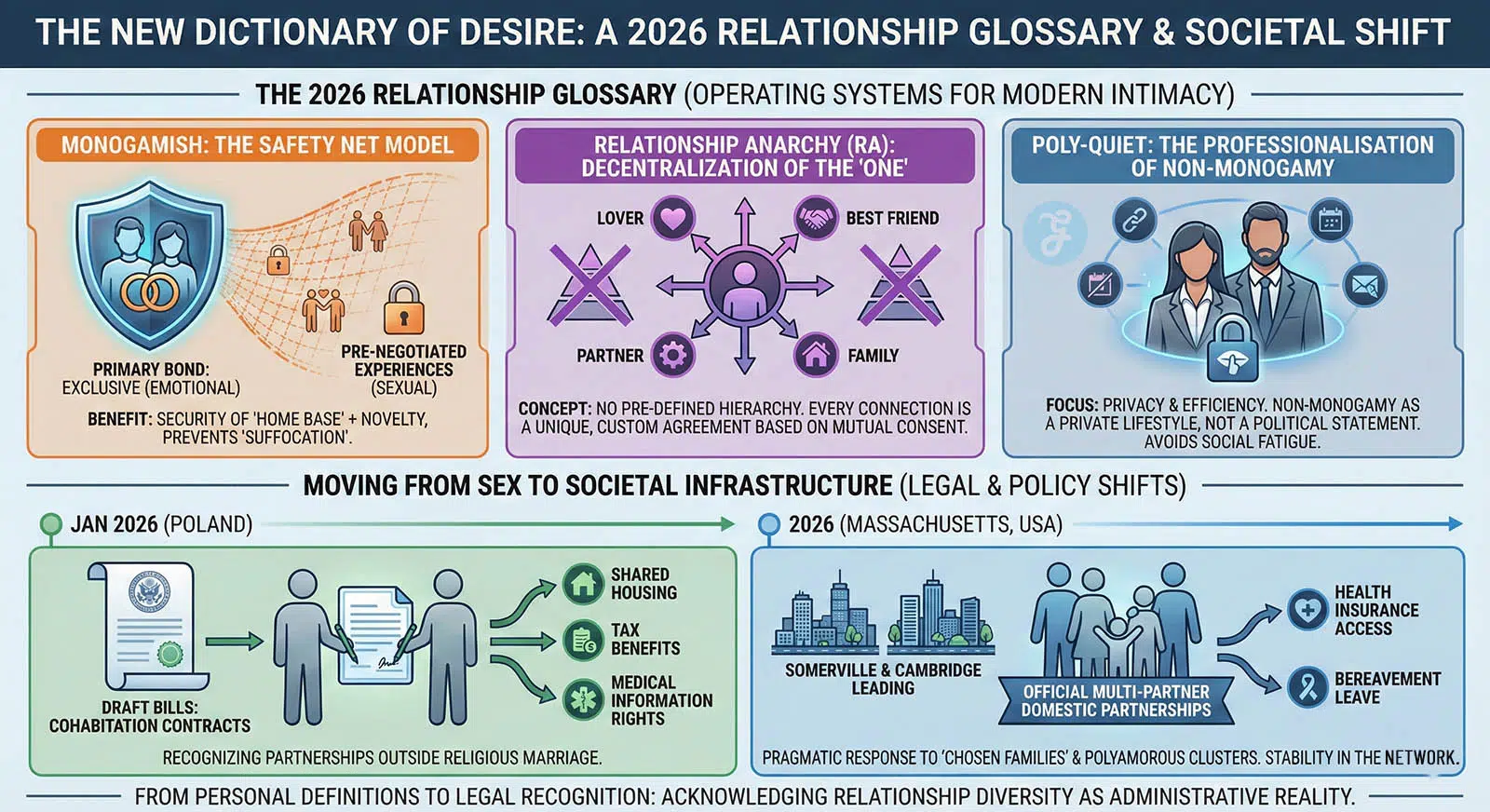
As traditional models face scrutiny, a new vocabulary has emerged to describe how people actually live and love. These aren’t just slang terms. They are the “operating systems” for modern intimacy.
Monogamish: The Safety Net Model
Monogamish is the compromise model for the 2020s. Coined originally by Dan Savage, it has become the dominant choice for Millennial couples in 2026 who value their primary bond but acknowledge the reality of human desire.
In this model, a couple remains emotionally and romantically exclusive. However, they allow for pre-negotiated sexual experiences with others. It acts as a safety net. It provides the security of a “home base” while preventing the “suffocation” that can come from total exclusivity over several decades.
Relationship Anarchy: The Decentralization of the “One”
Relationship Anarchy (RA) is the most radical shift in the 2026 lexicon. It rejects the idea that a romantic partner should automatically sit at the top of a person’s life hierarchy.
In RA, no relationship, whether romantic, sexual, or platonic, is prioritized based on a label. A best friend might be as vital to a person’s daily life and financial planning as a lover. It dismantles the “pedestal” entirely. It treats every connection as a unique, custom-built agreement based on mutual consent rather than societal rules.
Poly-Quiet: The Professionalisation of Non-Monogamy
A major trend for 2026 is Poly-Quiet Dating. This is the choice to practice non-monogamy without the “loud and proud” advocacy seen in previous years.
It is particularly popular among high-earners and professionals. These individuals prioritize privacy and low-key management of their multiple partners. They avoid public “scenes” or grand declarations. For the Poly-Quiet, non-monogamy is a private lifestyle efficiency, not a political statement. It is about deep connection without the social fatigue of explaining one’s life to everyone else.
Moving From Sex to Societal Infrastructure
The shift away from traditional monogamy is no longer just about personal preference. It is moving into the realm of law and corporate policy. We are seeing a move from “who you sleep with” to “how society recognizes your family.”
In January 2026, the Polish government introduced draft bills for Cohabitation Contracts. These allow any two adults, regardless of gender, to register a partnership. This provides legal rights to shared housing, tax benefits, and medical information. It signals a major shift in a traditionally conservative nation toward recognising partnerships outside of religious marriage.
Massachusetts and the Legal Frontier
In the United States, cities like Somerville and Cambridge, Massachusetts, continue to lead the way. They have officially recognised multi-partner domestic partnerships.
This allows groups of three or more adults to access health insurance and bereavement leave previously reserved for married pairs. It is a pragmatic response to the reality that many people in 2026 are building lives in “chosen families” or polyamorous clusters. These laws move the conversation from moral judgment to administrative reality. They acknowledge that in 2026, stability is found in the strength of the network, not just the couple.
The Infrastructure of Intimacy
The App Fatigue Catalyst
In early 2026, the University of Minnesota Duluth (UMD) released a report that redefined the “dating scene.” It focused on Dating Burnout as a public health crisis.
The study found that the endless cycle of swiping has led to profound emotional exhaustion. Users are no longer finding “connection.” They are finding “market fatigue.” The constant need to market oneself and decode mixed signals has made dating feel like unpaid labour.
This burnout is pushing people to question why they are searching for a single “soulmate” in the first place. If the tools to find “the one” are broken, perhaps the goal of finding “the one” is the problem.
The Impossible “Soulmate” Burden
For decades, we have inflated the job description of a romantic partner. In 2026, we are finally admitting that this burden is unsustainable.
We expect one person to be a passionate lover, a best friend, a steady co-parent, a financial co-pilot, and a primary therapist. Sociologists call this the “Soulmate Burden.” It is a high-pressure model that almost guarantees failure.
When a partner fails in just one of these five roles, we often view the entire relationship as a failure. In 2026, couples are realizing that no human being can satisfy such an impossible mandate. By lowering the expectations on a single partner, people are finding that their relationships actually become more stable.
The Return of “The Village”
The loneliness epidemic has reached a peak in 2026. Paradoxically, the solution for many is a return to an ancient model: The Village.
Modern non-monogamy is often less about “more sex” and more about “more support.” By opening up their relationship models, people are building communal networks. They are creating “chosen families” that share the emotional and physical load of modern life.
In these networks, a partner is a primary anchor, not a solo safety net. You have a web of connections for childcare, emotional crisis, or financial help. This decentralization of intimacy is a direct strike against the isolation of the nuclear family, turning a fragile two-person unit into a resilient communal structure.
Practical Support Over Romantic Fantasy
This shift is a move toward Relational Resilience. When you have a village, a breakup or a personal crisis doesn’t lead to a total collapse of your life.
Ethical non-monogamy and “relationship anarchy” are providing the infrastructure for this new village. People are finding that they can combat loneliness more effectively through a network of honest, varied connections than through a single, high-pressure monogamous bond. In 2026, the village isn’t just a nostalgic idea. It is a necessary survival strategy.
When Monogamy Meets Reality: The Future of “The One”
The Tech Angle: AI as an Emotional Outlet
In 2026, the definition of a “third party” in a relationship has shifted. It is no longer always human.
The landscape of fidelity has been complicated by the rise of generative AI companions and hybrid platforms like Flirtcam.ai. While generative chatbots offer 24/7 emotional validation and scripted roleplay, hybrid platforms allow for a blend of AI-driven interaction and human-led digital intimacy. For many, these outlets provide a way to satisfy specific needs that a primary partner cannot meet: all without the perceived “risk” of a physical, human affair.
However, this technology complicates the definition of cheating. If you are sharing your deepest secrets with an AI instead of your spouse, is that a betrayal? In 2026, “digital infidelity” is a leading cause of tension. Many couples are now forced to include “AI boundaries” in their relationship agreements to define what counts as a breach of trust.
Solo Partnership and the Rise of AI Bonds
For those practicing Solo Partnership, AI is a feature, not a bug. These individuals choose to remain their own “primary partner” while using AI for companionship.
AI companions don’t get moody. They don’t have “bad days.” They offer a level of predictable, non-judgmental support that human partners often struggle to maintain. For a generation exhausted by dating apps, an AI that “understands” them perfectly is a tempting alternative to the messiness of traditional dating.
The risk, according to psychologists, is the “Comfort Trap.” If an AI always agrees with you, you may lose the “relational muscles” needed to handle conflict with real people. In 2026, we are learning that while AI can provide comfort, it cannot provide the growth that comes from being challenged by another human.
The Expectation was the Failure
Monogamy is not failing in 2026. What is failing is the monopoly of monogamy.
The traditional model hasn’t changed, but the reality surrounding it has. We are living longer, working more, and expecting more from our partners than any previous generation. When we label monogamy as “the only way,” we set millions of people up for a sense of personal failure when they inevitably struggle.
Monogamy works best when it is a deliberate, conscious choice made by two people who understand the trade-offs. It fails when it is a cage that people feel they cannot leave without losing their social standing.
The Final Word: Authenticity Over Longevity
In 2026, we are witnessing the end of “longevity at all costs.” For decades, a “successful” marriage was simply one that lasted until death, regardless of the misery involved.
Today, relationship success is being redefined as Authenticity. A relationship that lasts five years and ends with mutual respect and growth is now viewed as more “successful” than a forty-year marriage built on silence and resentment.
The future of “The One” is no longer about finding a person who completes you. It is about finding a way of living that allows you to be your most honest self. Whether that involves one partner, multiple partners, or an AI companion, the goal in 2026 is clarity over conformity.
Read Part 1: Beyond the Pair: Why 2026 Rebranded Valentine’s Day Infidelity as ‘Essential’
Visit: Editorialge Eco Valentine Shop
Note: All names and identifying details in the case studies have been changed to protect the privacy and identity of the individuals involved.