

Many people spend hours searching for ways to boost their website’s search engine rankings. You might stack up backlinks, tweak your keywords, and still feel stuck on page two of Google. If this sounds familiar, you are not alone. Here is a fact you need today: In 2026, Topical Authority matters more than having lots of backlinks. Search engines now care more about content quality and subject expertise than simple link numbers.
I’m going to walk you through what Topical Authority means, why it outweighs link-building tricks, and how you can use it to stand out online. Stick with me if you want real answers on Topical Authority Vs Backlinks!
What is Topical Authority?
Topical authority shows how well you know a subject by the value and depth of your content. Think of it as showing up to a cookout with the best dish, everyone notices, and search engines do too.
Define and Explain Its Importance
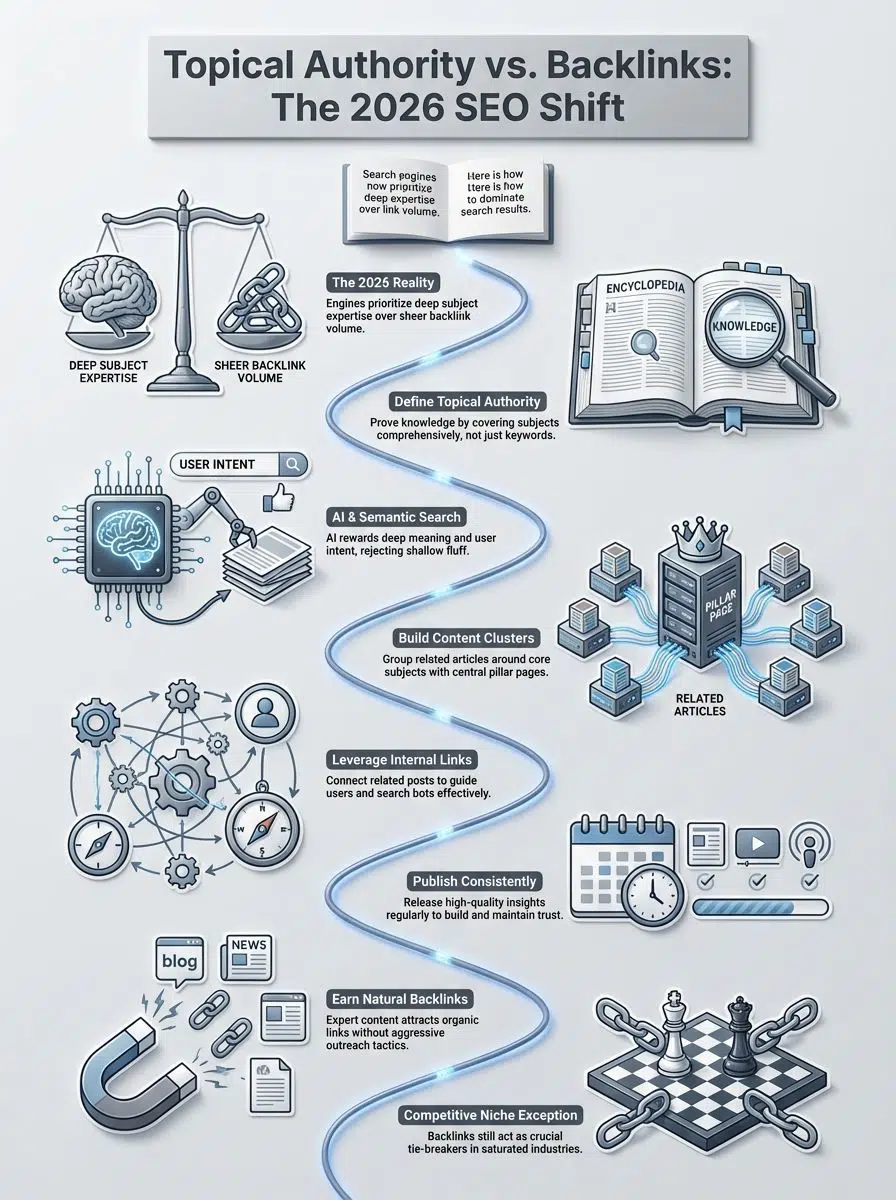
Topical authority means your website shows deep knowledge about a subject. People see you as the expert when they search for answers online. Search engines watch if you cover every angle of a topic and link related ideas together, not just sprinkle keywords around.
In my work as a front-end engineer, I often compare SEO to writing clean code. You can’t just patch a buggy application with external libraries and expect it to run smoothly; the core architecture has to be solid. Topical authority is that core architecture.
For example, a cooking site becomes an authority if it explains recipes, ingredients, methods, health tips, and reviews, all tied to food. Building this strength helps in SEO strategies now more than ever before. In 2026, Google’s algorithms care less about isolated backlinks and more about clear expertise shown through content relevance and coverage depth.
Sites that show real subject matter expertise get higher organic search rankings because users rely on them for trustworthy answers. This brings steady traffic without chasing after random links or using weak shortcuts that may backfire.
Topical Authority Vs Backlinks: Comparison
Grasping the difference between topical authority and backlinks can feel like comparing apples to oranges, yet both matter for SEO. Here’s a point-by-point comparison that clears the fog:
| Aspect | Topical Authority | Backlinks |
|---|---|---|
| Core Idea | Shows expertise on a subject via content clusters. | Other sites link to your page as a “vote.” |
| Value for SEO (2026) | Primary factor. Feeds AI models like Google Gemini with context. | Secondary factor. Heavy weighting reduced to fight spam. |
| How Engines Judge | Semantic connections, entity coverage, and internal linking. | Quantity, relevance, and “toxicity” score of links. |
| Long-Term Stability | High. Improves with every relevant post you add. | Volatile. Links can rot, break, or be disavowed. |
| Control | 100% in your hands. You own the code and content. | Low control. Depends on webmasters you don’t know. |
| Manipulation Risk | Low. It is hard to fake deep expertise. | High. Buying links is a common path to penalties. |
| Google’s Stance | Rewards “Information Gain” and depth. | Filters out “unnatural” patterns via SpamBrain. |
| Example | A JavaScript blog covering closures, scopes, and 30+ frameworks. | A generic tech blog with 50 random links from unrelated sites. |
The Significance of Topical Authority in 2026
Search engines now favor deep, clear expertise over scattered signals. Websites that show real knowledge on a subject rise fast, leaving shallow content in the dust.
The Shift Toward Content Depth and Relevance
Google’s core updates over the last two years have made content quality and topic relevance the top ranking factors. Search engines now check if a page answers real user questions, proves expertise, and covers a subject with accuracy. Thin pages that only repeat keywords cannot pass as trustworthy or expert anymore.
AI-driven search tools dig deeper than ever before. They connect ideas, compare facts, and spot shallow writing fast. Long articles stuffed with fluff or random links lose value. The websites winning in SEO focus on deep knowledge and tie it all together for their users’ intent.
According to data from Search Engine Land, pages that cover a topic comprehensively rank for 20% more keywords than those that rely on length alone. This proves that coverage matters more than word count.
Semantic Search Enhancement and User Intent
Content depth matters, but so does how search engines understand it. In 2026, Search Engine Optimization pulls ahead with smarter semantic search. AI-driven systems do more than match keywords now. They look for real meaning in your sentences and check if the content answers the user’s needs.
User intent acts like a compass for these tools. If someone types “how to fix a dripping faucet,” the algorithms scan your post for step-by-step help or expert tips, not just keyword stuffing. This shift brings subject matter expertise and topic relevance into focus as ranking factors.
“Search is getting brains and knows what you mean, not just what you type. Optimizing for entities, people, places, and things is the new keyword research.”
AI-driven Search Engines and Their Impact
AI-driven search engines like Google Search and Bing use smart algorithms to understand user intent better. These engines no longer depend just on counting backlinks. They analyze topic relevance, content quality, authority signals, and expertise much deeper than before. In 2026, search results will follow this trend even more.
A page filled with helpful information around one core subject often ranks higher now. Google’s Knowledge Graph helps these AI systems connect facts across different topics fast. Digital marketers focus on topical authority because AI can spot shallow or thin pages in a blink.
Brands that show true subject matter expertise get rewarded with improved visibility in organic search rankings and steady organic traffic flow. This shift pushes everyone to improve quality instead of chasing shortcuts through link schemes or old SEO strategies from years past.
The Declining Impact of Backlinks in 2026
Backlinks used to open doors, but now they often just hold them ajar. Search engines crave deeper signals of trust, something more than borrowed authority from other sites.

Relying on External Site Validation
Depending on other websites for validation means your site needs their approval to look trustworthy. This puts control in someone else’s hands. If those sites change their mind or lose quality, your own Search Engine Optimization (SEO) suffers fast.
Google and AI-powered search engines now focus more on content relevance and deep expertise than son imple links from outside sources. Building trust should come from strong topic coverage and well-organized content clusters instead of chasing random backlinks.
Site owners used link-building as a shortcut before, hoping that good links alone would boost rankings or digital credibility. This trick stopped working by 2026 because search engines learned to spot weak signals and empty authority signals quickly.
Now, only true knowledge graph strength and clear subject matter expertise move the SEO needle forward in organic search results. The game favors those who build value around topics users care about instead of counting votes from strangers online.
Ineffectiveness of Poor Link-Building Techniques
Cheap link schemes used to trick search engines, but they fizzle out fast now. Google’s SpamBrain AI can spot fake backlinks or spammy patterns in seconds. Sites that buy links end up with lower rankings or even get removed from results. By 2026, search engine optimization will focus on content quality and topic relevance instead of chasing weak authority signals.
A pile of low-value backlinks does not build real trust for your site. Search engines look at how useful and clear your topics are for users. If you stuff pages with random links, it confuses both people and search bots alike. Smart SEO strategies invest in topical authority, not outdated tricks that only fool algorithms briefly before backfiring.
Complications in Competitive Marketplaces
Poor link-building tricks often fizzle fast, especially as more brands chase top search engine spots in 2026. Giant websites with strong topical authority block out newcomers who only rely on backlinks. Search Engine Optimization now leans harder on content quality and topic relevance, not just Domain Authority or old-fashioned links.
Brands try to boost domain authority by gathering hundreds of links overnight, but that approach fails in demanding markets like online banking or health care. Heavyweights flood Google’s Knowledge Graph with pages packed with depth and expertise.
Smaller sites struggle to be seen without proof of real subject matter expertise. In busy digital marketing trends, having a mountain of weak backlinks throws you in a crowded race; here, it is true topical authority that moves your organic traffic needle and sets you apart from the pack on even the noisiest SERPs.
Strategies to Develop Topical Authority
Smart steps can help you stand out as the expert, so keep reading to pick up a few tricks. I treat this process just like mapping out a database schema; everything needs to relate to everything else logically.
Design Content Clusters Around Core Subjects
Grouping your content around core subjects builds authority fast. People and search engines like easy paths through deep, related information.
- Pick a niche topic: Choose a main topic that matches your niche and audience needs. This could be “Front-End Web Development” or “Organic Search SEO.”
- Map your questions: List ten to twenty questions, problems, or subtopics people have about this subject. Tools like AnswerThePublic are fantastic for visualizing what real people are asking.
- Create the hub: Write pillar content that covers the main topic deeply. This long guide acts as the hub for your cluster.
- Build the spokes: Build out supporting articles focused on those subtopics. Shorter posts answer specific questions or explain key parts in detail.
- Link it all together: Link each subtopic post back to your main pillar content using internal links. Also, link closely related posts inside the cluster.
- Use semantic language: Use clear keywords in every article title and header, such as “Content Quality,” “Expertise,” or “Authority Signals.” This boosts relevance and clarifies your site’s purpose for both humans and machines.
- Maintain freshness: Update each piece often with new facts, examples, or Google SEO changes from 2026 to keep it fresh and accurate.
- Show, don’t just tell: Highlight real tools, code samples, or case studies when possible. If you are showing how “Knowledge Graph” gives better online trust, include diagrams or practical tips from GitHub projects.
- Drive interaction: Encourage comments or feedback at the end of each post to spark user engagement and signal higher value to search engines.
- Analyze and iterate: Track which clusters drive more organic traffic using analytics. Double down on hot topics; prune weak ones to focus only on high-impact clusters.
This approach gives you strong topic relevance and digital credibility step by step.
Strengthen Topic Depth with Internal Links
Internal links act like bridges, helping readers and search engines move across your website. They boost content relevance, support SEO strategies, and grow topic authority. You can use tools like Screaming Frog to visualize your site’s architecture. If you see a page floating by itself without links, that is a problem.
- Connect related articles with descriptive anchor text to help users find more on a subject.
- Link new posts back to cornerstone content, signaling expertise on core ideas within your niche.
- Use internal links to highlight supporting guides or FAQs that explain complex terms or topics.
- Update old blog pages with fresh links that reference recent research, keeping the whole site current and trusted.
- Structure topic clusters with clear pathways for readers, making sure they can explore all layers of your knowledge graph easily.
- Place internal links in key places such as intros and summaries so both readers and bots grasp main connections fast.
- Integrate story-driven case studies as link targets to add depth and keep user engagement high.
- Balance the number of internal links per page; too many make things messy for people and search engines alike.
- Raise domain authority by sending link signals throughout your site, building stronger digital credibility every time someone clicks through.
- Boost organic traffic since people tend to stay longer exploring linked topics that matter most to them.
Commit to Regular, High-Quality Content Publication
Strong internal links set the stage for great content growth. Publishing often, with care for content quality, builds topical authority fast. Google’s AI-driven search in 2026 values fresh and expert articles over stale or thin pages. Think of each new post as another brick in your subject-matter house; you want walls, not just single stones.
Sites that push out rich insights week after week show digital credibility to both readers and search engines. Timely updates keep your site relevant in hot topics and maintain an edge over competitors lagging behind on SEO strategies. Consistency signals trustworthiness, a key ranking factor for organic search success today and tomorrow.
Topical Authority and Backlinks Interconnection
Strong content often draws links because people value expert answers. By focusing on topic depth, you can attract natural interest from other sites.

Natural Backlink Acquisition through Authority
Sites with strong topical authority often attract organic links. Other site owners, writers, and even journalists turn to trustworthy sources to back up their own work. Say you post detailed guides or in-depth tutorials about building a digital marketing strategy for 2026. Website owners might reference your expertise by linking back to your page as proof of content quality or subject matter expertise.
Google’s algorithms favor real authority signals over spammy link-building tactics more each year, especially after 2024’s search updates aimed at weeding out low-value backlinks. A famous example is DigitalOcean; their tutorials are so good that developers link to them constantly, even if they don’t use the hosting service.
As your topic relevance grows and user engagement rises, people share and recommend you naturally; that is how search engine optimization works best now. Those high-quality links can boost organic traffic further without chasing after every possible backlink yourself.
Supporting Role of Backlinks in Competitive Areas
Gaining links by showing subject matter expertise leads to steady growth. In tough markets, backlinks give your content a nudge, helping it reach the top in search engine rankings.
| Strategy | Outcome |
|---|---|
| Active Outreach | High effort, low yield. Often ignored by busy editors. |
| Passive Link Earning | Create “Reference Content” (stats, definitions) that writers need to cite. |
| Broken Link Building | Helping webmasters fix 404s by offering your superior content as a replacement. |
Digital trust signals like backlinks still count for SEO strategies, especially if many brands battle for niche domination or are backed by large teams with strong profiles. Think of backlink power as boosting a runner’s speed at the final stretch. Even as topical authority takes first place in 2026, high-quality backlinks from trusted domains sharpen your edge.
Large companies and new players both use these authority signals to gain organic traffic faster. It is about building on a solid foundation of expertise and letting good links push you ahead where competition gets fierce.
Scenarios Where Backlinks Remain Crucial
Sometimes, the race for the top spot gets cutthroat fast. Backlinks step up as your secret sauce when you need to prove your site is worth a second look.
Highly Competitive Industries
Finance, health, and law websites fight hard for every spot in search results. Topical authority shines here. Google now chases deep knowledge over shallow links. In 2026, strong content that covers a subject from many angles wins more trust from both users and AI-driven search engines.
A single backlink will not move the needle much against giants like WebMD or Investopedia. Sites must show true expertise with rich content clusters around core topics. This drives organic traffic better than old-school link swapping ever could. Authority signals matter most where the competition is fierce, and change comes fast.
Trust Verification for New or Lesser-known Sites
Google checks trust for unknown sites using many signals. Backlinks from trusted domains help show search engines that your site is safe and honest. In 2026, with stricter AI-driven rules, new sites need proof of credibility more than ever. A few strong links from known sources can boost online trust fast.
AI tools like Knowledge Graphs scan the web for authority signals quickly. They look at incoming links, mentions on social media, and public reviews to confirm reliability. Small or fresh websites often get a big lift in rankings if respected sites mention them even just once or twice. These signals tell users and search engines you care about accuracy and content quality right out of the gate.
Focusing on Topical Authority for Sustained SEO Impact
Building real expertise around a subject pays off for years, as search engines now value deep knowledge over link quantity. Shaping your site into an expert hub can draw steady attention and spark curiosity for more advanced ideas.
Advantages of Becoming an Authoritative Source
Sites with clear expertise pull in more organic traffic. Google and other search engines look for subject matter expertise before ranking pages high. People start to see the site as a trusted place for answers. Readers spend more time on the site, clicking and coming back often. Topical authority helps content show up faster in search results, especially within specialized niches.
Reputed sources get cited by others naturally without begging for links. Experts attract natural backlinks as proof of digital credibility and trustworthiness. More brands want partnerships; advertisers notice too. Niche dominance grows because users know where to go first for solutions that match their intent or needs. Search engine optimization works smarter since quality signals beat old ranking factors like weak backlinks every time.
Conformance with Current and Future SEO Trends
Google’s updates now reward expertise, content quality, and topic relevance over link quantity. AI-driven search systems focus on understanding user needs by analyzing in-depth subject coverage and accurate authority signals.
To stay ahead by 2026, websites must build niche dominance through clear knowledge graphs and strategic keyword optimization.
“The future of SEO isn’t just about being found; it’s about being the only logical answer. When you cover a topic so well that users don’t need to go anywhere else, you win.”
Search engines keep changing their algorithms to prefer informative content that satisfies user intent. Writers who publish useful guides or insightful tutorials win more organic traffic than those focused only on external links. Smart SEO strategies use internal links to connect detailed articles, helping readers and bots explore related topics with ease.
Final Words: Building a Kingdom of Content, Not Just Links
You now know why topical authority shapes your SEO future, leaving old link tricks in the dust. Creating deep content around one subject is easy when you break it into small parts and link them cleverly across your site. Search engines love depth, relevance, and honest expertise; these give your work real digital strength instead of just borrowed power from backlinks.
If you want more help, try reading Google’s own guides on search quality or follow trusted voices on modern SEO forums for fresh tips each month. Sharpen your focus and start making content that teaches, answers questions, and helps people, because a true kingdom is built brick by brick, not by borrowing someone else’s wall.






















