Is your wellness program collecting dust, or is it actually preventing burnout? In 2026, the corporate wellness landscape has shifted. The era of “step-counting competitions” and generic fruit baskets is over. Today’s workforce—driven by Gen Z standards and post-pandemic resilience—demands hyper-personalized, AI-driven support that addresses mental health, financial stability, and somatic recovery.
For HR Directors and People Operations leaders, the stakes are high. A Gallup 2025 report indicated that companies with effective wellness programs see a 21% increase in profitability and a 41% reduction in absenteeism. But with hundreds of platforms on the market, how do you choose the one that employees will actually use?
We tested, reviewed, and compared the market leaders to bring you the 7 best employee wellness apps of 2026.
Bottom Line Up Front: Top Employee Wellness Apps
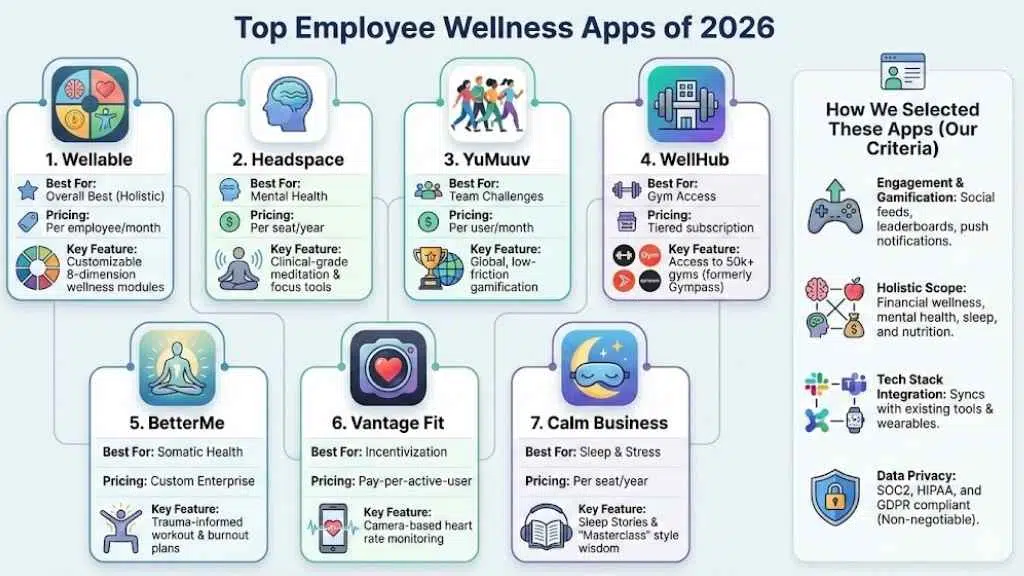
If you’re short on time, here is the quick verdict on the top platforms for this year.
| App Name | Best For | Pricing Model | Key Feature |
| 1. Wellable | Overall Best (Holistic) | Per employee/month | customizable 8-dimension wellness modules |
| 2. Headspace | Mental Health | Per seat/year | Clinical-grade meditation & focus tools |
| 3. YuMuuv | Team Challenges | Per user/month | Global, low-friction gamification |
| 4. WellHub | Gym Access | Tiered subscription | Access to 50k+ gyms (formerly Gympass) |
| 5. BetterMe | Somatic Health | Custom Enterprise | Trauma-informed workout & burnout plans |
| 6. Vantage Fit | Incentivization | Pay-per-active-user | Camera-based heart rate monitoring |
| 7. Calm Business | Sleep & Stress | Per seat/year | Sleep Stories & “Masterclass” style wisdom |
How We Selected These Employee Wellness Apps (Our Criteria)
To ensure this list represents the “best of the best employee wellness apps” for 2026, we evaluated platforms based on standards:
- Engagement & Gamification: Does the app keep users coming back after the first week? (Looking for: Social feeds, leaderboards, push notifications).
- Holistic Scope: Does it cover more than just fitness? (Looking for: Financial wellness, mental health, sleep, and nutrition).
- Tech Stack Integration: Does it talk to your existing tools? (Looking for: Slack, Microsoft Teams, and wearable syncing with Apple Watch/Fitbit).
- Data Privacy: Is it SOC2, HIPAA, and GDPR compliant? (Non-negotiable in 2026).
Top 7 Employee Wellness Apps of 2026
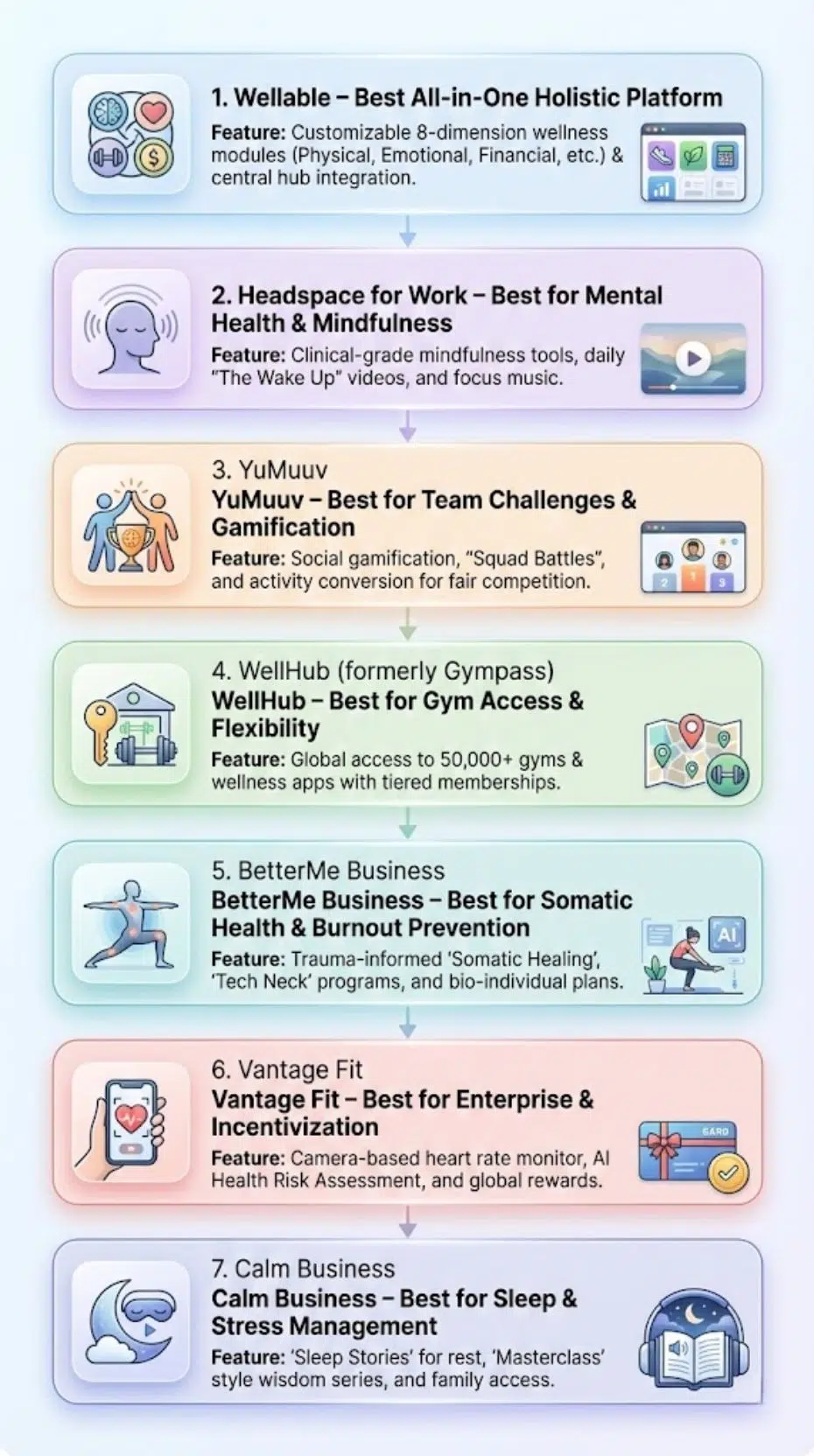
Navigating the crowded market of Employee Wellness Apps can feel overwhelming, but finding the right fit is crucial for a thriving workplace. In 2026, the best platforms go beyond simple activity tracking to offer holistic support for mental, physical, and financial health. We have rigorously tested and analyzed the leading contenders to bring you a curated list of tools that genuinely drive engagement. Whether you need a gamified challenge for remote teams or a comprehensive clinical solution, this breakdown covers it all. Here are the top 7 Employee Wellness Apps setting the standard for corporate well-being this year.
1. Wellable – Best All-in-One Holistic Platform
Verdict: The most customizable platform for companies who want to build a specific “wellness culture” rather than just offering a perk.
Wellable continues to dominate the market in 2026 because of its flexibility. Unlike rigid apps, Wellable allows you to build a program around 8 dimensions of wellness (Physical, Emotional, Financial, Occupational, Social, Environmental, Intellectual, and Spiritual). It acts as a central hub, pulling in data from apps employees already use (like MyFitnessPal or Strava) rather than forcing them to switch.
Top Features
- Multimedia Content Library: On-demand fitness classes, mindfulness sessions, and health coaching webinars.
- Custom Challenges: Run a “Hydration Week” or a “Financial Literacy Month” challenge with ease.
- Rewards Mall: Employees earn points for healthy behaviors which can be redeemed for gift cards or charity donations.
Pros & Cons
- Pros: Highly customizable; excellent customer support; integrates with almost every wearable device.
- Cons: The admin backend can be overwhelming due to the sheer number of options.
Pricing
Typically ranges from $3 – $6 per employee/month depending on company size and features selected.
2. Headspace for Work – Best for Mental Health & Mindfulness
Verdict: The gold standard for organizations prioritizing mental health and stress reduction above all else.
In 2026, mental health is health. Headspace for Work leverages its consumer-grade popularity to drive corporate adoption. It offers scientifically validated mindfulness tools that claim to reduce stress by 14% in just 10 days. The corporate dashboard gives HR leaders (anonymized) insights into the organization’s “stress pulse.”
Top Features
- “The Wake Up”: Daily bite-sized videos to start the work day with intention.
- Focus Music: Curated playlists scientifically designed to improve deep work concentration.
- SOS Sessions: 3-minute emergency meditations for moments of panic or high stress.
Pros & Cons
- Pros: Highest user adoption rate due to brand familiarity; clinical-grade content; very easy to use.
- Cons: Limited physical fitness content; fewer “team” features compared to challenge-based apps.
Pricing
Enterprise plans typically cost $50 – $70 per employee/year.
3. YuMuuv – Best for Team Challenges & Gamification
Verdict: The best “bang for your buck” for remote teams and startups wanting high engagement without complexity.
If your goal is to get people moving and talking, YuMuuv is the answer. It strips away the bloat of complex enterprise platforms and focuses entirely on social gamification. In 2026, they introduced “Squad Battles,” allowing departments (e.g., Sales vs. Marketing) to compete in wellness metrics.
Top Features
- Activity Conversion: It converts different activities (yoga, swimming, cycling) into a unified scoring system so everyone can compete fairly.
- Global Reach: Available in multiple languages, making it perfect for distributed international teams.
- Automated Admin: Set up a yearly plan in minutes; the app handles notifications and leaderboard updates.
Pros & Cons
- Pros: Extremely low administrative burden; fun and social; very affordable.
- Cons: Lacks deep clinical features (like therapy access) or financial wellness tools.
Pricing
One of the most affordable options, starting around $1 – $2 per user/month.
4. WellHub (formerly Gympass) – Best for Gym Access & Flexibility
Verdict: The ultimate “perk” for hybrid workforces who want access to premium gyms and studios worldwide.
Rebranded as WellHub, this platform is a corporate subscription that unlocks access to thousands of gyms (Gold’s Gym, Barry’s Bootcamp, SoulCycle) and wellness apps (Calm, Lifesum) under one membership. It solves the “hybrid work” problem: an employee can use a gym near the office on Tuesday and a yoga studio near their home on Thursday.
Top Features
- Global Access: Access to over 50,000 fitness partners worldwide.
- Tiered Membership: Employees pay for the tier they want (e.g., Bronze, Silver, Gold), making it cost-effective for the employer.
- Family Plans: Employees can often extend benefits to family members.
Pros & Cons
- Pros: Massive perceived value for employees; huge variety of activities; combines digital and physical wellness.
- Cons: Can be expensive for the employer to subsidize; requires a minimum headcount for best rates.
Pricing
Tiered subscription model. Employers pay a base fee, and employees pay a monthly fee (e.g., $29.99 – $100+) depending on access level.
5. BetterMe Business – Best for Somatic Health & Burnout Prevention
Verdict: The innovator of 2026, focusing on “Somatic Healing” and trauma-informed wellness for high-stress industries.
BetterMe has pivoted from a simple workout app to a comprehensive somatic health platform. It recognizes that burnout is often stored in the body. Their 2026 update includes specific programs for “Tech Neck,” “Desk Yoga,” and “Cortisol Regulation,” making it ideal for desk-bound workforces.
Top Features
- Somatic Exercises: Simple movements to regulate the nervous system (great for high-stress roles).
- Bio-Individual Plans: AI creates meal and workout plans based on the user’s age, weight, and goals.
- Direct Coaching: Access to chat with human health coaches for accountability.
Pros & Cons
- Pros: Unique focus on nervous system regulation; highly inclusive (workouts for seniors, wheelchair users, etc.); 30+ languages.
- Cons: The holistic approach might be “too much” for employees just looking for a step counter.
Pricing
Custom Enterprise Pricing, generally competitive with mid-market tools.
6. Vantage Fit – Best for Enterprise & Incentivization
Verdict: A tech-heavy solution for large corporations that want to tie wellness directly to monetary rewards.
Vantage Fit distinguishes itself with proprietary technology. Its standout feature in 2026 is the camera-based heart rate monitor, which allows users to measure HRV and pulse using just their smartphone camera—no wearable required. It also excels at “Incentivization,” allowing companies to automate rewards (gift cards) based on completed tasks.
Top Features
- AI Health Risk Assessment (HRA): fast and accurate profiling of employee health.
- Global Rewards Redemption: Employees in India, the US, or Europe can all redeem points for locally relevant gift cards.
- Squat & Step Tracker: Uses the phone’s gyroscope to accurately count reps (preventing cheating).
Pros & Cons
- Pros: Excellent for large, global enterprises; accurate tracking; robust rewards catalog.
- Cons: The UI is more “corporate” and less “lifestyle” than Headspace or Calm.
Pricing
Very flexible, often based on active users rather than total headcount. Plans can start as low as $2/user for basic features.
7. Calm Business – Best for Sleep & Stress Management
Verdict: The best choice for workforces suffering from insomnia, anxiety, or high-pressure deadlines.
While similar to Headspace, Calm differentiates itself with its “Sleep Stories” (narrated by celebrities like Matthew McConaughey) and its “Masterclass” style wisdom series. In 2026, they launched “Calm for Teams,” which encourages collective “deep breath” moments before Zoom meetings.
Top Features
- Sleep Stories: The #1 feature for helping employees disconnect and rest (crucial for productivity).
- Workplace Wisdom: Short audio lessons on overcoming impostor syndrome, public speaking anxiety, and leadership.
- Family Access: Most business plans allow employees to share their subscription with up to 5 dependents.
Pros & Cons
- Pros: Beautiful, relaxing UI; high-quality audio content; effective for improving sleep quality.
- Cons: Almost entirely focused on mental/audio; lacks fitness tracking or nutrition planning.
Pricing
Approximately $60 – $70 per employee/year.
Which Employee Wellness App Wins?
| Feature | Wellable | YuMuuv | Headspace | Vantage Fit |
| Primary Focus | Holistic | Team Challenges | Mental Health | Rewards/Tracking |
| Gamification | High | Very High | Low | High |
| Wearable Sync | Excellent | Excellent | N/A | Good |
| Cost | $$$ | $ | $$ | $$ |
| Best For | SMBs & Mid-Market | Remote Teams | Creative/Tech | Global Enterprise |
Key Trends in Employee Wellness App for 2026
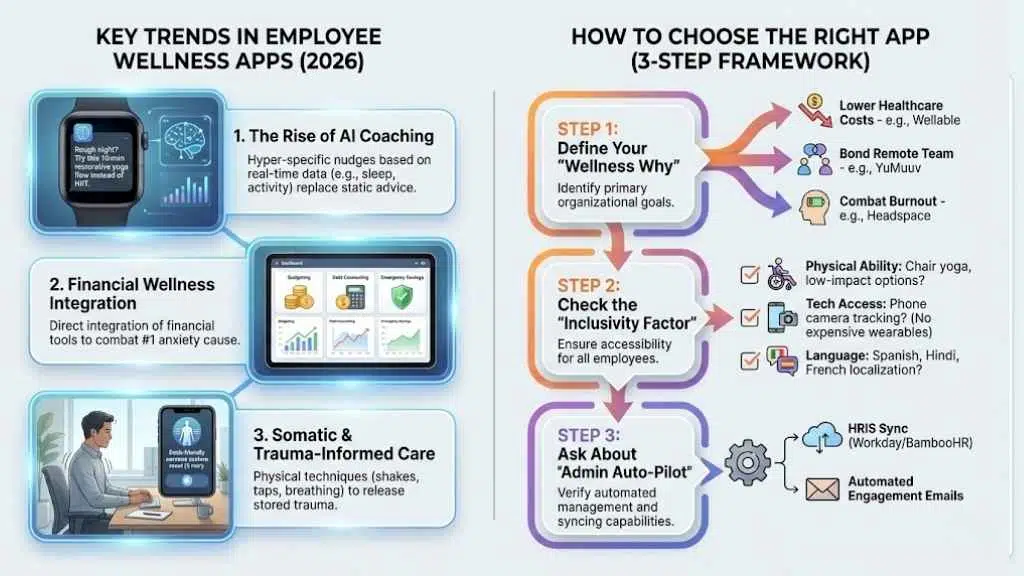
If you want your program to succeed this year, you must look beyond basic fitness. Here is what is trending in the most successful HR departments.
1. The Rise of AI Coaching
Static articles are out. AI Personalization is in. The best apps now use generative AI to send hyper-specific nudges.
- Example: Instead of a generic “Walk 10,000 steps” notification, the app notices an employee slept poorly (via Apple Watch data) and suggests: “You had a rough night. Skip the HIIT workout today and try this 10-minute restorative yoga flow instead.”
2. Financial Wellness Integration
Financial stress is the #1 cause of employee anxiety in 2026. Apps like Wellable and Vantage Fit are aggressively integrating budgeting tools, debt counseling, and emergency savings trackers directly into their wellness portals.
3. Somatic & Trauma-Informed Care
“Mindset” isn’t enough when the nervous system is fried. We are seeing a massive shift toward Somatic Exercises—physical techniques to release stored trauma and stress. Apps like BetterMe are leading this charge, offering “desk-friendly” shakes, taps, and breathing exercises that physically reset the nervous system in under 3 minutes.
How to Choose the Right Employee Wellness App
Don’t just buy the most popular one. Follow this 3-step framework:
Step 1: Define Your “Wellness Why”
- Is it to lower healthcare costs? (Choose Wellable or Vantage Fit for their Health Risk Assessments).
- Is it to bond a remote team? (Choose YuMuuv).
- Is it to combat burnout in a high-stress agency? (Choose Headspace or Calm).
Step 2: Check the “Inclusivity Factor”
Does the app work for everyone?
- Physical Ability: Does it have chair yoga or low-impact options?
- Tech Access: Does it work for employees who don’t have a $400 Apple Watch? (Apps like Vantage Fit that use the phone camera are great here).
- Language: Do you have Spanish, Hindi, or French speakers? Check the localization.
Step 3: Ask About “Admin Auto-Pilot”
You don’t want to spend 5 hours a week managing this. Ask the sales rep:
- “Does this sync automatically with our HRIS (Workday/BambooHR) to add/remove employees?”
- “Are the engagement emails sent automatically by the system?”
Final Thoughts
Selecting the right employee wellness app for 2026 is no longer just about ticking a box for benefits; it is a strategic move to secure your company’s long-term resilience. As we move further into an era defined by hybrid work and digital burnout, the “best” platform is simply the one that your specific workforce actually adopts and enjoys.
Whether your team requires the somatic stress relief of BetterMe, the global connectivity of WellHub, or the gamified engagement of YuMuuv, the core mission remains the same: demonstrating that you value their human health as much as their professional output.
Success this year won’t come from a passive subscription. It comes from choosing a partner that integrates seamlessly into your daily workflow, offering AI-driven, personalized support. Don’t let the variety of options overwhelm you. Start by piloting your top choice with a small, diverse champion group within your office. Their feedback is your ultimate roadmap. Investing in these tools today is the direct path to a happier, more productive, and loyal workforce tomorrow.