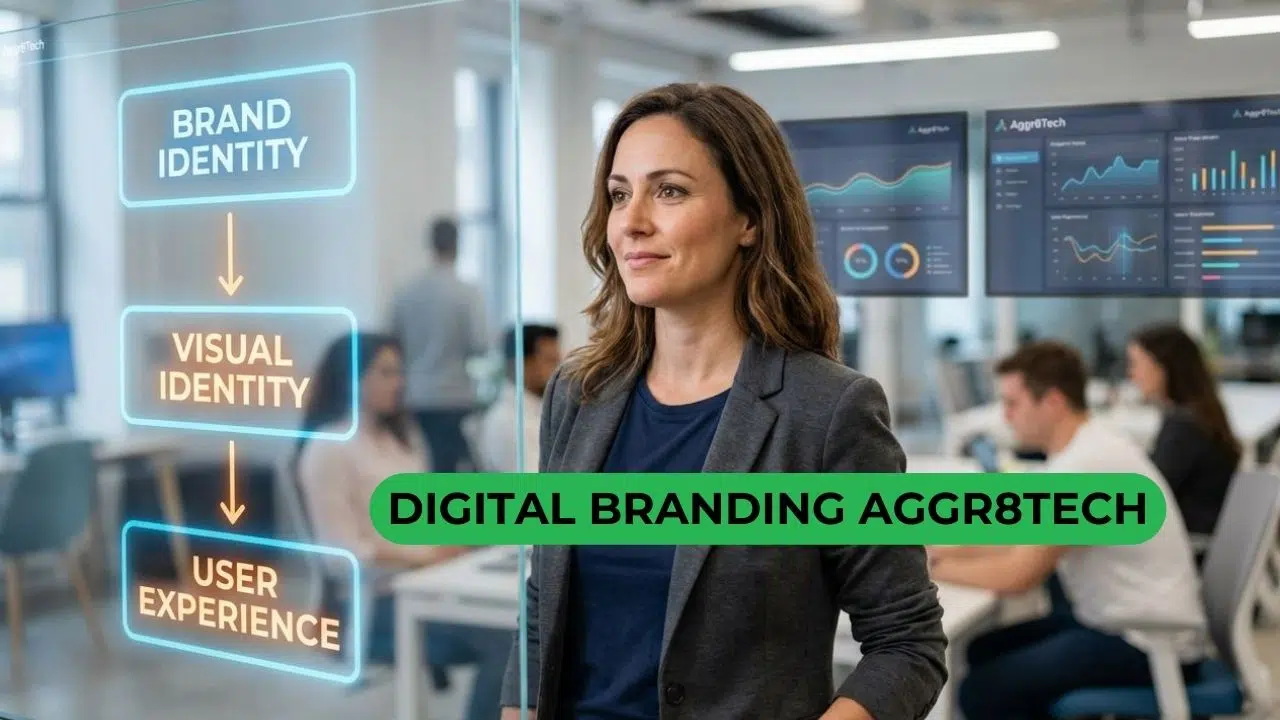
You know the problem: you can run solid digital marketing and still watch customers drift to a competitor because your brand feels inconsistent from ad to landing page to follow-up email. Digital branding Aggr8Tech style fixes that gap by treating your brand identity, visual identity, and user experience as one system you can measure and improve, instead of a set of one-off creative projects.
This page gives you a practical playbook.
I’m going to break down what “digital branding aggr8tech” means in practice, then walk through the growth strategies, engagement tactics, and KPI tracking habits that help you build brand recognition and customer loyalty in the US market.
Exploring Digital Branding Aggr8Tech
Aggr8Tech blends classic brand management with modern digital execution. The goal is simple: your brand image should feel the same across your website, social media platforms, ads, email, and mobile apps, even when different teams build different assets.
That consistency is not just cosmetic. It reduces customer confusion, speeds up decision-making, and helps you earn repeat business because people recognize what you stand for and what they can expect.
In a 2024 update on US customer experience, Forrester reported that customer-obsessed organizations grew faster, including 41% faster revenue growth and 51% better customer retention than their peers. That’s the business case for treating user experience and brand alignment as growth work, not “nice-to-have” polish.
What the Aggr8Tech Framework Includes
- Brand positioning strategy: how you win in your category and what you will not compete on.
- Messaging consistency strategy: a repeatable message hierarchy that keeps your promises and proof points aligned across channels.
- Digital transformation: the operational side, connecting content, data, and workflows so your brand scales without going off-brand.
- Brand reputation: how you build and protect trust across reviews, social proof, customer service, and privacy practices.
A Practical Way to Connect Brand Identity to Metrics
| Brand-building layer | What you publish | What you measure |
|---|---|---|
| Positioning | Value proposition, category pages, offers | Conversion rate, assisted conversions, win-loss notes in CRM |
| Brand narrative | Case studies, founder story, customer stories | Time on page, scroll depth, brand search lift, sentiment analysis notes |
| Visual identity | Logo use, typography, templates, ad creative | Ad recall signals, creative performance by template, consistency QA results |
| User experience | Navigation, forms, checkout, onboarding | Drop-off rate, funnel completion, support ticket themes |
Key Strategies to Propel Business Growth
Growth-focused digital branding is not about doing more channels. It’s about making the channels you already run feel like one coherent brand experience, then using data to tighten what works.
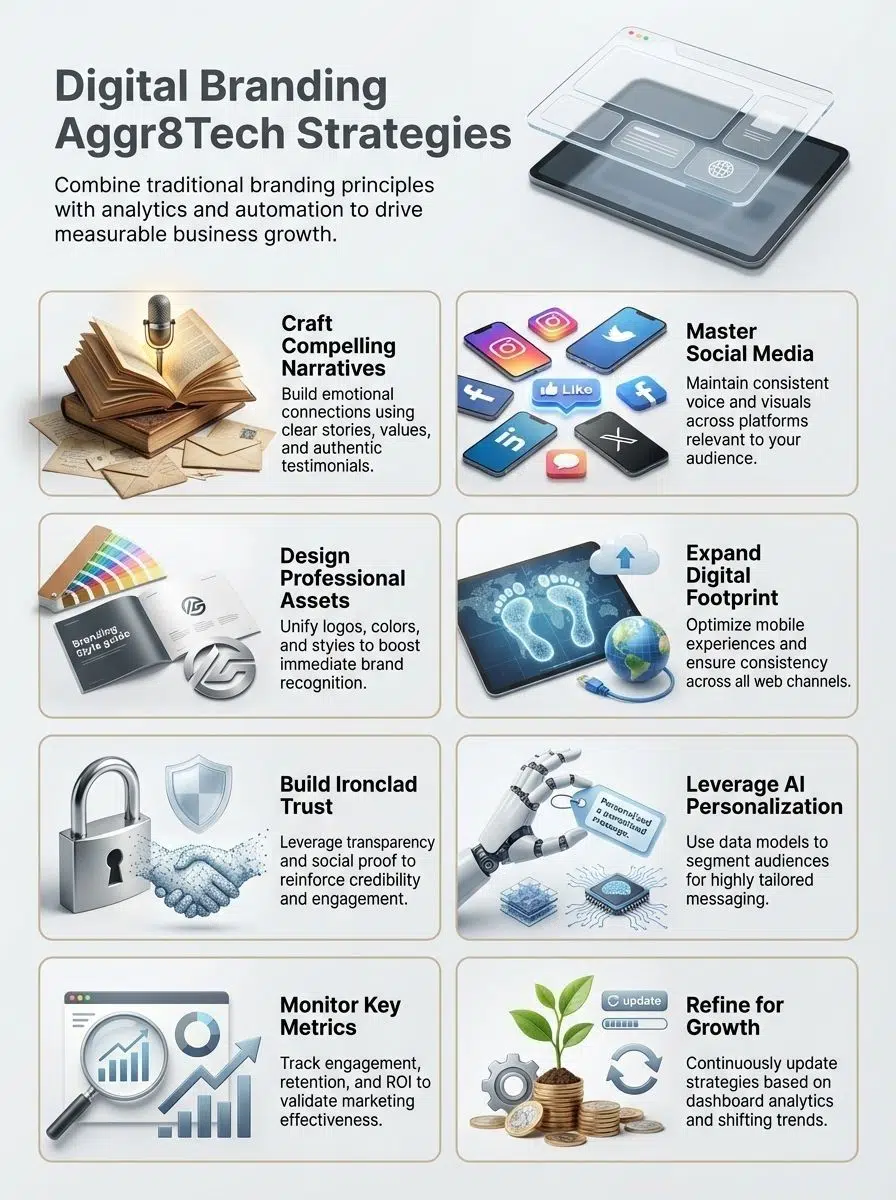
If you want a simple model, aim for these four levers: narrative clarity, recognizable visuals, search visibility, and channel execution that matches user behavior.
- Clarify your brand narrative: people should understand your promise in seconds, then find proof fast.
- Systemize your visual identity: templates and design rules prevent “off-brand drift” as content volume rises.
- Improve user experience: remove friction so trust turns into action on the web and mobile.
- Use analytics and CRM: connect behavior data to customer records so you can personalize without guessing.
Craft a Compelling Brand Narrative
A strong brand narrative is your “why,” your customer’s problem, and your proof, told in a way that stays consistent across every touchpoint. The most common mistake I see is treating the story like a tagline instead of a system your team can reuse.
Build a Message Hierarchy Your Team Can Actually Follow
- One-sentence promise: what you help the target audience achieve.
- Three proof points: specific outcomes, capabilities, or guarantees you can back up.
- Two differentiators: what makes you meaningfully different from rivals, not just “better service.”
- One next step: a clear CTA that fits the customer journey stage.
Make It Measurable With CRM and an Analytics Dashboard
To keep storytelling tied to business growth, connect content performance to your customer database. In practice, that means tagging key pages and campaigns to a customer journey stage (first touch, consideration, conversion, retention), then reviewing what moved customers forward.
Pro-tip: log qualitative feedback in your CRM too. Short notes from sales calls, chat transcripts, and support tickets give you real language you can reuse in headlines and ads, which tends to improve trustworthiness and brand alignment.
Utilize Social Media Platforms Effectively
Social media works best when you stop trying to post “one piece of content everywhere” and start designing content for how each platform gets used.
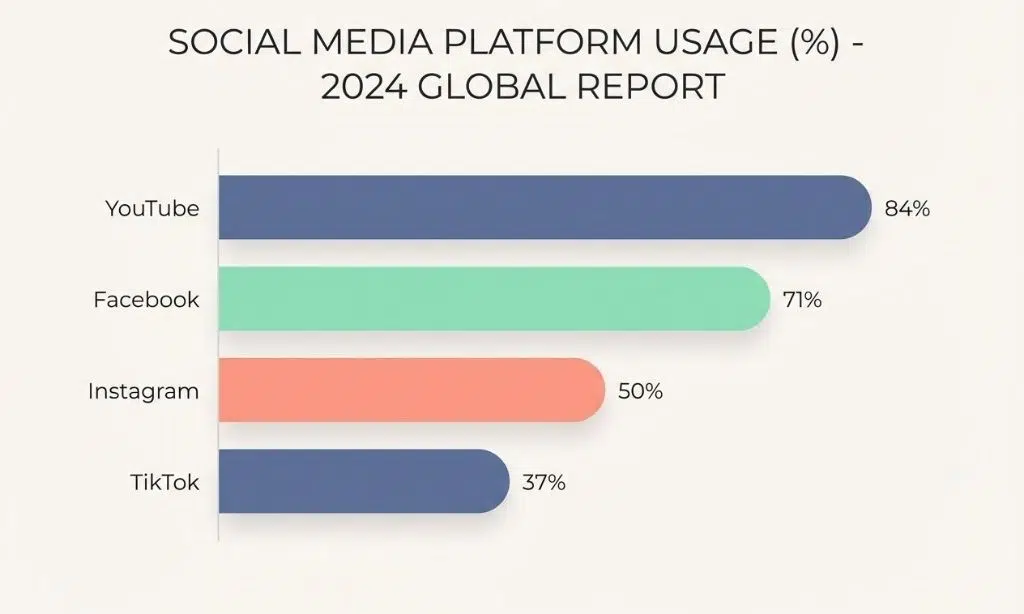
A Pew Research Center survey from 2025 found that YouTube (84%) and Facebook (71%) were the most widely used platforms among US adults, with Instagram at 50% and TikTok at 37%. Use those realities to choose where you go broad and where you go niche.
| Platform goal | Best-fit formats | What to track |
|---|---|---|
| Awareness and reach | Short video, creator collaborations, simple hooks | 3-second views, completion rate, follower growth quality |
| Consideration | How-to posts, comparisons, live demos, FAQ clips | Saves, shares, clicks to site, comment intent signals |
| Conversion support | Testimonials, offer reminders, retargeting creative | Landing page conversion rate, cost per lead, assisted conversions |
| Loyalty and community | Behind-the-scenes, customer spotlights, responses | Repeat engagement, UGC volume, customer service response time themes |
- Pick platforms based on evidence: match channel choice to where your target market shows up, then validate with your own traffic and lead data.
- Standardize your creative inputs: use a shared set of logos, colors, and typography so every post reinforces brand recognition.
- Make social proof a weekly habit: rotate reviews, testimonials, and user stories so credibility stays visible without sounding repetitive.
- Design for mobile first: lead with big, readable text, clear captions, and fast-loading landing pages to protect user experience.
- Test messaging, not just visuals: run A/B tests on hooks and CTAs, then feed winners back into your brand narrative.
- Use privacy-safe targeting: rely on first-party data where you can, and keep personalization transparent so you build trust, not doubt.
Design Professional Visual Assets
Visual identity is not “make it pretty.” It is a conversion tool because it signals professionalism in seconds, especially on mobile where people scan fast.
To make visual assets scale, build a small design system your whole team can use. That means a logo package (including small-size versions), a defined color palette, typography rules, and templates for ads, social posts, and sales decks.
If you want reliable execution, use tools built for collaboration and repeatability. Teams often use Figma for shared components and approvals, Adobe Illustrator for vector logo work, and Canva for fast on-brand production using locked templates. The “so what” is speed with consistency, so your brand building doesn’t break when content demand spikes.
A Quick Visual QA Checklist
- Does the logo stay readable at small sizes, including on mobile?
- Do headings, buttons, and links look like they belong to the same brand across the site?
- Do templates prevent off-brand fonts, colors, and spacing?
- Do images and icons follow one consistent style (photo, illustration, line icons, or a defined mix)?
Enhance Your Digital Footprint
Your digital footprint is the compound effect of your website experience, your content, and how discoverable you are in search. Consistency matters here too, because a great ad cannot rescue a slow, confusing landing page.
Google’s Web Vitals guidance sets clear targets for a good user experience: LCP at 2.5 seconds or less, INP at 200 milliseconds or less, and CLS at 0.1 or less (measured at the 75th percentile). Google also switched responsiveness measurement in March 2024 when INP replaced FID, so “snappy” interaction performance now matters more than many teams realize.
What to Fix First (Highest Impact)
- Speed: Compress and properly size images, reduce heavy scripts, and cache repeat assets so pages load quickly.
- Stability: Reserve space for images, embeds, and banners so the layout does not jump while people try to click.
- Clarity: Rewrite headlines and CTAs so users always know what happens next, especially on mobile.
- Search visibility: Publish content that answers real queries, then connect it to strong internal links and relevant landing pages.
- Consistency: Keep navigation labels, button styles, and tone consistent across the site and your social media platforms.
Boost Customer Engagement with Aggr8Tech
Customer engagement is where digital branding becomes real. People don’t “trust a brand,” they trust the experience they keep having with it.
The Aggr8Tech approach uses analytics and customer data to map consumer behavior, then tightens messaging and user experience so customers feel understood, not pushed.
Establish Trust and Credibility
Trust comes from repetition plus proof. If your offer, tone, and visuals shift from one channel to the next, customers hesitate, even if your product is good.
Make proof easy to find. Put testimonials close to the claim they support, include specific outcomes when you can, and keep your strongest social proof consistent across your website and social media.
If you use influencers or creator partnerships, follow the FTC’s disclosure guidance: when there is a material connection, the disclosure needs to be clear and easy to notice, not hidden or vague. That protects your brand reputation and prevents “surprise marketing” from eroding customer loyalty.
Trust Builders You Can Implement this Quarter
- Create a proof library: tagged testimonials, reviews, and case studies by industry, use case, and objection.
- Standardize claims: define which promises you can make and what proof must appear with each one.
- Build a fast path to help: clear contact options, transparent policies, and consistent customer service tone.
- Audit your brand image monthly: spot off-brand ads, outdated bios, and mismatched landing pages before customers do.
Implement Data-Driven Personalization
Personalization improves brand experiences when it feels helpful and expected. It backfires when it feels intrusive or when it creates inconsistent messaging across channels.
McKinsey’s research has found that personalization can drive a 5% to 15% revenue lift and that many consumers say personalized communications make them more likely to consider a brand and repurchase (from a 2021 analysis). Treat that as an upside, but only if you pair it with strong data privacy and ethical AI habits.
- Start with segmentation you can explain: build segments around intent and lifecycle stage, not just demographics.
- Personalize one layer at a time: begin with recommended content, the next-best email, or on-site modules, then expand.
- Use A/B testing as governance: test changes in headlines, CTAs, and offers so you improve performance without drifting from brand values.
- Connect CRM systems to behavior data: map key actions (pricing views, demo requests, repeat purchases) to lifecycle stages, then automate relevant communications.
- Design for consent and control: give users a preference center and honor opt-out choices.
- Audit for bias: review model outputs and targeting rules so personalization does not create unfair exclusions or inconsistent experiences.
Privacy and Compliance: the Non-Negotiables
In a 2025 announcement, the California privacy regulator described a joint enforcement sweep with Colorado and Connecticut focused on businesses that failed to honor opt-out rights, including signals sent through Global Privacy Control. If you personalize or run targeted advertising, build a workflow that can recognize and respect opt-out requests across your marketing channels.
Track and Refine Growth Strategies
Digital branding gets easier once you treat it like a performance system. You set KPIs, track behavior, and refine the brand narrative, visual identity, and user experience based on what customers do, not what you hope they do.
Monitor Key Performance Metrics
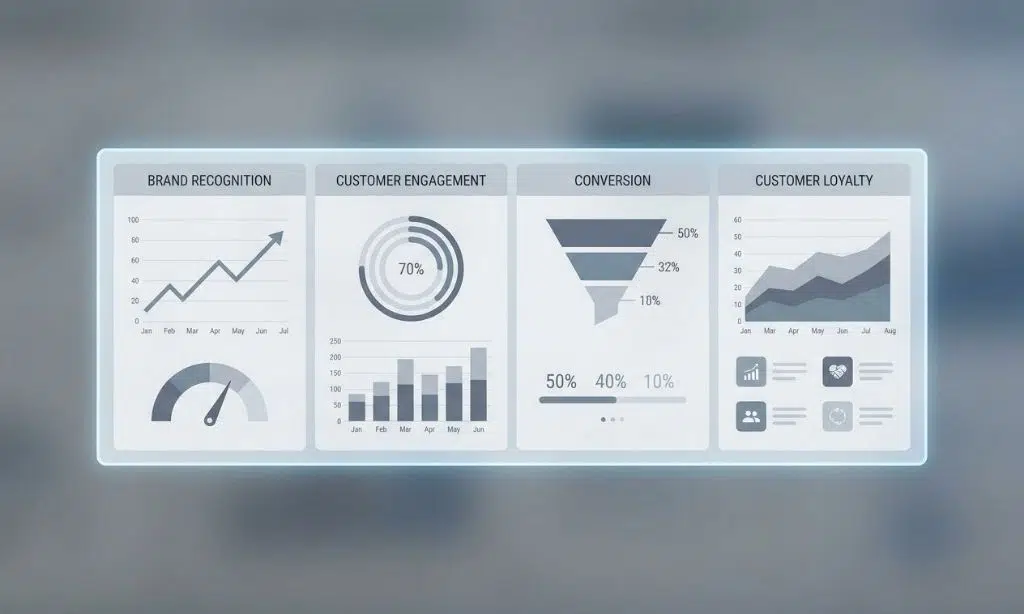
Track a short KPI set that covers the full funnel. If you only track conversions, you miss whether brand recognition and trust are rising, which is often what makes future conversions cheaper.
| Goal | KPIs to track | Where teams track it |
|---|---|---|
| Brand recognition | Branded search growth, direct traffic trend, returning visitors | Search Console, GA4, analytics dashboard |
| Customer engagement | Engagement rate, scroll depth, video completion, email clicks | GA4, email platform reports, social analytics |
| Conversion | Lead rate, checkout completion, demo-to-close rate | GA4 funnels, CRM systems |
| Customer loyalty | Repeat purchase rate, retention, referrals, review volume | CRM, commerce platform, support system reporting |
- Set monthly targets in your analytics dashboard, then review results by channel and by audience segment.
- Use heatmaps and session replays to find where user experience friction blocks business growth.
- Compare performance across creative templates, so your visual identity decisions become data-driven.
- Track sentiment analysis themes from reviews, support tickets, and sales notes, then update messaging to match real customer language.
Pursue Continuous Improvement for Sustained Growth
Brand longevity comes from small, repeatable improvements. A quarterly rebrand is rare, but a monthly cleanup of customer journey friction is realistic and often more profitable.
A simple Improvement Cycle that Works
- Observe: review dashboards, funnel drop-offs, and customer feedback themes.
- Prioritize: pick one user experience fix and one messaging test that can move a core KPI.
- Experiment: run A/B tests and small creative iterations across web and social media platforms.
- Standardize: document what worked in your style guide and templates so results repeat.
Consistent effort builds brand recognition and customer engagement, and those are the inputs that create customer loyalty over time.
Final Words
Digital Branding Aggr8Tech style drives business growth by connecting brand narrative, visual identity, and user experience to real metrics you can track and improve.
When you pair consistent execution on social media platforms with a clear analytics panel and CRM systems, you build brand recognition, protect trust, and create long-term growth for startups and enterprise teams alike.