Game Preservation In The Digital Age is about more than nostalgia. It is about saving a 180 billion dollar global industry from erasing its own history. Video games shape our culture just like film or literature. Yet they face a unique survival rate problem that most people do not see.
Since the 2000s, the infrastructure of gaming has shifted. We moved from physical cartridges to a reliance on remote servers and digital licenses. This shift puts even massive titles like Fortnite and Destiny at risk. If a server code is lost, the game does not just stop working. It ceases to exist.
I have analyzed the systems behind this shift. The engineering reality is brittle. A digital-only release on the PlayStation 5 or Xbox Series X relies on active authentication. When that handshake fails, the software is dead. We saw this vulnerability when the Nintendo 3DS and Wii U eShops closed in March 2023. Thousands of digital-exclusive titles simply vanished from the primary market.
Old classics are in even more danger. Source code is often lost during company mergers or bankruptcies. This makes restoring them an extreme technical challenge. Groups like the Video Game History Foundation now estimate that 87 percent of classic games are critically endangered. That is a higher loss rate than silent film.
There are solutions. Groups like Flashpoint save web-based games that depended on Adobe Flash. The Internet Archive maintains a massive library of playable history. But legal walls still block many of these efforts. Copyright rules like the DMCA often stop preservationists from legally saving games that publishers have abandoned.
So, I am going to break down the data on this loss. We will look at the specific technical hurdles we face. Then we will explore the practical strategies experts use to keep these systems alive.
Why Game Preservation Matters in the Digital Age
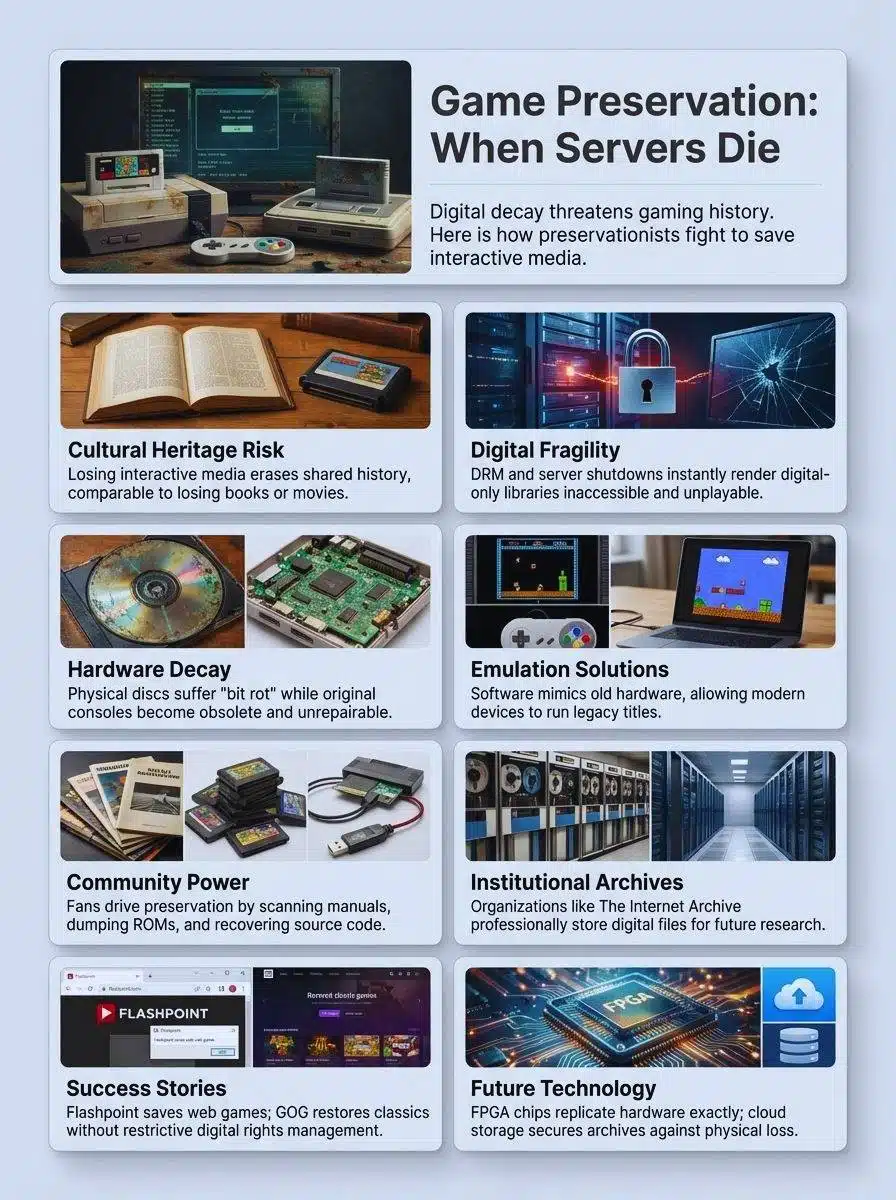
Video game preservation ensures that the code, art, and design of interactive media survive for future study. It bridges the gap between the 8-bit era and modern cloud gaming. Without it, we lose the ability to understand the technological evolution of the medium.
How does preserving games safeguard cultural heritage?
Saving games protects our shared digital history. A 2023 study by the Video Game History Foundation found that only 13 percent of games released before 2010 are currently accessible. This is a statistical crisis. It means we have effectively lost access to the vast majority of our gaming heritage.
When we lose these titles, we lose the context of how people lived and played. Historic games from the PlayStation 2 era are cultural artifacts. They hold the same value as vintage comic books or vinyl records. Organizations like The Video Game History Foundation work to document this before the physical media rots away.
Public outcry over unavailable media proves this value. When digital storefronts close, we see a tangible sense of loss. Without emulation tools and archive projects, entire genres could disappear. We are fighting to keep the “readable” history of the 20th and 21st centuries intact.
Why is maintaining historical continuity important in game preservation?
Historical continuity allows developers to trace the lineage of mechanics and code. If you lose the early version of a game, you break the chain. You cannot fully understand a modern title like Destiny 2 without seeing the iterative steps that led to it.
Hardware decay creates a hard deadline for this work. Physical components like capacitors in the original Xbox or batteries in Game Boy cartridges are failing. Once the hardware dies, the software trapped on it becomes inaccessible. We call this “bit rot.”
“From an engineering standpoint, reliance on proprietary servers is the single biggest point of failure for modern software preservation.”
Projects like Project Deluge step in to fill this gap. They find and back up prototypes that never saw retail shelves. This fills the missing links in the evolutionary tree of game design. It allows researchers to study what changed during development and why.
How does game preservation support retrospective analysis?
Retrospective analysis requires access to the original source material. You cannot analyze the code efficiency of a Nintendo 64 game if you can only play a modern remake. Preservationists save the original ROM image and design documents to allow for this deep technical audit.
Emulators are the primary tool here. They allow new devices to mimic the behavior of old hardware. This lets researchers run software from the Commodore 64 or Sega Genesis on a modern laptop. It separates the game from the failing plastic box it came in.
Legal restrictions often hamper this analysis. DRM (Digital Rights Management) can lock valid owners out of their own content. When a server for a game like The Crew shuts down, the code becomes useless. Community-led projects try to bypass this by creating private servers or “dummy” authentication tools to keep the software running for study.
Challenges of Game Preservation In The Digital Age
The barriers to saving games are technical, legal, and commercial. We are racing against time as physical media degrades and digital licenses expire. The shift to a “licensed, not owned” model is the core friction point.
What issues arise from digital-only game releases?
Digital-only releases have no physical backup. When a platform holder decides to close a store, those files are gone. We saw this clearly on March 27, 2023. That was the day Nintendo closed the eShops for the 3DS and Wii U. Over 1,000 digital-only titles disappeared from the primary market instantly.
This creates a preservation nightmare. You cannot buy a used copy of a digital download. Once the server is off, the legal supply chain is broken. Cloud gaming is even more volatile. Services like Google Stadia shut down completely, taking exclusive titles with them.
Updates are another layer of complexity. Modern physical discs often contain only a part of the game data. The rest must be downloaded. If the patch servers go offline, even the physical disc becomes a coaster. It renders the game unplayable in its intended state.
How do server shutdowns and DRM affect game access?
Server-dependent games are rentals disguised as products. Titles like The Crew, an online racing game by Ubisoft, showed the danger of this model. When Ubisoft shut down the servers in March 2024, they also revoked the licenses from players’ libraries. This made the game impossible to install or play, even in single-player mode.
This is the “kill switch” problem. Live-service titles rely on a constant heartbeat connection to a central server. Preservationists cannot easily archive these games because they do not have the server-side code. Without that backend software, the client on your PC is useless.
DRM complicates this further. It often requires a periodic “phone home” check. If the authentication server is gone, the DRM locks the door forever. This affects millions of accounts and erases memories overnight.
Why is technological obsolescence a problem for preserving games?
Hardware does not last forever. Consoles like the PlayStation 2 are now over 20 years old. Their optical lasers are failing. Their internal chips are dying. Finding working hardware to play legacy games is becoming expensive and difficult.
Media degradation is also accelerating. Disc rot refers to the chemical breakdown of the data layer on CDs and DVDs. Data on magnetic floppy disks is fading. Even flash memory in cartridges has a lifespan.
This forces us to rely on migration. We must move the data from physical media to digital ISO images. But special chips in cartridges, like the Super FX chip in SNES games, are hard to emulate perfectly. Each custom piece of silicon requires a dedicated engineering solution to replicate in software.
What legal and ethical barriers hinder game preservation?
Copyright law is the biggest non-technical hurdle. In the US, the Digital Millennium Copyright Act (DMCA) protects DRM. Section 1201 makes it technically illegal to break copy protection, even for preservation.
There are exemptions, but they are narrow. In October 2024, the US Copyright Office denied a request from the Video Game History Foundation to allow libraries to share digital games remotely. This means researchers must physically travel to an archive to play a preserved game. They cannot access it securely over the internet.
This creates a gray market. Abandonware sites and ROM sharing hubs operate outside the law to keep these titles alive. While companies like Nintendo aggressively protect their IP, they often do not offer a legal way to buy these older titles. This leaves preservation in a legal limbo.
Preservation Methods and Strategies
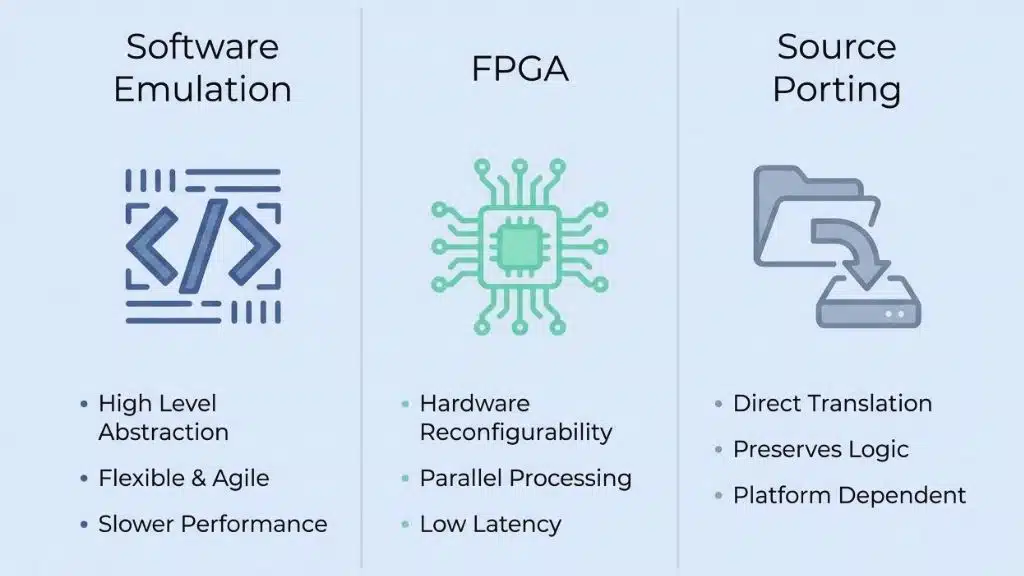
To save these systems, we use a mix of software engineering and hardware cloning. The goal is to separate the game experience from the decaying original device.
| Method | Technical Approach | Best Use Case |
|---|---|---|
| Software Emulation | Uses code to mimic hardware behavior (e.g., MAME, Dolphin). | Running games on modern PCs, Macs, or phones. |
| FPGA (Hardware Simulation) | Configures logic gates to replicate the original chip circuitry (e.g., MiSTer). | Cycle-accurate gameplay with zero latency on original hardware. |
| Source Porting | Recompiling original source code for new platforms. | High-performance native versions of games like Doom or Mario 64. |
How do emulation and virtualization help preserve games?
Emulation is the translation layer. It allows a modern CPU to understand instructions meant for a Sega Genesis or ZX Spectrum. Tools like RetroArch combine dozens of “cores” into one interface, making it easy to access thousands of titles.
Virtualization goes a step further. It creates a virtual machine that runs the entire original operating system. This is crucial for old PC games that rely on Windows 95 or DOS. It ensures the software runs in its native environment without crashing on modern Windows 11 systems.
These tools are vital for accessibility. They allow players to experience GoldenEye 007 or No One Lives Forever without hunting for expensive vintage hardware. They democratize access to history.
What is the role of migration and format conversion in preservation?
Migration involves moving data from obsolete media to modern standards. Preservationists “dump” ROMs from cartridges and create ISO disc images from CDs. This creates a digital master file that will not degrade physically.
Format conversion ensures these files remain readable. For example, old floppy disk formats are often converted to standard raw image files. This allows them to be mounted by emulators on any IBM PC compatible machine.
Community projects often handle the hardest work here. Fans use clean room design methods to reverse-engineer proprietary formats. This allows them to extract assets from unplayable formats and port them to open standards.
How do community-led initiatives contribute to game preservation?
The community does the work that corporations ignore. Groups like No-Intro and Redump set the standards for verifying that a game dump is perfect. They compare checksums of files to ensure the digital copy is a 1:1 replica of the original.
These volunteers scan manuals, box art, and maps. They archive the context, not just the code. High-quality scans of instruction booklets are essential because old games often did not include tutorials.
Fans also patch games to keep them working. When Games for Windows Live shut down, fans created patches to remove the broken DRM from titles like Fallout 3. Without these unauthorized fixes, the legal copies would be broken.
Can decompilation and source code recovery save lost games?
Decompilation is the reverse-engineering of compiled code back into human-readable source code. It is the gold standard for preservation. Projects like the Ship of Harkinian (a PC port of Ocarina of Time) prove how powerful this is.
Once you have the source code, you can fix bugs and add modern features. You can make the game run at 60 frames per second or support ultra-wide monitors. It frees the game from the constraints of the Nintendo 64 or PlayStation 1.
Source code recovery is rare but valuable. Sometimes developers find old hard drives in attics. Recovering this data can save unreleased prototypes or beta versions that show the creative process in action.
Role of Institutions in Game Preservation
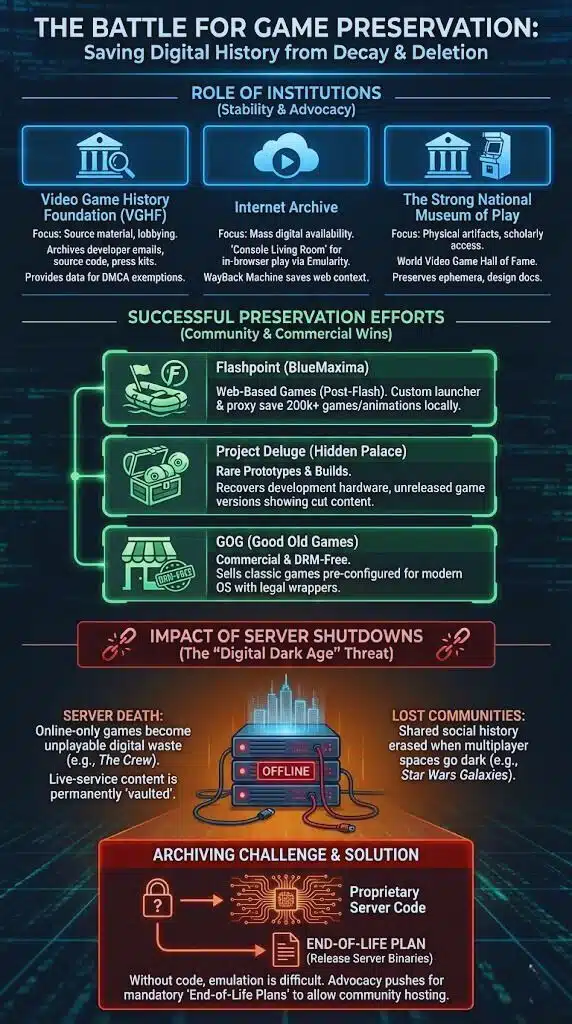
Formal institutions provide the stability that volunteer groups cannot. They have the climate-controlled storage and the legal standing to advocate for policy changes.
- Video Game History Foundation: Focused on source material and lobbying.
- Internet Archive: Focused on mass digital availability.
- The Strong Museum: Focused on physical artifact storage.
What does the Video Game History Foundation do for preservation?
The Video Game History Foundation, led by Frank Cifaldi, is a key player. They do not just collect games; they collect the story of their creation. They archive press kits, developer emails, and source code.
They also lead the fight in Washington. They provide the data and testimony for the DMCA exemption hearings. Their research proves the “87 percent” loss rate to lawmakers. They are the industry’s memory bank.
Their collaboration with the Software Preservation Network (SPN) is critical. Together, they push for legal frameworks that would allow libraries to digitally lend out-of-print games. They argue that preservation is a public service.
How does the Internet Archive support game preservation?
The Internet Archive takes a brute-force approach. Their “Console Living Room” allows you to play thousands of games directly in your browser. They use a system called Emularity to run emulators like DOSBox via JavaScript.
This lowers the barrier to entry. You do not need to install software or configure BIOS files. You just click a link. It makes gaming history instantly accessible to anyone with an internet connection.
They also archive the web itself. Their Wayback Machine saves the websites of defunct game studios. This preserves the marketing, forums, and patch notes that often disappear when a company folds.
What preservation efforts are led by the National Videogame Museum?
The National Videogame Museum in Frisco, Texas, focuses on the physical experience. They maintain working arcades and console setups. They believe that playing a game on a CRT TV with an original controller is a distinct historical experience from playing on an emulator.
They archive the hardware. They have a massive collection of rare consoles, controllers, and merchandise. This physical preservation is vital because hardware design tells us about the constraints developers faced.
They also educate the public. Their exhibits explain the history of the industry to families and students. They turn preservation into a tactile learning experience.
How does The Strong National Museum of Play contribute to preserving games?
The Strong in Rochester, New York, is a world-class research facility. They house the World Video Game Hall of Fame. Their International Center for the History of Electronic Games holds over 60,000 video game artifacts.
They focus on scholarly access. Researchers can visit their archives to study design documents from companies like Atari and Sierra. They treat video games with the same academic rigor as manuscripts or fine art.
They also preserve the “ephemera” of gaming. This includes marketing posters, t-shirts, and even the notes developers scribbled on napkins. These items provide the human context behind the code.
Examples of Successful Preservation Efforts
Despite the challenges, there have been massive wins. Dedicated archivists have saved libraries that were minutes away from deletion.
What is Flashpoint and how does it preserve web-based games?
Flashpoint is the lifeboat for the Flash era. When Adobe killed Flash Player in 2020, thousands of web games were set to break. The Flashpoint project, started by BlueMaxima, stepped in to save them.
They created a custom launcher that includes a proxy server. This tricks old games into thinking they are still on the internet. It allows them to load assets and save data locally.
Today, Flashpoint hosts over 200,000 games and animations. It is a masterclass in community engineering. They saved an entire decade of independent creativity that corporate neglect would have erased.
How does Project Deluge protect rare and unreleased games?
Project Deluge is a massive initiative by the group Hidden Palace. They specialize in recovering development hardware. In one drop, they released over 349 prototypes for the original Xbox alone.
These are not just retail games. They are “builds” from the middle of development. They show levels that were cut, characters that were changed, and mechanics that were scrapped. It is like finding the rough drafts of a famous novel.
The sheer volume of their work is staggering. They have archived thousands of discs for the PS2, Dreamcast, and CD-i. Each release is vetted and documented to ensure it is a legitimate piece of history.
What is GOG’s preservation program for DRM-free games?
GOG (formerly Good Old Games) proves preservation can be a business model. They sell classic games that are guaranteed to work on modern Windows. Crucially, they sell them without DRM.
They use legal wrappers like DOSBox to ensure compatibility. When you buy SimCity 2000 from them, it installs and runs instantly. You do not need to fiddle with configuration files.
This approach aligns commercial success with preservation. It gives rights holders a revenue stream from their back catalog. This incentivizes companies to keep their archives organized rather than letting them rot.
The Impact of Server Shutdowns
The “death of the server” is the new threat. It turns products people bought into digital waste. The industry is currently facing a reckoning over this practice.
What happens to online-only games when servers shut down?
When the server dies, the game dies. This was the brutal lesson of The Crew. Ubisoft did not just turn off the multiplayer; they made the single-player campaign inaccessible. Players who paid $60 for the game were left with nothing.
This is unique to the digital age. If you bought a chess set 50 years ago, the manufacturer could not come into your house and glue the pieces to the board. Server dependency gives companies that power.
Ross Scott, the creator of the “Stop Killing Games” campaign, argues this is a consumer rights violation. His movement is pushing for laws that would require companies to provide an “end-of-life” plan for games. This could mean releasing server software so the community can host it themselves.
How are multiplayer and live-service games disrupted by server closures?
Live-service games are transient. Destiny 2 regularly “vaults” content, removing paid expansions from the game to save space. This means story missions you paid for in 2018 simply do not exist anymore.
This erases the shared social history of these spaces. The communities that formed in Star Wars Galaxies or City of Heroes lost their meeting places when those servers went dark. It is the digital equivalent of demolishing a town square.
Fan projects sometimes resurrect them. The City of Heroes “Homecoming” server was recently granted an official license. This is a rare victory. It shows that community stewardship can coexist with IP rights if publishers are willing to cooperate.
Why is archiving digital-only content challenging after server shutdowns?
Archiving a server is harder than copying a disc. The server-side code is often complex and proprietary. It interacts with databases and authentication systems that are not public.
Without that code, emulators have to “guess” what the server was doing. Developers have to packet-sniff the network traffic of the game while it is still alive to reverse-engineer the protocol. It is an immense engineering task.
This is why preservationists ask for “End of Life” plans. If developers would simply release their server binaries when they shut down a game, the community could take over the hosting costs. It would save history at zero cost to the original studio.
Future Directions for Game Preservation
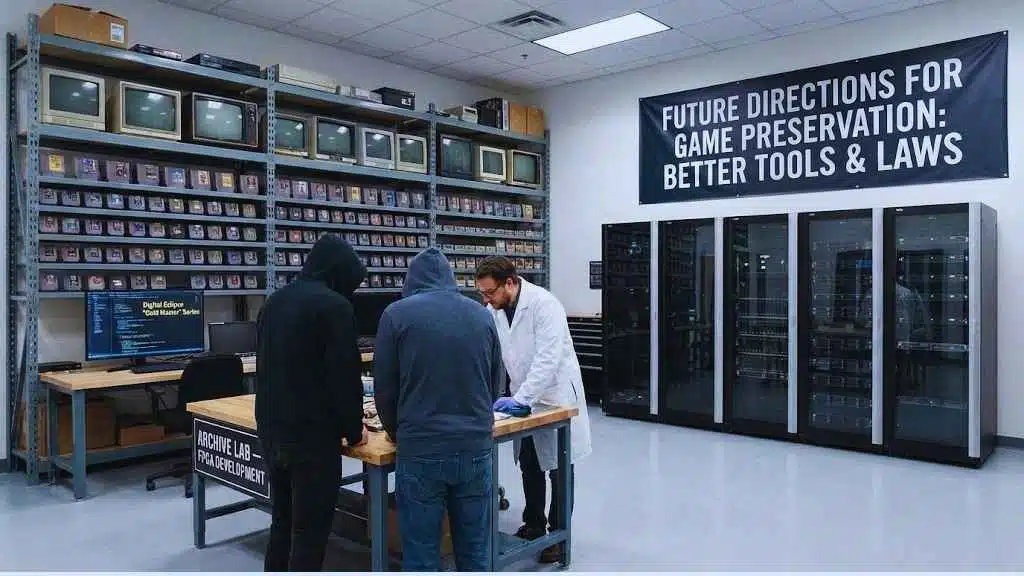
The future depends on better tools and better laws. We need a truce between the people who make games and the people who save them.
How can developers and preservationists collaborate effectively?
Developers need to build archiving into their workflow. Studios like Digital Eclipse are leading the way. Their “Gold Master” series includes design docs and video interviews directly in the game release.
The Software Preservation Network encourages studios to deposit their source code with archives. Even if the data stays dark for 20 years for trade secret reasons, it is safe. It ensures that when the copyright eventually expires, the data is not lost.
What advancements in FPGA and cloud storage aid preservation?
Field-Programmable Gate Arrays (FPGAs) are the hardware future. Devices like the MiSTer FPGA or the Analogue Pocket use these chips to replicate the original hardware at a transistor level. This is not software guessing; it is hardware cloning.
Cloud storage allows us to decentralize the archive. The Internet Archive stores petabytes of data. Distributing these backups ensures that a single fire or server failure cannot wipe out history.
How can advocacy and education expand awareness of game preservation?
We need to change the narrative. We must explain that preservation is not piracy. It is library science. Advocacy groups are teaching lawmakers that video games are art, and art deserves protection.
Public campaigns like “Stop Killing Games” are vital. They mobilize voters to demand consumer protections for digital goods. If we can pass laws that mandate offline modes for abandoned games, we solve the technical problem with a legal key.
Final Words
Game preservation is a race against data rot and legal indifference. Frank Cifaldi, the founder of the Video Game History Foundation, has made the stakes clear. His research confirms that nearly 90 percent of gaming history is already legally inaccessible.
This is not just about playing old games. It is about maintaining the record of a defining art form. Cifaldi and his team argue that we are in a “dark age” of digital history. Without intervention, the early 21st century will be a blank spot in the historical record.
The path forward requires a shift in how we view ownership. When you buy a game, you should own the right to play it, even if the manufacturer loses interest. Projects like Stop Killing Games and the work of the Software Preservation Network are fighting for this right.
We have the technology. FPGA chips and advanced emulators like Dolphin prove we can keep this software alive. The community has the passion. Groups like Hidden Palace and Flashpoint have done the heavy lifting that billion-dollar corporations refused to do.
The final piece is policy. We need exemptions that allow libraries to do their jobs. We need studios to see archivists as partners, not pirates. Until then, the burden falls on us—the users, the engineers, and the fans—to ensure that when the servers finally die, the culture they created does not die with them.