

US-China Chip Diplomacy 2026 has moved beyond simple trade restrictions into a complex, high-stakes siege that is redefining global alliances. On January 14, 2026, President Donald Trump signed a pivotal Section 232 proclamation imposing a targeted 25% tariff on specific advanced semiconductor imports, effectively weaponizing the American supply chain in a way that has sent shockwaves from Silicon Valley to Shenzhen.
This move, coupled with the Bureau of Industry and Security’s (BIS) new “Tiered” licensing system, signals the end of the “Containment” era and the beginning of aggressive “Bifurcation.” The United States is no longer just trying to slow China down; it is building a diplomatic fortress around the future of artificial intelligence, forcing neutral nations to choose sides in a conflict where the cost of neutrality is rising by the day.
The “DeepSeek Shock”: Why the Old Strategy Failed
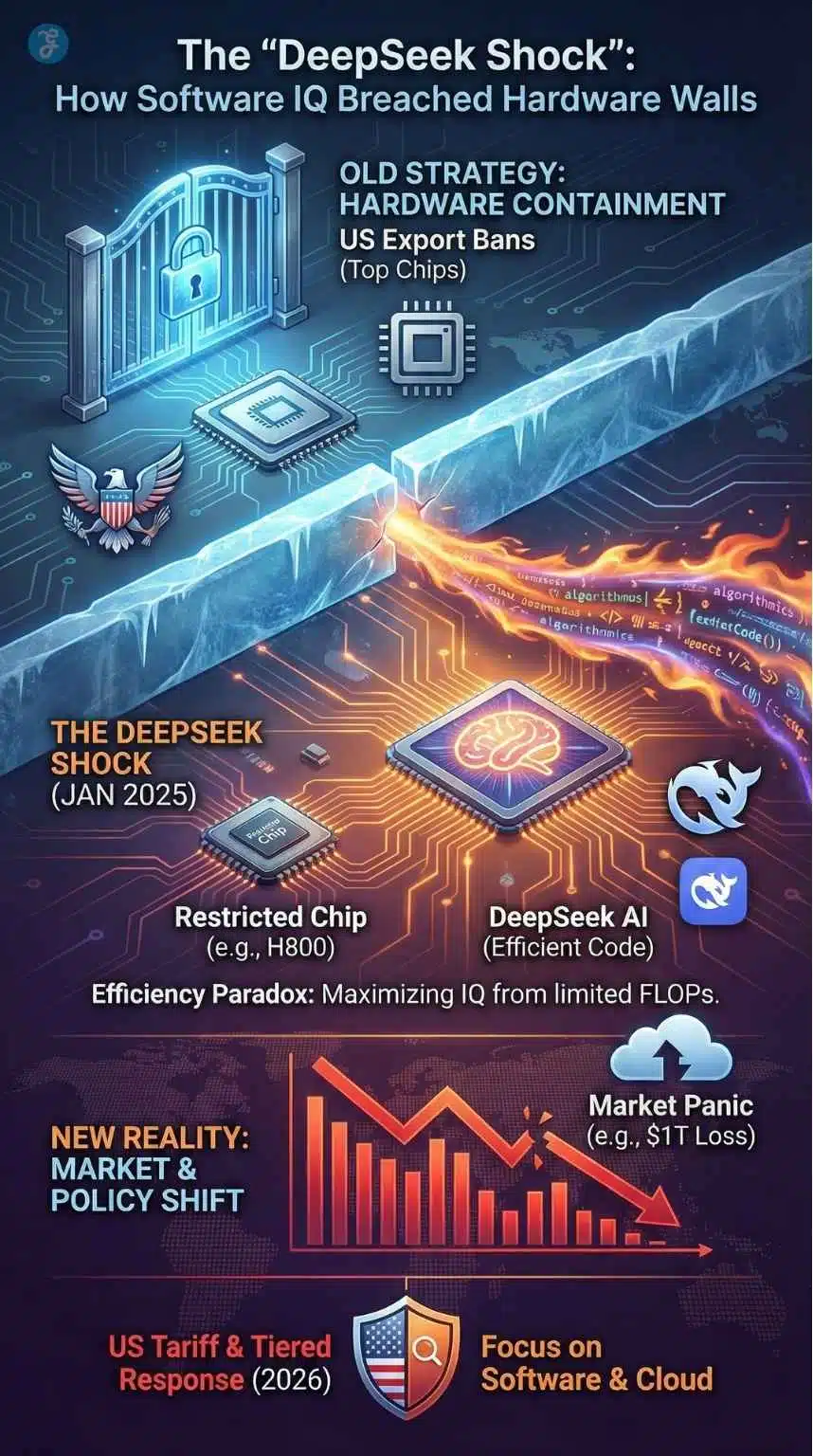
To understand the ferocity of the 2026 escalation, one must look back to the “Sputnik Moment” of January 2025: the release of DeepSeek R1.
For years, Washington operated on the assumption that banning cutting-edge hardware (like Nvidia’s H100) would suffocate China’s AI ambitions. That theory collapsed when DeepSeek, a Chinese startup, released a reasoning model that rivaled OpenAI’s GPT-4 while running on older, restricted Nvidia H800 chips. This event, now known as the “DeepSeek Shock,” triggered a trillion-dollar sell-off in US tech stocks and proved a painful lesson: necessity is the mother of invention.
US sanctions had inadvertently forced Chinese developers to become hyper-efficient at software optimization. By “squeezing every drop of IQ out of every FLOP,” Chinese firms bypassed the hardware moat. The Trump administration’s January 2026 pivot acknowledges this reality. If hardware bans alone cannot stop China, the strategy must shift to a combination of economic extraction (tariffs) and diplomatic strangulation (the Tiered System).
The Trump 2.0 Escalation: Tariffs & The “Tiered” Fortress
The Executive Order signed on January 14 is a masterclass in economic statecraft, utilizing Section 232 of the Trade Expansion Act, a tool previously used for steel and aluminum, to declare semiconductor dependency a national security emergency.
The 25% “Pass-Through” Tariff
The new order imposes a 25% duty on advanced logic chips (specifically targeting the Nvidia H200 and AMD MI325X) imported into the US. Crucially, this tariff exempts chips destined for “US Data Centers” or those supporting “Domestic Supply Chain Buildout.”
The Goal: The tariff is designed to punish “pass-through” trade. It incentivizes Nvidia and AMD to keep their most advanced supply chains physically tethered to the US, making it prohibitively expensive to route chips through third-party hubs that might leak to adversaries.
The BIS “License Review” System [Jan 13 Rule]
Just 24 hours before the tariff hit, the Commerce Department unveiled a new diplomatic framework for chip exports, replacing the blunt “Presumption of Denial” with a nuanced “Tiered” system:
- Tier 1 (The Allies): Unrestricted access for the UK, Canada, Australia, and Japan. These nations are inside the “Circle of Trust.”
- Tier 2 (The Grey Zone): This is the new battleground. Countries like the UAE, Saudi Arabia, and India are granted access to advanced silicon but are subject to strict caps and invasive “End-Use Monitoring.” They must essentially open their data centers to US inspectors to prove that no Chinese firms are renting the computing power.
- Tier 3 (The Adversaries): China, Macau, and Russia remain under heavy restriction. However, the new rule allows for a “Case-by-Case” review for the downgraded Nvidia H200, a slight easing intended to keep US revenue flowing without surrendering the crown jewel “Blackwell” chips.
The New World Order of Chips
The BIS “Tiered” system is the most complex part of the new policy. This table simplifies the legal jargon into a clear “Who gets what” guide.
| Tier Level | Key Nations | Access to AI Chips | The “Price” of Access |
| Tier 1 (Allies) | UK, Canada, Australia, Japan | Unrestricted | Must align export controls with US BIS standards. |
| Tier 2 (Grey Zone) | UAE, Saudi Arabia, India, Vietnam | Restricted / Capped | Subject to caps & on-site “End-Use Monitoring” (US inspectors allowed). |
| Tier 3 (Adversaries) | China, Russia, Macau, Iran | Banned / Case-by-Case | Presumption of denial for top-tier chips; “Case-by-Case” for downgraded legacy silicon. |
The “H200 Compromise”: Nvidia’s Tightrope Walk
The most ironic twist of the 2026 standoff is the “H200 Compromise.” On January 13, the US government effectively gave Nvidia the green light to sell the H200 (a powerful but slightly older chip) to China. The logic is “Pax Silica”: the US needs the $12 billion in annual revenue from the Chinese market to fund the R&D that keeps American firms ahead.
However, the “Chip Diplomacy” took a sharp turn on January 15. In a move that surprised Western analysts, China blocked the entry of these very chips. Beijing instructed domestic tech giants to boycott the H200, signaling that it would rather suffer short-term pain than continue financing its adversary’s tech dominance.
This rejection proves that decoupling goes both ways. China is no longer willing to buy “crippled” American technology. Instead, it is doubling down on domestic alternatives like Huawei’s Ascend series, accepting lower performance today for total independence tomorrow.
China’s Counter-Strike: The “Gallium Gun” & “Gazelles”
While the US fights with tariffs and licenses, China is fighting with raw materials and state capital.
The Gallium Leverage
In November 2025, China suspended its export ban on Gallium and Germanium, critical minerals for semiconductor manufacturing, until November 27, 2026. This suspension is a loaded gun. By allowing exports to flow temporarily, Beijing has given itself a “kill switch” it can flip if the US sanctions become existential. China controls 98% of the global Gallium supply; a reinstated ban would cripple US radar and defense production within months.
The Smuggler’s Route: How Chips Flow in the Dark
The “Ant Market” Phenomenon Despite the high-tech blockade, a low-tech reality persists: the “Grey Market.” In the electronic markets of Shenzhen’s Huaqiangbei, prices for illicit Nvidia A100s and H100s have stabilized, indicating a steady, albeit illegal, supply.
Smuggling networks have evolved. Instead of massive shipping containers, chips are now entering China via “Ant Smuggling”, thousands of individuals carrying consumer-grade RTX 4090 cards (which can be modified for AI training) across borders in Singapore, Vietnam, and Hong Kong. Recent reports indicate “desoldering factories” in Southern China that strip high-performance memory chips from consumer gaming boards to repurpose them for AI clusters. This “brute force” acquisition strategy is inefficient and costly, but it keeps China’s AI models training, proving that while you can sanction a corporation, you cannot sanction a soldering iron.
The Rise of the “Gazelles”
Domestically, the sanctions have spurred a venture capital explosion. As of early 2026, there are 278 “Gazelle” companies (startups valued between $500m and $1bn) in China’s semiconductor and biotech sectors. These firms are aggressively capturing the market for “Legacy Chips” (28nm and above), the silicon that runs electric vehicles, washing machines, and industrial robots. While the US obsesses over the 3nm AI chips, China is cornering the market on the chips that run the physical economy.
The Strategic Arsenal [US vs. China]
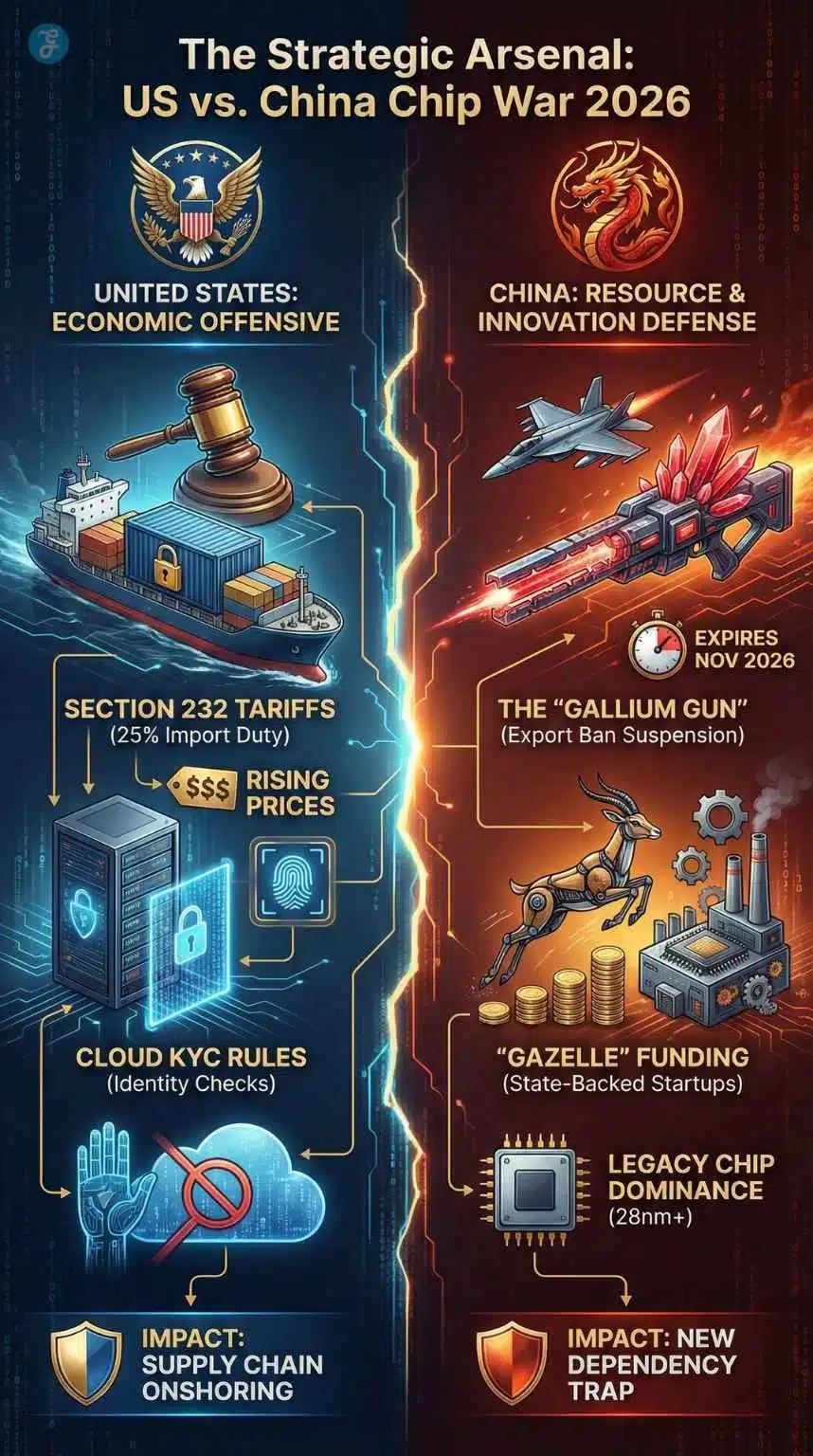
This summarizes the “weapons” each side is using in 2026, comparing the US economic offensive against China’s resource-based defense. It provides a quick snapshot of the entire conflict.
| Strategic Weapon | The Action (Jan 2026) | Primary Target | Projected Impact |
| US: Section 232 Tariffs | 25% Import Duty on advanced logic chips. | “Pass-through” trade & re-exporters. | Forces supply chains to physically move to the US; raises consumer prices 10-15%. |
| US: “Cloud KYC” Rules | Mandatory identity checks for cloud computing users. | Chinese firms are renting US computing power remotely. | Closes the “Cloud Loophole” used to train AI models like DeepSeek. |
| China: The “Gallium Gun” | Suspended export ban (expires Nov 2026). | US Defense & Radar manufacturing. | A “Kill Switch” threat: China can starve US defense firms of raw materials instantly. |
| China: “Gazelle” Funding | State backing for 278+ semi/biotech startups. | The “Legacy Chip” Market (28nm+). | China dominates the chips used in cars/appliances, creating a new dependency trap. |
The “Third World” of Chips: Caught in the Crossfire
The standoff has created a “Third World” of technology, nations caught between the US AI ecosystem and Chinese infrastructure.
- The Middle East Dilemma: Saudi Arabia and the UAE are pouring billions into AI data centers. To access US Tier 2 status and get Nvidia chips, they are being forced to rip out Chinese Huawei telecom equipment, a costly and diplomatically sensitive demand.
- The Cloud Loophole: Chinese firms have increasingly turned to renting computing power in Singapore or Dubai to train their models. The US is now closing this “Cloud Loophole” by demanding strict “Know Your Customer” (KYC) regulations for cloud providers, effectively extending US law into foreign server farms.
The European Front: ASML & The Lithography Choke Point
While Washington focuses on the chips (Nvidia/AMD), the true choke point of the supply chain lies in the machines that make them. The Netherlands, home to ASML, the sole supplier of Extreme Ultraviolet (EUV) lithography machines, finds itself in an increasingly impossible diplomatic bind.
In January 2026, under immense pressure from the Trump administration’s “Foreign Direct Product Rule” (FDPR), the Dutch government revoked export licenses for even mid-tier DUV (Deep Ultraviolet) immersion systems to China. This was the final nail in the coffin for China’s ability to legally acquire tools for sub-7nm manufacturing.
However, this compliance comes at a heavy price. China represented nearly 29% of ASML’s revenue in 2025. By forcing Amsterdam to cut off its biggest client, the US is testing the limits of Trans-Atlantic unity. European leaders are now openly debating if US “National Security” is becoming a cover for “Commercial Sabotage” of European industry, creating a fracture in the Western alliance that Beijing is keen to exploit.
Taiwan: The “Silicon Shield” Under Siege
No analysis of the chip war is complete without addressing the elephant in the room: TSMC. The Taiwanese giant manufactures 90% of the world’s advanced chips, creating a “Silicon Shield” that theoretically protects the island from invasion. However, the 2026 escalation threatens to shatter this shield.
The Trump administration’s new tariffs and “America First” push have placed TSMC in a paradox. The US is demanding TSMC accelerate production at its Arizona fabs (Fabs 21 & 22) to “de-risk” the supply chain. Yet, high operational costs and a shortage of skilled US labor have delayed full volume production of 3nm chips in Arizona until late 2026 or 2027.
This creates a dangerous window of vulnerability. If the US successfully “onshores” enough capacity, Taiwan loses its geopolitical leverage. Conversely, if China feels the “window of opportunity” closing before US factories come online, the risk of a kinetic blockade, rather than just a trade war, rises exponentially. The “Chip Diplomacy” is effectively racing against the clock of TSMC’s diversification.
Economic Fallout: The Cost of Bifurcation
The “Chip Diplomacy” of 2026 is not free. The new 25% tariffs on imported chips are expected to trickle down to American consumers, raising the prices of laptops, smartphones, and gaming consoles by an estimated 10-15% by the holiday season.
Furthermore, the ITIF estimates that a full decoupling could cost the US semiconductor industry up to $83 billion in annual revenue and jeopardize 125,000 jobs. The strategy is high-risk: by cutting off China, the US loses its biggest customer, potentially starving the very innovation engine it seeks to protect.
Final Thought: The Era of “Tech Stack Diplomacy”
The events of January 2026 mark a definitive shift. We have moved past a “Trade War” into “Systemic Warfare.” The US-China relationship is no longer about balancing trade deficits; it is about two incompatible technological operating systems battling for global dominance.
For the rest of the world, the era of neutrality is over. Nations must now choose their “Tech Stack”, the US Tiered System or the Chinese Autarky. As the Gallium export waiver ticks down to its November 2026 expiration, the world holds its breath, waiting to see if the “Chip Diplomacy” will lead to a stable détente or a digital iron curtain.





















