Economics Heat pumps used to feel like a niche upgrade. Now they are showing up in more homes, more climates, and more “replace my furnace” conversations than ever. The reason is not hype. It is economics.
When people say “heat pumps save money,” they usually mean one of three things: lower monthly bills, a faster payback thanks to incentives, or a better long-term total cost compared with gas, oil, propane, or electric resistance heating. The truth is more nuanced. Heat pumps can be a great financial move, but savings depend on your utility rates, your climate, your home’s insulation and air sealing, and whether the system is sized and installed correctly.
This guide breaks down the full cost picture: upfront costs, operating costs, incentives, and payback period. You will also get practical checklists and simple ways to estimate whether a heat pump is worth it for your home.
What “Economics” Means Here: Upfront Cost, Operating Cost, And Payback
Heat pump economics is not just “how much does it cost to install?” It is a full lifecycle question. Two systems can have the same purchase price and very different outcomes over ten to fifteen years.
A helpful way to think about it is like buying a car:
- Upfront cost is the purchase price.
- Operating cost is fuel (your energy bills).
- Maintenance and repairs are routine service and occasional fixes.
- Lifespan determines how long you benefit before replacing equipment.
- Incentives act like a discount that can radically change payback.
If you only compare installed price, you will miss the bigger picture. The economics of heat pumps is really about how money flows over time.
The 3 Numbers That Decide If A Heat Pump Saves You Money
If you want a quick decision framework, focus on these three numbers:
- Net installed cost: This is the quoted installed price minus rebates and tax credits you can actually claim.
- Annual operating cost difference: This is the estimated yearly heating and cooling cost with a heat pump compared with what you use now (gas, oil, propane, or electric resistance). This number can be positive or negative depending on utility rates.
- Expected lifespan and ownership horizon: Many homeowners stay long enough to see benefits. But if you plan to move soon, payback speed matters more than long-run savings.
If a heat pump has a higher net installed cost but saves a lot each year, payback is faster. If energy savings are small, payback can stretch out—unless incentives cover a large part of the upfront cost.
Simple Payback vs Total Cost Of Ownership
You will see two types of ROI talk online.
Simple payback is the easiest and the most common:
- Simple payback = (Net installed cost premium) ÷ (Annual savings)
It answers: “How many years until the savings equal the extra upfront cost?”
Total cost of ownership (TCO) is the more complete version. It includes:
- upfront costs
- energy bills year by year
- maintenance and repairs
- likely replacement cycle
- sometimes financing cost
TCO is better because it reflects real life. A heat pump might have a long simple payback but still be a smart choice if it replaces both heating and cooling equipment, reduces maintenance, or avoids fuel price spikes.
Why Heat Pumps Can Be Cheaper To Run (The Efficiency Advantage)
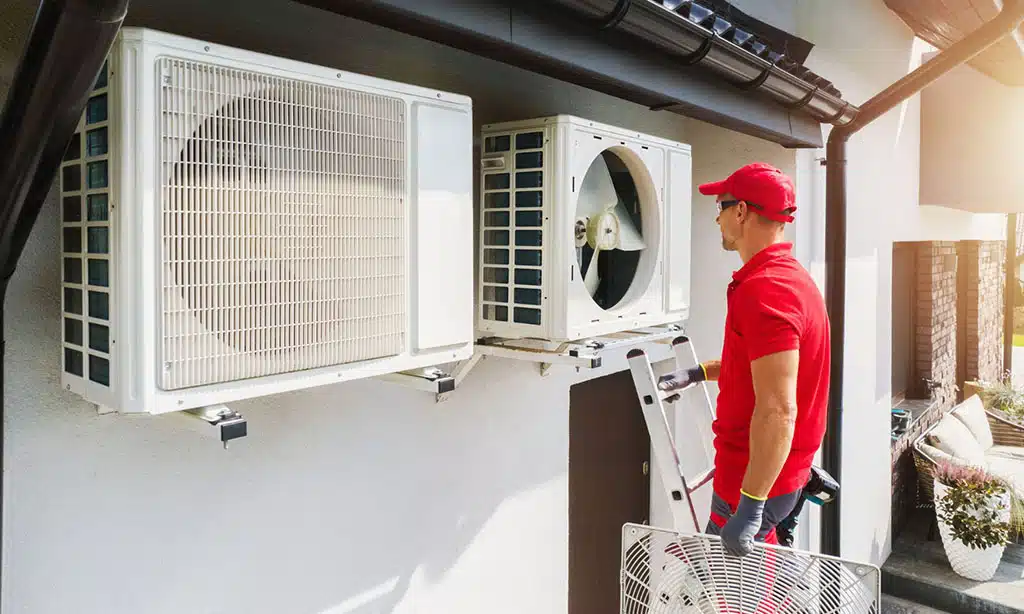
The biggest reason heat pumps can win economically is efficiency. A furnace makes heat by burning fuel. Electric resistance heat makes heat by converting electricity into heat. A heat pump does something different: it moves heat from one place to another.
That single difference changes the math.
Heat Pumps Move Heat Instead Of Making Heat
A heat pump works like an air conditioner running in reverse.
- In winter, it pulls heat from outdoor air (yes, even cold air contains heat energy) and moves it indoors.
- In summer, it pulls heat from inside your home and dumps it outdoors.
Because it transfers heat rather than creating it from scratch, a heat pump can deliver more heat energy than the electricity it consumes. That is why many heat pumps can achieve high efficiency in the real world, especially in moderate temperatures.
What this means in plain language:
- If your heat pump delivers “two to four units of heat” for each unit of electricity, your heating dollars can go further than electric resistance heat.
- Compared with gas, oil, or propane, the winner depends on fuel price and how efficiently your current system runs.
The Metrics That Matter: COP, SEER2, HSPF2 (In Plain English)
You do not need to become an HVAC engineer, but you should understand three terms because they connect directly to operating cost.
- COP (Coefficient of Performance): Think of COP as “heat delivered per unit of electricity.” A COP of 3 means the heat pump delivers about three units of heat for every unit of electricity used. Higher COP usually means lower operating cost.
- SEER2 (cooling efficiency): Higher SEER2 generally means lower summer cooling bills. If you currently use window units or an older central AC, this can be a meaningful savings driver.
- HSPF2 (heating efficiency): Higher HSPF2 generally means better heating performance per unit of electricity over a season.
Important tip: efficiency ratings are not everything. A slightly lower-rated system installed correctly can outperform a higher-rated system installed poorly.
Upfront Cost: What Heat Pumps Really Cost To Buy And Install
Heat pump installation cost is where many people get stuck. They hear wildly different numbers and assume someone is exaggerating. The truth is that the installed price is highly sensitive to home layout and project scope.
A good quote should include more than a model number. It should reflect sizing, duct condition, electrical capacity, and how the installer plans to commission the system.
Typical Installed Cost Ranges (And Why They Vary So Much)
Heat pumps can be more expensive upfront than a basic gas furnace replacement, especially if you need electrical upgrades or new ductwork. But costs range widely depending on the setup.
Common drivers that change the price:
- Ducted vs ductless
- Ductless mini-splits can avoid ductwork issues but may require multiple indoor heads.
- Ducted systems may need duct repairs or modifications.
- Ductless mini-splits can avoid ductwork issues but may require multiple indoor heads.
- Electrical upgrades
- Panel upgrades, new breakers, and wiring can add cost.
- Some homes need a service upgrade to handle added load.
- Panel upgrades, new breakers, and wiring can add cost.
- Duct condition
- Leaky or undersized ducts can reduce performance and comfort.
- Fixing ducts can add cost but improves ROI.
- Leaky or undersized ducts can reduce performance and comfort.
- System sizing and complexity
- Larger homes and complex layouts cost more.
- Multi-zone systems can raise equipment and labor costs.
- Larger homes and complex layouts cost more.
- Local labor and permitting
- Labor rates vary by region.
- Permits and code requirements add cost.
- Labor rates vary by region.
A practical way to think about it is this: a heat pump is not one product. It is a project.
Cost Breakdown Table (Recommended)
Here is a simple breakdown you can use to compare bids. If an estimate is missing major items, ask why.
| Cost Component | What It Includes | Why It Matters |
| Equipment | Outdoor unit + indoor unit(s), coils, controls | Core performance and efficiency |
| Labor | Installation, refrigerant handling, setup | Install quality drives comfort and bills |
| Electrical work | Breakers, wiring, disconnects, panel work | Can be a major hidden cost |
| Ductwork (if needed) | Modifications, sealing, balancing | Affects airflow, noise, and efficiency |
| Permits and inspection | Local permits, inspections | Protects you and ensures code compliance |
| Disposal | Removing old equipment | Often included, sometimes extra |
| Accessories | Thermostat, surge protection, condensate pump | Small items can add up |
When comparing heat pump installation cost quotes, ask the contractor to itemize these categories. You will spot gaps quickly.
Hidden Costs (And How To Avoid Overpaying)
Some costs are not “extras.” They are requirements for the system to perform as promised.
Common hidden costs to watch:
- No load calculation
- If a contractor is guessing size, your ROI is at risk.
- Oversizing can cause short cycling, humidity issues, and lower efficiency.
- If a contractor is guessing size, your ROI is at risk.
- Ignoring ducts
- If you have ducts, ask for duct leakage and airflow checks.
- A high-efficiency heat pump cannot fix bad airflow by itself.
- If you have ducts, ask for duct leakage and airflow checks.
- No commissioning
- Commissioning means verifying refrigerant charge, airflow, and controls.
- This is where real-world performance is won or lost.
- Commissioning means verifying refrigerant charge, airflow, and controls.
How to avoid overpaying:
- Get at least three quotes.
- Ask each contractor what assumptions they used.
- Compare scope, not just price.
- Look for clear warranty terms and service support.
Operating Costs: When A Heat Pump Beats Gas (And When It Doesn’t)
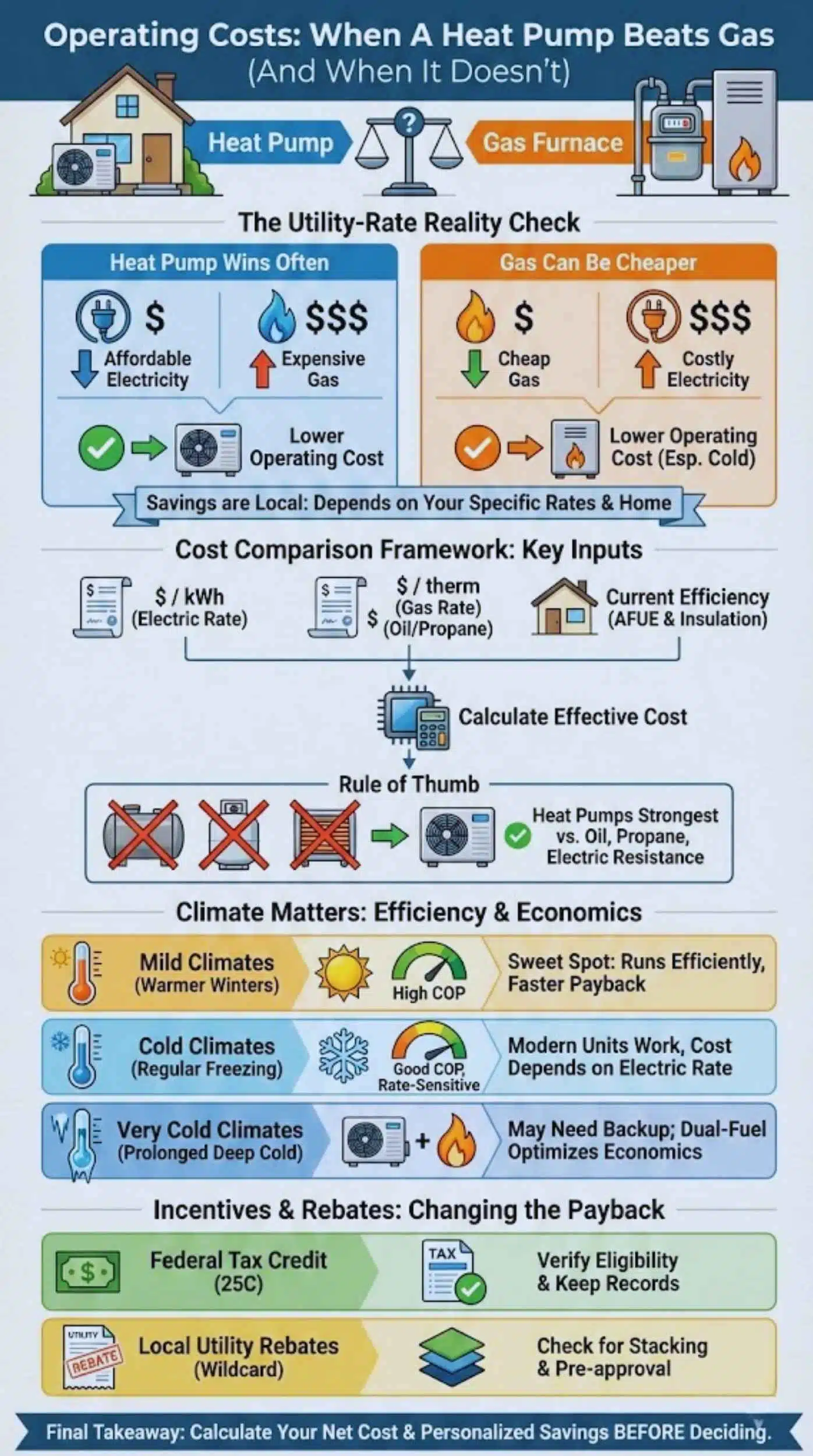
Operating cost is the heart of heat pump economics. Many people focus on “heat pumps are efficient,” but the actual bill depends on the price of electricity and the price of the fuel you are replacing.
A heat pump can be cheaper to run than gas in many places. It can also be more expensive in others. The key is understanding the variables.
The Utility-Rate Reality Check
Two homes with the same heat pump can have opposite outcomes.
- If electricity is relatively affordable and gas is expensive, a heat pump often wins.
- If gas is cheap and electricity is costly, gas can remain cheaper for heating, especially in very cold weather.
The most honest way to approach this is: heat pump savings are local. They depend on:
- your electricity price ($/kWh)
- your gas price ($/therm) or propane price ($/gallon) or oil price ($/gallon)
- how efficient your current system is
- how well your home holds heat
- how cold your winters are
That is why “cost to run heat pump vs gas furnace” searches are so common. People want the math for their situation.
Heat Pump vs Gas Furnace: Cost Comparison Framework
You can estimate the cost difference with a simple framework. You do not need perfect precision to make a smart decision.
Inputs you need:
- Your electric rate ($/kWh)
- Your gas rate ($/therm) or other fuel cost
- Your current furnace efficiency (AFUE) if you know it
- A reasonable heat pump seasonal efficiency estimate (COP/HSPF2)
- A sense of your heating demand (often approximated by your past bills)
A simple concept to remember:
- A furnace’s effective cost depends on fuel price and AFUE.
- A heat pump’s effective cost depends on electric price and seasonal COP, which changes with outdoor temperature.
If you want a quick rule of thumb to guide a deeper estimate:
- Heat pumps tend to look strongest when replacing oil, propane, or electric resistance, because those fuels often cost more per unit of usable heat.
- The heat pump vs gas comparison is more sensitive to local rates.
Practical step: Pull 12 months of utility bills and estimate current annual heating spend. Even a rough split between heating and non-heating months gives you a baseline.
Climate Matters: Mild, Cold, And Very Cold Scenarios
Climate is not just comfort. It is economics.
Mild climates (warmer winters):
- Heat pumps often operate at higher efficiency.
- The system spends more time in the “sweet spot,” which can reduce operating cost.
- Payback can be faster because the heat pump runs efficiently and also replaces cooling.
Cold climates (regular freezing weather):
- Modern cold-climate heat pumps can still work well.
- Efficiency typically drops as temperatures fall, so operating cost depends more on electric rates.
- Proper sizing, defrost strategy, and airflow become more important.
Very cold climates (prolonged deep cold):
- You may see more reliance on backup heat depending on system design.
- Some homeowners consider dual-fuel (heat pump + gas furnace) to optimize economics by switching fuels when one becomes cheaper.
Economic takeaway: cold weather does not “kill” heat pump economics automatically. It makes the decision more rate-sensitive and installation-sensitive.
Incentives And Rebates: How Credits Change The Payback
In many markets, incentives are the difference between “interesting” and “no-brainer.” A heat pump that looks expensive on paper can become competitive after tax credits and rebates.
The most important thing is to calculate your net installed cost correctly. That means understanding what you qualify for and what documentation you will need.
Federal Tax Credit (25C): What It Covers And How To Document It
In the United States, the Energy Efficient Home Improvement Credit (often called 25C) can apply to qualifying heat pumps. The credit rules, annual limits, and eligible equipment details matter, so it is worth verifying the most current IRS guidance when you plan your project.
What to do from a homeowner standpoint:
- Confirm your chosen heat pump meets eligibility requirements.
- Keep invoices and manufacturer certification statements if provided.
- Save proof of payment and installation date.
Tip: Treat incentives like a project checklist item. A good contractor should be able to explain what models qualify and what paperwork you should keep, but you are responsible for your records.
ENERGY STAR Guidance And Program Stacking (Where Allowed)
ENERGY STAR maintains guidance on federal tax credits and which products may qualify. This can be a helpful cross-check when evaluating equipment.
When it comes to stacking incentives:
- Some programs allow stacking (federal + state + utility).
- Others reduce benefits if you receive certain rebates.
- Some require pre-approval or use a participating contractor.
Action step: Before signing a contract, ask:
- “Do I need pre-approval for the rebate?”
- “Is this model on the eligible list?”
- “Do I need a participating installer?”
- “Do I need permits and final inspection for payout?”
Local Utility Rebates: The Biggest Variable
Utility and regional rebates are often the biggest wildcard in the economics of heat pumps.
In some areas, rebates can be large enough to:
- reduce the upfront premium vs a furnace replacement
- shorten payback by several years
- allow upgrades like duct sealing or panel work to fit the budget
Quick checklist for local rebates:
- eligibility (income-based or general)
- required efficiency rating
- contractor participation rules
- paperwork requirements
- deadlines and funding availability
Payback Period: How Fast Does A Heat Pump “Pay For Itself”?
The heat pump payback period is the question that drives most switching decisions. People want a timeline. They want to know when the savings become real.
Payback is not one number for everyone. It is a range, shaped by local energy prices and your home’s baseline efficiency.
A Simple Payback Example (With Sensitivity Notes)
Here is a simple example using round numbers to show how the process works. Do not copy these numbers as “typical.” Use them as a template.
Example:
- Heat pump installed cost: $12,000
- Comparable replacement option: $8,500
- Upfront premium: $3,500
- Incentives reduce heat pump net cost by $2,000
- Net premium after incentives: $1,500
- Estimated annual energy savings: $500
Simple payback = $1,500 ÷ $500 = 3 years
Now the sensitivity:
- If annual savings are only $250, payback becomes 6 years.
- If incentives cover the full premium, payback can be near immediate.
- If electricity is expensive relative to gas, annual “savings” may shrink or become a cost increase.
This is why it is smart to run at least two scenarios: a conservative case and an optimistic case.
What Speeds Up Payback
Payback is usually faster when you have one or more of these conditions:
- You are replacing oil, propane, or electric resistance heat
- Your heating bills are high and your home needs steady heating
- You qualify for strong rebates or tax credits
- Your home is reasonably well insulated and air sealed
- You are replacing both a furnace and an aging air conditioner
Also, a well-installed system can reduce operating costs more than a high-rated system installed poorly. Installation quality is part of economics.
What Slows Down Payback
Payback can stretch out when:
- Gas is cheap and electricity is expensive in your area
- Your home leaks heat (poor insulation or air sealing)
- The system is oversized, poorly ducted, or incorrectly commissioned
- You choose premium features that do not improve comfort or savings for your needs
- Your current system is already high-efficiency and relatively new
If your current gas furnace is modern and efficient, the operating cost gap may be smaller. In that case, the decision may be driven more by incentives, comfort, cooling benefits, and long-term plans.
Real-World Reference Point: Case Study Payback Ranges
Payback can vary widely. Some homeowners see faster payback because rebates reduce net cost and because they are replacing expensive fuels. Others see longer payback if the heat pump premium is high and their current fuel is relatively cheap.
Real-world examples often show payback in the mid-single digits in favorable conditions, but it can also be longer depending on local rates and installation scope. The key is to calculate payback based on your net cost and your bills, not someone else’s headline number.
Why “Everyone Is Switching”: The Macro Drivers Behind The Trend
Heat pump adoption is not happening for one reason. It is the result of several forces that make heat pumps more attractive than they were a decade ago.
Bills, Volatility, And The Promise Of Lower Energy Costs
Energy prices move. Some fuels swing more than others. Heat pumps give homeowners a way to shift heating away from fuels that can be volatile or expensive in certain regions.
Also, heat pumps can replace or reduce reliance on:
- oil heating systems
- propane heating
- electric resistance heating
- older, inefficient HVAC setups
For many households, that switch can reduce operating costs and improve comfort at the same time.
Policy, Electrification, And Home Resale Appeal
Incentives matter. When governments and utilities promote heat pumps, they change the economics by lowering the net installed cost.
Beyond incentives, homeowners are also considering:
- modern comfort expectations (quiet, consistent heating and cooling)
- the idea of electrifying systems for long-term flexibility
- resale value tied to efficient, updated mechanical systems (this varies by market)
Even when a heat pump does not deliver dramatic monthly savings in year one, it can still be an appealing modernization move if it improves comfort and reduces future risk.
Important Nuance: Adoption Isn’t Uniform Everywhere
It is easy to say “everyone is switching,” but adoption varies by country and region. Policy changes, energy prices, and public incentives can accelerate or slow heat pump sales.
That is why you should avoid one-size-fits-all claims. A heat pump can be an excellent decision in many homes, but it is not automatically the cheapest option in every market at every moment.
Decision Checklist: Should You Switch To A Heat Pump?
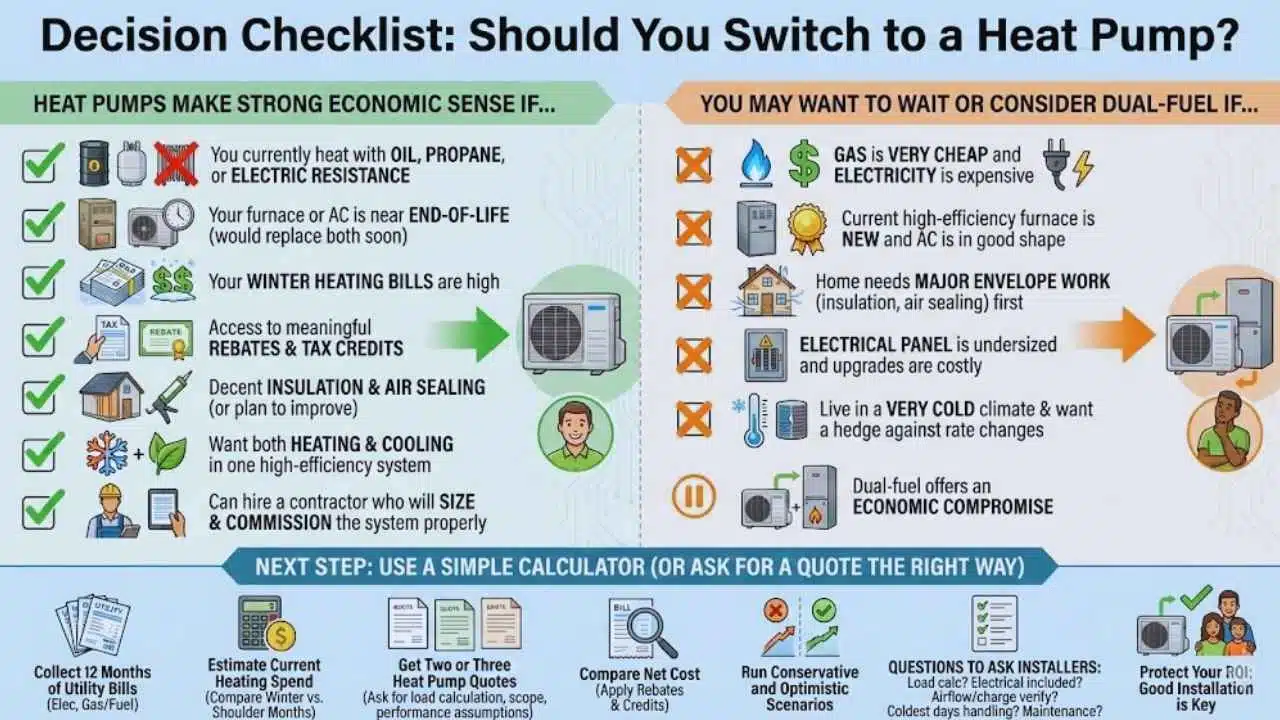
If you want a fast answer to “is a heat pump worth it?” start with this checklist. It reflects real-world drivers of cost savings and comfort.
Heat Pumps Make Strong Economic Sense If…
- You currently heat with oil, propane, or electric resistance
- Your furnace or AC is near end-of-life and you would replace both soon
- Your winter heating bills are high
- You have access to meaningful rebates and tax credits
- Your home has decent insulation and air sealing (or you plan to improve them)
- You want both heating and cooling in one high-efficiency system
- You can hire a contractor who will size and commission the system properly
You May Want To Wait Or Consider Dual-Fuel If…
- Gas is very cheap in your area and electricity is expensive
- Your current high-efficiency furnace is new and your AC is also in good shape
- Your home needs major envelope work (insulation, air sealing) first
- Your electrical panel is undersized and upgrades are costly
- You live in a very cold climate and want a hedge against rate changes
Dual-fuel systems can sometimes offer an economic compromise by using the heat pump when it is efficient and switching to gas when it becomes cheaper to operate.
Next Step: Use A Simple Calculator (Or Ask For A Quote The Right Way)
If you want to make a confident decision, do not rely on guesses. Use your own bills and demand estimates.
Here is a simple, homeowner-friendly process.
Collect 12 months of utility bills
- electricity usage and cost
- gas usage and cost (or propane/oil deliveries)
Estimate current heating spend
- Compare winter months to shoulder months to estimate heating-related cost.
Get two or three heat pump quotes
Ask for:
- a load calculation or clear sizing justification
- a written scope including electrical and duct items
- expected performance assumptions for your climate
Compare net cost
- Apply known rebates and expected credits to compute net installed cost.
Run conservative and optimistic scenarios
- Conservative: modest savings, modest incentives
- Optimistic: strong incentives, stronger savings
Questions to ask installers (copy and paste):
- “Will you perform a load calculation to size the system?”
- “What is included in the quote for electrical and permits?”
- “Will you verify airflow and refrigerant charge after installation?”
- “How will the system handle the coldest days in my area?”
- “What maintenance is required and what does it cost?”
These questions protect your ROI because they reduce the risk of poor installation, which is one of the biggest reasons people fail to get the savings they expected.
Final Thoughts
The economics of heat pumps comes down to a simple idea: what you pay upfront versus what you save over time. A heat pump can be a strong financial upgrade when it replaces expensive fuels (like oil, propane, or electric resistance), when incentives reduce the net installed cost, and when your home is reasonably efficient. In those cases, monthly savings can be real and the payback period can be surprisingly short.
But switching is not automatically a win for every home. If gas is very cheap where you live, electricity is costly, or your home needs insulation and air-sealing work first, the ROI may be slower. That does not mean a heat pump is a bad choice—just that the decision should be based on your utility rates, your climate, your home’s condition, and a properly sized system.
If you want the best outcome, focus on the steps that protect your investment: get itemized quotes, insist on load calculations, verify rebate requirements before signing, and choose an installer who will commission the system correctly. Do that, and you will not just follow the trend—you will make a switch that makes financial sense.