Have you ever looked at a royal wedding or a golden carriage and wondered, “Just how deep do those pockets really go?” It is a question that crosses everyone’s mind. While we see the crowns and the castles, the real numbers in their bank accounts are often hidden behind palace walls.
You might be surprised to learn that the most famous royals—like the British family—are actually far from the richest. In fact, they don’t even crack the top five.
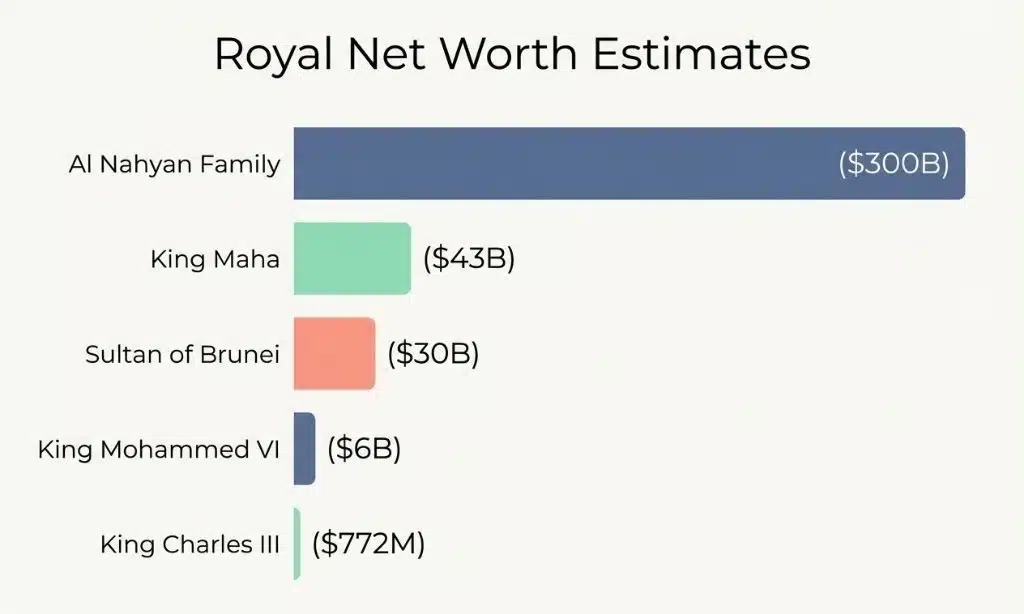
Here is a detail that might shock you: King Maha Vajiralongkorn of Thailand currently sits at the number one spot. His estimated net worth is up to $43 billion, completely eclipsing the fortunes of better-known European monarchs. We aren’t just talking about old money here; we are talking about active investments in cement, banking, and real estate that rival major corporations.
In this guide, I’m going to walk you through the true financial heavyweights of the royal world. We will look at exactly where their money comes from—whether it is oil, land, or smart investing—and see who truly holds the economic crown in 2026.
So, grab a cup of coffee, and let’s look at the ledger. The scale of this wealth is something you have to see to believe.
Key Takeaways
- Thailand’s King is #1: King Maha Vajiralongkorn holds the top spot with a fortune estimated at $43 billion. He personally owns massive stakes in Siam Cement Group and Siam Commercial Bank, assets that were previously held by the Crown Property Bureau.
- The “Trillion-Dollar” Family: While individual net worths are high, the Al Nahyan family of Abu Dhabi controls a fortune estimated at $300 billion to $1 trillion, surpassing even the Walton family (owners of Walmart).
- Cars, Cars, Cars: Sultan Hassanal Bolkiah of Brunei owns a collection of 7,000 vehicles worth over $5 billion. This includes roughly 600 Rolls-Royces and a custom Bentley SUV made years before the Bentayga existed.
- Business Empires vs. Oil Wells: While Middle Eastern royals rely on oil, Morocco’s King Mohammed VI has built a $6 billion fortune through a holding company that invests in renewable energy and banking across Africa.
- The British Gap: King Charles III has seen his wealth jump to around $772 million thanks to inheritance and property values, but he is still “poor” compared to his Asian and Middle Eastern counterparts.

King Maha Vajiralongkorn (Thailand) – $43 Billion
King Maha Vajiralongkorn, also known as Rama X, is widely considered the wealthiest individual monarch on the planet. While estimates vary based on land valuations, credible 2025 reports place his personal net worth at approximately $43 billion. He ascended to the throne in 2016 following the passing of his father, King Bhumibol Adulyadej.
The key to this massive number is a major change he made shortly after taking power. In 2018, he gained direct personal ownership of the assets previously managed by the Crown Property Bureau. This isn’t just a ceremonial fund; it acts more like a massive holding company.
What is in His Portfolio?

- Prime Real Estate: He owns over 16,210 acres of land. This includes 17,000 rental contracts in Bangkok alone, covering some of the most expensive commercial districts in the city.
- Corporate Giants: He holds a 23% stake in Siam Commercial Bank and a 33% stake in Siam Cement Group. These are two of the country’s largest industrial and financial pillars.
- The Golden Jubilee Diamond: This is the largest faceted diamond in the world, weighing in at 545 carats.
His spending is just as notable as his earning. The royal hangar houses 38 jet planes and helicopters, ensuring he can travel between Thailand and his residence in Germany at a moment’s notice. This level of control and wealth has sparked significant conversation in Thailand, especially among younger generations questioning the gap between royal fortune and public struggles.
Sultan Hassanal Bolkiah (Brunei) – $28-$30 Billion
Sultan Hassanal Bolkiah is a name that has been synonymous with “unlimited wealth” for decades. With a net worth hovering around $30 billion, he is the world’s second-longest-reigning monarch. He serves as his country’s Prime Minister, Defense Minister, and Finance Minister, giving him total control over the nation’s direction.
The source of this cash is straightforward: oil and natural gas. Brunei sits on massive reserves that have fueled the economy—and the Sultan’s bank account—for half a century.
Related Read: Faiq Bolkiah Net Worth: The Complete Breakdown of $20 Billion
The World’s Most Expensive Garage
While many billionaires buy cars, the Sultan buys car companies’ entire production runs. His collection is valued at over $5 billion and contains roughly 7,000 vehicles.

| Vehicle Type | Estimated Count | Notable “Insider” Detail |
|---|---|---|
| Rolls-Royce | ~600 | Includes a Silver Spur plated in 24-karat gold for his wedding day. |
| Ferrari | ~450 | Includes the Ferrari Mythos concept cars—he bought them all so no one else could have one. |
| Bentley | ~380 | He commissioned the “Dominator,” a custom SUV, years before Bentley officially made SUVs. |
He resides in Istana Nurul Iman, the largest residential palace in history. It features 1,778 rooms and air-conditioned stables for his favorite polo ponies. For context, that is more than three times the size of Buckingham Palace. It is a level of opulence that is hard to wrap your head around, fueled entirely by the black gold beneath his country’s soil.
King Salman bin Abdulaziz Al Saud (Saudi Arabia) – Around $21 Billion (Personal)
King Salman bin Abdulaziz Al Saud controls one of the most powerful positions on Earth. His personal net worth is estimated at $21 billion, but this number is just a drop in the bucket compared to the total wealth of the House of Saud. The royal family as a cohesive unit is worth an estimated $1.4 trillion.
While oil is the foundation, the King and his son, Crown Prince Mohammed bin Salman, are aggressively shifting the country’s business model through “Saudi Vision 2030.”This massive project aims to diversify their income so they don’t rely solely on oil prices.

“The Public Investment Fund (PIF), which the royal family steers, has tripled its assets to over $900 billion. They are betting big on tech, tourism, and mega-projects like NEOM.”
King Salman’s personal assets act as symbols of the state’s power. He owns the Erga Palace in Riyadh and luxury retreats in Tangier, Morocco. When he travels, it is often on a private Boeing 747, and he has a superyacht valued at over $110 million.
It is important to understand the scale here: The king’s personal $21 billion allows for a lavish life, but the family’s trillion-dollar control allows them to reshape global sports, technology, and energy markets.
Sheikh Mohammed bin Rashid Al Maktoum (Dubai) – Approximately $14-$18 Billion
Sheikh Mohammed bin Rashid Al Maktoum, the ruler of Dubai, is the man largely responsible for turning a desert port into a futuristic global hub. His personal fortune is estimated to be between $14 billion and $18 billion. Unlike some other monarchs who rely passively on resources, Sheikh Mohammed acts more like a CEO.
He launched Emirates Airlines in the 1980s, which has grown into a global aviation titan. He also drove the creation of DP World, a logistics company that manages ports all over the planet.
His “Insider” Investment Strategy:
- Landmarks as Assets: He didn’t just approve the Burj Khalifa; his holding companies developed it. These massive real estate projects drive tourism dollars directly back into the emirate’s economy.
- The Godolphin Stables: He is perhaps the world’s biggest spender in horse racing. His Godolphin operation breeds and trains thoroughbreds in the US, UK, and Ireland, turning a passion into a global business.
- International Land: He is one of the largest landowners in the UK, owning extensive estates in Scotland and around London.
His personal life often makes headlines as well. In 2021, a UK court ordered him to pay a divorce settlement of over $710 million to Princess Haya. It was one of the largest settlements in British legal history, proving that even for a ruler of his stature, legal battles can be incredibly costly.
Prince Hans-Adam II (Liechtenstein) – $9.2 Billion

Prince Hans-Adam II proves you don’t need oil to be incredibly wealthy; you just need a very good bank. He is the richest monarch in Europe, with a fortune that has surged to roughly $9.2 billion as of recent Bloomberg estimates.
Unlike British royals who live off grants and trust income, Prince Hans-Adam II personally owns the LGT Group. This is a private banking and asset management firm that handles over $334 billion for wealthy clients worldwide.
Why is he So Much Richer than Other European Kings?
- Direct Ownership: He owns the bank outright. It is not a state asset; it is a family business.
- The Princely Collections: He owns one of the most valuable private art collections in the world. We are talking about masterpieces by Rembrandt, Rubens, and Van Dyck housed in the Liechtenstein Garden Palace in Vienna.
- Land Holdings: The family owns significant agricultural and forest land in Austria, far larger than their own tiny country.
He is a savvy businessman who rebuilt the family fortune after World War II. While he technically holds the powers of a monarch, he runs his estate like a modern financial chairman.
King Charles III (United Kingdom) – $772 Million
King Charles III falls far down this list, with a net worth estimated around $772 million (£610 million). While he is certainly wealthy by normal standards, he is not a billionaire.
Since the passing of Queen Elizabeth II, Charles’s personal wealth has increased significantly. This isn’t just from savings; he inherited the Queen’s private investment portfolio and her two private estates: Balmoral Castle in Scotland and Sandringham House in England.
The “Public vs. Private” Confusion
It is easy to get confused by the Crown’s assets. The Crown Estate (which owns Regent Street in London and the seabed around the UK) is worth billions, but Charles does not own it. He cannot sell it, and he only receives a small percentage of its profits (the Sovereign Grant) to pay for official duties.
His real financial power comes from the Duchy of Lancaster. This is a private estate of land and property established in 1399 to provide an independent income for the Sovereign. It generates roughly $25-$30 million a year in pure profit, which he uses to fund his lifestyle and family expenses.
Sheikh Mohamed bin Zayed Al Nahyan (Abu Dhabi) – Family Wealth ~$300 Billion+
Sheikh Mohamed bin Zayed leads a family that has recently been identified as the richest in the world. The Al Nahyan family’s net worth is estimated at over $300 billion, with some analysts suggesting their total control of state funds pushes their influence closer to $1 trillion.
They control the Abu Dhabi Investment Authority (ADIA), a sovereign wealth fund that invests oil profits into markets around the globe.
Where You Might See their Influence
- Sports: The family’s wealth transformed Manchester City FC into a global football dominance (owned by Sheikh Mansour, MBZ’s brother).
- Space & Tech: Under MBZ, Abu Dhabi has invested heavily in SpaceX and artificial intelligence firms (like G42).
- Real Estate: They are major landlords in London’s prestigious Mayfair district.
While Sheikh Mohamed is known for a simpler personal lifestyle compared to others in the region, the financial muscle he commands is unmatched. He directs the capital that shapes the entire Middle East’s economy.
King Mohammed VI (Morocco) – Around $6-$8 Billion

King Mohammed VI of Morocco holds a fortune estimated between $6 billion and $8 billion. He is a unique figure in Africa—a monarch who is also the country’s leading businessman.
His wealth doesn’t just come from tax money. He is the majority shareholder of Al Mada, a massive holding company that operates like the Berkshire Hathaway of Morocco.
How Al Mada Makes Money
| Sector | Company/Brand | Why It Matters |
|---|---|---|
| Banking | Attijariwafa Bank | It is one of the largest banks in Africa, operating in 25 countries. |
| Mining | Managem | They mine gold and cobalt, which are critical for electric vehicle batteries. |
| Energy | Nareva | A leader in wind and solar energy, positioning Morocco as a green energy hub. |
Critics often point out the contrast between his wealth and the poverty in rural Morocco. His daily palace operating budget is reported to be nearly $1 million. He also has a taste for luxury fashion and owns a hotel in Marrakech (The Royal Mansour) that is often voted one of the best in the world. His approach combines traditional royal authority with aggressive corporate expansion.
Sheikh Tamim bin Hamad Al Thani (Qatar) – Approx. $2.5 Billion (Personal)
While the Al Thani family controls a sovereign wealth fund worth over $450 billion, Sheikh Tamim’s personal influence and assets make him a unique modern monarch. Unlike the older generation of rulers who focused on oil infrastructure, Sheikh Tamim has positioned himself as a Global “Trophy Asset” Collector.
He doesn’t just govern Qatar; through the entities he controls, he effectively owns some of Europe’s most iconic landmarks and brands.
-
The Shard: The family owns 95% of Europe’s tallest building.
-
Harrods: The world’s most famous luxury department store was purchased by the Qatar Investment Authority (which he guides) for a reported $2.2 billion.
-
The Olympic Village: They acquired the East Village (the athletes’ housing from the 2012 Olympics) to turn it into a rental empire.
Sports Washing or Smart Business?
Sheikh Tamim was the driving force behind the purchase of Paris Saint-Germain (PSG). Under his watch, the club transformed from a struggling French team into a billion-dollar global brand, proving that he views sports as a geopolitical tool as much as a business.
Prince Albert II (Monaco) – $1 Billion
Prince Albert II might look like he runs a tiny country, but he effectively operates one of the world’s most exclusive real estate holding companies. With a net worth hovering around the $1 billion mark, he is wealthier than King Charles III, despite ruling a nation smaller than Central Park.
His wealth is tangible, historical, and inextricably linked to the dirt (and sea) of Monaco itself.
The “Landlord of Luxury”
-
Société des Bains de Mer (SBM): This is the crown jewel. Prince Albert owns a significant interest in SBM, the company that owns and operates the Casino de Monte-Carlo, the Opéra de Monte-Carlo, and the Hôtel de Paris. If you lose chips at the casino, the House (and the Prince) literally wins.
-
A Quarter of the Country: It is estimated that the Prince personally owns about a quarter of the land in Monaco. Considering Monaco has the most expensive real estate on earth (averaging $50,000+ per square meter), this land bank is priceless.
-
The $2 Billion Expansion: He is currently overseeing the “Mareterra” land reclamation project—building six hectares of new land directly on top of the Mediterranean Sea to create super-luxury apartments. It’s a literal expansion of his assets into the ocean.
Final Words
When you look at the numbers, royal wealth operates on a different level than celebrity rich lists. Figures like King Maha Vajiralongkorn and the Al Nahyan family aren’t just buying yachts; they are building cities and funding national industries.
We are seeing a shift, too. The old model of just “sitting on oil” is changing. The smartest monarchs, from Liechtenstein to Dubai, are turning into active investors, diversifying into tech, renewable energy, and global real estate to ensure their dynasties last another century.
So, the next time you see a king wave from a balcony, remember: the crown on his head is likely the least valuable asset in his portfolio.