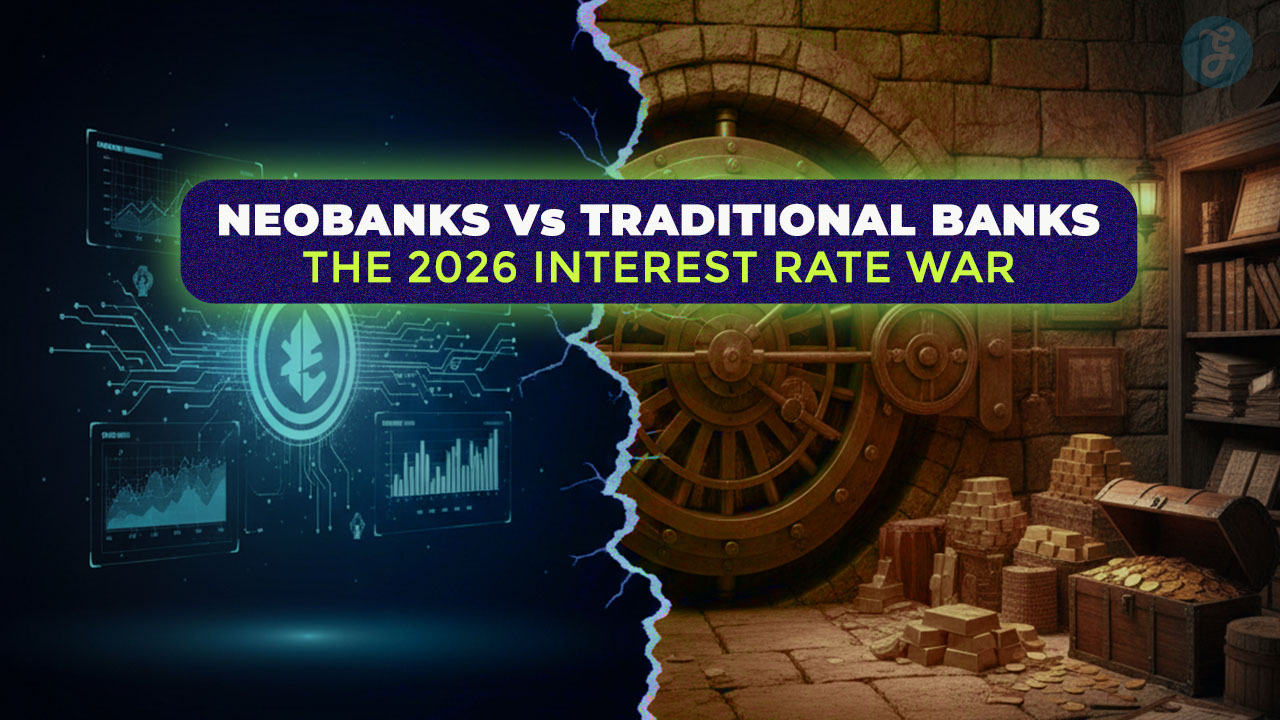
Why this is significant right now: The “free money” era is dead. As 2026 interest rates stabilize in a “neutral zone” (approx. 3-4%), the easy arbitrage for fintechs has vanished. We are witnessing a pivotal shift: Neobanks must now prove profitability over growth, while traditional “vaults” like JPMorgan and HSBC are deploying “Agentic AI” to weaponize their massive capital advantages. This isn’t just about who pays a higher APY anymore; it’s a war for the primary financial operating system of the consumer’s life.
Key Takeaways
- The “Neutral Zone” Shift: With central banks ending easing cycles in mid-2026, the battleground has moved from raw interest rate offers to “Autonomous Finance” (AI that manages money for you).
- The Profitability Imperative: The “growth at all costs” model is over. Neobanks like Monzo and Nubank are now profitable giants, forcing traditional banks to slash fees and close branches faster than predicted.
- Agentic AI is the New Teller: 2026 marks the rise of “Agentic AI”—autonomous bots that don’t just chat but execute complex financial strategies, a field where tech-first banks currently lead.1
- Regulation Strikes Back: New 2026 frameworks (Open Finance in UK/EU, stricter capital rules in US) are leveling the playing field, removing some regulatory arbitrage neobanks previously enjoyed.
Contextual Background: From “Cash Burn” to “Cash Cows”
To understand the 2026 landscape, we must look at the trajectory. The 2010s were defined by the “unbundling” of banking—startups picked off specific services (transfer, lending, savings) and offered them cheaper, subsidized by venture capital. The early 2020s saw the return of inflation and the end of Zero Interest Rate Policy (ZIRP), which killed off weak fintechs.
Now, in 2026, we have entered the “Re-bundling” phase. Surviving neobanks have become “Super Apps,” offering everything from crypto to mortgages. Conversely, traditional banks have undergone brutal digital transformations. The distinction is blurring, but the philosophical divide remains: Neobanks view banking as software; Traditional Vaults view software as a channel. This year, with the global economy projected to pick up (2.7% growth forecast) but recession risks lurking (35% probability according to JP Morgan), consumers are flighty, demanding both high yields and extreme safety.2
The Frontlines of the 2026 War

1. The “Neutral Rate” Trap: Yield Scarcity
In 2024-2025, high interest rates were a rising tide that lifted all boats. Neobanks could easily offer 5% APY just by passing on central bank rates. In 2026, with rates stabilizing or dipping slightly (the “neutral zone”), that easy margin is compressing.
- The Neobank Pivot: Unable to simply out-rate the giants, neobanks like Revolut and Chime are pivoting to “Active Yield” products—using algo-trading and DeFi (Decentralized Finance) backends to squeeze out extra basis points for users, effectively blurring the line between a savings account and a hedge fund.
- The Traditional Defense: Legacy banks are still flush with “lazy deposits” (money sitting in near-zero interest accounts). In 2026, they are aggressively ring-fencing these profitable customers by offering tiered “relationship rates” that unlock only if the customer brings their entire financial life (mortgage, investments) to the bank.
2. Technology: The Rise of “Agentic” Banking
The buzzword of 2026 is not “Generative AI” but “Agentic AI.”3
- Beyond Chatbots: Traditional banks spent billions on chatbots that summarize statements. Neobanks in 2026 are deploying Agents—autonomous software that can cancel subscriptions, switch utility providers, or move money between accounts to optimize yield without user intervention.
- The Trust Gap: While neobanks have better tech, trust remains the moat for traditional vaults. In a 2026 survey context, while 60% of Gen Z prefers a neobank interface, 70% still want their “life savings” in a institution with physical branches, fearing AI glitches or cyber-attacks.
3. The “Super App” Convergence
The table has turned. It is no longer about “specialization.”
- Neobanks becoming Banks: Entities like Monzo and Nubank have secured full banking licenses and are rolling out heavy products: mortgages, business loans, and insurance. They are effectively becoming the “Old Banks” they sought to destroy, just with better code.
- Banks becoming Tech: JPMorgan and HSBC are launching “digital-only” fighter brands (or revamping existing ones) that mimic neobank features—early wage access, spending analytics, and carbon footprint tracking—but backed by trillion-dollar balance sheets.
4. Regulatory “Adulting”
2026 is the year regulators caught up.
- Basel III Endgame: Full implementation is forcing traditional banks to hold more capital, squeezing their ability to lend cheaply. This should help neobanks, but…
- Consumer Protection: New BNPL (Buy Now, Pay Later) regulations in the UK and EU (effective mid-2026) are crushing a key revenue stream for many fintechs, forcing them to conduct rigorous affordability checks that slow down their “frictionless” onboarding.
5. The Demographic Tipping Point
Gen Alpha is opening their first bank accounts in 2026. This generation is “post-branch.” They do not view a physical building as a sign of security; they view it as a sign of inefficiency. Neobanks are winning this demographic with “Gamified Finance”—turning savings into streaks, levels, and social challenges. Traditional banks are losing the acquisition war for the under-18s, which spells an existential crisis for their 2035 outlook.
Data & Visualization: The 2026 Battlefield

Comparison: Neobanks vs. Traditional Vaults (2026 Standards)
A comparative analysis of the average offerings in major markets (US/UK/EU).
| Feature | Leading Neobanks (e.g., Revolut, Chime, Monzo) | Traditional Vaults (e.g., Chase, HSBC, Wells Fargo) | Winner |
| APY (Savings) | 3.5% – 4.25% (Active/Variable) | 0.01% – 2.5% (Tiered/Relationship) | Neobanks |
| Tech Stack | Agentic AI (Auto-switching, predictive budgeting) | Hybrid AI (Chatbots + Human Advisors) | Neobanks |
| Fees | Near Zero (Freemium models for extra perks) | Moderate (Maintenance fees remain common) | Neobanks |
| Trust/Safety | Improving (Full licenses, but support is chat-only) | High (Physical branches, 24/7 phone support) | Traditional |
| Lending | Algorithmic (Instant, smaller amounts) | Holistic (Mortgages, complex business loans) | Traditional |
| Global Access | Seamless (Multi-currency wallets standard) | Frictional (High FX fees, slow transfers) | Neobanks |
| Metric | 2024 Status | 2026 Projection | Trend Analysis |
| Neobank User Base | ~300 Million | ~450 Million | +50% Growth (Driven by LatAm/Asia) |
| Global Market Value | ~$400 Billion | ~$552 Billion | Consolidation of smaller players |
| Primary Account Status | 15% of users | 28% of users | Users are finally ditching legacy banks |
Expert Perspectives
To maintain objectivity, we must look at conflicting viewpoints regarding the 2026 outlook.
- The “Fintech Bull” Case: Analysts at Forrester and Andreessen Horowitz argue that the cost of maintaining legacy IT systems (COBOL mainframes) is an anchor around the neck of traditional banks.4 They predict a “Nokia Moment” for a major Tier-1 bank in 2026—a collapse or forced merger due to an inability to compete with the cost-efficiency of cloud-native neobanks.
- The “Empire Strikes Back” Case: Contrarily, strategists at JP Morgan and Deloitte emphasize the “Flight to Quality.” They argue that as cyber-attacks become more sophisticated (AI-driven hacking), consumers will retreat to the “too big to fail” institutions. They believe neobanks have hit a “saturation ceiling” and will struggle to capture the profitable older demographic.
- The “Hybrid” Reality: Most independent economists suggest a convergence. We won’t see a total victory for either side. Instead, we will see “Embedded Finance” taking over—where non-banks (like Apple, Amazon, or Tesla) offer banking services powered by traditional vaults in the background, effectively rendering the consumer-facing brand of the bank invisible.
Future Outlook: What Happens Next?
As we look toward the latter half of 2026 and into 2027, three major trends will define the victor of this war:
- The “Autonomous” Account: The concept of “managing” money will disappear for the wealthy. AI agents will automatically move liquid cash between high-yield savings, index funds, and crypto staking based on real-time market conditions. Neobanks are building this now; traditional banks are still holding committee meetings about it.
- Biometric Identity as Currency: The password is dead. In 2026, “Pay by Face” or “Pay by Palm” will become standard. The bank that owns the biometric identity layer (verifying it’s actually you) will own the transaction rail.
- The Great Consolidation: With 400+ neobanks globally, the market is fragmented. 2026 will be the year of M&A (Mergers and Acquisitions). Expect traditional banks to stop trying to build competitors and start buying them to acquire their tech stacks and Gen Z user bases.
Final Words
In 2026, the line between technology and banking has dissolved. Neobanks have definitively won the battle for user experience and yield, utilizing “Agentic AI” to automate wealth creation. Yet, traditional banks retain the fortress of trust and lending power. For the consumer, the smartest strategy is now hybrid: leverage fintechs for aggressive daily interest and seamless transactions, while anchoring substantial assets in legacy vaults. The future isn’t about choosing one side; it is about orchestrating both to maximize your financial autonomy.