President Donald Trump’s recent receipt of the inaugural FIFA Peace Prize has ignited a firestorm of controversy, especially coming on the heels of a dramatic U.S. military operation in Venezuela that captured President Nicolás Maduro. Critics worldwide decry the award as hypocritical amid escalating tensions in Latin America. The timing has amplified accusations that FIFA sacrificed its neutrality for political favor.
The FIFA Peace Prize Ceremony
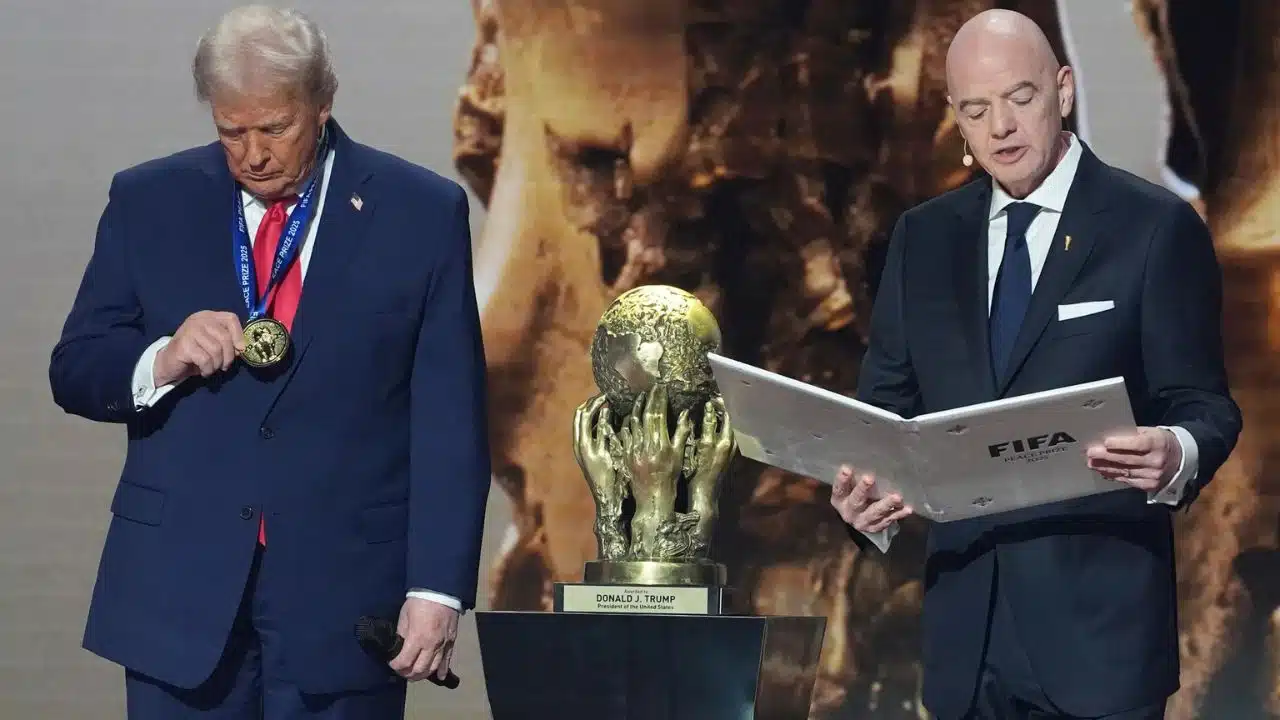
FIFA presented the newly created Peace Prize to Trump during the 2026 World Cup draw in Washington, D.C., on December 5, 2025. FIFA President Gianni Infantino hailed Trump for “exceptional and extraordinary actions for peace,” citing efforts like the Abraham Accords and attempts at Gaza ceasefires. Trump, who has long coveted the Nobel Peace Prize, called it “one of the great honors of my life” and immediately donned the gold medal.
The award, featuring a trophy of hands lifting a globe and a certificate praising global unity, marked a departure for the soccer body, which faced immediate backlash for lacking nominees or transparent selection. Infantino’s close ties to Trump, including White House visits, fueled perceptions of favoritism ahead of the U.S.-co-hosted World Cup. Football Supporters Europe labeled it an “ego-stroking stunt,” violating FIFA’s neutrality rules.
Social media erupted with ridicule, from comparisons to awarding a biter like Luis Suarez for good behavior to outright mockery of FIFA’s judgment. Human Rights Watch and the ACLU condemned it, pointing to Trump’s immigration policies and military actions as antithetical to peace.
Buildup to the Venezuela Operation
Tensions with Venezuela simmered for months before the prize. Since August 2025, the U.S. amassed warships, including the USS Gerald R. Ford, and 15,000 troops in the Caribbean under Operation Southern Spear, targeting alleged drug vessels linked to Maduro’s “narco-state”. Strikes began in September 2025, sinking boats and killing dozens, with Trump posting videos of explosions on Truth Social.
Indictments from Trump’s first term accused Maduro of narcoterrorism, leading to designations of groups like Cartel of the Suns as terrorists . CIA teams tracked Maduro, while oil tanker seizures in December escalated the blockade . Trump invoked the Monroe Doctrine, threatening mainland strikes and vowing U.S. dominance in the hemisphere.
Opposition leader María Corina Machado, the 2025 Nobel Peace Prize winner, met Trump in Miami, promising oil access, while Maduro denounced U.S. “aggression”. By late December, rehearsals positioned forces for what became Operation Absolute Resolve .
Details of the Military Strikes
On January 3, 2026, at Trump’s order, over 150 U.S. aircraft—including F-22s, F-35s, B-1Bs, and helicopters—launched airstrikes across northern Venezuela starting at 2:00 a.m. local time. Targets included military bases like La Carlota and Fort Tiuna, Higuerote Airport, and La Guaira port, destroying radars, a Buk missile system, warehouses, and vehicles .
Delta Force raided Maduro’s fortified compound in Caracas with FBI support, capturing him and wife Cilia Flores amid disrupted power and air defenses. Helicopters flew low under fighter cover; one was damaged but completed the mission . Maduro, blindfolded and in a sweatsuit, was photographed aboard the USS Iwo Jima before flying to New York .
The half-hour assault caused explosions in urban areas like Catia La Mar, where an apartment was hit . Trump called it a “spectacular assault like World War II,” with no U.S. fatalities but minor wounds. Maduro faces narcoterrorism charges in Manhattan court on January 5 .
Casualties and Immediate Fallout
Venezuelan officials reported at least 80 deaths, including civilians, from strikes on urban sites; Defense Minister Vladimir Padrino López cited rockets in populated areas . Attorney General Tarek Saab decried “innocent victims,” while anonymous sources pegged 40 initial fatalities . Trump alleged Cuban protectors died but provided no figures .
Vice President Delcy Rodríguez assumed acting presidency, demanding proof of life and calling it a “barbaric kidnapping”. She rejected U.S. control, declaring Venezuela no “colony” . Power outages hit Caracas; the FAA banned U.S. flights over Venezuela . Protests erupted in Caracas demanding Maduro’s release, while diaspora celebrated in Miami, Bogotá, and Madrid .
Trump vowed to “run the country” until transition, eyeing oil for U.S. firms, but Rubio clarified no war or further action. No occupation followed; hardliners like Diosdado Cabello held power .
Domestic U.S. Reactions Split
Republicans rallied behind Trump. VP JD Vance justified it as arresting a fugitive; Rep. Lisa McClain praised acting against a “narco-terrorist” . Sen. Mike Lee cited Article II authority post-Rubio briefing; Defense Sec. Pete Hegseth eyed oil investments . Trump styled it the “Donroe Doctrine” for hemispheric supremacy .
Democrats cried foul. Sen. Chuck Schumer called it unauthorized, vowing war powers votes. Sens. Tim Kaine, Bernie Sanders, and Ruben Gallego deemed it illegal, risking chaos . Rep. Adam Schiff warned of eroded U.S. standing; protests hit Times Square with “No Blood for Oil” chants. NYC Mayor Zohran Mamdani opposed it directly to Trump .
International Condemnation Mounts
The UN’s António Guterres decried a “dangerous precedent” breaching international law; Security Council meets January 5. Russia, China, Cuba, Iran, and North Korea condemned it as sovereignty violation. Colombia mobilized border forces fearing refugees; Spain and EU urged de-escalation .
Allies diverged: Argentina’s Javier Milei and Peru’s José Jerí praised Maduro’s fall; UK PM Keir Starmer welcomed it cautiously . Analysts compared it to Panama 1989 or Iraq 2003, warning of “Putinization” of U.S. policy and oil grabs .
Criticism Links Prize to Invasion
The prize, awarded December 5, now symbolizes irony post-strikes. A reporter grilled Trump at the ceremony: “Do you deserve a peace prize conflicting with your Venezuela pledge?” He defended settling “eight wars”. Critics like Craig Mokhiber called it “shameful,” obscuring rights abuses.
FIFA faces ethics complaints from FairSquare for flouting neutrality. HRW mocked: Trump’s record shows no “peace and unity“. Late-night hosts and journalists lampooned it amid airstrikes. Maduro himself criticized U.S. threats post-prize.
Broader Geopolitical Implications
Experts fear chaos: paramilitaries, ELN incursions, or military fracturing . ICC notes regime intact, questioning regime change . Oil stakes loom large—Trump eyes billions in infrastructure, reimbursing via reserves . Yet, no U.S. takeover materialized, with Rodríguez defiant .
This saga tests Monroe Doctrine revival versus global rules, risking copycat aggressions . As Maduro’s trial nears, Venezuela teeters, with opposition like Machado eyeing power amid celebrations and skepticism . Trump’s “peace president” vow clashes with bombs-away reality.
Future Outlook Uncertain
Rodríguez vows resistance; U.S. eyes trials and oil . Congress debates war powers; protests grow. FIFA’s prize, meant for unity, spotlights division. With World Cup looming, Infantino’s Trump bet risks backlash.
The world watches: Will Venezuela fracture or consolidate? Trump’s actions redefine U.S. intervention, blending law enforcement, counter-narcotics, and resource grabs . Peace prize or war trophy—the debate rages.