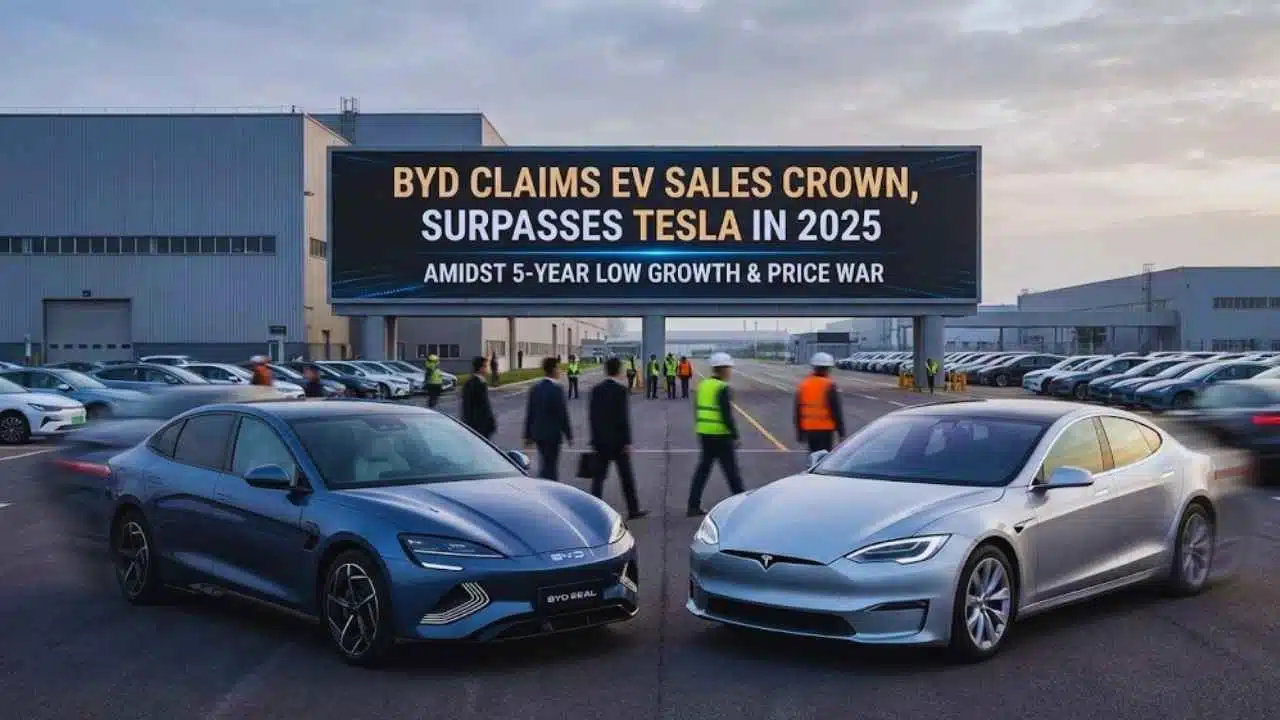
BYD sold about 4.6 million vehicles in 2025, positioning it ahead of Tesla in global EV volume as China’s price war and tougher rivals slowed BYD’s growth to its weakest pace in five years.
What Happened: BYD vs Tesla in 2025
China’s BYD closed 2025 with roughly 4.6 million total vehicle sales (including battery-electric and plug-in hybrid models), a level that effectively cements its status as the highest-volume electrified automaker globally by unit sales. The headline, though, comes with a warning sign: annual growth of about 7.7%, the company’s slowest expansion in five years, reflecting a maturing home market and relentless competition.
Tesla, meanwhile, entered year-end facing another down year for deliveries, with market expectations clustering around about 1.64 million deliveries for full-year 2025. If confirmed in Tesla’s fourth-quarter update, that would extend a cooling trend after Tesla delivered 1,789,226 vehicles in 2024 and about 1.81 million in 2023.
The crossover is symbolic for the global EV industry. For years, Tesla defined scale in battery-electric vehicles; BYD’s rise signals how quickly Chinese manufacturers—backed by deep supply chains, fast product cycles, and aggressive pricing—are reshaping the market.
BYD’s 2025 Scorecard: Big Volume, Slower Momentum
BYD’s 2025 performance underlines a new reality: hitting big numbers is no longer the hard part—defending share and margins is.
Several metrics explain the mixed picture:
- Full-year sales reached about 4.6 million vehicles, but growth slowed sharply compared with earlier years of rapid expansion.
- December sales declined about 18% year over year, extending a multi-month stretch of softer comparisons.
- BYD leaned harder on overseas markets, with international sales rising strongly to more than 1 million vehicles in 2025—an increasingly important buffer as domestic demand became more price-sensitive.
BYD’s scale remains a competitive moat, especially because it controls key inputs such as batteries and many power electronics. But the company is operating in a market where “good” increasingly means “good at a lower price.”
BYD and Tesla Volume Snapshot (2023–2025)
| Year | BYD Total Vehicle Sales (All Powertrains Sold by BYD)* | Tesla Deliveries | Notes |
| 2023 | — | ~1.81M | Tesla’s high-water mark in annual growth |
| 2024 | ~4.27M | 1,789,226 | BYD expands fast; Tesla dips slightly |
| 2025 | ~4.6M | ~1.64M (expected) | BYD growth slows; Tesla expected to decline |
*BYD figure includes electrified models and total reported vehicle volume; Tesla deliveries are all-electric.
Challenges Mount at Home: A Crowded Budget Segment
China remains the world’s largest EV market, but it is also one of the toughest to dominate for long. The fiercest pressure is coming from below—the budget segment, where buyers are highly price-sensitive and new models arrive constantly.
Competitors have sharpened their value propositions with better driver-assistance features, fresher interiors, faster charging, and more aggressive financing. That has made it harder for any one brand—even BYD—to sustain the same growth pace year after year. In practical terms, BYD is fighting on multiple fronts:
- Rivals are pushing into BYD’s core price bands with feature-rich trims and rapid refresh cycles.
- Consumer upgrades are slowing, especially in lower tiers of the market where replacement cycles are longer and incentives matter more.
- Promotions have become continuous, not seasonal, pulling demand forward and compressing pricing power.
This home-market squeeze is part of why BYD’s growth slowed even as it posted industry-leading volume.
Price War Takes a Toll: Government Pushback and Margin Pressure
China’s EV price war has been widely described by policymakers and industry bodies as harmful “involution-style” competition—intense rivalry that drives prices down faster than costs fall, reducing profitability across the sector.
Authorities and industry organizations have repeatedly signaled concerns about disorderly competition and urged automakers to avoid destructive discounting. The pressure is not only economic; it is also structural. Too many brands are chasing the same buyers, and the easiest lever to pull is price.
Market indicators show how far pricing has slid. Industry commentary in 2025 highlighted that the average price of new energy vehicles (NEVs) fell to around RMB 158,000 in September, down from RMB 171,000 in 2024 and RMB 184,000 in 2023—a sharp compression in a short period. With average selling prices falling, automakers must either cut costs, sell more, or accept lower margins. Often, they do all three.
For BYD, price pressure has been a double-edged sword. It helps the company protect share, but it can weigh on profitability and investor sentiment if markets believe pricing is outrunning cost reductions.
How BYD Is Responding: More Tech, Faster Cycles, Bigger Overseas Push
BYD’s strategy in 2025 and heading into 2026 centers on staying ahead on product value while leaning harder on global expansion.
1. Accelerating overseas growth: With domestic competition intensifying, overseas markets have shifted from “growth opportunity” to “strategic necessity.” BYD’s international volume exceeded 1 million vehicles in 2025, and the company has signaled ambitions for significantly higher overseas sales in 2026. That expansion is supported by broader distribution, localized marketing, and an increasing lineup tailored to regional preferences.
2. Broadening the lineup across price points: BYD has launched and refreshed models across multiple bands to keep showrooms busy. The goal is to prevent rivals from owning key price points for long, especially as technology features become table stakes.
3. Using scale to defend cost: BYD’s vertical integration—especially in batteries—still matters. Even when prices fall, firms with better cost control can outlast peers. That is a key reason BYD can compete aggressively without the same level of balance-sheet strain faced by smaller brands.
What This Shift Means for the Global EV Race
The 2025 “crown change” is about more than bragging rights. It underscores three longer-term shifts:
- China is exporting its EV playbook: The combination of competitive pricing and improving quality is accelerating adoption outside China, especially where tariffs or barriers are limited.
- Scale is no longer unique: Tesla’s advantage in manufacturing scale has narrowed as Chinese leaders ramped output and improved supply-chain control.
- The market is splitting: One lane competes on affordability and rapid iteration; another lane competes on brand, software ecosystems, and differentiated autonomy features.
Tesla still dominates parts of the conversation around charging networks, software, and autonomy. BYD, by contrast, is increasingly defining the economics of the mass market: what an EV (or plug-in hybrid) costs, and how quickly features commoditize.
Key Forces Pressuring EV Makers in 2025
| Pressure Point | What It Looks Like | Why It Matters |
| Price compression | Lower average NEV prices, persistent promotions | Reduces margins, forces cost cuts |
| Faster competition cycles | More frequent new launches/refreshes | Shortens model life, raises R&D intensity |
| Feature parity | Driver-assistance and fast-charging becoming standard | Weakens differentiation |
| Overseas expansion race | Chinese brands scaling exports rapidly | Intensifies competition in Europe and beyond |
| Policy scrutiny | Calls to curb “disorderly” competition | Could limit extreme discounting |
A Milestone With a Warning Label
BYD’s 2025 volume leadership is a milestone that reflects years of scale-building, cost control, and rapid product execution. But the slower growth rate and late-year softness show the next phase will be harder: defending share without sacrificing profitability in a market where competitors copy fast and buyers shop on price.
Tesla’s expected 2025 decline adds another layer to the story—global EV leadership is no longer anchored to one company or one country. The next 12–24 months will likely hinge on which automakers can balance affordability, feature improvements, and sustainable margins while navigating policy scrutiny and uneven demand across regions.