

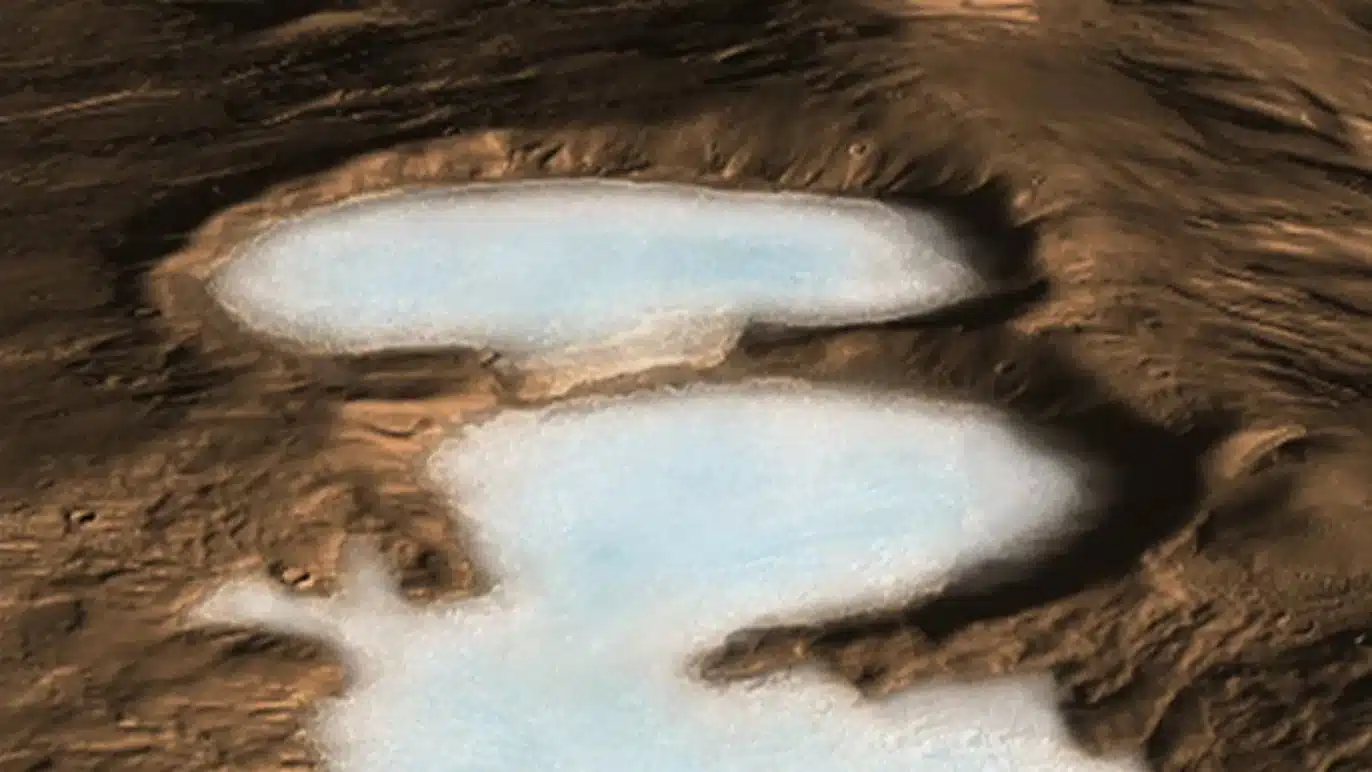
NASA’s latest discovery of abundant water ice just beneath the surface of Mars is reshaping plans for future human missions, potentially determining the most strategic landing sites for astronauts and robotic explorers. This breakthrough, highlighted by new mapping and remote sensing data, could be the key to unlocking sustainable human habitation on the Red Planet and revolutionizing our understanding of Mars’ climate history.
The Discovery: Water Ice Just Below the Surface
Recent studies, including those led by NASA and international partners, have confirmed the presence of water ice lying less than one meter below the surface in several mid-latitude regions of Mars, most notably in the Amazonis Planitia area. High-resolution orbital imagery and advanced radar techniques have revealed widespread ice-rich layers, often exposed by recent meteorite impacts or visible in the walls of craters and trenches. These findings are part of the Subsurface Water Ice Mapping (SWIM) project, which synthesizes data from multiple Mars orbiters to create detailed maps of subsurface ice deposits.
The significance of this discovery cannot be overstated. Water is essential for life support, agriculture, and fuel production, making these ice deposits a potential game-changer for Mars exploration. Accessible water ice means future missions can rely less on Earth for supplies, reducing costs and increasing mission longevity.
Why Mid-Latitudes? The Perfect Compromise
While Mars’ polar regions are known to harbor vast quantities of water ice, the mid-latitudes—particularly in the northern hemisphere—offer a unique balance of resources and environmental conditions. These areas receive enough sunlight to power solar panels, yet remain cold enough to preserve ice near the surface. This makes them ideal for landing sites, where future habitats and infrastructure can be built with access to both energy and water.
Amazonis Planitia, located in the northern mid-latitudes, stands out as one of the most promising regions. It features numerous exposed ice sites at the bottoms of craters and widespread ice-related surface features, making it a prime candidate for both robotic and crewed missions. Other mid-latitude regions identified by the SWIM project include Utopia Planitia and Arcadia Planitia, which also show strong evidence of subsurface ice.
Mapping the Ice: How Scientists Know Where to Look
The SWIM project, spearheaded by researchers at the Planetary Science Institute and NASA’s Jet Propulsion Laboratory, combines two decades of data from orbiters like Mars Odyssey, Mars Reconnaissance Orbiter, and Mars Global Surveyor. Scientists use multiple methods to predict the presence of ice, including:
-
Hydrogen mapping: High concentrations of hydrogen in the soil suggest water ice is present.
-
Radar wave speed: Radar signals travel faster through ice than through rock, helping identify ice-rich layers.
-
Thermal inertia: The rate at which the surface heats and cools can indicate the presence of ice.
-
Surface features: Polygonal terrain patterns and exposed ice in crater walls are telltale signs of near-surface ice.
These techniques have allowed researchers to create detailed probability maps, highlighting the most promising regions for future missions.
Implications for Human Missions
Access to water ice is a cornerstone of NASA’s “in situ resource utilization” (ISRU) strategy, which aims to use local resources to support human exploration. Water ice can be processed to provide:
-
Drinking water: Essential for crew survival.
-
Oxygen: Produced through electrolysis, supporting life support systems.
-
Rocket fuel: Water can be split into hydrogen and oxygen, key components of rocket propellant.
Moreover, ice-rich regions may also harbor clues to Mars’ climate history and potential for past or present microbial life. Drilling ice cores could reveal layers of climate data, much like ice cores on Earth, providing insights into the planet’s atmospheric changes over millions of years.
Challenges and Next Steps
Despite the excitement, challenges remain. Confirming the purity and accessibility of ice deposits requires direct measurements from rovers or human explorers. Remote sensing can only provide indirect evidence; actual drilling and sampling are needed to verify the composition and quality of the ice. Additionally, landing in mid-latitude regions poses technical challenges, such as ensuring safe touchdown on potentially icy or uneven terrain.
Future missions, such as the planned Mars Ice Mapper (MIM) project by JAXA, aim to address these challenges by deploying advanced radar and imaging instruments to further characterize subsurface ice deposits. These missions will help refine landing site selection and pave the way for sustainable human presence on Mars.
The Road Ahead: From Ice to Habitats
The discovery of accessible water ice on Mars is a pivotal moment in the history of space exploration. It transforms theoretical plans for human habitation into tangible possibilities, offering a lifeline for future astronauts and a scientific treasure trove for researchers. As NASA and international partners continue to map and study these ice-rich regions, the dream of establishing a permanent human presence on Mars moves closer to reality.
In the coming years, the focus will shift from discovery to utilization—developing technologies to extract, process, and use water ice for life support and fuel production. This will require collaboration across disciplines, from engineering and robotics to biology and climate science, to ensure that humanity can thrive on the Red Planet.
Conclusion: A New Era of Mars Exploration
The recent discovery of water ice beneath the surface of Mars marks the dawn of a new era in space exploration. With detailed maps and advanced technologies, scientists and engineers are now equipped to select the best landing sites for future missions, ensuring that astronauts have access to the resources they need to survive and thrive. As humanity prepares to take its first steps on Mars, the presence of water ice offers hope, inspiration, and a tangible path forward in our quest to become a multi-planetary species.





















