The legal profession is currently standing on the precipice of its most significant transformation since the invention of the printing press. Future of Law Predictions are no longer just speculative science fiction; they are immediate strategic warnings. The “savage reduction” of traditional roles often cited in older forecasts has not resulted in mass unemployment, but rather a radical “hollowing out” of routine tasks. As we look toward 2030, the question is no longer if technology will replace lawyers, but which lawyers will use technology to replace their competitors.
This article updates the classic “18 Bold Predictions” for the new reality of the 2020–2030 era. From the final death of the billable hour to the rise of the “synthetic” law firm, here is where the industry is heading.
Key Takeaways
-
Adapt or Atrophy: The lawyers who survive the next decade will be those who view AI as a partner, not a rival.
-
Productize Everything: Successful firms will stop selling “services” and start selling “products” (templates, automated tools, subscriptions).
-
Humanity is the Premium: As logic becomes free/cheap, the premium value of a lawyer shifts to emotional intelligence, negotiation strategy, and ethical judgment.
The Context: Why the Rules Are Rewriting Now [2026 Status Check]

To understand where the law is going, we must first accept that the “wait and see” era is over. According to some credible sources on Law and Artificial Intelligence, Generative AI has officially moved from “experimentation” to “critical infrastructure.” The predictions that seemed radical in 2020 are now being driven by three non-negotiable forces:
The “Glass Box” Client Revolution
For a century, law was a “black box”—clients put money in and got advice out, with no idea how the sausage was made. That era is dead. Corporate clients are now using their own AI to “grade” the contracts drafted by outside counsel.
-
The Reality: If a firm’s draft has a 40% error rate that the client’s AI catches in seconds, that firm loses the account. Clients are demanding radical transparency—they want to see who is working on the file (human or AI?) and when it is happening.
The Talent “Tech-Ultimatum”
The “Great Resignation” evolved into the “Great Realignment.” Gen Z talent is refusing to work for firms that lack modern tech stacks.
-
The Reality: A survey revealed that 60% of junior associates would turn down a higher salary at a “traditional” firm to work at a tech-forward firm that automates grunt work. They know that in a post-AI world, learning to “manually review documents” is a career dead-end.
The Economic Squeeze
With global inflation impacting legal spend, the “more with less” mantra has become a mandate.
-
The Reality: A Legal Trends Report shows that firms offering flat fees or subscription models are growing 2x faster than those strictly clinging to the billable hour. Efficiency is no longer just profitable; it is a survival requirement.
These drivers have created a perfect storm where the cost of inaction is finally higher than the cost of innovation. The following 18 predictions are the direct result of this pressure cooker.
The “Big Three” Core Shifts
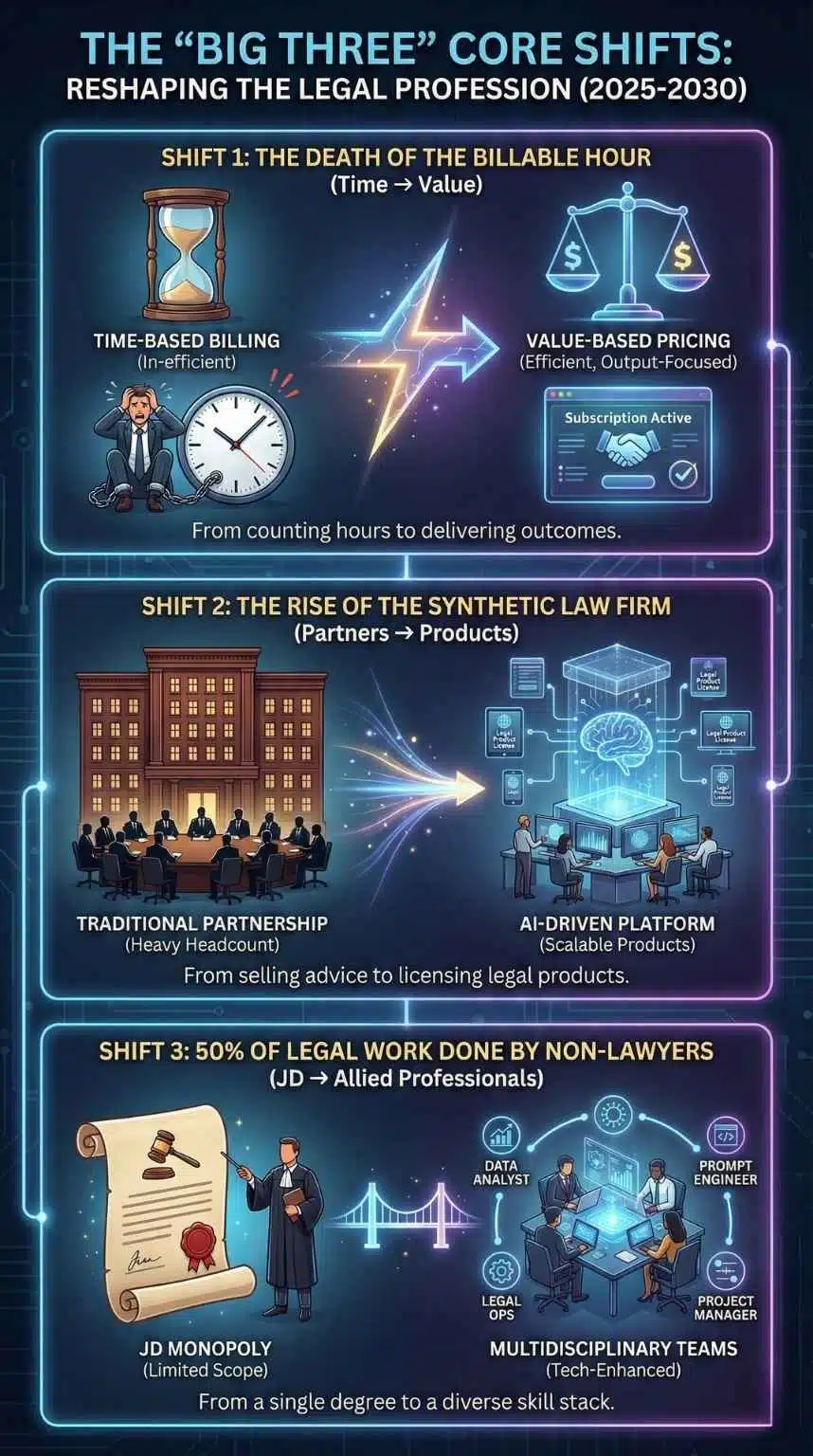
These are the fundamental economic and structural changes that will define the next decade of legal practice.
1. The Death of the Billable Hour (Finally)
For decades, critics have predicted the end of the billable hour, but Generative AI has finally provided the murder weapon. When an AI tool can complete 10 hours of junior associate research in 30 seconds, charging by time becomes not just inefficient but ethically dubious.
-
Prediction: By 2028, value-based pricing and subscription models (e.g., “Compliance-as-a-Service”) will become the dominant billing standard for corporate law.
-
Impact: Firms will profit from efficiency, not inefficiency.
2. The Rise of the “Synthetic” Law Firm
We are witnessing the birth of firms that look less like partnerships and more like software companies. These “synthetic” firms will have fewer human partners but massive revenue streams derived from licensing proprietary legal AI products.
-
Prediction: The most profitable law firm of 2030 may have fewer than 50 human lawyers but serve 5,000 clients via automated platforms.
3. 50% of Legal Work Done by Non-Lawyers
The Juris Doctor (JD) is losing its monopoly on legal service delivery. The complexity of modern legal tech requires a new breed of professional.
-
Prediction: By 2030, half of the workforce in top-tier firms will be “Allied Legal Professionals”—data analysts, prompt engineers, legal operations specialists, and project managers.
Technology & AI Integration
The integration of AI is shifting from a “nice-to-have” tool to a fundamental standard of competence.
4. Generative AI as the Standard of Care
Just as refusing to use email was once a fireable offense, refusing to use AI will soon be a liability.
-
Prediction: By 2026, failing to use AI for initial document review or contract analysis will be considered legal malpractice due to the unnecessary cost and increased error rate of manual human review.
5. The “AI Board Member”
Corporate governance will evolve to rely on data-driven foresight.
-
Prediction: Major corporations will install AI observers on their boards. These systems will not have a vote, but they will have a “voice”—providing real-time risk scores on proposed strategies (e.g., “This merger has a 78% chance of triggering an antitrust lawsuit”).
6. Virtual Courts Become Permanent
The pandemic forced courts online; efficiency will keep them there.
-
Prediction: By 2030, 75% of civil litigation and procedural hearings will move permanently to asynchronous digital platforms. Physical courtrooms will be reserved primarily for criminal jury trials and high-stakes public interest cases.
7. Predictive Justice & Settlement
“Going to court” will become a rare luxury as outcomes become mathematically predictable.
-
Prediction: Insurance companies and funding firms will use algorithms that predict case outcomes with 90%+ accuracy, forcing parties to settle weeks after filing rather than years into discovery.
8. Multimodal AI Evidence Analysis
Text is just the beginning.
-
Prediction: Lawyers will use “Multimodal AI” to instantly analyze thousands of hours of body-cam footage, CCTV, and audio recordings, identifying inconsistencies that human review would miss.
The Human Element: Health, Ethics, & Society
As machines handle the logic, humans will double down on empathy, ethics, and strategy.
9. From “Performance Drugs” to Wellbeing KPIs
Early 2020s predictions feared lawyers would turn to nootropics to compete with AI. The reality is the opposite.
-
Prediction: To prevent burnout in an always-on world, firms will track “Wellbeing KPIs” as rigorously as billable hours. Mental health support will become the primary retention tool for top talent.
10. The Ethics of “Black Box” Law
-
Prediction: A major new legal field will emerge focused solely on “Algorithmic Defense”—challenging the decisions made by opaque AI systems in criminal sentencing, credit scoring, and hiring.
11. The End of the Generalist
-
Prediction: The “Jack-of-all-trades” lawyer will go extinct. With AI handling general knowledge, human lawyers must become hyper-specialized “micro-niche” experts (e.g., “Drone Airspace Liability in the EU”) to survive.
12. Access to Justice Revolution
-
Prediction: Advanced, government-backed legal chatbots will finally bridge the “justice gap,” allowing low-income citizens to resolve tenancy disputes and small claims without hiring a lawyer.
Structural & Regulatory Changes
The rules of the game—and who is allowed to play it—are being rewritten.
13. Non-Lawyer Ownership Goes Global
-
Prediction: Following the UK and states like Arizona, the ban on non-lawyer ownership (ABS) will crumble globally. The “Big Four” accounting firms will finally capture a significant share of the mid-market legal sector.
14. The “Gig Lawyer” Economy
-
Prediction: Top-tier talent will increasingly reject the “Partner Track.” Instead, “Super-Temps”—highly specialized senior lawyers—will work on a project basis for multiple firms via high-end freelance platforms.
15. Data as the New Asset Class
-
Prediction: Law firms will be valued not by their client list, but by the quality of their structured data. Firms that have cleaned and organized their historical case data will license it to AI developers for millions.
16. Global Regulatory Sandboxes
-
Prediction: Nations will compete to attract legal-tech startups by creating “Regulatory Sandboxes”—zones with relaxed rules allowing companies to test AI legal services on the public without fear of “unauthorized practice of law” suits.
Wildcards: The Boldest Forecasts
These predictions represent the extreme edge of possibility for the decade’s end.
17. Automated Legislation
-
Prediction: Governments will begin using AI to draft legislation. These systems will “simulate” a new law before it is passed to identify loopholes and conflicting statutes, creating “bug-free” legislation.
18. The “Robo-Judge” Pilot
-
Prediction: While controversial, we will see the first Western pilot program (likely in small claims or traffic court) where a human judge is removed entirely, and a binding decision is rendered solely by an AI adjudicator.
Summary of Shifts: 2020 vs. 2030
| Feature | The Old World (2020) | The New World (2030) |
| Primary Metric | Billable Hours (Time) | Fixed Fee / Subscription (Output) |
| Junior Role | Document Review & Drafting | AI Pilot & Strategy |
| Tech Usage | Microsoft Word & Email | Generative AI & Predictive Analytics |
| Competition | Other Law Firms | The “Big Four” & Tech Companies |
| Court | Physical Building | Online Platform |
The Cybersecurity Siege: Law Firms as Primary Targets
As law firms digitize, they become the “soft underbelly” of corporate security—holding the secrets of the Fortune 500 without the fortress-level security of a bank.
-
The “Ransomware” Reality: By 2026, it is predicted that a major global law firm will face a catastrophic “extinction-level” data breach, forcing the industry to adopt banking-level security protocols.
-
Client Audits: Corporate clients will no longer just ask for legal advice; they will demand sec-ops audits. If a firm’s cybersecurity rating is lower than the client’s, they won’t get the business.
-
Prediction: The “Chief Information Security Officer” (CISO) will become a higher-paid partner than the head of litigation in many top 100 firms.
The “Green” Mandate: ESG as a License to Operate
Environmental, Social, and Governance (ESG) is no longer a PR buzzword; it is a hiring and firing criterion.
-
The Talent War: By 2028, over 60% of top law graduates will refuse to work for firms that represent fossil fuel giants or fail diversity KPIs, creating a “talent drought” for traditionalist firms.
-
Supply Chain Pressure: Corporate clients have their own Net Zero 2030 targets. They will fire law firms that drag down their carbon footprint (e.g., unnecessary international flights for meetings that could be Zoom calls).
-
Prediction: Law firms will be required to publish “Carbon Impact Statements” alongside their annual revenue reports.
The “Glass Box” Revolution: Clients Grade the Work
For a century, law was a “black box”—clients put money in and got advice out, with no idea how the sausage was made. That era is over.
-
AI vs. AI: Corporate legal departments are now using their own AI to “grade” the contracts drafted by outside counsel. If your firm’s draft has a 40% error rate that the client’s AI catches in seconds, you will lose the contract.
-
Radical Transparency: Clients will demand access to a firm’s project management dashboard. They want to see who is working on the file (human or AI?) and when it is happening, in real-time.
The “Monday Morning” Action Plan: How to Prepare Your Firm
| If you are a | Your Priority for 2026–2030 |
| Managing Partner | Diversify Revenue: Stop relying on the billable hour. Invest in building “Legal Products” (subscription software/tools) that make money while you sleep. |
| Senior Associate | Become a “Cyborg”: Master Generative AI prompting. Your value is no longer doing the work, but verifying the machine’s work. |
| Law Student | Learn “O-Shaped” Skills: Law school teaches law. You must self-teach data analytics, emotional intelligence, and project management. |
| Small Firm / Solo | Niche Down: Pick a hyper-specialized micro-niche (e.g., “Crypto-Tax Litigation”) that AI cannot easily automate yet. |
Frequently Asked Questions: Future of Law Predictions
1. Will AI replace lawyers by 2030?
No, but it will replace tasks. AI will handle research, drafting, and reviewing, while lawyers will focus on strategy, negotiation, and client counseling. Lawyers who do not use AI will likely be replaced by those who do.
2. What is the “Death of the Billable Hour”?
This refers to the shift away from charging clients by the time spent on a task. Since AI can reduce a 5-hour task to 5 minutes, billing by time is no longer profitable for firms or acceptable to clients.
3. What are “Synthetic” Law Firms?
These are modern legal businesses that rely heavily on technology and automation rather than a large headcount of lawyers. They scale by selling digital legal products rather than just human advice.
4. Is it safe to use AI for legal work?
It is becoming safer, but “human-in-the-loop” is essential. AI can hallucinate (invent facts), so a human lawyer must verify the output. However, by 2030, not using AI may be considered negligent due to its superior data processing speed.
5. What should law students focus on today?
Law students should focus on “T-shaped” skills: deep legal knowledge combined with broad skills in technology, data analytics, project management, and emotional intelligence.
Final Thought: Law Predictions for the Next Decade
The Future of Law Predictions outlined here are not a death knell for the profession, but a call to evolution. The “Golden Age” of the generalist lawyer billing for administrative time is over. In its place rises a more efficient, accessible, and data-driven profession.
The winners of 2030 will not be the firms with the fanciest offices or the longest heritage. They will be the agile pioneers who view data as an asset and adaptability as a core competency. The choice facing every legal professional today is stark but simple: you can cling to the sinking ship of tradition, or you can build the engine for the future.
The robot is not coming for your job—but a lawyer using the robot is. The future belongs to the curious.