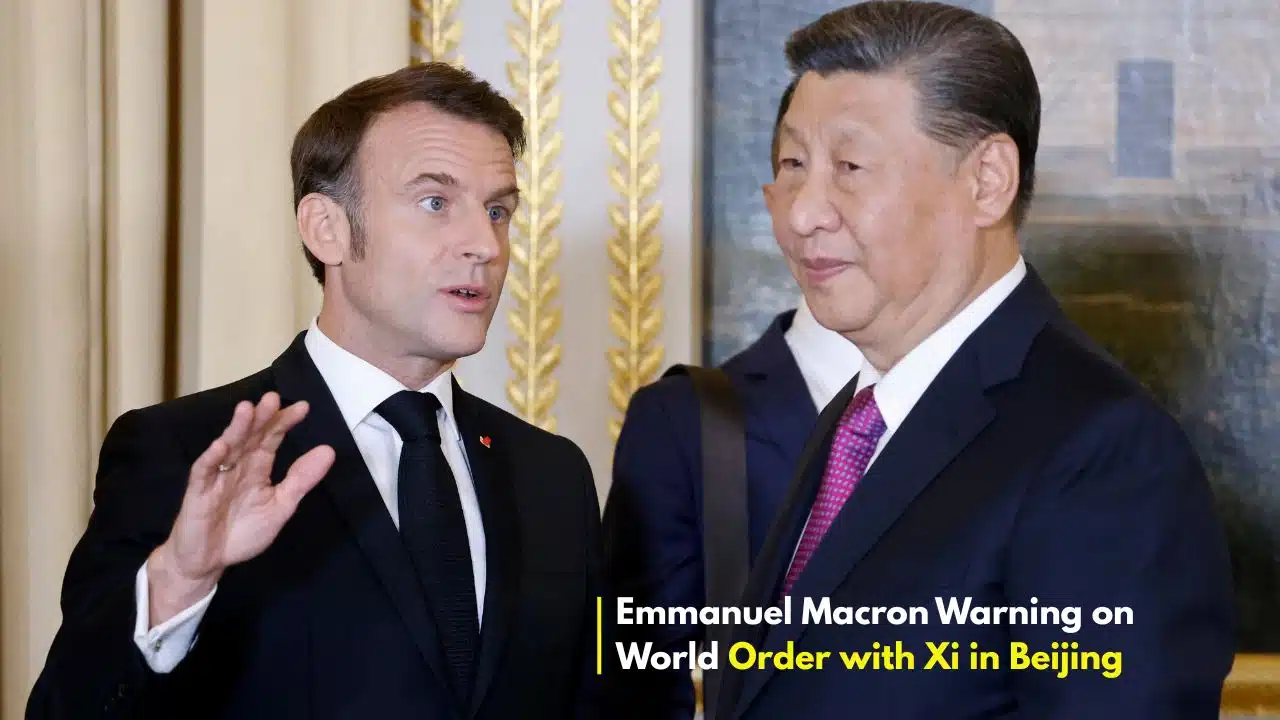
French President Emmanuel Macron has warned that the world faces a “risk of the disintegration of the international order” as he met Chinese President Xi Jinping in Beijing, urging China to play a more active role in resolving the war in Ukraine and easing mounting trade frictions with Europe.
The talks took place on Thursday, 4 December 2025, at the Great Hall of the People in Beijing during Macron’s three-day state visit to China, his fourth as president and one accompanied by a large French business delegation.
Macron’s Warning on a Fragile Global Order
Macron told Xi that the post-Cold War system that has underpinned relative peace for decades is under strain from geopolitical rivalry and economic confrontation. “We are facing the risk of the disintegration of the international order that brought peace to the world for decades,” he said, adding that dialogue between China and France is “more essential than ever.”
He called on Beijing to support, at minimum, a ceasefire in Ukraine, proposing a moratorium on strikes against critical infrastructure as a first step.
The warning in Beijing echoes messages Macron delivered earlier this year in Singapore, where he argued that escalating rivalry between the United States and China is the main risk facing the world and that Asia and Europe share an interest in preventing the “disintegration of the global order.”
Key points of Macron’s warning
| Point | What Macron is stressing |
| “Disintegration” of order | Risk that global rules and institutions break down |
| US–China rivalry | Seen as main driver of instability |
| Role of France & China | Need for dialogue and “coalitions of action,” not new blocs |
| Link to Ukraine and trade | Security and economic tensions are part of the same fragile order |
What Macron Wants from Beijing
During their meeting, Macron laid out a “three-fold agenda” for France–China ties: geopolitical stability, economic rebalancing, and environmental sustainability.
On Ukraine, Macron urged China to use its leverage with Russia to move toward at least a ceasefire, while reiterating European calls for security guarantees for Kyiv.
On trade and the economy, he pushed for more reciprocal market access and a fairer global economic system, warning that a spiral of tariffs and counter-tariffs between Europe and China risks deepening fractures in the world order.
On climate and environment, the French president promoted cooperation on green technologies and emissions reduction, aligning with previous China–EU climate commitments.
Macron’s agenda in Beijing
| Priority area | Macron’s main asks | How China responded |
| Ukraine war | Help press Russia toward at least a ceasefire | Xi backed “all efforts” for peace, but no firm pledge |
| Trade & market access | Fairer rules, reduced imbalances, more access for French firms | Xi highlighted China’s “open door” and new opportunities |
| Climate & environment | Joint work on green tech and sustainability | Cooperation agreements in green sectors |
Xi Jinping’s Message: Independence and Multilateralism
Xi Jinping responded by calling on both countries to “demonstrate independence and strategic vision,” a phrase widely read as a call for Europe not to follow Washington’s line automatically on China policy.
The Chinese leader said China supports “all efforts that work towards peace” in Ukraine but stopped short of endorsing France’s specific call for a ceasefire moratorium on infrastructure strikes.
Xi also announced that China would provide US$100 million in assistance to Gaza, linking the Beijing talks to broader crises in the Middle East and presenting China as a global actor on conflict resolution and humanitarian issues.
Xi’s key messages
| Theme | Xi’s position |
| Foreign policy | China and France should remain “independent” major powers |
| Multilateralism | Both sides should “raise high the banner of multilateralism” |
| Ukraine | Supports peace efforts, but no explicit endorsement of ceasefire plan |
| Gaza | Pledged US$100 million in humanitarian and reconstruction aid |
Trade Tensions: Deficits, Tariffs and Cognac
Behind the diplomatic language, economic tensions dominated much of the conversation.
The European Union’s trade deficit with China reached about €304.5 billion in 2024, with exports of €213.3 billion and imports of €517.8 billion.
France’s bilateral deficit with China has also grown, hitting nearly €47 billion in 2024 according to French and Chinese data, even as overall French trade deficits have recently narrowed.
At the same time, the EU has moved to curb what it sees as unfair Chinese subsidies:
- In October 2024, Brussels imposed definitive countervailing duties on Chinese battery electric vehicles (BEVs) for five years after a subsidy probe.
- Provisional additional customs duties of up to around 50% on some Chinese EV brands took effect in July 2024.
China has responded with its own measures. It launched an anti-dumping investigation into EU brandy, culminating in final “anti-dumping” taxes of up to 34.9% on EU brandy as of July 2025, though some high-profile Cognac producers were granted partial exemptions.
According to officials quoted by AP and Reuters, France used the Beijing visit to secure clarity on those exemptions while trying to avoid a broader trade war that could further destabilize the global order Macron referenced in his warning.
Europe–China trade snapshot
| Indicator (2024) | Figure |
| EU exports to China | €213.3 billion |
| EU imports from China | €517.8 billion |
| EU goods trade deficit with China | €304.5 billion |
| France’s trade deficit with China | ≈ €47 billion |
| EU tariffs on Chinese BEVs | Definitive duties for 5 years; up to high double-digits/provisional surcharges |
| China’s final duties on EU brandy | Up to 34.9% over five years |
Ukraine, Gaza and Security Concerns
Macron’s “disintegration” warning was closely tied to the war in Ukraine and a broader sense of crisis in global security.
France, which will hold the G7 presidency in 2026, is seeking to build a wider coalition behind a ceasefire and eventual peace framework in Ukraine. In Beijing, Macron asked China to join European efforts to halt strikes on critical infrastructure, framing it as an urgent humanitarian and strategic need.
China, however, has deepened trade with Russia since the invasion, providing an economic lifeline even while positioning itself diplomatically as neutral.
On Gaza, Xi used the joint appearance with Macron to announce new humanitarian funding and to call for multilateral efforts to end the conflict, which Beijing has presented as another test of fairness and balance in the international system.
Crisis diplomacy at a glance
| Issue | Macron’s focus | Xi’s public stance |
| Ukraine | Ceasefire, moratorium on strikes on infrastructure | Supports “all efforts” for peace; no specific pledge |
| Gaza | Humanitarian crisis, regional stability | Announces US$100m aid; backs multilateral peace efforts |
| Global order | Avoiding new blocs, preventing collapse of institutions | Calls for multilateralism and “right side of history” |
Europe’s Balancing Act Between Washington and Beijing
Macron’s comments in Beijing build on his long-running theme of European “strategic autonomy” – the idea that Europe should be neither a follower of the US nor dependent on China.
At the Shangri-La Dialogue in Singapore in May 2025, he warned that forcing countries to “choose sides” between Washington and Beijing could destroy institutions created after World War II and lead to the “disintegration” of the global order.
Since then, the EU has adopted a tougher economic security line, unveiling a doctrine to reduce dependence on critical imports and to accelerate trade-defence measures against practices seen as coercive or unfair, including possible export curbs and tighter investment screening.
Analysts say Beijing is likely to use Macron’s visit to strengthen ties with one of the EU’s largest economies at a time when the bloc is divided internally over how far to go on tariffs for Chinese goods. Some fear that bilateral deals and exemptions could weaken a unified EU front.
Recent milestones in France–China relations
| Date | Event |
| May 2024 | Xi visits France; leaders mark 60 years of diplomatic ties |
| Oct 2024 | EU imposes definitive anti-subsidy duties on Chinese BEVs |
| July 2025 | China finalises brandy duties; partial Cognac exemptions |
| Dec 2025 | Macron’s fourth state visit to China; “disintegration” warning |
What Comes Next
Macron will continue his China trip with a visit to the southwestern city of Chengdu, including stops linked to panda conservation and education exchanges, underlining the cultural and people-to-people side of the relationship.
But the political stakes remain high. Europe faces a delicate balancing act:
- It wants to protect key industries and reduce strategic dependence on China.
- It also needs Chinese cooperation on climate, global finance, and conflicts from Ukraine to the Middle East.
Macron’s warning about the possible “disintegration” of the world order in his meeting with Xi is a signal that, in Paris’ view, the choices made by Beijing, Washington and European capitals over trade, security and diplomacy in the coming years will determine whether that system fragments—or is reshaped but preserved.