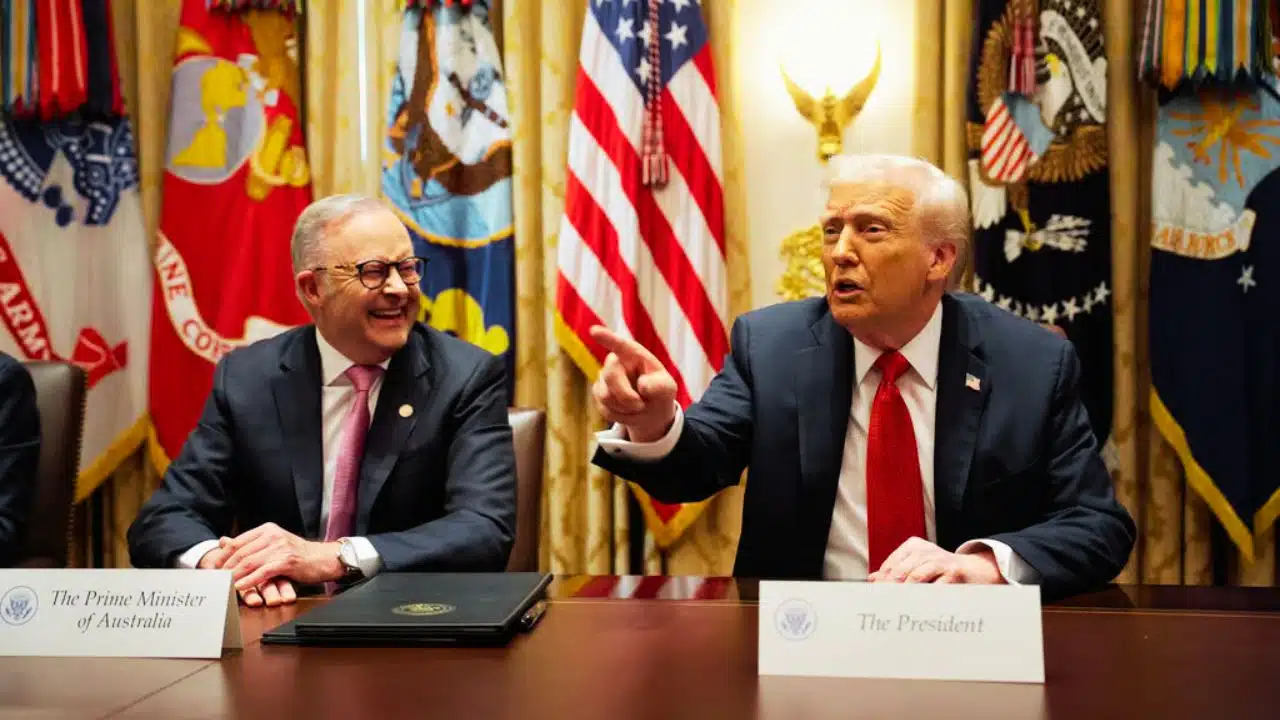
In a calculated move just weeks before a crucial summit with Chinese President Xi Jinping, President Donald Trump has publicly underscored a deepening strategic partnership with Australia, focusing on breaking China’s dominance in the rare-earth partnership and accelerating the AUKUS nuclear-powered submarine pact.
The discussions, held with Australian Prime Minister Peter Dutton, signal a robust, bipartisan American commitment to counteracting Beijing’s influence in the Indo-Pacific, leveraging economic and military collaboration as a cornerstone of US foreign policy. The meeting sets a firm tone for the upcoming talks with Beijing, placing supply chain security and regional military balance at the forefront of the agenda.
Quick Take: The Stakes
- Strategic Minerals: The talks aim to finalize a landmark deal to create a secure, US-allied supply chain for rare-earth elements, critical for defense, electronics, and green technology, directly challenging China’s near-monopoly.
- AUKUS Acceleration: Both sides are discussing plans to fast-track the delivery and operational timeline for Australia’s nuclear-powered submarine fleet under the AUKUS security pact, a major deterrent to Chinese maritime expansion.
- Pre-Summit Signaling: The timing is deliberate, sending a powerful message to Beijing that Washington is solidifying alliances and diversifying critical supply chains ahead of the G20 summit where Trump and Xi are scheduled to meet.
- Economic Impact: The partnership could inject billions into the Australian mining sector and stabilize global prices for critical minerals, reducing market vulnerability to Chinese export controls. As of Q3 2025, China still refines over 85% of the world’s rare earths.
- Bipartisan Consensus: The initiatives build on policies from the Biden administration, indicating a rare and strong bipartisan consensus in Washington on the strategic necessity of countering China.
A Geopolitical Chess Match
For years, the United States and its allies have grappled with a glaring strategic vulnerability: an overwhelming dependence on China for rare-earth elements (REEs). These 17 minerals are the lifeblood of modern technology, essential for everything from F-35 fighter jets and missile guidance systems to electric vehicles and smartphones. Beijing’s willingness to weaponize this dominance, demonstrated through past export restrictions, has set off alarm bells in Western capitals.
Simultaneously, the AUKUS pact—a trilateral security agreement between Australia, the United Kingdom, and the United States—represents the most significant regional defense arrangement in decades. Its central pillar is providing Australia with a fleet of conventionally-armed, nuclear-powered submarines (SSNs), a capability designed to patrol the vast and contested waters of the Indo-Pacific and act as a potent check on China’s naval ambitions.
Trump’s recent engagement with Prime Minister Dutton weaves these two threads together. By linking economic security (rare earths) with military deterrence (AUKUS), the US is forging a more integrated and resilient alliance structure, designed to withstand pressure from Beijing.
What Happened: A Renewed Pledge in Washington
During a high-profile meeting at Mar-a-Lago last week, Trump and Dutton reportedly finalized the framework for the “Strategic Minerals and Resilient Supply Chains Treaty.” While details are still emerging, sources indicate the agreement involves significant US investment in Australian mining and processing facilities, along with purchase guarantees from the U.S. Department of Defense.
“We are not going to be held hostage by any single country for the materials that power our economy and defend our nation,” Trump was quoted as saying in a press release following the meeting. “Australia has the resources, and we have the partnership to build a supply chain of, by, and for free nations.”
Discussions also focused on expediting the AUKUS timeline. The original schedule projected the first Australian-built SSN to be delivered in the early 2040s. The revised talks are exploring options for Australia to lease a US Virginia-class submarine sooner and for increased rotations of US and UK submarines at HMAS Stirling naval base in Western Australia.
Latest Data & Statistics: The Stark Imbalance
The strategic urgency is underscored by the latest market and military data:
- China’s Rare-Earth Dominance (2025 Data): As of September 2025, China accounted for approximately 68% of global rare-earth mining and, more critically, 87% of the global refined output. This gives Beijing immense control over the value chain. In contrast, Australia’s mining share is around 16%, but it currently sends most of its raw ore to China for processing.
- AUKUS Program Cost Projection: The Australian Strategic Policy Institute (ASPI) recently updated its cost estimate for the AUKUS submarine program, projecting a total expenditure of up to AUD $368 billion by 2055. The push to accelerate the program could increase near-term costs by 10-15% over the next decade.
- Global REE Market Growth: The global market for rare-earth elements is projected to grow from $9.8 billion in 2024 to over $15.5 billion by 2030, driven by the clean energy transition and consumer electronics. The US-Australia partnership aims to capture at least 25% of the non-Chinese processing market within that timeframe.
Official Responses and Expert Analysis
The move has been met with predictable condemnation from Beijing. Chinese Foreign Ministry spokesperson Hua Chunying stated last Friday, “Bloc confrontation and exclusive circles have no future. We urge the relevant countries to abandon their Cold War mentality and contribute to regional peace and stability, rather than creating new tensions.”
Experts, however, see the US-Australia move as a necessary strategic rebalancing. Dr. Becca Wasser, a senior fellow at the Center for a New American Security (CNAS), commented on the development:
“This is a classic example of integrated deterrence. You cannot separate economic security from national security in the 21st century. By tackling the rare earths dependency and hardening the AUKUS military pact simultaneously, the U.S. is signaling to Xi that the cost of aggression in the Indo-Pacific will be unacceptably high, both militarily and economically.” (Paraphrased from a CNAS policy brief published October 18, 2025).
A miner at Lynas Rare Earths’ Mount Weld mine in Western Australia, who asked not to be named, shared a local perspective: “For years, we’ve just been digging the stuff up and shipping it off. If this deal means we start processing it here, building a real industry… that’s jobs, that’s security for our kids. It feels like we’re finally taking back control.”
Impact on People and Global Markets
The immediate impact will be felt in the global commodities markets, where prices for key rare earths like neodymium and dysprosium are expected to see increased volatility as the market digests the potential for a major new supply chain. For Australian workers in states like Western Australia, the deal promises a new era of high-skilled jobs in mineral processing, a significant step up from simply mining and exporting raw materials.
For American tech and defense firms, the rare-earth partnership offers the prospect of long-term stability and predictability, insulating them from the geopolitical whims of Beijing. However, the transition will not be instant. Building out the required processing infrastructure in Australia and the US will take several years and immense capital investment, during which time the market remains exposed.
What to Watch Next
All eyes are now on the upcoming G20 summit in Rio de Janeiro. The key question is whether this fortified US-Australia alliance will bring Xi Jinping to the negotiating table in a more conciliatory mood or lead to an escalatory response.
- The Trump-Xi Meeting: Will Trump use this leverage to extract concessions on trade and security, or will it lead to a diplomatic standoff?
- China’s Reaction: Watch for potential Chinese responses, which could range from trade actions against Australian exports to increased military exercises in the South China Sea.
- Formal Treaty Signing: The official signing of the US-Australia rare-earth treaty is expected before the end of the year. Its specific clauses on investment and offtake agreements will be critical.
Donald Trump’s strategic embrace of Australia is more than just pre-summit posturing. It represents a fundamental, and likely enduring, shift in American policy to build a coalition of allies that can collectively counterbalance China’s economic and military might. By securing critical mineral supply chains and reinforcing military deterrence through AUKUS, Washington is laying the groundwork for a more competitive and potentially more contentious phase of US-China relations. The success of this rare-earth partnership could well define the geopolitical landscape for decades to come.