
Sen. Cynthia Lummis (R-Wyo.) publicly backed Elon Musk’s latest case for Bitcoin as a safeguard against inflation and fiscal excess, using the moment to re-promote her long-running idea of a Strategic Bitcoin Reserve that the U.S. could audit on-chain and, over decades, potentially use to reduce federal debt.
What triggered the exchange
Musk posted that Bitcoin’s design ties value to energy via proof-of-work, contrasting it with fiat money that governments can expand at will—especially during an AI arms race that could accelerate deficit spending. Lummis responded the same day, arguing that these properties make the case for a U.S. reserve even stronger. Multiple outlets captured both posts and their timing.
Lummis’s policy frame
Lummis has positioned Bitcoin as a fiscal integrity tool and national competitiveness hedge. In recent weeks she reiterated that funding a reserve could begin without new taxpayer burdens, with holdings verifiable by the public and auditable at any time. Her team and allies point to budget-neutral mechanisms discussed in prior drafts and concept notes.
Is a “Strategic Bitcoin Reserve” a real proposal?
Yes—versions have circulated on Capitol Hill. Earlier this year, a House–Senate push branded as the BITCOIN Act outlined accumulating up to 1 million BTC over several years, using sources such as Fed remittances and other offsets, with cold-storage custody at Treasury. It remains a proposal, not law, and would face standard committee and floor hurdles.
Where broader crypto legislation stands
In parallel to any reserve concept, senators and Senate Banking Committee staff continue to explore digital-asset market-structure rules that clarify the roles of the SEC and CFTC, define which tokens are commodities vs. securities, and set exchange/custody standards. Staff capacity and technical drafting remain gating factors, slowing bill text and markups.
September’s industry roundtable in Washington
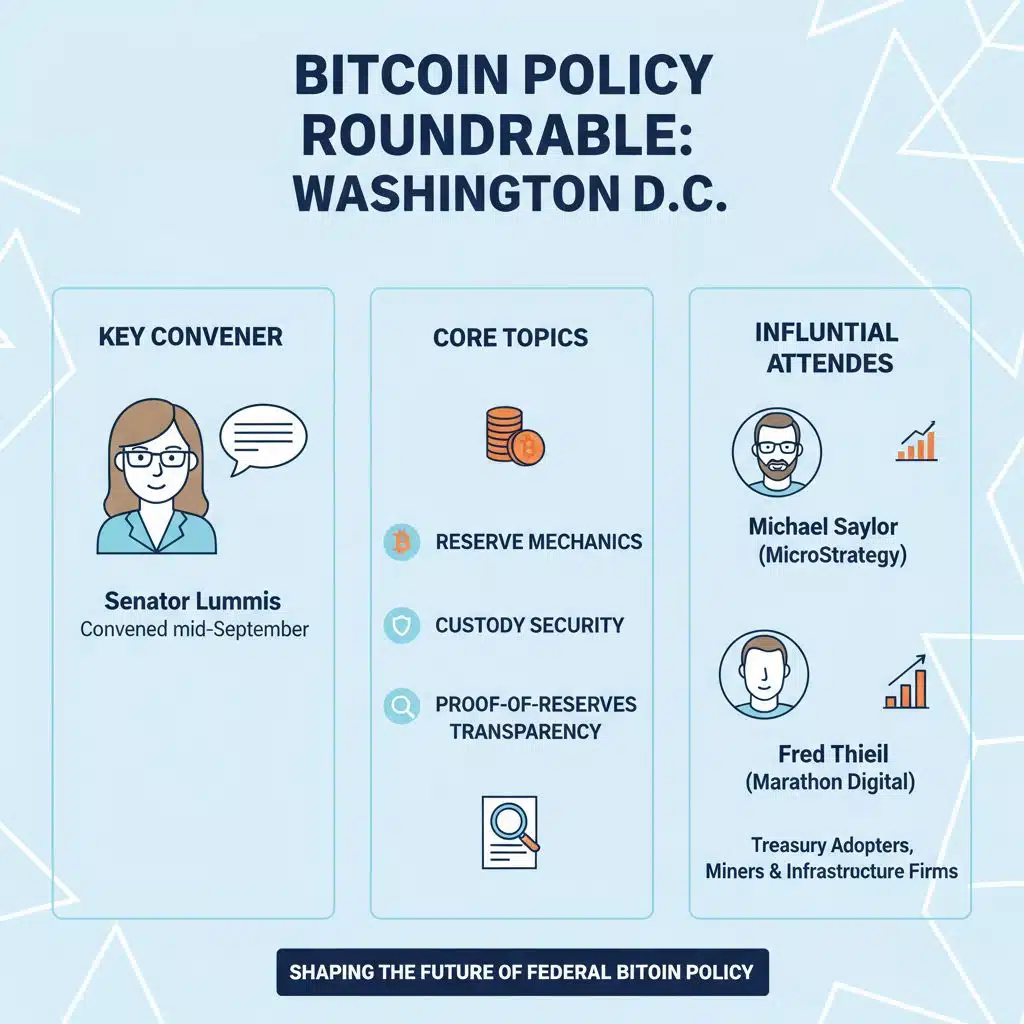
Lummis convened executives and policy voices in mid-September to discuss paths for federal Bitcoin policy, including reserve mechanics, custody security, and proof-of-reserves transparency. Attendees included Michael Saylor (MicroStrategy) and Fred Thiel (Marathon Digital)—a signal that treasury adopters, miners, and infrastructure firms want seats at the table as drafts evolve.
Why Musk’s message resonates now
With governments racing to fund AI infrastructure, Musk’s argument that energy-anchored Bitcoin resists monetary debasement reframes BTC as a macro hedge rather than just a speculative asset. Media coverage emphasized this “energy basis” framing and noted the market impact his endorsements have historically carried.
Supporters’ case: verifiability, scarcity, and auditability
Proponents say a sovereign reserve leverages Bitcoin’s fixed issuance, transparent on-chain accounting, and public auditability to strengthen balance-sheet resilience. They argue that multi-sig, geographically distributed cold storage plus periodic proof-of-reserves reports could set a global standard for sovereign digital-asset stewardship. (This synthesis draws from the Act’s public summary language and coverage of Lummis’s posts.
Skeptics’ cautions: volatility, execution risk, and market impact
Economists and market-structure lawyers counter that Bitcoin’s volatility could add pro-cyclical risk to federal finances, that large-scale sovereign buying might distort price discovery, and that custody/governance frameworks would need to be iron-clad before any accumulation. They also note that market-structure clarity—who regulates what—should precede any reserve authority. (This section synthesizes critiques surfaced in policy reporting around draft bills and staff briefings.
What to watch next
-
Hill activity: Whether Lummis or House partners drop updated bill text reflecting reserve mechanics, custody standards, and audit protocols—and whether Banking and Finance committees schedule hearings.
-
Agency posture: Any SEC/CFTC staff notes or testimonies clarifying jurisdictional splits that would affect spot-market integrity, exchange licensing, and federal custody.
-
Industry input: Follow-on roundtables with miners, custodians, and public-company treasurers refining proof-of-reserves and key management practices for a sovereign context.
-
Musk–market feedback loop: Further posts from Musk and responses from high-profile holders can influence sentiment and keep political attention elevated.
Lummis’s endorsement of Musk’s argument is more than social-media alignment; it’s a bid to convert a viral moment into legislative momentum. The Strategic Bitcoin Reserve remains a live proposal—credible enough to be debated, but still distant from enactment. Expect incremental steps first (market-structure clarity, custody/audit standards, seized-asset policy) before any serious vote to authorize federal accumulation of BTC.