


Many new founders need cash to grow their idea. They draft a business plan, but they hit a dead end. Banks ask for collateral, like a house or a car. That need can block your path.
Here is one bright fact. Credit Suite can give you a credit line hybrid up to $150,000 with no collateral. In this guide, we list 12 top ways to fund your startup without assets. We cover business lines of credit, merchant cash advances, invoice factoring, and term loans.
We even share simple steps for the loan application process and tools like a business loan calculator. Ready to learn more?
Key Takeaways
- Credit Suite’s Credit Line Hybrid gives up to $150,000 unsecured credit with a 0% intro APR. It needs a FICO score of 700 or more, no late payments in two years, at most three active loans, balances at or below 40%, and no more than five hard pulls per bureau per year.
- National Funding gives unsecured loans with a personal guarantee or UCC lien to firms with six months in business and $250,000 in yearly revenue. Terms run two to five years for truck leasing or four to 24 months for payroll, with no collateral, no prepayment fees, auto pay, and early-pay discounts.
- SBA microloans lend up to $25,000 with 85% SBA backing. They need an EIN, good revenue, and a personal guarantee. They offer lower APRs but take longer to fund than online lenders and work well for inventory or payroll.
- Merchant cash advances use future credit card sales as collateral and repay via a daily sales percentage, while invoice financing advances up to 90% of invoices due in 60 to 90 days and funds land in days. Both require no other collateral.
- Revenue-based financing will grow from $5.78 billion in 2024 to $41.81 billion by 2028 at a 64% CAGR. It gives upfront funds in exchange for a share of future revenue and needs no collateral but may require a personal guarantee.
What is a Credit Line Hybrid and How Does It Work?
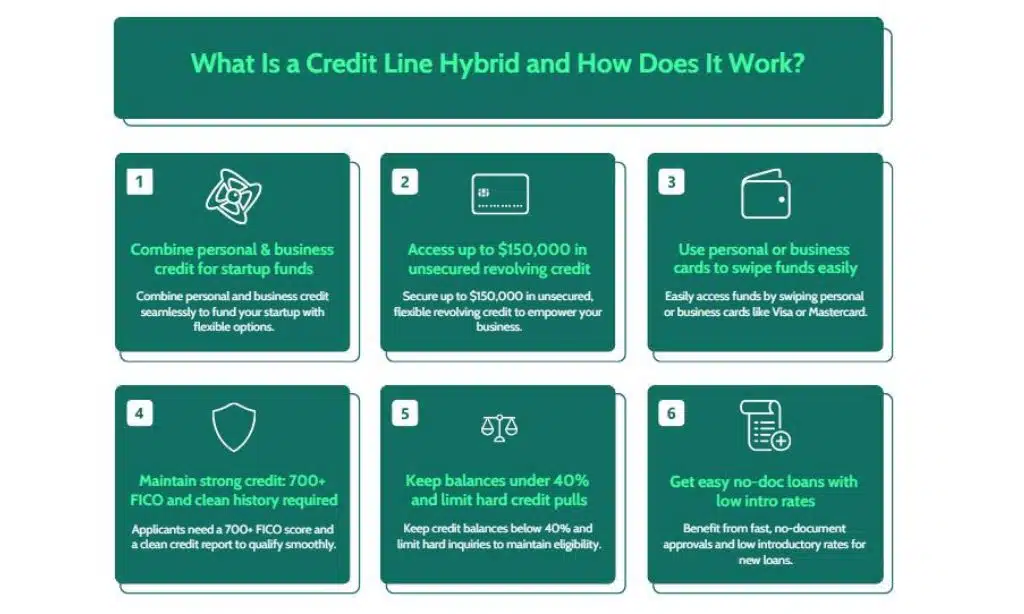
Credit Suite’s Credit Line Hybrid blends business and personal credit into one tool; founders can tap up to $150,000 in unsecured startup business loans. Introductory interest rates can drop to zero percent for a set period.
Entrepreneurs swipe funds via a personal or business card, like a Visa or Mastercard. This line works like a revolving credit account with no collateral.
Applicants need a FICO score of 700 or higher and a clean credit report. No bankruptcies, no charged-off accounts, and no late payments in two years clear the path. They also may not hold more than three unsecured loans on their credit history in the past twelve months.
Revolving credit balances must stay at or below forty percent of available lines. Hard pulls must total under five per bureau in a year. This no doc process skips piles of paper and speeds up the loan application process.
How Does National Funding Support Startups Without Collateral?
National Funding offers unsecured business loans with only a personal guarantee or a UCC lien. Clients skip pledging assets. They approve more often and check scores with less strict rules.
Companies need six months in business and $250,000 in yearly revenue. They issue six-month loans, printer leasing, and payroll financing. It lists loan origination fees up front and sets fixed interest and APR.
Payments auto-withdraw from a checking account. Business owners earn early pay discounts if they clear debts fast.
National Funding backs firms in trucking, construction, insurance, and law. Approval flows faster than with bank loans or SBA loans. You can apply via online lenders or a quick loan application process.
Loan repayment terms span two to five years for truck leasing or four to twenty-four months for payroll loans. Firms pay no prepayment penalties and face no collateral hassles. This plan matches a startup’s need for fast cash and can boost a business credit score.
What Financing Options Does Fora Financial Offer for Startups?
Fora Financial provides unsecured business loans in amounts from $5,000 up to $1.5 million. The lender drops loan origination fees, and it waives prepayment penalties. A soft credit check kicks off the loan application process, followed by a hard inquiry after approval.
Decisions arrive in 4 to 24 hours, and funding hits accounts in 24 to 72 hours.
Clients regain access to credit lines after paying down 60 percent of the principal. This offers a revolving credit feel while preserving term loan simplicity. Fast turnaround and clear interest rates suit startup owners chasing quick growth.
Entrepreneurs can tap this flexible funding as their small business scales.
How Do SBA Microloans for $25,000 or Less Benefit New Businesses?
SBA microloans up to $25,000 let new businesses borrow without collateral. They need a personal guarantee instead. These term loans have shorter repayment periods. The U.S. Small Business Administration backs about 85 percent of each loan, which cuts lender risk.
Microlenders across the country, not just banks, offer this cash boost. Startups with solid credit scores can win approval.
The loan application process moves slower than with online lenders, but it pays off in lower annual percentage rates. New entrepreneurs use these funds to buy inventory or cover payroll.
Applicants only need good revenue records and an EIN. They avoid hefty loan origination fees and prepayment penalties. This path fits early stage firms that need a quick boost in startup capital.
How Can Equipment Financing Help Startups Without Collateral?
Equipment financing works like a car loan or mortgage. It uses the equipment itself as collateral. It applies even on leased equipment. Lenders check equipment value, expected life, and depreciation.
That can help startups with poor credit. This method lets them avoid pledging other business assets.
This option frees working capital for payroll or marketing. Loan terms and interest rates depend on equipment type and value. Businesses in construction or manufacturing find it useful.
Some lenders charge loan origination fees or prepayment penalties. Entrepreneurs use a business loan calculator or loan comparison tools to pick the best deal. They start the loan application process with a formal appraisal and equipment details.
What Are Merchant Cash Advances and How Do They Work?
Startup owners sell unpaid credit card receipts to get a merchant cash advance. That business funding route, known as accounts receivable financing, uses card sales as collateral. A business needs several months of receipts to qualify.
Approval hinges on the merchant’s reputation, so lenders vet its sales history.
Companies with net 30, 60, or 90 payment cycles tap this tool for fast capital. Online lenders often approve funds in days, unlike standard small business loans. Disbursement happens within a short window, so cash flow stays steady.
Borrowers repay a slice of daily credit card sales, instead of a fixed monthly fee.
How Can Business Credit Cards Serve as Startup Capital?
A business credit card acts like a mini line of credit. It taps up to $5,000 or more for daily costs. Card issuers review your personal guarantee and credit score. Some offer 0% APR for 12 to 18 months on purchases.
That deal can fund rent, supplies or equipment buys with no loan origination fees. You pay down the balance before high interest rates kick in.
Using a card on time builds your business credit score. That score boosts your odds for unsecured business loans. Cards chew through startup costs like a pro. They refill as you pay down your balance.
You also rack up cash back or travel points on buys. Banks and major card networks link cards to expense apps. Approval happens in days, not weeks, cutting your loan application time.
What Are Invoice Financing Options for Startups?
Startups can tap invoice financing to free cash fast. Lenders check accounts receivable due in 60 to 90 days. They fund up to 90 percent of each bill. A small reserve stays on hold, until clients pay.
This plan beats term loans for speed. It needs no office or equipment collateral.
Invoice factoring stands out as a tool for growing firms. Some fintechs let you link your accounting software for online invoice discounting. Once linked, funds can land in your bank in days.
You clear the advance after your client pays. This model helps you plug cash leaks in slow seasons. It may require a personal guarantee but skips business assets.
How Does Cash Flow Financing Support New Businesses?
Lenders base cash flow financing on bank statements, not credit card sales. This unsecured business loan suits new ventures with shaky credit if they can show steady cash flow. It demands no physical collateral, only a personal guarantee.
The application process runs online with minimal paperwork. Providers check transaction records and past finances. They set funding amounts by cash inflow trends. Approval and funding arrive in about three business days.
Businesses repay via fixed daily or weekly withdrawals, which keeps finances smooth. Lenders list loan origination fees and interest rates up front. They avoid prepayment penalties with clear loan repayment terms.
Smart entrepreneurs use loan comparison tools and a business loan calculator to weigh offers from online lenders, Bank of America, or Wells Fargo. This short-term loan can plug gaps in payroll or inventory without choking cash flow.
When Should You Consider HELOC or Personal Loan Options?
For founders with high home equity and solid credit score, a HELOC can unlock capital fast. A HELOC or personal loan can deliver funds when an SBA 7(a) or term loan falls through. This line of credit behaves like revolving credit, drawing on a mortgage balance.
Approval hinges on your personal guarantee and property value, not on business revenue. Interest rates often sit below those on business credit cards but above those on secured term loans.
You can lose your house if you default. Loan amounts vary by your home’s equity and other assets. These options do not help build your business credit. Origination fees and repayment schedules differ across Bank of America, PNC Bank, or online lenders.
You should skip these routes if you cannot afford to risk personal assets.
How Do Crowdfunding Platforms Help Raise Startup Capital?
Crowdfunding taps a large pool of individual backers, each pledging small amounts. This no collateral funding model avoids personal guarantee, because startups skip unsecured business loans and promise rewards or equity.
A campaign page shows a business plan, photos, and a clear pitch. Founders set reward tiers, from branded stickers to widget prototypes. A strong social media push on a crowdfunding site fuels traffic, a catchy video sparks curiosity, and humor wins hearts.
Startups gain market validation as backers vote with their dollars, revealing real demand.
Running a campaign feels like juggling flaming torches, fun but tricky. Founders log hours on social media posts, email updates, and backer questions. Most sites charge a fee, say 5% of funds, plus 3% payment gateway fee.
Legal risk lurks if rewards miss delivery or funds stray from the pitch. Success rates sit below 30% for many industries, so careful planning matters. No repayment ever looms, yet founders trade equity stakes or ship promised items.
This tool proves priceless for early customers, strong branding, and startup capital.
What Are Revenue-Based Financing Solutions for Startups?

Revenue-based financing gives startups a lump sum in exchange for a small share of future sales. Lenders use a factor rate, not traditional interest rates, to calculate total repayment.
This unsecured business loan ties payments to monthly revenue, so you pay more when sales rise and less in slow months. Approval often comes within days, making this faster than SBA loans or term loans.
The sector may hit 41.81 billion dollars by 2028, up from 5.78 billion dollars in 2024, a 64 percent CAGR for revenue-based financing. SaaS and e-commerce ventures can tap into this option without pledging business assets.
You may sign a personal guarantee, but you skip collateral and curb prepayment penalties typical of secured loans. You can use a business loan calculator or loan comparison tools to weigh this route against revolving credit or peer-to-peer lending.
Key Advantages of No Collateral Loans
No collateral loans let you tap a credit line or invoice factoring fast, without risking your equipment or storefront. These unsecured deals avoid high origination costs, free up cash flow for marketing or tech upgrades, and keep you moving ahead.
What Are the Main Benefits of Loans Without Collateral?
Unsecured business loans carry no risk of losing business or personal assets. Lenders skip asset appraisals, requiring a personal guarantee instead of collateral, so your office equipment stays safe.
Providers such as Bank of America and online lenders set interest rates using credit score and cash flow. Funds hit your account in days, not weeks. Faster approval times help you seize market chances early.
Small service firms often lack property to pledge. They tap business line of credit or term loans to get funds. Entrepreneurs can use a business loan calculator to gauge payments. Borrowers apply capital to payroll, marketing, or upgrades.
This broad access lets startups move fast.
How Do No Collateral Loans Improve Startup Financing?
No collateral loans let a startup tap funds fast, without risking assets. They remove the need for equipment financing as a pledge. They lower barriers for first-time founders. Funds go to working capital, growth, or emergencies.
Approval can take days, not weeks, so a small shop can pivot on a dime. Borrowers may choose a business line of credit, short-term loan, or a merchant cash advance.
Lenders shift risk with higher interest rates and stricter credit checks, not by seizing gear. This focus on personal guarantee nudges owners to build a strong record. It also helps build business credit for a small business administration 7(a) loan later.
Apps from online lenders, Bank of America, and PNC Bank link to loan comparison tools or a simple business loan calculator. Startups can stay agile, grab new opportunities, and still mind loan repayment terms.
Common Challenges With Unsecured Loans
Unsecured loans can hike interest rates fast if your business credit score slides. You may need a personal guarantee and face heavy loan origination fees at Bank of America or PNC Bank.
What Are the Risks of Taking Unsecured Loans?
Many startups pay interest rates from 8 to 30 percent, plus loan origination fees. Lenders set strict business credit score and revenue minimums, so new ventures fail the loan application process.
They cap funding below what a secured loan offers. A personal guarantee can put a founder’s house or car at risk if the business defaults. Shorter, rigid loan repayment terms strain cash flow, while prepayment penalties punish early payoff.
Online lenders may bar businesses in cannabis, adult or gambling niches. Defaults can crush both personal and business credit, closing off future funding.
How Can Startups Overcome Challenges with No Collateral Loans?
Founders polish their credit rating by paying bills on time. Tracking revenue and crafting a clear business plan sharpens their case. They plug numbers into a business loan calculator to compare term loans and lines of credit.
Limiting debt to 36% of annual pay cuts personal guarantee risks. Using prequalification tools helps find the best deals, without hurting credit.
Some startup programs skip collateral. Founders share strong cash flow forecasts and use accounts receivable financing or MCAs to fund equipment purchases. They shop origination costs and grab early repayment discounts to slash interest rates.
Filing neat, complete docs speeds the loan application process. Beginners may start with small SBA 7(a) loans or online personal loans, then grow lender ties.
How to Apply for No Collateral Loans
Gather your EIN, buff up your business credit score, and nail down a clear business plan. Then use a loan comparison tool on a FinTech platform, weigh interest rates and origination fees, and pick the best SBA or term loan.
What Are the Steps to Apply for Unsecured Startup Loans?
Start your loan request with the right info. A clear plan boosts approval odds.
- Prequalify on a rate site for a soft credit check and side-by-side lender comparison.
- Choose a funding portal and fill a short form with business info, revenue, funding amount, purpose, and ownership.
- Compare lender lists of interest rates, origination fees, prepayment penalties, and repayment terms.
- Prepare key paperwork such as your business plan, employer ID number, bank statements, and tax returns.
- Check your business credit score and correct any mistakes before you apply.
- Draft a personal guarantee if the lender asks, as many unsecured business loans need one.
- Submit your loan application online through the lender’s platform, often in minutes.
- Wait for a decision, which can come in one day with online lenders or several weeks with banks or SBA.
- Review all offers, weighing term loans, revolving credit lines, invoice factoring, or merchant cash advance deals.
- Sign loan documents and get funds in 24, 48 hours after approval, so you can start growing your startup.
How Can You Increase Your Approval Chances?
Strong credit signals lower costs. Clear growth data wins lender trust.
- Maintain healthy credit scores of 600 or higher for lender portals, 680 or higher for banks, and 640 or higher for SBA loans. Lenders scan your score before review.
- Show at least six months of stable revenue or up to twenty-four months for stricter banks, with $100,000 annual sales for lender portals and $250,000 for bank lines of credit. This record proves you can handle term loans.
- Prepare a clear business plan and state your loan purpose in simple terms. A sharp plan boosts lender confidence.
- Keep debt ratios low and clear any late payments, bankruptcies, or charged-off accounts. Firms flag these as red marks.
- Register your tax ID and gather organized balance sheets, cash flow statements, and profit reports. A tidy file speeds your loan application process.
- Use loan comparison tools to weigh interest rates, loan origination fees, prepayment penalties, and loan repayment terms. This step helps you pick the best offer.
- Plug your numbers into a business loan calculator before you seek short-term loans or revolving credit. This habit maps your payment capacity.
- Offer a personal guarantee if you chase unsecured business loans without collateral. This move can sway lender decisions.
- Pick lenders that match your profile, from U.S. Bank and PNC Bank to the Small Business Administration and local web lenders. Alignment with their terms eases approval.
- Highlight your past invoice factoring, merchant cash advance, or equipment financing deals. Showing on-time debt service proves you can handle new credit.
Documents Required for Application
Gather your ID number, a one-page business plan, and recent bank statements to apply for a startup loan. Check your credit score and fee estimates, then use comparison tools to pick the best lender.
What Paperwork Is Needed to Apply for No Collateral Loans?
Startups must fill out the right papers to get unsecured business loans. Lenders need clear proof of finances and legal status.
1 Business plan with clear goals and use of funds for unsecured business loans
2 Company license plus Employer Identification Number to verify legal status
3 Two to three years of business and personal tax returns for small business administration (sba) reviews
4 Twelve to twenty four months of bank statements to track cash flow for revolving credit approval
5 Balance sheet and income statement to outline revenue, expenses, and net income
6 Payroll records and accounts payable and receivable logs for invoice factoring and merchant cash advance
7 Equipment quotes or vendor invoices for equipment financing or equipment loans
8 Proof of business insurance to protect business assets and meet lender conditions
9 Ownership chart along with organizational documents for sba 7(a) loan or term loan underwriting
10 Completed application forms from online lenders, Bank of America, U.S. Bank, or PNC Bank
11 Signed personal guarantee to set terms for interest rates, loan origination fees, and prepayment penalties
12 Rate schedule printouts and loan comparison tools to weigh loan repayment terms
13 Business loan calculator reports to estimate payment schedules and costs before signing
How Should You Prepare Your Loan Documentation?
Gather all your paperwork before you start the loan application. Keep each file neat, clear, and ready to share.
- Update financial statements. Use your accounting software or a simple spreadsheet to check profit, loss, and cash flow.
- Label income tax returns and personal financial statements. Attach the EIN for each guarantor and clarify personal guarantee terms.
- Organize your business plan. Add a cash flow forecast with revenue and expense details for lenders.
- List business assets. Include equipment financing agreements or lease records that could back short-term loans or term loans.
- Prepare AR/AP aging reports. Attach supporting schedules in PDF to speed the loan application process.
- Collect insurance certificates, UCC filings, and vendor or supplier reports. These back your small business financing story.
- Verify business registration and licensing status. Scan your state permit or business license to prove your legal standing.
- Gather ID scans and bank statements. Show recent balances to highlight your business credit score strength.
- Create a folder per lender. Name each set to match the portal titles on Bank of America or other online lenders.
- Arrange a fee outline for loan origination fees and interest rates. Use a business loan calculator to check costs.
- Upload all documents to a secure portal. Set them ready for electronic signatures to speed approval.
- Use loan comparison tools to track offers. Note key rates, fees, and repayment terms side by side.
- Keep a backup on an external drive or cloud storage. That extra copy shields you from data loss during the loan approval process.
Tips for Choosing the Right Loan Provider
Use loan comparison tools like a treasure map to find the lowest interest rates. Check your business credit score, then match your plan with a lender that backs fresh ventures.
What Factors Should You Consider When Selecting a Lender?
Picking the right lender sets up success. Better terms boost your cash flow.
- Check interest rates carefully. Seek an APR between 7% and 75% to balance monthly payments. A business loan calculator helps you compare offers.
- Compare total loan costs. Tally origination fees, late fees, and prepayment penalties. This prevents hidden surprises in your loan application process.
- Review lender requirements. Verify minimum business credit score, two-year track record, EIN, and industry rules. Factor in any personal guarantee demands or business assets needed.
- Assess funding speed. Online lenders can send money in one to three days. Banks and SBA 7(a) loans often take three to six weeks.
- Look at product variety. Explore term loans, short-term loans, business lines of credit, equipment financing, invoice factoring, revenue-based financing, and SBA microloans under $25,000.
- Read customer satisfaction ratings. Bluevine scores 4.3 out of 5, Fundbox hits 4.2, SMB Compass shows 4.3, and Bank of America reports 4.1. Star reviews guide your choice.
- Confirm transparency of terms. Check if a lender clearly lists interest rates, loan origination fees, repayment schedule, and any hidden costs. Transparency keeps your budget on track.
- Test customer support and advisory services. Contact U.S. Bank or online lenders to judge response time. Friendly guidance can ease your loan approval process.
- Factor in market access. Recent rate hikes and banking turmoil can shrink small business funding. Shop around to find lenders still approving loan applications.
How Can You Compare Loan Offers Effectively?
Comparing loan offers takes careful study. You must sort interest rates, fees, and terms to find the best fit.
- Use prequalification tools for instant rate, fee, and term comparisons without hard credit checks.
- Review APR, loan origination fees, and covenants to spot hidden costs.
- Compare amortization schedules to see monthly payment and total interest.
- Spot fixed versus variable rates to plan for stable or shifting payments.
- Factor in extension, exit, and due diligence fees when you tally total cost.
- Weigh loan amounts from $5,000 to $5 million and terms from three to sixty months.
- Match term loans for one time funding to lines of credit for revolving credit.
- Explore Bank of America Preferred Rewards for no fees, higher rewards, and 25 percent loan discounts.
- Analyze early pay discounts and flexible repayment options to save on interest.
- Plug numbers into a business loan calculator and loan comparison tools for side by side data.
- Inspect prepayment penalties, covenants, and personal guarantee clauses in lender terms to avoid surprise fees.
- Look at SBA 7(a) loans, microloans, or online lenders to find interest rates that fit your business credit score.
- Check your EIN, business plan, and financials so you can speed up the loan application process.
Managing Startup Loans Responsibly
You weigh SBA 7(a) loans with an online loan comparison tool and note each origination fee. You log every payment in your cash flow report and check your small business credit score.
How Can You Manage Your Startup Loan Wisely?
Keep debt under 36 percent of yearly income, for example $36,000 if you earn $100,000. Automate payments via a business line of credit or online lender to avoid late fees or credit damage.
Build a reserve fund for sudden costs or dips in sales. Maintain a debt service coverage ratio of 1.25x for bank term loans, 1.15x for SBA 7(a) loans, and check balances often to track repayment.
Use loan funds only for approved business assets or growth projects in your business plan. Monitor cash flow weekly with a simple spreadsheet or a business loan calculator. Watch interest rates and loan origination fees, use comparison tools to find the best term loans.
Seek early repayment discounts to cut interest on short-term loans when you have extra cash.
What Are Best Practices for Loan Repayment?
Automate your repayments. You can link your checking account to an online lender or U.S. Bank platform for scheduled withdrawals. Clear term loans and revolving credit both need on-time payments to keep your business credit score high.
Missing even one payment on an SBA 7(a) loan or short-term loan can ding your credit. Set alerts before due dates and track loan origination fees. Talk with your lender early if cash flow dips, so you can tweak a payment plan.
File all loan documents in one folder and note each invoice factoring, equipment financing or business line of credit term. Track your debt service coverage ratio and monitor cash flow, then update your financial forecasts weekly with a business loan calculator.
Scan covenants on your personal guarantee and compliance rules to avoid default. Compare new offers with loan comparison tools if you spot lower interest rates. You may refinance or consolidate debt to cut rates and simplify payments.
Takeaways
Tapping no collateral loans is like finding wind for your sails. SBA Microloans and equipment financing help you buy gear or cover rent. Business credit cards, invoice financing, and merchant cash advances join your funding toolbox.
A loan comparison tool shows key rates, while a business loan calculator maps your costs. Seek smart terms, track repayments, and steer your venture toward solid growth.
FAQs on Startup Capital Loans That Don’t Require Collateral
1. What types of startup business loans need no collateral?
You can tap term loans, short-term loans, invoice factoring (receivable funding), credit line, equipment financing (gear leasing), SBA 7(a) loans. Each option lists interest rates and loan origination fees. Many ask only for a personal guarantee.
2. How does a personal guarantee work in these deals?
You promise to pay the debt if your startup can’t. Think of it as skin in the game, your word on the line. Collateral stays at home, but your signature counts.
3. What costs should I watch in the loan application process?
Interest rates and loan origination fees can bite. Use a business loan calculator and loan comparison tools. That way you dodge hidden charges.
4. Which lenders offer no-collateral startup loans?
Digital lenders, Bank of America, U.S. Bank and the SBA all pitch in here. They skip asset checks but vet your business credit score. Some online lenders move at warp speed.
5. How can I boost my odds for fast loan approval?
Nail a clear business plan, share your EIN, mind your business credit score. It’s like laying a strong foundation before you build. No monkey business.





















