What happens when a person is not recognized as a citizen by any country? For over 10 million individuals worldwide, this isn’t just a hypothetical—it’s a daily reality. These are the stateless people whose very existence sits in a legal and social limbo.
They lack a passport, a national ID, access to healthcare and education, and often, even basic human rights. The issue of stateless people by country is often underreported, but it represents one of the most urgent human rights challenges of our time.
This article explores the global distribution of statelessness through a powerful, interactive map—offering data-driven insights into which nations have the largest stateless populations and why. From the Rohingya in Myanmar to the Bidoon in Kuwait, these stories show how citizenship is not just a legal formality—it’s a lifeline.
What Does It Mean to Be Stateless?
Statelessness is defined by the 1954 UN Convention Relating to the Status of Stateless Persons as the condition of an individual “who is not considered a national by any state under the operation of its law.” In simpler terms, a stateless person doesn’t belong to any country—legally or politically.
Causes of Statelessness
Statelessness can arise due to a range of causes, often deeply rooted in historical injustices, bureaucratic failures, or discriminatory practices. Here are the primary reasons:
-
Discriminatory Nationality Laws: In some countries, women cannot pass citizenship to their children, especially if the father is unknown or foreign—a problem prevalent in parts of the Middle East and North Africa.
-
Ethnic and Religious Discrimination: Some minorities, like the Rohingya in Myanmar, are denied nationality based on ethnicity or religion.
-
State Dissolution or Border Changes: The breakup of countries like the Soviet Union, Yugoslavia, or colonial empires left millions in stateless limbo.
-
Lack of Birth Registration: Children born outside formal hospital systems or to undocumented parents often fall through the cracks.
-
Conflicting National Laws: Some countries may not grant nationality based on birth in the country (jus soli) or bloodline (jus sanguinis), leaving individuals without legal status.
Key Global Statistics: Where Statelessness is Most Prevalent
To understand the magnitude of the crisis, we’ve created an interactive map that visualizes the number of stateless people by country. These figures, based on the latest available data from UNHCR and human rights reports, highlight not only the scope but also the regional concentrations of statelessness.
Global Overview at a Glance
| Country | Estimated Stateless Population | Major Affected Groups |
|---|---|---|
| Myanmar | 600,000+ | Rohingya Muslims |
| Côte d’Ivoire | 1,000,000+ | Descendants of West African migrants |
| Thailand | 500,000+ | Hill tribes and ethnic minorities |
| Kuwait | 100,000+ | Bidoon (stateless Arabs) |
| Bangladesh | 300,000+ | Urdu-speaking Biharis |
| Latvia/Estonia | 250,000+ | Soviet-era Russian speakers |
| Syria/Lebanon | 500,000+ (Palestinians) | Refugees without formal nationality |
| Dominican Republic | 200,000+ | Haitian descendants |
Regional Highlights: Where the Problem is Most Acute
Statelessness manifests differently around the world—shaped by local history, political transitions, ethnicity-based discrimination, and even gendered laws. Below is a breakdown of the most affected regions and the communities bearing the brunt of statelessness.
Asia-Pacific: Home to the Largest Stateless Group
-
Myanmar is ground zero for one of the most persecuted stateless communities: the Rohingya Muslims. Stripped of citizenship under the 1982 Citizenship Law, they’ve faced generations of exclusion, mass displacement, and genocide-level violence. Over 600,000 Rohingya remain stateless inside Myanmar, while another million have fled to Bangladesh.
-
In Thailand, over 500,000 people—mostly from hill tribes and minority groups like the Karen, Lahu, and Hmong—lack citizenship due to documentation gaps and marginalization.
-
Nepal sees statelessness, especially among children born to Nepali mothers and foreign fathers, due to gender-discriminatory nationality laws.
-
Malaysia and Brunei also have stateless children, often born to migrant or refugee parents.
Middle East and Gulf: Statelessness by State Design
-
In Kuwait, around 100,000 Bidoon (short for “bidūn jinsiyya” or “without nationality”) have been excluded from citizenship for decades despite being long-time residents. They are denied state jobs, higher education, and even marriage licenses.
-
Saudi Arabia, the UAE, and Qatar have similar cases, though data is scarce.
-
Palestinians in Lebanon and Syria remain stateless even after generations, with no path to citizenship and limited rights in host countries.
Africa: Colonial Legacies and Legal Gaps
-
Côte d’Ivoire has over 1 million stateless people—many of them descendants of West African migrant workers. Their status remains unresolved due to the country’s strict laws on origin and nationality.
-
In Zimbabwe, people of Mozambican descent born in refugee camps after the liberation war often remain stateless.
-
Kenya faces statelessness issues among the Shona, Makonde, and Pemba communities, historically excluded from citizenship frameworks.
Europe: Post-Soviet Statelessness
-
After the collapse of the Soviet Union, thousands of ethnic Russians in Latvia and Estonia found themselves stateless. Despite legal residence, they lacked nationality, leading to restricted political participation and travel limitations.
-
Today, over 200,000 non-citizens still reside in Latvia and Estonia, many of them elderly, with reduced access to full state benefits.
-
Roma communities across Serbia, Bosnia, North Macedonia, and Hungary also suffer from statelessness due to poor birth registration and discrimination.
Human Impact: Stories Behind the Numbers
While data helps us visualize the scope of the problem, the lived reality of statelessness goes far beyond numbers. Stateless individuals often find themselves trapped in cycles of poverty, exclusion, and invisibility. Without legal recognition, their fundamental rights are compromised—sometimes for generations.
Education and Health Access: Doors Shut Early
Without national identity documents or a birth certificate, stateless children are often barred from enrolling in school. Even if they’re allowed to attend primary classes informally, they may be unable to sit for national exams or graduate with valid certificates.
-
In Thailand, stateless highland children frequently walk for hours to attend makeshift schools that can’t issue valid diplomas.
-
In Bangladesh’s Rohingya camps, children face limited learning options, often taught in informal “learning centers” with no formal recognition or career pathway.
Lack of citizenship also prevents access to basic healthcare. Stateless individuals may be denied free or subsidized services in public hospitals, and they often lack insurance or the ability to buy medication at fair prices.
Employment and Mobility: Trapped in the Shadows
Stateless people cannot apply for legal employment in most countries. This forces them into informal or exploitative jobs, often with no contracts, no protections, and no path to social mobility.
-
In Kuwait, Bidoon youth graduate with high marks but are barred from becoming doctors, lawyers, or civil servants.
-
In Lebanon, stateless Palestinians are banned from over 30 professions and are restricted to working in manual labor or black-market trades.
Mobility is another major restriction. Stateless people cannot obtain passports, which means they can’t travel abroad—even for medical emergencies or higher education opportunities.
Psychological Toll: The Identity Crisis
Living without a nationality leads to a profound sense of exclusion. Stateless youth, especially those born in host countries, grow up with a confusing and painful reality: they belong everywhere and nowhere.
“I was born here. I speak the language. But the government tells me I am not from here. Then where am I from?” — a 16-year-old stateless girl in the Dominican Republic
Mental health issues like depression, anxiety, and hopelessness are common among stateless individuals, especially when faced with repeated rejection by authorities and society.
International Efforts and Gaps
The global response to statelessness has gained momentum in recent years, particularly due to the efforts of the United Nations High Commissioner for Refugees (UNHCR). However, while some legal frameworks exist, the implementation remains uneven, and millions remain in limbo.
UNHCR’s #IBelong Campaign
In 2014, the UNHCR launched the #IBelong Campaign with the ambitious goal of ending statelessness by 2024. It focused on:
-
Encouraging countries to reform nationality laws
-
Promoting universal birth registration
-
Supporting statelessness determination procedures (SDPs)
-
Collecting and sharing accurate data on stateless populations
Progress has been made in several countries, but the global numbers remain stubbornly high. As of 2024, the UNHCR acknowledged that millions of people remain stateless, and many governments have not followed through on promised reforms.
International Legal Instruments
Two major international conventions guide statelessness policy:
-
1954 Convention Relating to the Status of Stateless Persons
-
Grants civil, economic, and social rights to stateless individuals
-
Encourages equal treatment and identity documentation
-
-
1961 Convention on the Reduction of Statelessness
-
Prevents new cases of statelessness from occurring
-
Encourages countries to allow citizenship to children born on their territory if they would otherwise be stateless
-
While over 90 countries are parties to these conventions, key countries — including India, Thailand, Malaysia, Lebanon, and the Dominican Republic — are not signatories, limiting the conventions’ global impact.
Implementation Gaps and Barriers
Despite legal frameworks, challenges remain:
-
Lack of Political Will: Many governments view statelessness as a security issue, not a humanitarian crisis.
-
Bureaucratic Hurdles: Stateless individuals are often forced to navigate complex and hostile legal systems with little support.
-
Exclusionary Nationalism: Rising nationalist movements have led to more restrictive citizenship laws — making the stateless even more vulnerable.
-
Limited Data: Many countries either do not track stateless populations or underreport figures, complicating response planning.
What’s Being Done: Countries Taking Action
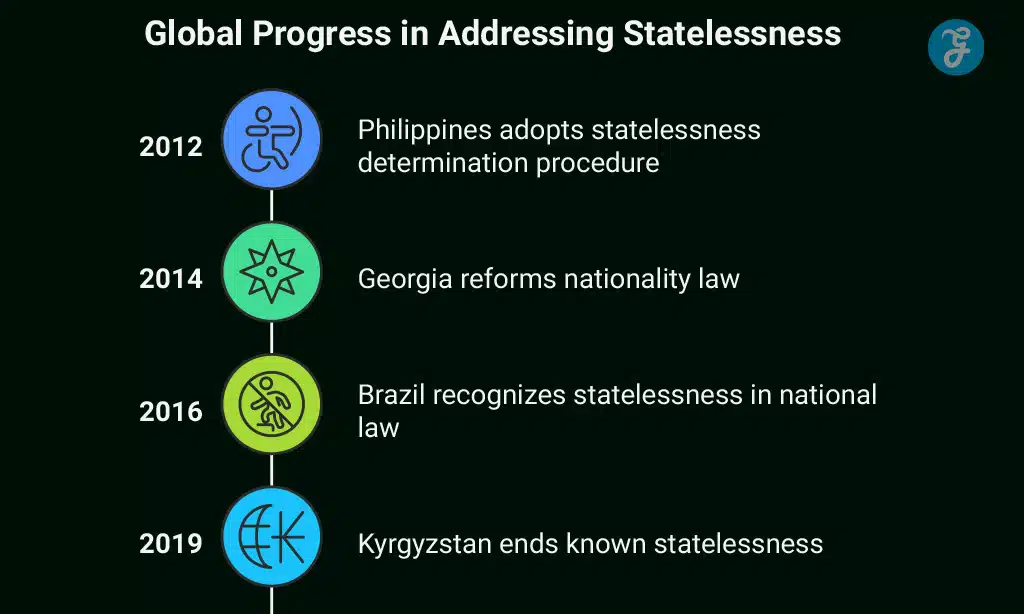
While the global crisis of statelessness remains widespread, a few countries have made notable progress through legal reform, political will, and grassroots pressure. These success stories demonstrate that statelessness is not an unsolvable issue — with the right policies and humanitarian focus, millions can be restored their right to a nationality.
Philippines: A Regional Leader in Inclusion
The Philippines stands out in Southeast Asia for adopting a statelessness determination procedure (SDP) in 2012 — the first in the region. It has granted nationality to hundreds of stateless individuals, especially those of Chinese and Indonesian descent. The government works closely with UNHCR and civil society to identify, protect, and naturalize stateless people.
Georgia: Simplifying the Path to Citizenship
After reforming its nationality law in 2014, Georgia introduced clear legal procedures for identifying stateless persons and granting them a permanent residence permit or nationality. According to UNHCR, the country has one of the most efficient systems in Eastern Europe, with growing transparency and data reporting.
Brazil: Embracing the Stateless
In 2016, Brazil recognized statelessness in its national law and became one of the few countries in the Americas to naturalize stateless individuals. It granted Brazilian nationality to several stateless Palestinians, Syrians, and Kurds who were stranded in legal limbo. Brazil’s framework combines compassion, legal structure, and regional leadership.
Kyrgyzstan: Ending Known Statelessness
In 2019, Kyrgyzstan made global headlines by becoming the first country in the world to resolve all known cases of statelessness within its borders — nearly 13,000 individuals. The government, in partnership with UNHCR and local NGOs, launched mobile registration units to reach remote and undocumented communities.
Other Countries Making Strides
-
Uzbekistan amended its nationality law in 2020 to grant citizenship to long-term residents.
-
Ivory Coast initiated mass birth registration campaigns in response to widespread statelessness.
-
Thailand has made partial reforms, allowing stateless students and athletes to represent the country internationally.
These examples show that statelessness can be resolved — but only when governments recognize the moral urgency and commit to reform. In the next section, we’ll look at broader policy recommendations and the road ahead.
Recommendations and the Road Ahead
Eradicating statelessness requires more than good intentions — it demands coordinated action across governments, legal systems, civil society, and international bodies. Below are key recommendations supported by UNHCR and leading statelessness experts to move the world closer to a solution.
1. Universal Birth Registration
“Every child should be registered at birth, regardless of their parents’ legal status.”
Lack of birth documentation is one of the leading causes of childhood statelessness. Governments must:
-
Ensure universal, free, and accessible birth registration
-
Eliminate penalties for late registration
-
Allow registration regardless of parental nationality or legal status
2. Eliminate Gender Discrimination in Nationality Laws
Over 20 countries still have laws that prevent mothers from passing their nationality to their children on equal terms with fathers.
Reforms must:
-
Guarantee gender-equal citizenship rights
-
Remove conditionality based on marital status or nationality of the father
-
Provide retroactive remedies for already-affected children
3. Establish Statelessness Determination Procedures (SDPs)
Countries need clear and fair legal mechanisms to identify stateless individuals and grant them protection.
Effective SDPs should:
-
Be accessible, especially to those without legal support
-
Be handled by specialized agencies with trained personnel
-
Lead to residency rights or a path to nationality
4. Grant Nationality to Long-Term Residents
Many stateless people have lived in the same country for decades — sometimes their entire lives. States should:
-
Allow naturalization without excessive barriers
-
Accept alternative forms of proof for residence and identity
-
Offer amnesty or fast-track citizenship programs for affected groups
5. Strengthen International Accountability
The UN, regional bodies (like the African Union or ASEAN), and civil society organizations must:
-
Track progress toward #IBelong campaign goals
-
Pressure non-signatory countries to join the 1954 and 1961 conventions
-
Fund grassroots projects supporting stateless communities
6. Empower Stateless Voices
Stateless people should be at the center of the conversation. This means:
-
Including stateless individuals in policy consultations
-
Supporting advocacy networks like the Global Statelessness Youth Network
-
Sharing their stories in media and public discourse
Together, these measures can form a roadmap toward a more inclusive and just world, where no one is denied the basic right to belong.
Takeaways
Statelessness is often called an “invisible crisis” — not because it affects a few, but because those it affects are excluded from everything that grants a person legal visibility: identity, nationality, documentation, and rights. The interactive map you’ve explored in this article offers not just a snapshot of the problem, but a call to see and acknowledge the millions of lives erased by legal inaction and discrimination.
As we’ve shown through this data-driven visualization, stateless people by country are concentrated in specific regions, but the causes — discrimination, war, gender inequality, and bureaucratic neglect — are global. The consequences are deeply personal, affecting children who can’t go to school, mothers who can’t access healthcare, and generations stuck in poverty because they lack a passport or even a birth certificate.
But it doesn’t have to be this way. Countries like Kyrgyzstan, Brazil, and the Philippines have shown that with political will and inclusive laws, statelessness can be reduced — and even eradicated. Through stronger legal protections, universal birth registration, and international cooperation, the world can honor the basic human right to belong.