The 2026 FIFA World Cup Draw is one of the most anticipated events in the world of football. With the 2026 World Cup being the first to feature 48 teams, the draw holds more significance than ever before. It sets the stage for the tournament’s group stages, influencing matchups, team dynamics, and the overall progression toward the knockout rounds.
Held in the United States, this ceremony is the moment when the world’s most powerful football nations discover their initial paths to glory across the three host countries: Canada, Mexico, and the USA.
In this article, we’ll break down everything you need to know about the 2026 FIFA World Cup Draw — from the ceremony itself to how the teams are seeded, and what fans can expect.
The Importance of the 2026 FIFA World Cup Draw
The 2026 FIFA World Cup Draw is a critical event because it determines how the 48 teams will be distributed into 12 groups, each consisting of four teams. This early phase has a huge impact on the tournament’s trajectory, as the groups will influence potential knockout-stage matchups and overall team strategies. Understanding how the draw works can help fans predict the most exciting and competitive groupings.
Why Is the Draw So Important?
- Fair Competition: The draw ensures that no group is disproportionately stronger than the others.
- Fan Engagement: Fans eagerly anticipate which countries will face each other in the group stages.
- Influence on Rankings: The draw influences the knockout stage bracket, creating potential rivalries or exciting matchups in later rounds.
Importance of the 2026 FIFA World Cup Draw:
| Factor | Impact |
| Group Stage Setup | Determines the competitive balance for group stages. |
| Fan Excitement | Builds anticipation around matchups and rivalries. |
| Knockout Stage Path | Influences how teams may progress to the finals. |
When and Where Is the 2026 FIFA World Cup Draw?
The 2026 FIFA World Cup Draw will take place on December 5, 2025, at 17:00 GMT (12:00 local time) at the John F. Kennedy Center for the Performing Arts in Washington, D.C. This glamorous event will be hosted by supermodel Heidi Klum, comedian Kevin Hart, and actor Danny Ramirez. The ceremony will feature live musical performances from Andrea Bocelli, Robbie Williams, and Nicole Scherzinger, making it a star-studded occasion.
Draw Day Details
The official ceremony takes place in the heart of the U.S. capital, a symbolic location for the tri-nation-hosted event. It serves as the official starting line for the tournament.
| Detail | Information |
| Event | FIFA World Cup 2026 Final Draw |
| Date | Friday, December 5, 2025 |
| Location | John F. Kennedy Center for the Performing Arts, Washington, D.C., USA |
| Start Time (Local) | 12:00 PM Eastern Time (ET) |
| Global Start Time (GMT) | 17:00 GMT |
| Live Coverage | FIFA+ streaming, FOX, Telemundo (in the US), and global broadcast partners. |
| Performers | Andrea Bocelli, Robbie Williams, Nicole Scherzinger |
The Ceremony and Broadcast
FIFA has structured the event to be a global spectacle. It will feature musical performances, speeches from world dignitaries, and appearances by football legends who will act as Draw Assistants. The whole ceremony is expected to run for about two hours, culminating in the drawing of the 48 teams into their respective groups.
Fans should note that the full match schedule, including specific kick-off times and venue assignments for each group-stage game, will be released the day after the draw, on Saturday, December 6, 2025.
The New Format: Understanding the 48-Team Structure
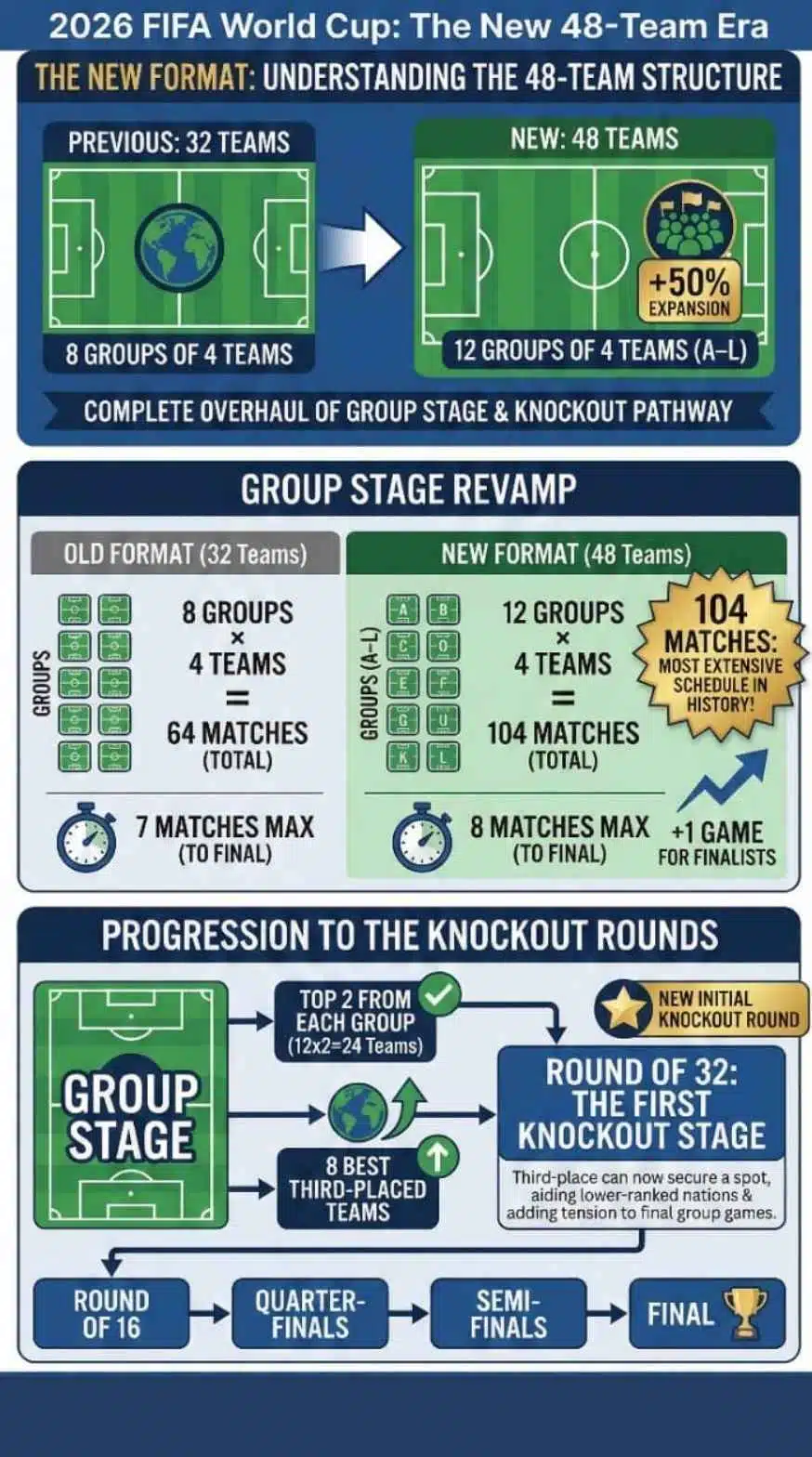
The most significant change for the 2026 tournament is the expansion to 48 teams. This move necessitates a complete overhaul of the group stage structure and the pathway to the final. This new format was chosen over an initial plan of 16 groups of three teams.
Group Stage Revamp
Instead of the traditional eight groups of four, the 2026 World Cup will feature 12 groups of four teams each, running from Group A to Group L.
The total number of matches in the tournament dramatically increases from 64 (in the 32-team format) to an incredible 104 matches—the most extensive schedule in World Cup history. Crucially, any team that reaches the final will now play eight games, an increase from the previous maximum of seven.
Progression to the Knockout Rounds
Under the 32-team structure, only the top two teams advanced from each group. With the 48-team format, a total of 32 teams will still move on to the knockout phase, leading to a new initial round.
Round of 32:This is the first knockout stage.
Advancing Teams:
- The top two teams from each of the 12 groups (24 teams total).
- The eight best third-placed teams across all 12 groups (8 teams total).
This means a third-place finish is often enough to keep a team in the competition, offering hope to lower-ranked nations and adding more tension to the final round of group matches.
| Format Feature | 2022 World Cup (32 Teams) | 2026 World Cup (48 Teams) |
| Number of Groups | 8 Groups of 4 (A-H) | 12 Groups of 4 (A-L) |
| Total Matches | 64 | 104 |
| Knockout Stage Start | Round of 16 | Round of 32 |
| Teams to Advance | 16 (Top 2 per group) | 32 (Top 2 + 8 Best 3rd-Place) |
| Matches for Finalists | 7 | 8 |
Special Seeding Rules for the 2026 FIFA World Cup Draw
For the first time, FIFA will use a special seeding system to ensure that the four highest-ranked teams—Spain, Argentina, France, and England—are placed in separate quadrants of the knockout bracket. This helps prevent early matchups between these teams, increasing the chances of blockbuster matches in the later stages.
Top Four Teams and Their Impact
The special seeding system means that Spain, Argentina, France, and England will be placed in different halves of the knockout bracket. However, this only applies if these teams win their groups. If they finish second in their group, they lose their special seeding status.
Potential Group Matchups for Top Teams
- Spain vs. Argentina: Cannot meet before the final.
- France vs. England: Will be kept apart until the semifinals.
Special Seeding for Top Four Teams
| Top Team | Seeding Rule | Group Restrictions |
| Spain | Must be placed in a separate quadrant from Argentina | Cannot face Argentina until the final |
| Argentina | Must be placed in a separate quadrant from Spain | Cannot face Spain until the final |
| France | Must be placed in a separate quadrant from England | Cannot face England until the semifinals |
| England | Must be placed in a separate quadrant from France | Cannot face France until the semifinals |
How Will the 2026 FIFA World Cup Draw Work?
The 2026 FIFA World Cup Draw involves drawing teams from four pots into 12 groups of 4 teams each. The process ensures that no group has more than one team from the same confederation, with exceptions for European teams. Here’s how it works:
Pot Structure and Seeding System
- Pot 1: The top 9-ranked teams and the 3 host nations (USA, Mexico, Canada) automatically go into Pot 1.
- Pot 2: Teams ranked just below the top 9 are placed here.
- Pot 3 and Pot 4: These pots are filled with the remaining teams, including those qualifying through play-offs.
Draw Process
- The draw will start with Pot 1, where the top-ranked teams and hosts are placed first.
- Teams will then be drawn from Pots 2, 3, and 4 into the 12 groups.
Host Nation Assignments
To optimize scheduling and logistics across the vast territory of North America, the three co-hosts are already pre-assigned to their respective group positions in Pot 1.
- Mexico is assigned to position A1 (Group A).
- Canada is assigned to position B1 (Group B).
- USA is assigned to position D1 (Group D).
Pot Allocation for the 2026 FIFA World Cup
With 42 teams having secured their place, the pots are largely confirmed, though six spots remain reserved for playoff winners.
| Pot 1 (Top Seeds & Hosts) | Pot 2 | Pot 3 | Pot 4 (Lowest Seeds & Playoff Teams) |
| Spain (Rank 1) | Croatia | Norway | Jordan |
| Argentina (Rank 2) | Morocco | Panama | Cabo Verde |
| France (Rank 3) | Colombia | Egypt | Ghana |
| England (Rank 4) | Uruguay | Algeria | Curaçao |
| Brazil | Switzerland | Scotland | Haiti |
| Portugal | Japan | Paraguay | New Zealand |
| Netherlands | Senegal | Tunisia | UEFA Play-Off Winner A |
| Belgium | Iran (IR Iran) | Côte d’Ivoire | UEFA Play-Off Winner B |
| Germany | South Korea | Uzbekistan | UEFA Play-Off Winner C |
| USA (Host) | Ecuador | Qatar | UEFA Play-Off Winner D |
| Mexico (Host) | Austria | Saudi Arabia | IC Play-Off Winner 1 |
| Canada (Host) | Australia | South Africa | IC Play-Off Winner 2 |
Draw Constraints: Ensuring Fairness and Competitive Balance
The process of drawing the balls is not simply random. FIFA employs specific Draw Constraints to ensure competitive integrity and prevent geographical clashes in the initial stage. This is a critical element of the 2026 FIFA World Cup Draw.

The Rule of Geographical Separation
The most important rule dictates that no group can contain more than one team from the same confederation. This prevents, for instance, Brazil from being drawn with Uruguay (both CONMEBOL) or Japan being drawn with South Korea (both AFC).
The UEFA Exception
Europe (UEFA) has a record 16 qualified teams, making it impossible to adhere to the single-confederation rule across all 12 groups. Therefore, UEFA is the sole exception: Each group must contain at least one, but no more than two, European teams. This is how strong groups featuring two European sides (e.g., Spain and Scotland) can occur.
The Top-Seed Bracket System
To protect the most prestigious match-ups for the later stages, FIFA introduced a system for the top four-ranked teams—a kind of “tennis-style” bracketing.
The four highest-ranked non-host teams (currently Spain, Argentina, France, and England) are drawn into opposite pathways on the tournament bracket. This rule ensures that, assuming all four teams win their respective groups, they cannot face each other until the semi-finals. This preserves the potential for a blockbuster final or semi-final between these global heavyweights.
| Constraint Type | Rule Summary |
| Confederation Limit | Only one team per confederation is allowed per group (e.g., only one CONMEBOL team). |
| UEFA Exception | A group can contain a maximum of two European teams (due to 16 UEFA qualifiers). |
| Host Assignment | Canada (B1), Mexico (A1), and the USA (D1) are automatically pre-assigned to their groups. |
| Top 4 Seeding | The four highest-ranked teams are separated into opposite sides of the knockout bracket to prevent them from meeting before the semi-finals. |
The ‘Group of Death’ Scenario and Potential Upsets
For fans and analysts, the main drama of the 2026 FIFA World Cup Draw lies in identifying the potential “Group of Death”—the theoretically toughest group. Due to the widespread presence of strong teams across Pots 2 and 3, several terrifying possibilities exist.
A Look at a Worst-Case Scenario
A hypothetical nightmare scenario for a Pot 1 team (other than the four top seeds) could look like this:
| Pot | Team Example | Strength Analysis |
| Pot 1 | Germany (High-ranked European Seed) | A traditional powerhouse aiming to rebound. |
| Pot 2 | Morocco (Top African Side) | A 2022 semi-finalist with world-class talent. |
| Pot 3 | Scotland (Strong European Side) | A well-organized, highly motivated UEFA team (satisfying the two-Europe team rule). |
| Pot 4 | Italy (If Qualified via Playoff) | A four-time World Cup winner, potentially misranked due to late qualification. |
This group creates a high-stakes, highly unpredictable mini-tournament, with Germany facing two very strong European rivals and a powerful African team.
The Playoff Problem
One of the most intriguing aspects of the draw is the presence of six Playoff Placeholders in Pot 4. These six spots—four from UEFA and two from the Inter-Confederation Play-offs—will not be decided until March 2026. This means groups will be drawn with placeholders like “UEFA Play-Off Winner A,” leading to two possible scenarios.
- A top team like Italy (if they qualify via the playoffs) being placed in Pot 4, despite a strong ranking, potentially creates a “Group of Death.”
- A low-ranked, debutant team filling the slot, leading to a much easier group.
This uncertainty adds a huge layer of tension to the draw ceremony.
Qualification Summary by Confederation
The expansion to 48 teams changed the number of slots allocated to each of FIFA’s six continental confederations, ensuring greater global participation than ever before.
| Confederation | Teams in 2022 | Teams in 2026 | Guaranteed Spots | Play-Off Spots |
| AFC (Asia) | 4 (plus 1 playoff) | 8 | 8 | 1 |
| CAF (Africa) | 5 | 9 | 9 | 1 |
| Concacaf | 3 (plus 1 host/playoff) | 6 | 3 (Hosts) + 3 | 2 |
| CONMEBOL (S. America) | 4 (plus 1 playoff) | 6 | 6 | 1 |
| OFC (Oceania) | 0 (plus 1 playoff) | 1 | 1 | 1 |
| UEFA (Europe) | 13 | 16 | 16 | 0 |
| Total | 32 | 48 | 46 | 2 (Inter-Confederation) |
Note: The total of 46 guaranteed spots includes the three Concacaf hosts (Canada, Mexico, USA). The final two spots come from the inter-confederation play-offs.
Planning and Next Steps After the Draw
Once the 2026 FIFA World Cup Draw is complete, the focus immediately shifts to logistics, planning, and ticketing. For fans, this is when the tournament truly becomes real. The next step is the release of the match schedule. While teams will know which group they are in and who their opponents are, they will not immediately know the exact venues or kick-off times.
Venue and Schedule Announcement
The crucial next step occurs one day after the draw. FIFA will release the Updated Match Schedule on Saturday, December 6, 2025.
Post-Draw Information
| Event | Details |
|---|---|
| Match Schedule Release | December 6, 2025 (17:00 GMT) |
| Venue Information | Released alongside the match schedule |
| Host Nations’ Matches | Mexico, Canada, and the USA’s match venues are pre-determined |
This schedule will:
- Confirm the specific stadium for every group-stage match.
- Detail the final kick-off times for all 104 matches, balancing travel needs for teams and viewing times for global audiences.
- Map the entire knockout bracket pathway, allowing teams and fans to visualize their potential route to the final in New York/New Jersey on July 19, 2026.
Ticketing and Hospitality
The draw directly impacts fan travel and ticket purchasing decisions. The Random Selection Draw entry period for the next phase of ticketing is set to open shortly after the draw, allowing fans to apply for tickets to specific group games once they know their team’s location.
The overall World Cup timeline spans from the Opening Match on June 11, 2026, in Mexico City to the final just over five weeks later.
The Final Countdown Begins
The 2026 FIFA World Cup Draw will be a monumental event that sets the stage for the largest World Cup in history. By determining the groups, seeding, and matchups, the draw will play a crucial role in shaping the tournament.
Fans can look forward to exciting matchups, fierce competition, and unforgettable moments. As we await the draw, one thing is clear: the 2026 FIFA World Cup Draw is a pivotal moment in football history, and it’s just the beginning of a thrilling global spectacle and the most expansive World Cup ever, introducing a new 48-team, 12-group format designed to bring more nations onto the global stage.