In today’s changing world of advanced computers new ways of designing systems are always being thought of to make them work better, use less energy and adapt easily. One idea thats getting attention is the ZQV9 Lunar Pulse Protocol 77X Silent Framework. Even though the name sounds like science fiction, the ideas behind it are a model designed around communication, execution and quiet background processing.
This guide explains what the ZQV9 Lunar Pulse Protocol 77X Silent Framework is, how it works, its parts, benefits and how it can be used. It also compares it to system frameworks.
By the end of this article you’ll understand this framework and its place in the future of computing.
What Is ZQV9 Lunar Pulse Protocol 77X Silent Framework?
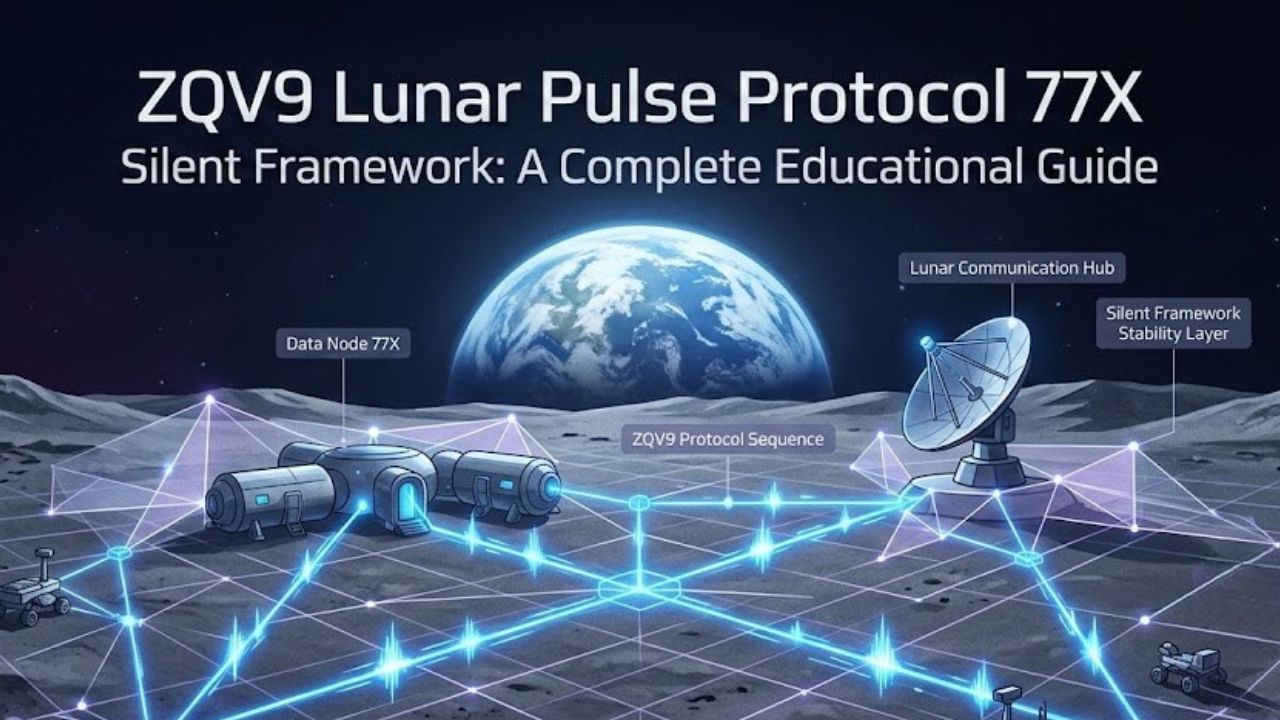
The ZQV9 Lunar Pulse Protocol 77X Silent Framework is an architecture built around four main parts:
- ZQV9 Communication Layer – A optimized protocol system
- Lunar Pulse Engine – A signal processing core that works in cycles
- 77X Adaptive Intelligence Module – A self-improving execution engine
- Silent Framework Layer – A processing environment that works quietly
These parts create a system that operates in pulses adapts and uses resources efficiently while working quietly in the background.
The main idea of this framework is pulse-based execution of continuous execution. It triggers actions in pulses based on real-time signals of running processes all the time.
Understanding the “Pulse” Concept
Traditional systems often rely on:
- checking
- Constant background checks
- Repetitive loop executions
These approaches use a lot of CPU power and system memory.
The Lunar Pulse Protocol introduces a strategy:
- It operates using timed micro-pulses that activate processes when needed.
What Is a Pulse in This Context?
A pulse is a precisely timed signal that:
- Triggers a task
- Executes an operation
- Transfers data
- Then returns to a state
This reduces resource consumption while maintaining responsiveness.
Breaking Down Each Component
Lets examine each part of the ZQV9 Lunar Pulse Protocol 77X Silent Framework in detail.
1. ZQV9 Micro-Protocol Layer
The ZQV9 protocol is the communication backbone of the framework.
Key Characteristics:
- Lightweight packet design
- Small transaction routing
- Low-latency signal transfer
- Secure encrypted data bursts
Unlike heavy API calls the ZQV9 layer sends data in compact pulse packets.
2. Lunar Pulse Engine
The Lunar Pulse Engine is inspired by cyclical systems like lunar cycles.
Core Functions:
- Time-based signal coordination
- Event-triggered activation
- Energy- synchronization
- Adaptive pulse frequency adjustment
Instead of constant processing the engine activates subsystems during designated micro-windows.
3. 77X Adaptive Intelligence Core
The 77X module adds a layer to the system.
What Does It Do?
- Learns usage patterns
- Optimizes pulse frequency
- Eliminates tasks
- Prioritizes signals
The number “77X” symbolizes extended optimization cycles.
4. Silent Framework Layer
The silent framework is the defining characteristic of the architecture.
What Makes It “Silent”?
- Minimal logging
- background execution
- Non-disruptive updates
- synchronization
How the Entire Framework Works Together
Lets look at the layered workflow of the ZQV9 Lunar Pulse Protocol 77X Silent Framework.
Step 1: Signal Detection
The system detects an event trigger.
Step 2: Pulse Activation
The Lunar Pulse Engine schedules a micro-pulse.
Step 3: ZQV9 Micro-Transmission
Data is transmitted using the ZQV9 protocol in encrypted bursts.
Step 4: 77X Intelligent Routing
The adaptive engine determines if execution is necessary.
Step 5: Silent Completion
The task executes and returns to a dormant state.
Major Advantages
Here are the advantages of the ZQV9 Lunar Pulse Protocol 77X Silent Framework:
- Energy Efficiency
- Scalability
- Reduced System Noise
- High Security
- Adaptive Performance
Potential Use Cases
The ZQV9 Lunar Pulse Protocol 77X Silent Framework can be applied in industries.
1. IoT Networks
Smart devices require low-energy communication.
2. Cloud Infrastructure
Microservice communication can use pulse routing.
3. Mobile Applications
Mobile apps benefit from updates.
4. AI and Machine Learning Systems
AI models often require updates.
5. Cybersecurity Systems
Pulse-based monitoring can detect anomalies quietly.
Comparison with Traditional Frameworks
| Traditional Framework | ZQV9 Lunar Pulse Protocol 77X Silent Framework |
| Continuous processing | Pulse-based execution |
| Heavy logging | Intelligent minimal logging |
| Static configurations | Adaptive optimization |
Architectural Philosophy
The philosophy behind this framework centers around three core principles:
- Minimalism
- Adaptability
- Silence
Challenges and Considerations
Implementing such a system would require:
- synchronization algorithms
- Careful pulse timing calibration
- Secure micro-encryption methods
The Future of Pulse-Based Frameworks
As computing moves toward edge computing, autonomous systems and smart cities, pulse-based architectures like the ZQV9 Lunar Pulse Protocol 77X Silent Framework represent a shift from processing to intelligent activation.
Frequently Asked Questions
Is the ZQV9 Lunar Pulse Protocol 77X Silent Framework an existing standard?
No, the ZQV9 Lunar Pulse Protocol 77X Silent Framework is not an officially recognized industry standard. It is a conceptual architectural model rather than a formally adopted protocol like those defined by organizations such as ISO or IEEE. It serves as a theoretical framework for rethinking system design, focusing on efficiency, adaptability, and intelligent background processing rather than compliance with existing certification bodies.
What makes it different from frameworks?
Unlike conventional frameworks that rely on static execution models or rigid request-response cycles, this approach emphasizes:
-
Pulse-based execution – operations triggered in rhythmic, optimized cycles rather than constant polling.
-
Micro-protocol communication – lightweight, modular communication structures that reduce overhead.
-
Adaptive intelligence – dynamic adjustment based on system state and performance signals.
-
Silent background operation – minimal visible resource disruption, enabling seamless user experiences.
Traditional frameworks often prioritize structure and predictability, while this model prioritizes adaptability, efficiency, and scalability.
Who would benefit most from it?
The ZQV9 Lunar Pulse Protocol 77X Silent Framework represents a conceptual approach to system architecture. By combining pulse-based execution, micro-protocol communication, adaptive intelligence and silent background operation it offers a thinking model, for efficient and scalable computing.