You spend hours crafting the perfect article. You research the keywords, optimize the headings, and finally hit publish. A few weeks later, you check your data. The page is ranking number one on Google. It is sitting right at the top. But when you look at your traffic analytics, the line is flat. No one is visiting the website. Welcome to the Zero Click SEO reality.
For decades, the deal between publishers and search engines was simple: you provide the content, and the search engine provides the visitors. It was a symbiotic relationship. But that deal has changed. Google is no longer just a signpost pointing users to your website; it has become the destination itself.
Today, nearly 60% of all searches end without a single click to an external website. Between AI Overviews, Featured Snippets, Knowledge Panels, and Local Packs, users are getting their answers directly on the results page. For digital marketers and business owners, this is terrifying. But it does not have to be a death sentence for your digital presence. It just means the game has changed.
This guide will walk you through exactly how to adapt. We are going to look at why this is happening, what strategies you need to implement right now, and how to measure success when “clicks” are no longer the only metric that matters.
The Reality of the Zero Click SEO Landscape in 2026
To fix the problem, we first have to understand the scale of it. The concept of zero-click search has been growing for years, but the introduction of generative AI into search results accelerated the trend significantly. The rise of AI Overviews means that complex answers are now synthesized right at the top of the page, often pushing the classic “ten blue links” far below the fold.
This isn’t just a minor update; it’s a fundamental shift in how people consume information. Users are no longer “searching” in the traditional sense; they are “prompting” an engine for an immediate solution. This behavior is particularly aggressive on mobile devices, where screen real estate is limited and scrolling is a friction point. If Google can answer the query in the viewport, the user stops there.
This behavior has forced SEOs to rethink their entire value proposition, moving away from “traffic generation” toward “brand impression management.”
Key Statistics You Can’t Ignore
Recent data paints a stark picture regarding user behavior. As of early 2026, approximately 60% of all Google searches are Zero Click SEO. When you break this down by device, the numbers are even more telling. On desktop, where users are often doing deep research or work, click-through rates remain decent because the user is typically in a “study” mindset.
But on mobile devices, where immediate answers are preferred, Zero Click SEO searches account for nearly 77% of queries. This massive disparity means that if your traffic is predominantly mobile, you are likely losing the majority of your potential visitors to the SERP itself. The user gets the definition, the weather, or the sports score, and closes the app.
The Role of AI Overviews and Featured Snippets
The biggest driver of this change is the evolution of the Search Engine Results Page (SERP) features. Years ago, we just had “10 blue links.” Then came Featured Snippets, those boxes at the top that answered simple questions. Now, we have AI Overviews (formerly SGE). These AI-generated summaries take information from multiple sources and synthesize it into a coherent answer.
While Google includes links to the sources within these overviews, user behavior studies show that most people read the summary and move on. They feel their query has been satisfied. The scary part for publishers is that the AI does a really good job. It’s often faster and more concise than clicking through to a ad-heavy blog post.
Why Google Wants to Keep Users on the SERP?
It is easy to get frustrated with Google, but their motivation is simple: user retention and ad revenue. Every second a user spends on Google’s platform is a second they can be served ads or kept within the Google ecosystem. By answering questions directly, Google provides a faster, smoother user experience. For them, it is a feature.
For website owners relying on ad revenue or traffic, it is a bug. Google wants to be the “Star Trek computer”—the ultimate answer engine. If they send you away to another site, they lose the ability to track your next move or serve you the next ad. This “walled garden” approach is the new standard, and fighting it is futile; adapting to it is the only way forward.
| Metric | 2022 Context | 2026 Context | Impact on Zero-Click SEO |
| Global Zero-Click Rate | Approximately 48% | Approximately 60% | Majority of searches now yield no traffic. |
| Mobile Zero-Click Rate | Approximately 55% | Approximately 77% | Mobile traffic is hardest to capture. |
| Primary SERP Feature | Featured Snippets | AI Overviews & SGE | AI summarizes content, reducing click necessity. |
| User Mindset | Search & Explore | Ask & Receive | Users expect immediate answers without digging. |
Decoding User Intent: When Do Users Click?
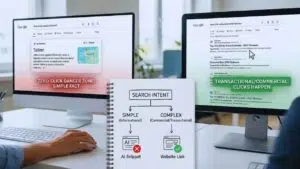
Not all searches are created equal. The impact of zero-click trends varies wildly depending on what the user is actually looking for. Understanding this distinction is the first step in your new Zero Click SEO strategy. You cannot simply look at keyword volume anymore; you have to look at “click potential.” Some keywords have high volume but zero click potential because the answer is a simple fact.
Others might have lower volume but very high click potential because the user needs to buy something or read a deep analysis. Categorizing your content roadmap by these intents is crucial to ensure you aren’t wasting resources optimizing for keywords that will never send you a single visitor.
Informational Intent: The “Zero-Click” Danger Zone
Searches with “informational intent” are the hardest hit. These are queries where the user wants to know something specific. Questions starting with “who,” “what,” “when,” “where,” and simple “how” queries often fall into this bucket. If you run a dictionary site, a currency converter, or a weather blog, you have likely already felt the pain. Google can answer “What is the capital of Estonia?” or “100 USD to EUR” without any help from a third party.
If your content strategy relies solely on defining terms or answering simple factual questions, you are in the danger zone. The AI can scrape your definition, present it to the user, and give you no credit other than a tiny citation link that nobody clicks.
Transactional and Commercial Intent: Where Clicks Still Happen
The good news is that “transactional” and “commercial” searches are largely immune to the Zero Click SEO effect. When a user searches for “buy running shoes size 10” or “best CRM software for small business,” an AI summary is rarely enough. Users need to see products, compare prices, look at photos, and actually complete a purchase. Google cannot sell you shoes directly (yet).
It still needs to send you to an e-commerce store. Therefore, businesses that sell physical products or complex software services will continue to see healthy click-through rates. The friction of buying something requires a trusted environment (your website), which protects these keywords from AI cannibalization.
Complex Queries vs. Simple Facts
There is a middle ground. Complex informational queries still drive clicks. If a user asks “how to treat a sprained ankle,” Google might give a summary. But if they ask “personal experiences with ankle surgery recovery,” an AI summary feels insufficient. Humans crave connection, nuance, and detailed storytelling. This is where your opportunity lies. People want to know what it was like, not just the textbook definition.
They want forums, reddit threads, and long-form blog posts from real experts. If you can target these “high-nuance” queries, you can still drive significant traffic because the AI simply cannot replicate the human experience of struggle and success.
| Search Intent | Example Query | Risk Level | Zero Click SEO Strategy |
| Simple Informational | “Height of Eiffel Tower” | Critical | Optimize for brand visibility in snippets; accept low traffic. |
| Complex Informational | “How to plan a Paris trip” | Moderate | Create deep, step-by-step guides with unique images/videos. |
| Commercial Investigation | “Best hotels in Paris” | Low | Provide comparison tables, real photos, and verified reviews. |
| Transactional | “Book Paris hotel” | None | Focus on CRO (Conversion Rate Optimization) and clear CTAs. |
Strategy 1: Master Answer Engine Optimization (AEO)
If you cannot beat them, join them. Since Google is answering questions directly, your goal should be to be the source of that answer. This is called Answer Engine Optimization (AEO). AEO is different from traditional SEO because you aren’t optimizing for a human to read your page; you are optimizing for a machine to understand your page so it can summarize it.
This means your formatting needs to be impeccable. You need to spoon-feed the AI the answers it is looking for. If the AI has to dig through five paragraphs of fluff to find the definition, it will skip you and go to your competitor who answered the question in the first sentence.
Structuring Content for AI and Humans
Robots prefer structure. To increase your chances of being cited in an AI Overview or a Featured Snippet, you need to format your content in a way that is easy for a machine to parse. Use clear, descriptive headings. Your H2s and H3s should often be the questions your users are asking. Immediately following the heading, provide a direct, concise answer.
We call this the “definition style.” For example, if your heading is “What is Zero Click SEO?”, the very next sentence should be a clear definition: “Zero Click SEO is the practice of optimizing your content to provide value and brand visibility directly on the search results page, rather than relying solely on website traffic.”
The “Inverted Pyramid” Writing Style
Journalists have used the inverted pyramid for over a century, and it is perfect for AEO. Start with the most important information (the answer) at the top. Follow it with supporting details, and then end with background information or context. This structure works because it satisfies the user (and the AI) immediately.
If the AI sees the answer clearly at the top, it is more likely to pull that snippet. If you bury the answer in paragraph four after a long-winded introduction about the history of search engines, the AI might miss it entirely. It signals to the algorithm that your content is direct, relevant, and high-quality.
Optimizing for Featured Snippets and “People Also Ask”
The “People Also Ask” (PAA) box is a goldmine for zero-click visibility. These are the related questions Google displays in the middle of the search results. To target these, look at the PAA box for your target keywords. Take those exact questions and add them to your article, perhaps in a dedicated FAQ section.
Answer them concisely (40 to 60 words is the sweet spot). Using lists and bullet points also increases your chances of being featured, as Google loves structured data. Even if the user doesn’t click, seeing your brand name answer 3 or 4 of their questions builds massive authority and trust.
| AEO Element | Best Practice | Why It Works for Zero Click SEO |
| Direct Answers | 40-60 word definition immediately after H2. | Matches the typical length of a Google Featured Snippet. |
| List Formatting | Use <ul> or <ol> tags for steps. | Google prefers lists for “How-to” and “Best of” queries. |
| FAQ Schema | Implement JSON-LD FAQ schema markup. | Directly feeds questions and answers into the search results. |
| Short Sentences | Keep sentences under 20 words where possible. | Easier for NLP (Natural Language Processing) models to parse. |
Strategy 2: “On-SERP” SEO and Brand Visibility
In a Zero Click SEO world, you have to treat the search results page as your billboard. Even if they do not click, they see you. This concept is often called “On-SERP SEO.” Think of the search results page as Times Square. You might not walk into every store in Times Square, but you see the giant neon signs.
In SEO, your “neon sign” is your favicon, your site name, your meta description, your images, and your star ratings. You need to maximize every pixel of space Google gives you to ensure that even if the interaction ends there, the user remembers your brand name.
Optimizing Your Knowledge Panel
If you are a brand or a public figure, you likely have a Knowledge Panel on the right side of the desktop search results. This is your digital business card. You must claim this panel and ensure the information is accurate. Add your social media profiles, your official website, and high-quality images.
The more robust your Knowledge Panel, the more legitimate you look to a user who is just glancing at the results. A verified, fully populated Knowledge Panel signals to the user that you are a major player in your industry, which can influence their decision to search for you directly later on.
Owning the Map Pack (Local SEO)
For local businesses, the “Map Pack” (the map with three business listings) is the ultimate Zero Click SEO feature. A user searches for “pizza near me,” sees your rating, your hours, and your phone number, and calls you directly. They never visit your website, but you still got the sale. To win here, your Google Business Profile must be impeccable. Focus on getting consistent, high-quality reviews. Ensure your categories are correct.
Upload photos of your interior, your team, and your products. Local SEO is essentially Zero Click SEO with a direct path to revenue because the “conversion” (a phone call or drive-by) happens off-site.
Brand Mentions as a Ranking Signal
Google is getting better at understanding entities. It knows that “Nike” is a brand associated with “shoes” and “sports.” You want Google to associate your brand with your specific niche. Focus on getting mentioned in other authoritative places on the web. This could be through PR, guest podcasting, or industry reports. When Google sees your brand name associated with specific topics across the web, it builds trust.
This trust signals to the AI that you are a credible source to cite in its overviews. The more your brand appears in the training data (via mentions on other sites), the more likely the AI is to recommend you.
| SERP Asset | Description | Optimization Tactic |
| Knowledge Panel | Information box for entities (brands/people). | Claim via Google, sync with Wikidata, keep info current. |
| Local Map Pack | Top 3 local business results with map. | Generate reviews, post weekly updates, add high-res photos. |
| Favicon & Site Name | Visual branding next to search result. | Use a high-contrast, recognizable logo file. |
| Thumbnail Images | Images appearing next to text results. | Use relevant, high-quality images with descriptive Alt Text. |
Strategy 3: Creating “Click-Worthy” Content
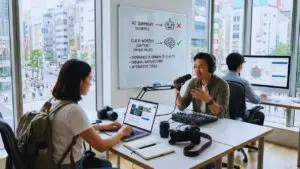
While optimizing for Zero Click SEO is smart, you also want to create content that is immune to it. You want to create content that an AI simply cannot replicate. AI is a “consensus engine”—it reads everything on the web and gives you the average.
To beat the average, you have to be unique. You have to provide something that didn’t exist in the training data. This means moving away from generic “Ultimate Guides” that just rehash what everyone else is saying, and moving toward opinionated, experience-led content that challenges the status quo.
Going Deeper Than the AI Summary
AI is great at summarizing the “what,” but it is often terrible at the “why” and the “how.” It can tell you what a camera’s specs are, but it cannot tell you what it feels like to hold it in your hand during a rainy photoshoot in Tokyo. To earn the click, your content must offer high “Information Gain.” This means providing unique value that cannot be found elsewhere.
Avoid generic fluff. If your article looks like a Wikipedia summary, the AI will replace you. If your article is full of rich detail, nuance, and specific examples, users will click to read more. You need to answer the question the AI can’t answer.
Prioritizing Experience and Opinion (E-E-A-T)
Google’s quality guidelines emphasize E-E-A-T: Experience, Expertise, Authoritativeness, and Trustworthiness. The first “E”—Experience—is your secret weapon against AI. AI has no life experience. It has never used a product, failed at a project, or felt emotion.
Lean into this. Use first-person language (“I found that…”). Share personal anecdotes. Explain why you hold a certain opinion. This human element is becoming the premium currency of the web. Readers can smell robotic content a mile away; they click when they feel a human connection on the other side of the link.
Data-Driven and Interactive Content
Another way to force a click is to provide utility that a text summary cannot. Tools, calculators, and interactive charts require a visit. Original research is also powerful. If you survey 500 people in your industry and publish a report, you own that data.
AI might summarize one stat, but anyone who wants the full picture has to come to you. Original data also attracts backlinks, which remains a critical ranking factor. If you become the source of the data, the AI has to cite you, and researchers will click through to verify the methodology and see the full charts.
| Content Type | Why AI Can’t Replicate It | Zero Click SEO Immunity |
| First-Hand Reviews | Requires physical interaction with a product. | High – Users trust humans over bots for reviews. |
| Opinion Pieces | Requires a distinct point of view/argument. | High – AI is programmed to be neutral/objective. |
| Original Data/Studies | Requires conducting surveys or experiments. | High – You own the proprietary data. |
| Interactive Tools | Requires software execution (calculators/quizzes). | High – Text summaries cannot replicate functionality. |
Measuring Success in a Zero Click SEO World
If traffic is dropping but business is stable, your metrics need to change. You can no longer judge the success of your SEO strategy solely by the number of sessions in Google Analytics. This is a terrifying shift for marketers who are used to reporting “traffic growth” every month.
But if you cling to that old metric, you will think you are failing when you might actually be winning. You need to start measuring “influence” and “visibility” rather than just “clicks.” The goal is revenue, and revenue can come from a user who saw your brand on Google, remembered it, and came back later.
Moving Beyond Click-Through Rate (CTR)
In the past, a low CTR meant your title tag was bad. Today, a low CTR might just mean you answered the user’s question perfectly in the snippet. This is a mindset shift. Stop panicking over a slight dip in organic traffic if your impressions are stable or growing.
If your impressions are high, it means you are winning visibility. You are occupying real estate in the user’s mind, even if they didn’t tap the link. You have to educate your clients or stakeholders that a “zero-click” interaction is still a brand touchpoint. It is an impression, just like seeing a billboard or a TV ad.
Start looking closer at Google Search Console “Impressions.” This tells you how often your brand appeared in search. You should also monitor “Share of Voice.” Are you showing up for the major keywords in your industry, even in the AI summaries? “Brand Lift” is another crucial metric.
Are more people searching for your brand name directly? If your Zero Click SEO strategy is working, people will start to recognize your name from the snippets and eventually search for you directly. This is the ultimate win: when users bypass Google entirely and type your URL because they trust you.
Tracking Direct Traffic and Brand Search Volume
Often, a user will see an answer in a snippet, remember the brand name, and then visit the site directly days later. This shows up as “Direct Traffic” in analytics, not “Organic Search.” If you see organic search dipping but direct traffic rising, do not assume your SEO is failing.
It might be succeeding in a way that traditional attribution models can’t track. You need to look at the holistic picture of your website’s health. Correlate your impression spikes in Search Console with your direct traffic spikes in Analytics. You will often find they move in tandem.
| Old Metric | New Metric | What It Tells You |
| Organic Sessions | Total SERP Impressions | How many people saw your brand, regardless of clicks. |
| CTR (Click Through Rate) | Brand Search Volume | Is your on-SERP presence creating brand demand? |
| Keyword Rankings | Share of Voice (SoV) | How much SERP real estate do you own (snippets, maps, images)? |
| Bounce Rate | Engagement Rate | When they do click, are they staying? (Critical for deep content). |
Final Thoughts
The era of easy traffic is over. The Zero Click SEO future is not coming; it is already here. But this shift represents an opportunity for those willing to adapt. The brands that will die are the ones that refuse to accept reality, clinging to strategies from 2015. The brands that will thrive are the ones that look at the search results page and see a canvas, not a barrier.
By shifting your focus from pure traffic to holistic visibility, you can build a brand that dominates the search results. Master the art of the concise answer for the AI, but reserve your deep, experience-based content for the humans who want more. Optimize your “On-SERP” assets like Knowledge Panels and Local Packs. And most importantly, change how you measure success.
The winner in this new landscape is not necessarily the one with the most clicks. It is the one with the most influence. Adjust your strategy today, and you will ensure that even when users don’t click, they still know exactly who you are.