Beijing turned the global spotlight onto itself on September 3, 2025, when China staged its largest-ever military parade in Tiananmen Square. The event commemorated the 80th anniversary of Japan’s defeat in World War II, which Beijing describes as the “Chinese People’s War of Resistance Against Japanese Aggression.” It was no ordinary parade. Instead, it became a spectacle of military power, historical symbolism, and geopolitical signaling.
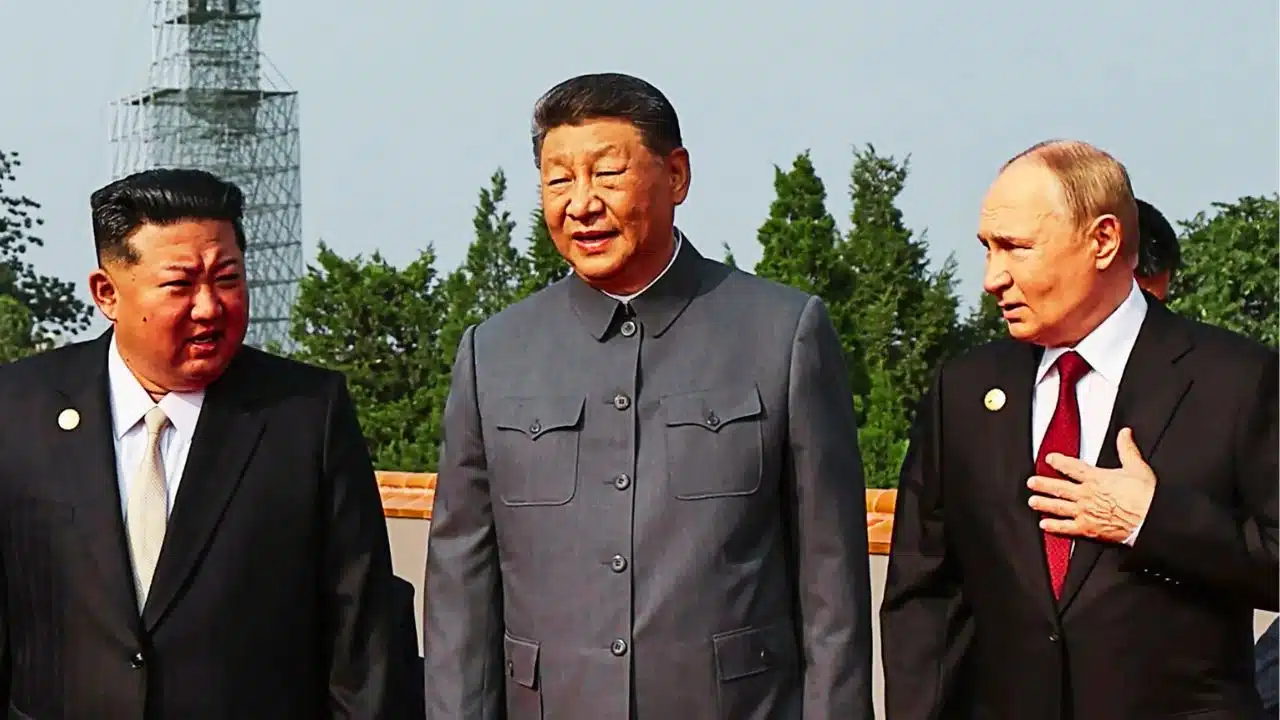
Over 50,000 spectators filled the grand square as President Xi Jinping presided over the meticulously choreographed showcase. Standing at the heart of Beijing’s political center, Xi was flanked by two controversial world figures—Russian President Vladimir Putin and North Korean leader Kim Jong-un. Their presence sent a powerful message: while many Western leaders declined to attend, China stood united with its partners who also challenge U.S. and Western dominance.
Xi Jinping’s Central Message: Peace, War, and the Path Forward
Xi used the stage not only to honor history but also to project a vision for the present and future. His speech underscored that humanity is once again at a crossroads, with nations facing a choice between cooperation or conflict. While his words invoked the memory of wartime struggles, they were also aimed at today’s shifting global order.
He portrayed China as a nation firmly aligned with peace, development, and dialogue, positioning his country as a moral and stabilizing power. His framing implied that countries seeking confrontation and zero-sum competition risk being on the wrong side of history. Observers noted that this rhetoric was aimed as much at the United States and its allies as it was at inspiring pride within China’s own people.
The Military Showcase: Technology, Symbolism, and Strength
The core of the event was the parade itself—a 70-minute spectacle designed to highlight China’s rapid military modernization.
-
Advanced Missiles: Among the weapons displayed were intercontinental ballistic missiles and hypersonic delivery systems, intended to demonstrate China’s capability to deter and respond to global threats. Some of these missiles were revealed publicly for the first time.
-
Naval and Submarine Technology: Giant underwater drones and submarine-launched missiles such as the JL-3 symbolized China’s growing reach in maritime power.
-
Aerial Strength: Fighter jets, bombers, and helicopters performed flyovers in tight formation, with some creating visual patterns in the sky, including the number “80” to mark the anniversary.
-
Cyber and Space Units: Reflecting the realities of modern conflict, the parade included newly formed cyberspace units tasked with cybersecurity and electronic warfare. These units marched alongside the more traditional People’s Liberation Army formations of the navy, air force, and ground troops.
The inclusion of high-tech weaponry, artificial intelligence-based systems, and digital warfare divisions illustrated that China is not only honoring past victories but also showcasing its ambition to dominate future battlefields.
International Guests and Their Strategic Importance
What made this parade especially striking was the diplomatic choreography. While Western leaders largely stayed away, two prominent figures stood with Xi:
-
Vladimir Putin: The Russian leader’s attendance underscored the tightening alignment between Moscow and Beijing. Putin’s visit coincided with announcements of expanded energy and trade deals, strengthening a partnership aimed at countering Western sanctions and influence.
-
Kim Jong-un: For the first time in over six decades, a North Korean leader attended a Chinese military parade. Kim’s presence signaled Beijing’s willingness to elevate its alliance with Pyongyang. Even more symbolic was the international debut of Kim’s daughter, Ju Ae, whom South Korean intelligence views as his likely successor.
Together, the trio’s presence suggested the emergence of an alternative bloc of powers—China, Russia, and North Korea—sharing common ground in resisting U.S. influence and Western isolation. Analysts observed that the event might mark the early stages of deeper defense and security cooperation among them, building upon existing treaties signed in 2024 between Russia and North Korea, and parallel arrangements between Beijing and Pyongyang.
Tight Security and Massive Preparations
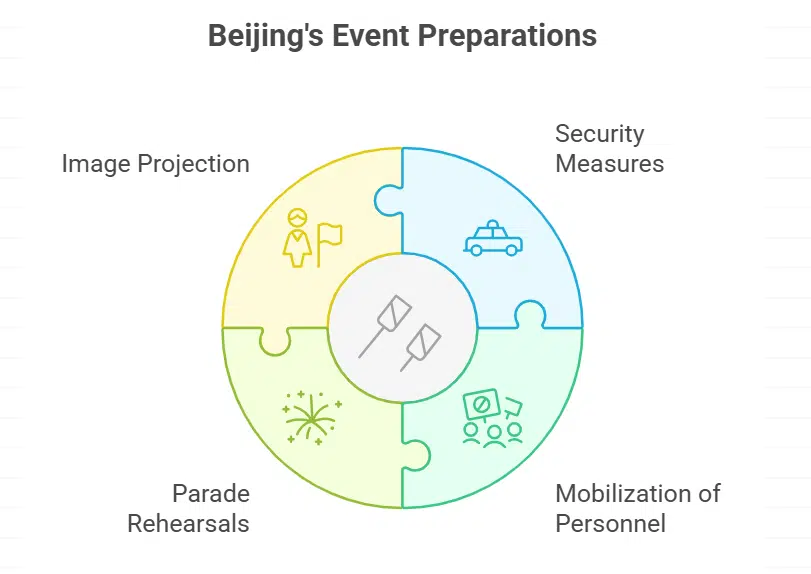
Beijing was effectively locked down for the event. Authorities shut down schools, closed major roads, and deployed extensive security forces across the city. In addition, tens of thousands of Communist Party members and volunteers were mobilized nationwide to monitor for potential unrest, with recruitment notices revealing the scale of the mobilization.
The parade itself was the culmination of weeks of rehearsals, many conducted at night to maintain secrecy and minimize disruption. The sheer scope of preparation reflected both the sensitivity of the moment and the importance Beijing attached to projecting an image of unity, order, and national strength.
Historical Narrative: From Past Struggles to National Rejuvenation
The event was not only about military technology. It also served as a reminder of China’s narrative of suffering and triumph. By revisiting the atrocities of Japan’s wartime occupation and framing China’s resistance as a cornerstone of its modern identity, Xi sought to connect past struggles with the nation’s present resurgence.
He linked the commemoration to the broader project of the “great rejuvenation of the Chinese nation”—a concept that underpins his leadership. In this narrative, World War II was not merely a global conflict but a key step in China’s long journey from humiliation to strength.
Critics in the West pointed out that this framing often minimizes the role of the U.S. and other Allied forces in defeating Japan, instead placing China at the center of the victory story. Supporters argue that it is an effort to restore rightful recognition to China’s sacrifices, as millions of Chinese lives were lost during the war.
Global Reaction and U.S. Response
The parade inevitably drew reactions abroad. Western governments, particularly the United States, viewed it as both a nationalist celebration and a pointed geopolitical signal.
-
Donald Trump, the U.S. President, took to social media during the parade. He reminded his followers of America’s role in helping China resist Japan during World War II. He also issued a sarcastic message aimed at Xi, Putin, and Kim, accusing them of conspiring against U.S. interests. At the same time, Trump downplayed the event in remarks to reporters, saying it did not directly challenge the United States and reaffirming his personal ties with Xi.
-
Analysts in Washington and Europe interpreted the parade as part of China’s growing ambition to reshape the Asia-Pacific security landscape. With U.S. trade relations strained by Trump’s tariffs and allies questioning Washington’s consistency, Beijing seized the moment to present itself as a more stable leader of an emerging bloc.
What the Parade Means for the Future
Beyond the pageantry, the 2025 military parade may be remembered as a turning point in geopolitics. It reinforced three core messages:
-
China is now a military power with global reach. The unveiling of advanced weapons and new combat units highlighted its technological progress.
-
Beijing is redefining alliances. The presence of Putin and Kim showed a readiness to deepen ties with countries that share its rivalry with the West.
-
Xi is consolidating internal unity. By showcasing the People’s Liberation Army’s loyalty and invoking historical sacrifice, he strengthened the Communist Party’s narrative of authority and legitimacy.
The Tiananmen Square parade of September 2025 was more than a commemoration of past victories. It was a strategic message to the world that China intends to be at the center of a new global order. With its military on full display, its alliances with Russia and North Korea highlighted, and its domestic audience rallied, Beijing used the occasion to signal that the balance of power in the Asia-Pacific—and perhaps globally—is shifting.
The world is left to interpret Xi’s framing of the moment: whether it is truly a call for peace and cooperation, or a warning that new divisions and conflicts may lie ahead.