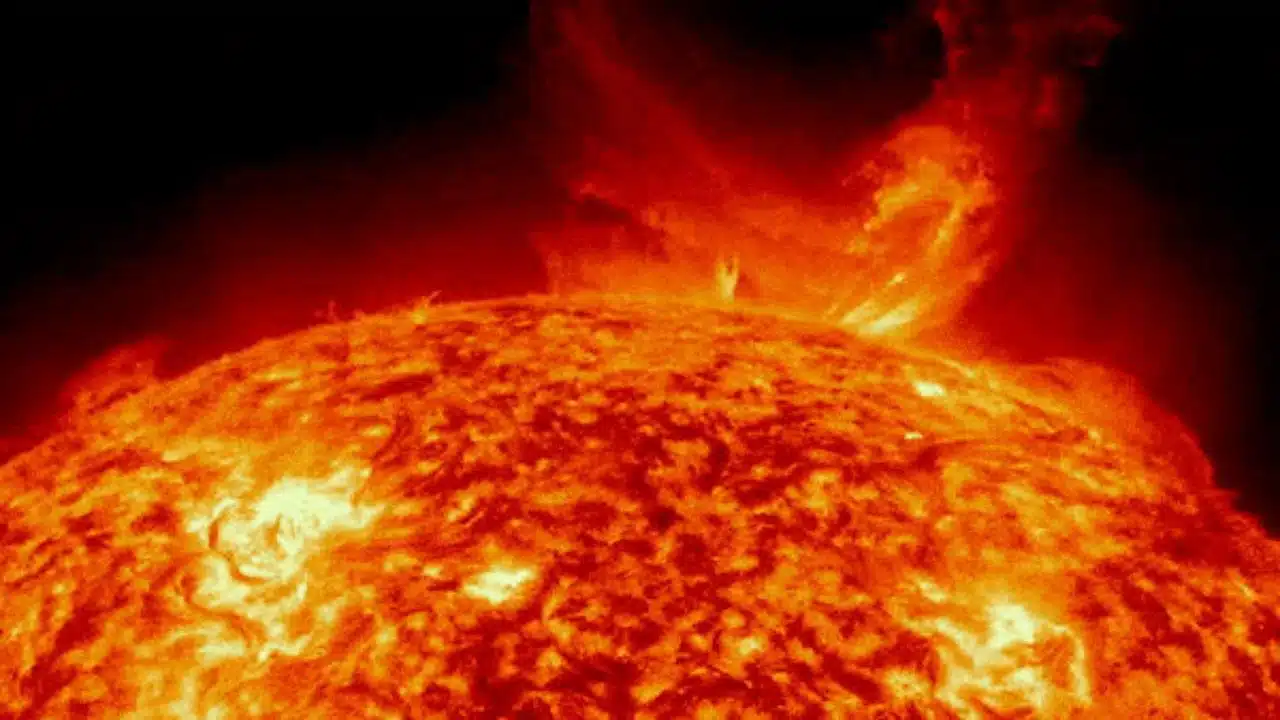
In a dramatic display of solar fury, the Sun erupted with an X5.1-class solar flare on November 11, 2025, marking the most powerful solar event of the year and the strongest since October 2024.
Peaking at 5:04 a.m. EST (10:04 UTC), this massive burst originated from the highly active sunspot region AR4274, which has been a hotspot for intense solar activity over the past week. The flare’s immense energy release triggered immediate disruptions to radio communications across parts of Europe and Africa, highlighting the Sun’s unpredictable influence on Earth’s technological infrastructure.
The Flare’s Explosive Origin and Scale
Solar flares are classified by their intensity, with X-class denoting the most severe category, and the number indicating strength—each increment represents a tenfold increase in energy output. At X5.1, this event ranks near the upper end of the scale, surpassing all other flares in 2025 and underscoring the peak activity of Solar Cycle 25, our current 11-year solar period. The eruption stemmed from AR4274, a sprawling sunspot cluster that has dominated recent solar observations; this region alone has produced multiple X-class flares, including an X1.7 on November 9 and an X1.2 on November 10.
Scientists monitoring the event via NASA’s Solar Dynamics Observatory noted the flare’s rapid onset, with extreme ultraviolet and X-ray radiation surging toward Earth at the speed of light. This radiation ionized the upper atmosphere, creating sudden ionospheric disturbances that degrade high-frequency radio signals—a phenomenon known as radio blackouts. The impact was classified as R3 (strong) level by NOAA’s Space Weather Prediction Center, affecting aviation, maritime, and amateur radio operations on the sunlit side of the planet.
Immediate Effects: Radio Blackouts and Global Disruptions
The X5.1 flare’s radiation wave hit Earth’s atmosphere within minutes, causing widespread radio blackouts primarily over southern Africa and much of Europe. High-frequency communications, essential for transcontinental flights and emergency services, experienced severe degradation lasting up to an hour in some areas. While no major power grid failures were reported, the event serves as a stark reminder of solar flares’ potential to disrupt modern satellite networks, GPS systems, and even low-Earth orbit satellites through increased atmospheric drag.
This outburst is part of a broader surge in solar activity; AR4274’s position directly facing Earth amplified the flare’s reach, making it one of the most prolific flare producers in Solar Cycle 25. Historical precedents, like the massive flares of 2023 and 2024, have shown that such events can extend beyond radio issues to affect global navigation and financial transactions reliant on precise timing signals. As space weather experts analyze coronagraph imagery, they confirm the flare’s association with a fast-moving coronal mass ejection (CME), estimated at over 1,300 km/s, which could further complicate matters.
Looming Threats: Coronal Mass Ejections and Geomagnetic Storms
Accompanying the X5.1 flare was a potent CME, described by forecasters as the “most energetic and fastest” from AR4274 to date. This plasma cloud, laced with charged particles and magnetic fields, is barreling toward Earth and expected to arrive as early as late November 11 or early November 12. Compounding the risk, two prior CMEs from the November 9 and 10 flares may merge with this one, forming a “cannibal CME”—a scenario where a faster ejection overtakes slower ones, intensifying the overall impact.
NOAA has issued a G4 (severe) geomagnetic storm watch for November 12, potentially escalating to G5 (extreme) if the cannibal effect materializes. Such storms could induce currents in power lines, risking blackouts in vulnerable grids, while satellite operators brace for heightened radiation exposure that might shorten spacecraft lifespans. On a brighter note, the disturbances promise vivid auroras visible far beyond polar regions—possibly as far south as the U.S. Midwest or northern Europe—turning the night sky into a spectacle for skywatchers.
Broader Context in Solar Cycle 25
Solar Cycle 25, which began in 2019, is nearing its maximum phase, characterized by heightened sunspot numbers and flare frequency, as seen in this week’s barrage from AR4274. Earlier in 2025, notable flares included an X2.7 in May and an X1.85 in January, but none matched the X5.1’s intensity until now. This cycle has already produced extraordinary events, like the April 2025 cannibal CME that sparked G4 storms and auroras over France.
As humanity’s reliance on space-based assets grows—from Starlink constellations to deep-space missions—these solar tantrums emphasize the need for robust space weather forecasting. International agencies like NOAA and ESA continue to refine models to predict and mitigate impacts, ensuring that innovations in AI-driven monitoring keep pace with the Sun’s volatile behavior. While this flare poses manageable risks, it underscores the delicate balance between our star’s power and Earth’s technological vulnerabilities.