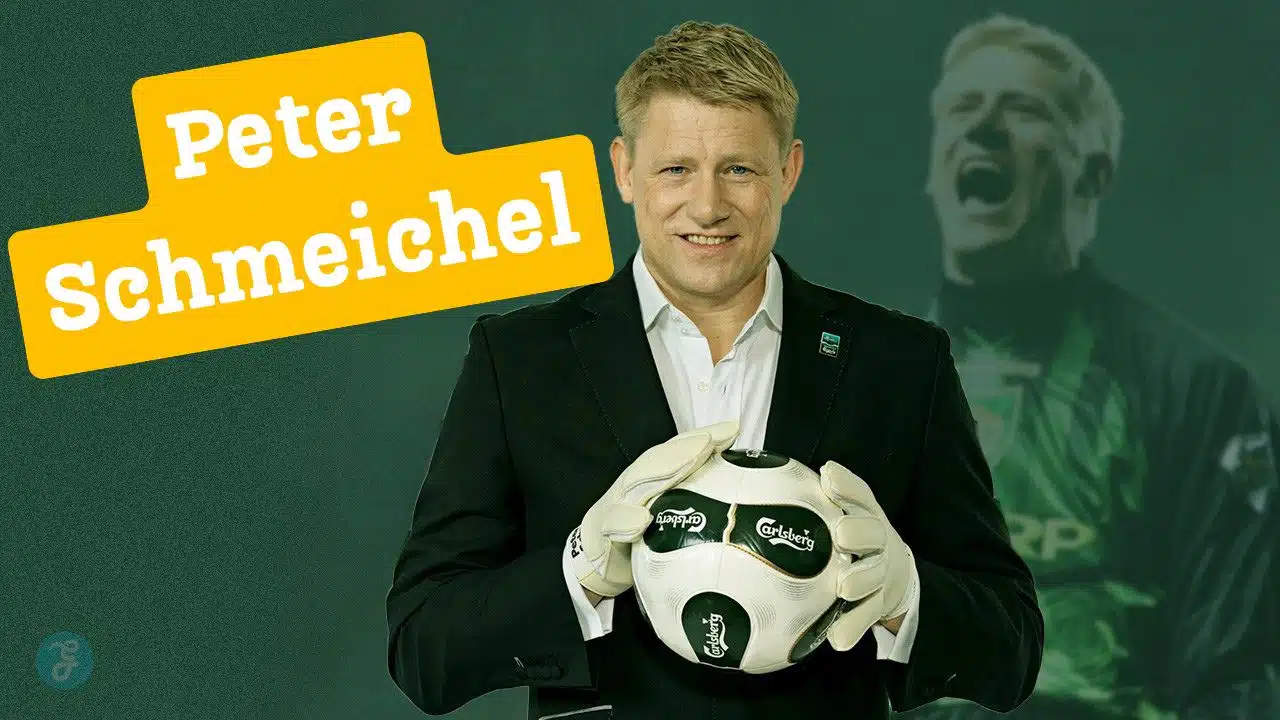
Have you ever watched a game and wondered what separates a good goalkeeper from a truly legendary one? Peter Schmeichel didn’t just stop shots. He commanded the entire defense like a general on the battlefield, and his presence alone made strikers think twice.
Peter Schmeichel won five Premier League titles with Manchester United and captained them to the famous 1999 treble, becoming the only thing standing between opponents and the goal.
This blog will show you how Schmeichel’s unique skills, fierce leadership, and clutch performances in massive games made him one of the greatest goalkeepers ever to wear the gloves.
Let’s get into it!
Key Takeaways
- Peter Schmeichel won 15 trophies at Manchester United in eight seasons, including five Premier League titles, three FA Cups, and the 1999 Champions League as captain.
- He was voted IFFHS World’s Best Goalkeeper in both 1992 and 1993, and in 2001, a Reuters poll of 200,000 people named him the best goalkeeper ever.
- Schmeichel helped Denmark win UEFA Euro 1992, saving a crucial penalty from Marco van Basten in the semi-final shootout and making decisive stops throughout the tournament.
- His 128 clean sheets in 310 Premier League appearances gave him a 42% clean sheet ratio, still among the highest in league history.
- Known as the “Great Dane,” his vocal leadership style kept defenders sharp through constant communication and fierce criticism when mistakes happened.
- Manchester United signed him for just £505,000 in 1991, a transfer Sir Alex Ferguson later called the “bargain of the century.
How Did Peter Schmeichel Demonstrate Leadership on the Field?
Peter Schmeichel’s leadership went way beyond just making saves. He organized the entire defensive line with constant shouts and commands. His 6-foot-4-inch frame and booming voice made sure every defender knew exactly where to be.
During tight matches at Old Trafford, you could hear him clapping his gloves and directing traffic. He never hid when the pressure was on.
In the 1992-93 season, his leadership helped United secure their first Premier League title in 26 years with 22 clean sheets. According to former Manchester United goalkeeper Tom Heaton, Schmeichel’s style was revolutionary at the time. Heaton said the “shouting at the back four” and his “aura and presence” brought respect and trust from everyone on the pitch.
Schmeichel also had famous arguments with center-backs Steve Bruce and Gary Pallister. These weren’t petty fights; they kept the defensive unit on their toes. As a fierce competitor, he loudly criticized any perceived mistakes by his defenders, which drove them to perform better.
For Denmark’s national team, his voice carried the same weight. He captained the side in 30 international matches and rallied his teammates after every setback. His vocal presence was especially crucial during Denmark’s shock 1992 European Championship win, where he kept spirits high despite entering the tournament as last-minute replacements.
Even after leaving Manchester United for clubs like Sporting CP and Aston Villa, his leadership style remained the same. Wherever he played, teammates knew they had a guardian and a leader between the posts.
Key Goalkeeping Techniques of Peter Schmeichel
Peter Schmeichel had a unique style that set him apart from every other goalkeeper. His massive frame combined with lightning reflexes made him a nightmare for strikers.
Let me walk you through what made his techniques so special.
What Made Schmeichel’s Shot-Stopping Skills Exceptional?
Schmeichel’s reflexes were on another level. His 6-foot-4-inch frame gave him incredible reach, and he used every inch to full effect. Opposing forwards often found themselves shaking their heads after he made saves that seemed impossible.
He was voted IFFHS World’s Best Goalkeeper in both 1992 and 1993. That recognition came from his ability to stop shots that other keepers couldn’t even get near.
One technique that made him famous was the “star jump” save. He pioneered this move, which he learned from his handball-playing background in Denmark. By spreading his arms and legs wide, he could cover more of the goal and block shots from close range.
His agility was stunning for someone his size. He weighed close to 220 pounds during his playing days and wore specially made XXXL shirts, yet he could spring sideways or dive full-length in an instant. Former teammate Ryan Giggs once told Tom Heaton that during shooting drills, “there were days where you’d be laughing at him because you just couldn’t get the ball past him.”
In big matches like the 1999 Champions League final, he made crucial saves against Bayern Munich when it mattered most. According to Schmeichel himself, his fingertip save to tip over Jürgen Klinsmann’s header in the Euro 1992 final was “the greatest save” of his career.
He achieved 128 clean sheets in 310 Premier League appearances, giving him a clean sheet ratio of 42%. That’s still one of the highest in Premier League history.
How Did Schmeichel Excel at Saving Penalties?
Schmeichel had a presence on the penalty line that got inside strikers’ heads. His wide stance and intimidating frame made the goal look smaller than it was. Penalty takers often lost their nerve before they even kicked the ball.
His mental game was just as important as his physical skills. In a 2023 interview, Schmeichel revealed his mindset: “I would think I was invincible, the best in the world. The person kicking the ball was just wasting his time.” That confidence showed, and strikers could feel it.
One of his most famous penalty saves came during the 1999 FA Cup semi-final replay against Arsenal. He stopped Dennis Bergkamp’s spot-kick in injury time, sending the match to extra time. It’s worth noting that before this save, Schmeichel had gone five years without saving a penalty for United, making this stop even more critical.
During Denmark’s Euro 1992 triumph, he saved Marco van Basten’s penalty in the semi-final shootout against the Netherlands. That stop was the only miss in the entire shootout and sent Denmark through to the final with a 5-4 victory.
His read of the game helped too. He studied penalty takers and could anticipate which direction they’d shoot. While his overall penalty-saving record was described as “distinctly average” by some analysts, he had a knack for making the big saves when his team needed them most.
Major Career Milestones of Peter Schmeichel
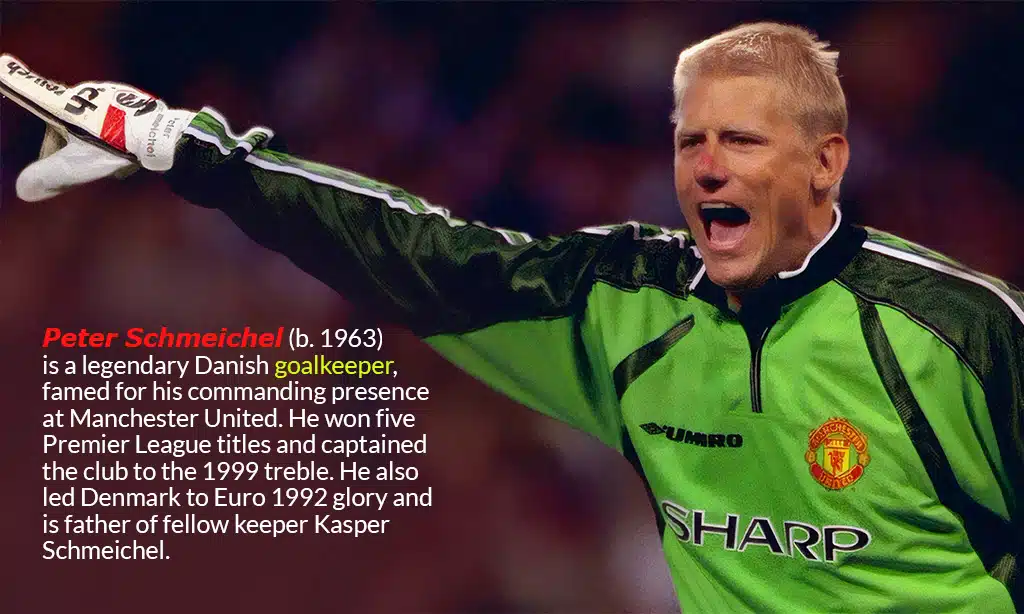
Peter Schmeichel’s career is filled with moments that changed football history. From his early days at Brøndby to his legendary status at Manchester United, he proved himself time and again on the biggest stages.
What Was Schmeichel’s Role in Manchester United’s Treble Win?
The 1998-99 season was Schmeichel’s final year at Manchester United, and what a way to go out. He was the first-choice goalkeeper for all 60 matches that season, a grueling schedule that would test anyone.
In the absence of suspended captain Roy Keane, Schmeichel wore the armband for the 1999 Champions League final against Bayern Munich. United were losing 1-0 as the clock ticked down, and Bayern fans were already celebrating.
Then came the most dramatic finish in Champions League history. With three minutes of stoppage time, Schmeichel ran forward for a corner kick to cause confusion in Bayern’s box. Teddy Sheringham scored the equalizer. Just two minutes later, Ole Gunnar Solskjær poked home the winner.
According to Schmeichel in a FourFourTwo interview, “At no point did we think we’d lost. We’d scored in injury time quite a few times that season.” That belief kept United pushing until the very end.
His saves throughout the final were crucial too. Mario Basler’s early free kick beat him in the sixth minute, but after that, he made important stops to keep United in the game. When Bayern hit the post twice late in the match, many thought it just wasn’t their night.
By winning the treble (Premier League, FA Cup, and Champions League), United became the first English club to achieve this feat. Schmeichel’s performance throughout the season earned him a perfect ending to his eight years at Old Trafford.
What Are Schmeichel’s Notable Achievements with Denmark?
Schmeichel’s international career with Denmark is the stuff of legend. He earned 129 caps between 1987 and 2001, which made him Denmark’s most-capped player until Simon Kjær overtook him in 2023.
His crowning achievement came at UEFA Euro 1992. Denmark hadn’t even qualified for the tournament initially. They got a last-minute call-up just two weeks before it started because Yugoslavia was banned due to the Balkan crisis.
Denmark opened with a 0-0 draw against England, where Schmeichel made several key saves. Then in a crucial group match against France, he produced decisive stops against Eric Cantona and Jean-Pierre Papin, helping Denmark win 2-1 to reach the semi-finals.
The semi-final against defending champions Netherlands went to a penalty shootout after a 2-2 draw. Schmeichel dove low to his left to save Marco van Basten’s penalty, the only miss in the shootout. Denmark won 5-4.
In the final against Germany on June 26, 1992, Schmeichel was at his absolute best. He saved three shots in the opening 15 minutes alone. His full-length dive to tip over Jürgen Klinsmann’s header is still remembered as one of the tournament’s greatest saves. Denmark won 2-0.
Beyond Euro 1992, Schmeichel also helped Denmark win the 1995 FIFA Confederations Cup. He played at the 1998 World Cup and appeared in four European Championships total during his international career.
His leadership for Denmark was recognized through his 30 matches as captain. He even scored one international goal from a penalty kick in a June 2000 friendly against Belgium.
Why Peter Schmeichel’s Physical Attributes Mattered
Schmeichel’s size was a huge part of what made him so effective. Standing at 1.93 meters (6 feet 4 inches) tall and weighing close to 100 kg (220 pounds), he physically dominated his penalty area. Those measurements meant he could cover more of the goal and intimidate attackers.
Because of his build, he wore specially made size XXXL football shirts. His imposing frame made strikers second-guess their shot placement. Many forwards admitted to feeling nervous when facing the “Great Dane.”
His handball background in Denmark helped him develop the agility and quick reflexes that became his trademark. The star-jump save technique he pioneered came directly from skills he learned playing handball as a youth.
How Schmeichel’s Transfer to Manchester United Changed Everything
Manchester United signed Schmeichel on August 6, 1991, for just £505,000 from Brøndby. At the time, he was virtually unknown outside Denmark, and most United squad members had never heard of him.
Sir Alex Ferguson later described this transfer as the “bargain of the century” in a 2000 interview. And he wasn’t exaggerating. Over eight seasons, Schmeichel won 15 trophies with United.
In his first season, United finished second in the league but won the Football League Cup for the first time in club history. His performances earned him the title of “World’s Best Goalkeeper of 1992” by IFFHS.
The following season (1992-93) was when everything clicked. His 22 clean sheets helped United win the Premier League for the first time in 26 years. He was again named World’s Best Goalkeeper in 1993.
According to a 2001 Reuters poll of 200,000 participants, Schmeichel was voted the best goalkeeper ever, ahead of legends like Lev Yashin and Gordon Banks. That recognition shows just how much impact he made during his career.
What Made Schmeichel’s Distribution So Effective?
Schmeichel wasn’t just a shot-stopper. His distribution skills were revolutionary for his era. He could launch counterattacks with pinpoint accuracy using his rocket-like throws and powerful kicks.
Ferguson used this ability as a key part of United’s tactics in the 1990s. Tom Heaton noted that Schmeichel’s distribution “was something utilized to good effect” and influenced the team both offensively and defensively.
His long throws were so powerful that they could reach midfield in one toss. This gave United quick transition opportunities and caught opponents off guard. He showcased this catapult throw as early as August 17, 1991, in a 2-0 victory against Notts County.
Schmeichel’s ability to read the game meant he knew when to launch a quick counter and when to slow things down. This game intelligence, combined with technical skill, made him a complete goalkeeper.
The Unique Records Peter Schmeichel Set
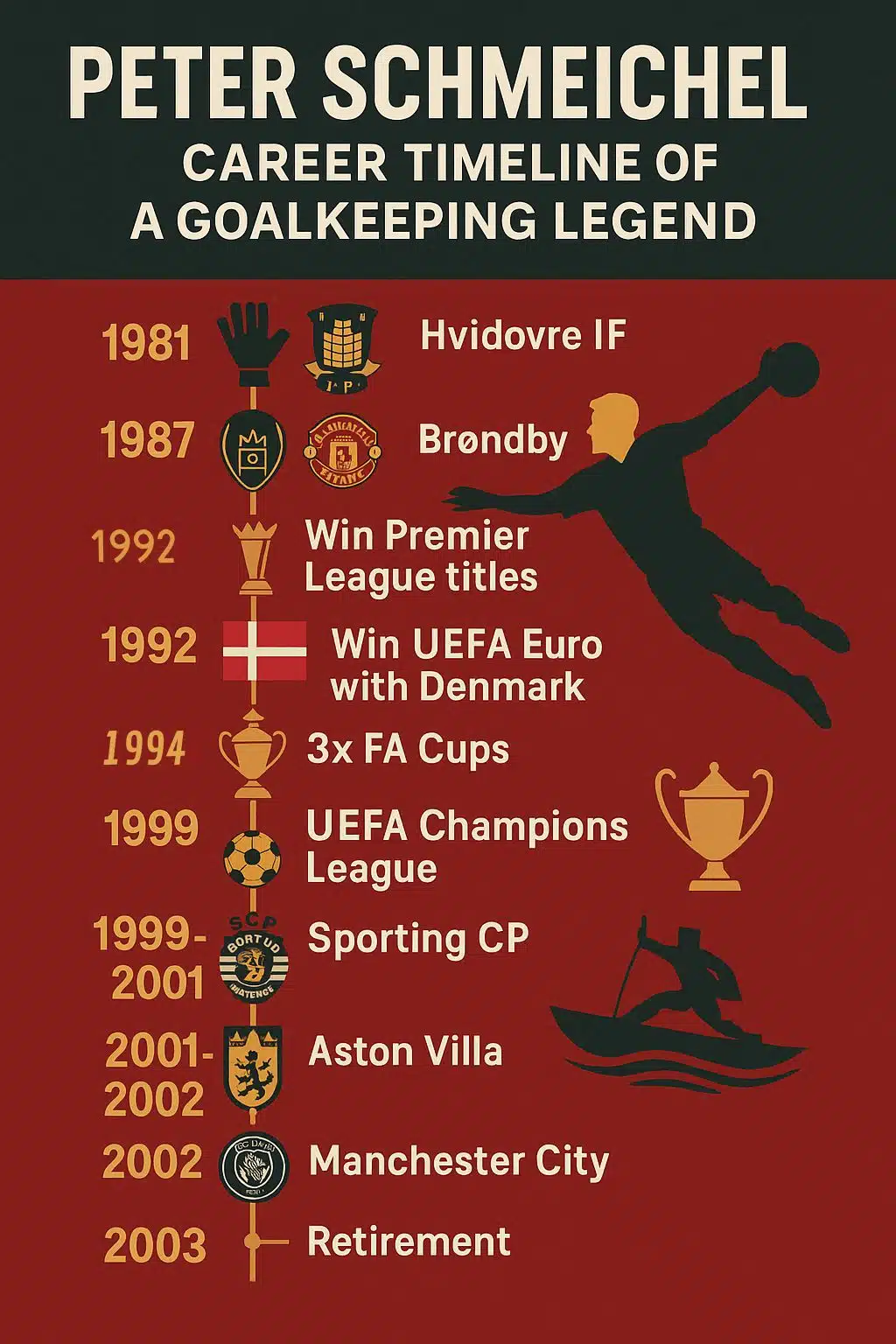
On October 20, 2001, while playing for Aston Villa, Schmeichel became the first goalkeeper to score a Premier League goal. He scored in a 3-2 defeat away to Everton. This feat has only been repeated five times since by goalkeepers like Brad Friedel, Paul Robinson, Tim Howard, Asmir Begović, and Alisson Becker.
Unusually for a goalkeeper, Schmeichel scored 11 goals during his career. These included headers, volleys, penalties, and memorably, an overhead kick. One of his most famous goals came in a UEFA Cup match against Rotor Volgograd at Old Trafford in September 1995, when he scored in the dying minutes to make it 2-2.
His clean sheet record speaks for itself. In Premier League appearances alone, he kept 128 clean sheets in 310 matches. That 42% clean sheet ratio remains one of the highest in league history and shows his consistency over nearly a decade.
Schmeichel’s Life After Retirement
After hanging up his gloves in 2003, Schmeichel didn’t disappear from football. He worked as a pundit for the BBC and became a regular analyst on Match of the Day until 2005.
He then hosted live UEFA Champions League coverage on Danish television channel TV3+. Since 2021, he’s worked for CBS Sports on their Champions League broadcasts, sharing his expertise with American audiences.
In December 1999, Schmeichel became the owner of his childhood club, Hvidovre IF, though he withdrew from the club in June 2002. He’s remained connected to the sport through media work and appearances at football events.
His son, Kasper Schmeichel, followed in his footsteps and became a professional goalkeeper. Kasper won the Premier League with Leicester City in 2016, making the Schmeichels the only father-son duo besides the Wrights to both win England’s top division.
Recognition and Hall of Fame Status
In 2003, Schmeichel was inducted into the English Football Hall of Fame for his impact on the English game. This honor recognized not just his trophies, but how he changed the goalkeeper position forever.
In March 2004, FIFA named him as one of the “125 Greatest Living Footballers” at their FIFA 100 celebrations. He was also ranked among the top 10 goalkeepers of the 20th century by the International Federation of Football History & Statistics.
In 2001, he was awarded an honorary MBE for his services to football. These accolades show that his greatness was recognized not just by fans but by football’s governing bodies and fellow professionals.
Takeaways
Schmeichel set the gold standard for goalkeepers everywhere. His combination of physical dominance, mental toughness, and technical brilliance made him nearly unbeatable. The treble-winning season with Manchester United and Denmark’s Euro 1992 triumph proved his greatness on the world’s biggest stages.
His vocal leadership and ability to read the game changed how people viewed the goalkeeper position. Few players can match his trophy haul or his impact on football history.
Peter Schmeichel is widely regarded as one of the best ever to wear the gloves, and his legacy continues through the next generation of shot-stoppers he inspired.
FAQs on Peter Schmeichel
1. Where was Peter Schmeichel born and how did his career start?
Schmeichel was born in Gladsaxe, Denmark, and began his career at local clubs before Manchester United signed him from Brøndby in 1991 for just £505,000. Manager Sir Alex Ferguson later called the deal the “bargain of the century.”
2. What made Peter Schmeichel’s time at Manchester United so special?
His time at Manchester United was defined by incredible success, including five Premier League titles and three FA Cups. He famously captained the team in the 1999 Champions League final against Bayern Munich to secure their historic treble-winning season.
3. Did Peter Schmeichel play for other clubs after leaving Manchester United?
Yes, after United, he won a league title with Sporting Lisbon in Portugal before returning to England. He famously became the first goalkeeper to score a Premier League goal while playing for Aston Villa against Everton on October 20, 2001.
4. What international success did Schmeichel achieve with Denmark?
He was the hero of Denmark’s incredible 1992 European Championship victory, making a crucial penalty save against Marco van Basten in the semi-final.
5. How is Peter Schmeichel recognized by football organizations?
He has received numerous honors, including being named the IFFHS World’s Best Goalkeeper in both 1992 and 1993. In 2004, he was also included by Pelé in the FIFA 100 list of the world’s greatest living players.
6. What has Schmeichel done since retirement and why does his legacy matter?
Since retiring, Schmeichel has worked as a respected football pundit for major broadcasters like the BBC. His legacy continues through his son, Kasper, who also became a Premier League-winning goalkeeper with Leicester City in 2016.