Fantasy and sci-fi should be streaming’s perfect genres. They build passionate fandoms, spark social chatter, and create worlds that can fuel spin-offs for years. Yet the cancellation headlines keep coming, and fans keep asking the same question: why Netflix cancels fantasy & sci-fi even when a show looks popular.
The short answer is money and math. These genres often cost a lot upfront, demand more time to produce, and rely on completion behavior that is harder to guarantee. When a series does not convert curiosity into loyal, finish-the-season viewing fast enough, the budget becomes the villain.
This article breaks down the “budget curse” in plain terms, and shows why high-concept storytelling can be a renewal trap on a subscription platform.
Why Netflix Cancels Fantasy & Sci-Fi: The Budget Curse Basics
When people debate cancellations, they usually focus on taste and trends. Netflix focuses on a business question: will another season produce enough subscriber value to justify the next invoice. That is the core of why Netflix cancels fantasy & sci-fi, even when the creative is strong.
Fantasy and sci-fi can succeed on Netflix, but they must clear a higher bar than many other genres. They typically arrive with larger budgets, higher expectations, and a narrower margin for “slow growth.” If early viewing signals come in mixed, Netflix often chooses to reinvest in cheaper shows that can deliver similar engagement.
The Real Business Goal: Subscriber Value Per Dollar
Netflix does not sell tickets. It sells ongoing subscriptions, and it tries to keep you paying every month. A show is valuable when it does at least one of these things well:
- Pulls in new subscribers
- Prevents cancellations by giving current subscribers something they must watch
- Creates repeat viewing habits that keep people in the Netflix ecosystem
- Builds a brand franchise that can stretch across seasons, spin-offs, and merch-style extensions
Fantasy and sci-fi can do all of that. The problem is they can also miss one step and still cost too much to carry.
The Invisible Standard: It Must Win Quickly
Netflix can let a cheaper drama grow slowly. A big fantasy epic rarely gets the same patience. When the cost is high, Netflix wants proof fast, because every month without a strong signal is an expensive gamble.
Fantasy And Sci-Fi Are Expensive Before Viewers Even Press Play
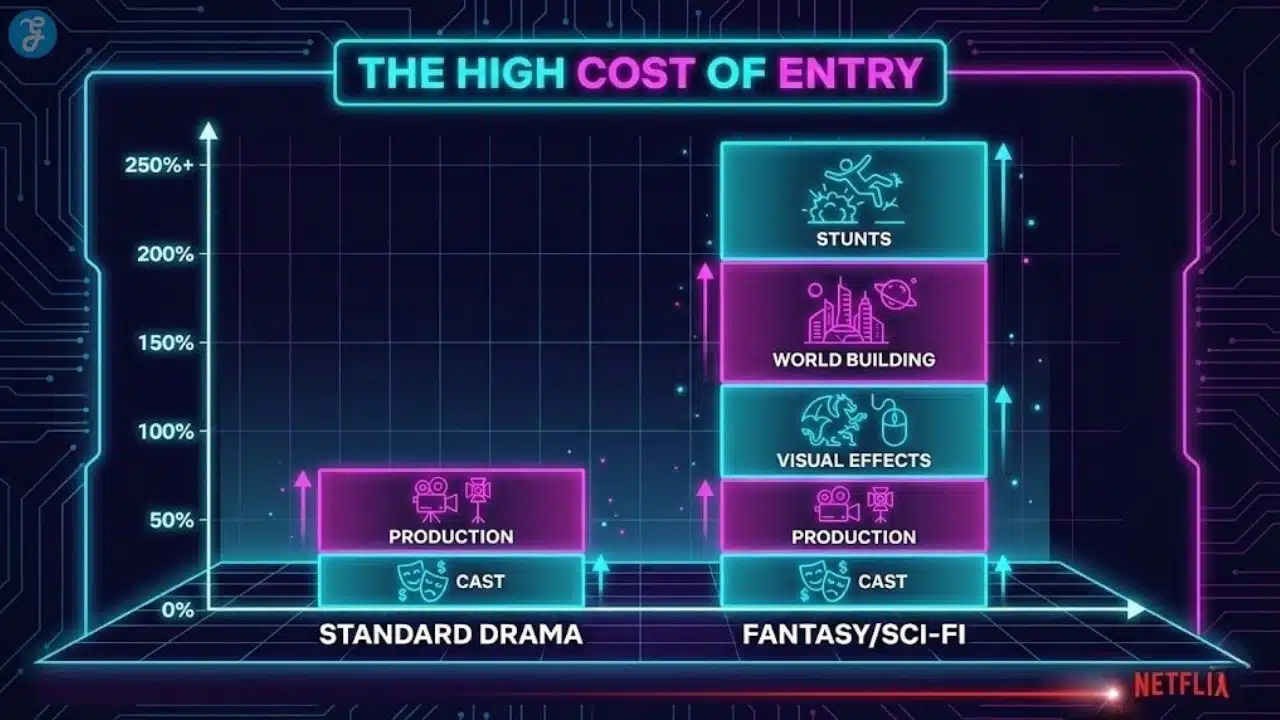
Most genres can scale budgets up or down. Fantasy and sci-fi have a floor cost, and that floor is higher than people think. Even “simple” genre storytelling needs world-building that must look believable.
The Cost Stack That Hits These Genres Hardest
Fantasy and sci-fi usually require multiple budget layers at once:
- Visual effects and compositing for creatures, powers, and environments
- Production design for sets, props, and custom builds
- Costumes and makeup that match the world, not today’s streetwear
- Stunts and choreography for action-heavy sequences
- Location work, or stages that simulate locations convincingly
- Sound design and score that carry scale and tension
You cannot remove these elements without changing the genre promise. When Netflix greenlights the show, it buys an expectation of spectacle.
VFX Is Not Just A Line Item, It Is A Schedule Risk
Visual effects can balloon costs in two ways. First, the show needs more shots than expected once the edit reveals gaps. Second, the VFX pipeline becomes a bottleneck that can delay release dates.
Delays matter because Netflix’s release calendar is crowded. If Season 2 arrives too late, the audience forgets, and the show must re-earn attention from scratch.
World-Building Costs Do Not Reset Each Season
People assume sets and assets are “paid once.” Some are, but many costs repeat:
- Storage, maintenance, and rebuilds
- Upgrades to meet new story demands
- New environments and new creatures each season
- More complex sequences as the story escalates
If Season 1 builds the world, Season 2 usually expands it. Expansion is where budgets jump.
The Completion Problem: Spectacle Does Not Guarantee Finishers
A fantasy concept can attract huge sampling. Sampling looks like success on social media, but sampling is not the same as finishing. Netflix cares deeply about whether viewers commit, because commitment predicts future season demand.
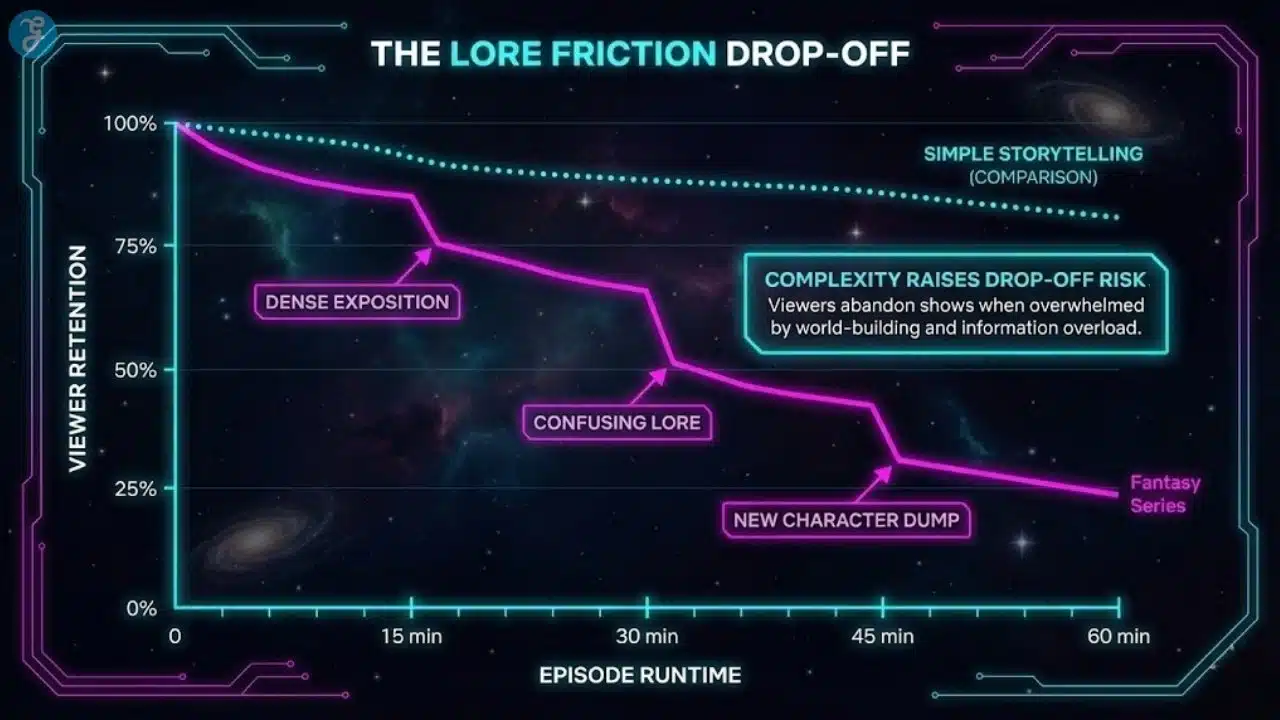
Fantasy and sci-fi face a completion challenge that is structural. These shows often ask the viewer to learn rules, history, names, and politics. That can be thrilling for fans, but it can also create early drop-off for casual viewers.
Complexity Raises The Drop-Off Risk
Many genre series require patience:
- Multiple timelines
- A large cast introduced quickly
- Lore-heavy exposition
- Slow-burn mysteries that pay off late
If a viewer feels lost by Episode 2, they quit. If too many viewers quit, the show’s “value” collapses relative to its cost.
The Hook Must Match The Trailer Promise
Fantasy and sci-fi marketing often sells scale. If the first episode feels smaller than the trailer, viewers may feel misled. That mismatch can hurt early retention, which then hurts the show in the evaluation window.
Binge Friction Is Higher With Longer Episodes
Many genre shows run long. Long episodes create a simple problem: fewer people finish quickly. Even if viewers love the show, they may not complete it within the most important window for decision-making.
The Budget Curse Is Really A Cost-To-Engagement Equation
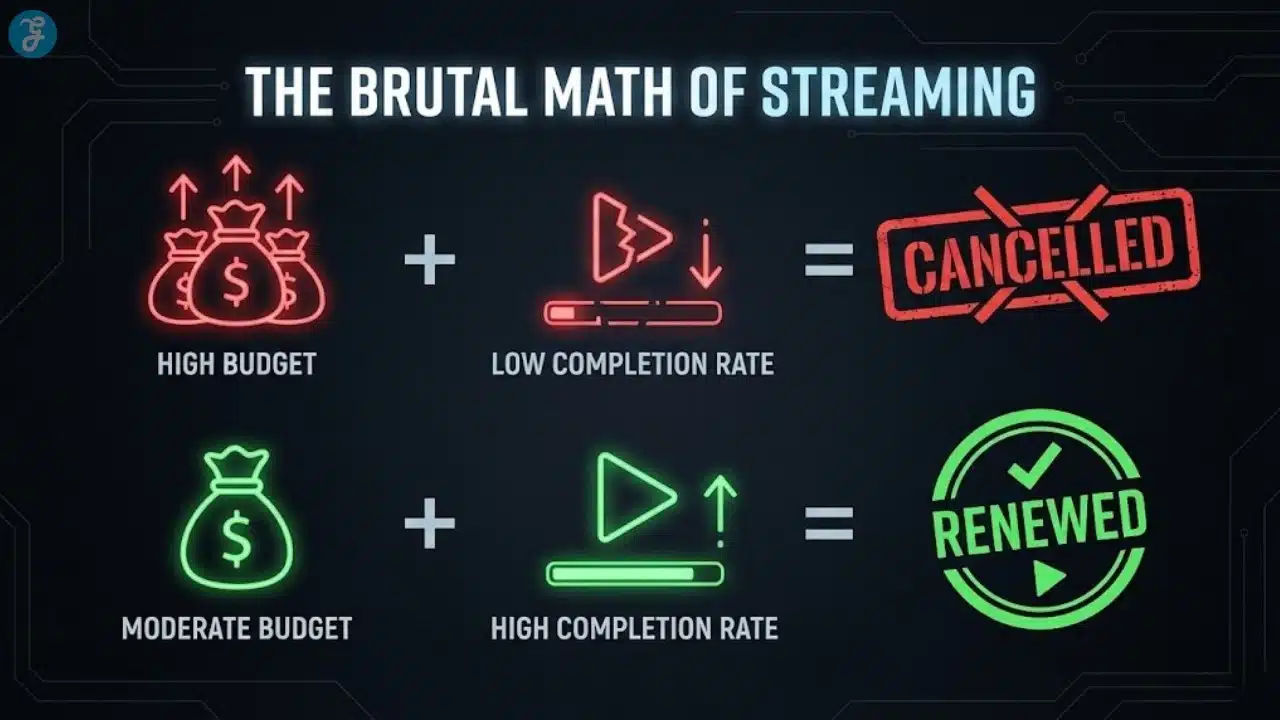
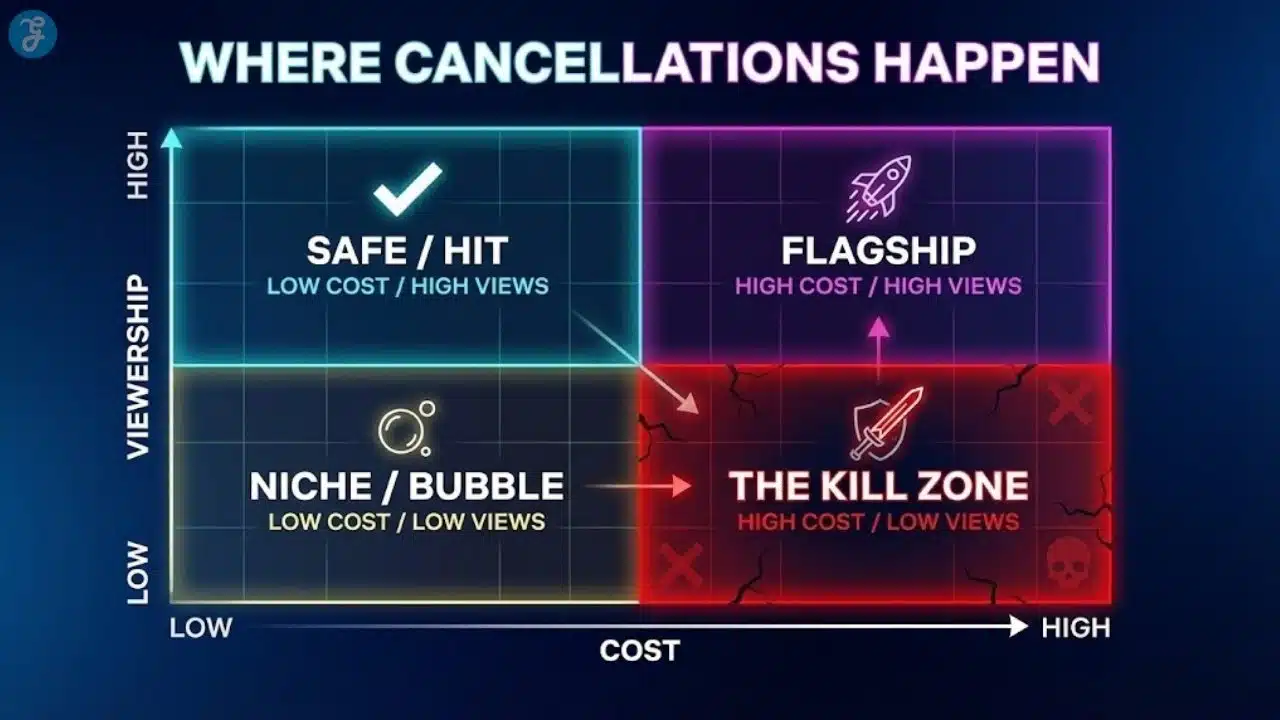
Think of renewal as an equation. Netflix compares what it spent to what it got back in engagement and subscriber impact. Fantasy and sci-fi often start the equation in debt, because they cost more.
A Simple Framework Netflix Can Use Internally
Netflix likely evaluates a mix of signals, but the logic can be explained simply:
- How many people started the season
- How many finished it
- How many watched quickly enough to create momentum
- How much the season cost to produce
- How the show affected subscriptions and churn
- How the show performed across regions
If the show is expensive, it needs stronger signals. If it is cheaper, it can survive with “good enough” signals.
Table: Common Cost Drivers And The Few Levers Netflix Can Pull
| Cost Driver In Fantasy And Sci-Fi | Why It Costs So Much | Netflix’s Limited Levers |
| Heavy VFX shots | Labor-intensive and time-consuming | Reduce shots, simplify sequences |
| Custom sets and builds | Materials, construction, storage | Reuse sets, limit locations |
| Large ensemble casts | More contracts, more scheduling | Trim characters, focus arcs |
| Action-heavy episodes | Stunts, rehearsals, safety | Reduce action set pieces |
| World travel production | Locations, permits, logistics | Stage work, fewer travel scenes |
| Short turnaround demands | Overtime and rushed post | Extend schedule, accept later release |
The levers often make the show feel smaller. If shrinking the show breaks the fantasy promise, Netflix may decide cancellation is cleaner than compromise.
Season Two Is Where Costs Spike And Renewals Get Brutal
A lot of cancellations happen after Season 1, and that is not random. Season 2 often costs more, even if the audience is stable. That gap is a major part of why Netflix cancels fantasy & sci-fi so frequently.
Contracts Get More Expensive
When a show succeeds, actors and key creators gain leverage. Their contracts often include escalators, renegotiations, or bonuses. If Netflix wants to keep the cast, the cost rises.
Even if Netflix wants a cheaper Season 2, it may not be able to pay less. It may only be able to pay more.
The Story Naturally Demands Escalation
Genre storytelling loves escalation. Bigger villains, bigger battles, bigger stakes. That escalation usually means:
- More VFX and bigger sequences
- New worlds and new characters
- More complex production need
If Netflix wants Season 2 to be bigger, it must pay for bigger. If Netflix wants Season 2 to be smaller, it risks disappointing the exact fandom it needs most.
Production Timelines Are Long, And That Adds Risk
Fantasy and sci-fi seasons can take longer to shoot and finish. A long timeline adds business risk:
- Audience memory fades
- Marketing costs increase to restart buzz
- Release gaps reduce the chance of a strong early surge
A cheaper reality show can return quickly and keep engagement steady. A genre epic that returns late must fight harder for attention.
Genre Fandom Is Loud, But Netflix Needs Broad Viewing
Fantasy and sci-fi communities are passionate. They generate memes, fan art, deep lore threads, and nonstop debate. That energy is real, but Netflix renewals usually need more than loud fandom.
The Difference Between “Fandom Intensity” And “Audience Scale”
A fandom can be intense and still be small. Netflix needs shows that either:
- Scale big enough to justify big costs, or
- Stay cheaper while maintaining strong completion and loyalty
When the show is expensive and the audience is mid-sized, the math becomes unforgiving.
Niche Genres Can Be Misread By Marketing
Marketing can push a fantasy or sci-fi show to mainstream audiences. That can increase starts, but it can also increase drop-off if the show is truly niche.
A show that is “for fans only” may actually perform better if it is marketed honestly. Overpromising scale to attract casual viewers can inflate sampling while hurting completion.
Global Performance Can Decide A Renewal Faster Than U.S. Buzz
Netflix is global. That means a show’s renewal odds can depend on performance outside the U.S. A genre show that trends in one market but fails to travel may not justify its budget.
Why Travel Matters
Netflix wants content that performs across regions because:
- It spreads cost across a bigger subscriber base
- It reduces reliance on one market’s taste shifts
- It supports algorithmic discovery worldwide
Fantasy and sci-fi can travel well, but only if the story is accessible and the dubbing or subtitling experience holds up. Dense lore can reduce travel because it increases viewer friction.
Cultural Specificity Can Be A Strength Or A Barrier
A strong cultural identity can make a show stand out. It can also limit its reach if the platform markets it as global spectacle instead of a specific story with specific roots.
When budgets are high, Netflix prefers fewer barriers to entry. A show that asks viewers to work harder must reward them quickly.
The Discovery Problem: Netflix Can Move On Faster Than Viewers Can Catch Up
Netflix releases a lot of content. That pace creates a brutal reality: a show can be good and still get buried.
Fantasy And Sci-Fi Compete With Everything
These shows do not only compete with other genre shows. They compete with:
- True crime series that trend fast
- Reality franchises that return often
- Big movies that dominate the home page
- Established comfort shows that rewatch endlessly
If a new fantasy series does not lock viewers in early, Netflix can shift attention to the next release. The show loses visibility, and late discovery becomes harder.
Late Discovery Is Valuable, But It Is Harder To Measure Early
Some shows become cult hits over time. Netflix can benefit from that, but it often prefers predictable wins. Predictable wins matter because the platform commits large budgets months before it sees performance.
This is where the “budget curse” bites hardest. A slow-building fantasy show may need time, but its budget demands speed.
Mid-Article Reality Check: The Core Reason Keeps Returning
At this point, the pattern should be clear. The biggest driver of cancellations is not hatred of genre storytelling. It is the risk profile.
Here is the simplest version of why Netflix cancels fantasy & sci-fi so often: these shows cost a lot, take a long time, and must prove broad, high-completion demand early enough to justify an even more expensive next season.
When one part of that chain breaks, Netflix can replace the show with cheaper content that keeps subscribers just as effectively.
Why “Good Reviews” And “Top 10” Do Not Always Save A Genre Show
Reviews and charts matter, but they do not tell the whole story. A fantasy show can hit the Top 10 and still fail Netflix’s internal thresholds.
Top 10 Can Reflect Curiosity, Not Commitment
A strong debut can come from marketing, brand recognition, or curiosity. If viewers drop after the first episode, the title might still chart briefly because of raw starts.
A renewal needs stickiness. Stickiness shows up in finishing behavior and week-to-week steadiness, not only in a hot first weekend.
Critics And Awards Do Not Always Translate To Subscriber Behavior
Critical acclaim can help brand value. It does not guarantee mass viewing. Netflix funds a wide slate, and it must make trade-offs. When budgets are high, it tends to prioritize titles that prove broad engagement.
The “Loud Minority” Effect On Social Media
Social platforms amplify passionate fans. That can create the illusion of a massive audience. Netflix can see the actual audience size and the actual completion curve.
If the curve drops sharply, social volume cannot fix it.
What Netflix Does Instead: Cheaper Genre-Lite And Controlled Risk
Netflix still wants fantasy & sci-fi. It just prefers forms that control risk.
Limited Series And Miniseries Reduce The Renewal Problem
A limited series can deliver a full story without promising Season 2. That reduces:
- Contract escalation
- Story escalation expectations
- Long-term production commitments
It also reduces fan backlash because the ending feels complete.
Animation Can Deliver Scale More Efficiently
Animation can be expensive, but it often scales better than live-action fantasy. It can deliver monsters, magic, and cosmic scenes without the same VFX pipeline constraints.
It also allows consistent character visuals across time, which helps with long production cycles.
Netflix sometimes partners with studios or international networks. Shared financing can make a high-cost genre show less risky. When Netflix carries the whole budget alone, it demands stronger performance.
Franchise Extensions Can Be Safer Than New Worlds
A new world is a gamble. A known franchise has built-in sampling and clearer positioning. Netflix can justify budgets more easily when the brand already signals demand.
How Fantasy And Sci-Fi Shows Can Improve Renewal Odds Without Losing Identity
Creators cannot control everything, but they can design for completion and clarity. These changes do not require selling out. They require respecting the viewer’s attention.
Make Episode 1 A Promise And A Payoff
The first episode must do two things:
- Clearly state what the show is
- Deliver at least one satisfying payoff
If Episode 1 only sets the table, viewers may not stay long enough to eat.
Reduce Lore Friction Early
Lore is fun, but it can overwhelm. You can reduce friction by:
- Anchoring the story in one character’s emotional goal
- Explaining rules through action, not speeches
- Introducing factions gradually, not all at once
Viewers stay when they feel oriented.
Create A Strong Episode 3 Turning Point
Many viewers decide around Episode 2 or 3 whether to continue. A turning point that raises stakes can stabilize retention. This is especially important for genre shows that start with setup.
End The Season With Closure Plus A Doorway
A cliffhanger can be exciting. It can also feel like manipulation if the season offers no closure. A season ending that resolves one major arc while teasing a larger threat often encourages completion and trust.
What Fans Can Do That Actually Helps In The Renewal Window
Fans cannot control budgets, but they can influence viewing signals. If you want to support a fantasy or sci-fi show, focus on behavior that proves demand.
Finish The Season Quickly
Finishing is the strongest signal. It tells Netflix the show delivered satisfaction, not just curiosity.
Bring New Viewers Who Will Finish
Convincing a friend to start is helpful. Convincing a friend to start and finish is far more valuable.
Avoid Spreading “Wait For Renewal” Advice
Some fans delay watching until renewal is confirmed. That can backfire, because it weakens early performance signals. If many people wait, the show can look weaker than it truly is.
Rewatching Helps, But Completion Comes First
Rewatching can signal loyalty. Completion, especially first-time completion, signals broad satisfaction and reduces renewal risk.
A Practical Risk Checklist For Genre Cancellations
You cannot predict every decision, but you can spot warning signs. If a show hits several of these at once, the budget curse is in play.
- The show looks expensive on screen with heavy VFX every episode
- The story is lore-dense and slow to explain its rules
- Episodes are long, and the season has many episodes
- The show spikes in conversation and then vanishes quickly
- The ending feels incomplete without Season 2
- The cast is large and includes higher-cost talent
- Production takes a long time with long gaps between seasons
Table: Renewal Friendly Vs Renewal Risk Signals
| Signal Type | Renewal Friendly | Renewal Risk |
| Viewer behavior | High finishing, steady week-to-week | Big debut, sharp drop-off |
| Season structure | 6 to 8 tight episodes | Long season with padding |
| Story clarity | Clear stakes by Episode 1 | Lore confusion early |
| Budget profile | Controlled spectacle | Constant VFX dependence |
| Ending | Closure with future tease | Ending feels unfinished |
| Global appeal | Travels across regions | Strong in one market only |
If a show is expensive and hits multiple risk signals, Netflix may see cancellation as the rational choice.
The Real Takeaway: Budget Is The Genre’s Hidden Villain
Netflix does not cancel fantasy and sci-fi because it hates imagination. It cancels because the economics punish expensive shows that do not convert fast enough.
Here is the simplest closing answer to why Netflix cancels fantasy & sci-fi: the platform can fund two or three cheaper hits for the price of one genre epic, and if that epic does not show clear, broad, high-completion demand quickly, Netflix often chooses the safer portfolio.
That does not make the cancellations feel better. It does explain why they keep happening, and why the “budget curse” follows these genres more than most.