Many folks search who is mark rober online and get lost in jargon. They need a simple guide to his life, work, and fun projects. Most pages feel like puzzles with big words.
Mark Rober spent nine years at NASA’s Jet Propulsion Laboratory and helped build the Curiosity rover. We will chart his path from engineer to YouTube star, show his work on virtual reality at Apple, and break down his STEM kits for kids.
Let’s explore his journey.
Key Takeaways
- Mark Rober grew up in Brea, California. He finished high school in 1998 at Brea Olinda. He earned a bachelor’s in mechanical engineering from BYU in 2004 and a master’s at USC in 2014.
- He spent nine years at NASA’s Jet Propulsion Lab. He worked on AMT, GRAIL, SMAP, and the Mars Science Lab. He wrote Python and MATLAB code to test the Curiosity rover and made a VR wiki for engineers.
- From 2015 to 2019 he joined Apple’s Special Projects Group. He used LiDAR and virtual reality to map roads for self-driving cars and filed key patents.
- He launched his YouTube channel in October 2011. A 2018 glitter-bomb video hit 25 million views in one day and his 2021 squirrel puzzle reached 114 million views. He also sold his Digital Dudz startup for $250 K in 2013.
- He co-led #TeamTrees, raising $20 million by 2020, and #TeamSeas, raising $34 million in 2021. He founded CrunchLabs to send monthly STEM kits and won STEM Personality of the Year in 2021.
Early Life and Education
Mark Rober grew up in Brea, California, as the youngest of three siblings. He finished high school at Brea Olinda in 1998.
Rober, mark then studied mechanical engineering at Brigham Young University. He earned a Bachelor of Science in 2004. His classes introduced design software and hands-on labs. He returned to school at USC for a Master of Science in 2014.
His graduate work touched on virtual reality applications. These studies set stage for his work at nasa’s jet propulsion laboratory and mars science laboratory projects.
Career Highlights
Mark honed his craft at NASA’s Jet Propulsion Laboratory and tweaked gear at Apple. Now he crafts viral YouTube feats with real science and virtual reality, so read on to see how he shook up the science world.
Work at NASA’s Jet Propulsion Laboratory
The YouTuber mark rober spent nine years at nasa’s jet propulsion laboratory. He joined missions like AMT, GRAIL, SMAP and the Mars Science Laboratory. That role had him write Python scripts and use MATLAB to test rover code.
During seven of those years he heated up robotics trials for the Curiosity rover. Sensors like accelerometers and spectrometers got fine tuning under his watch.
A group led by Rober built JPL Wired as a corporate memory wiki. It used version control, metadata tags, search engines and CAD mockups. Virtual reality demos let engineers view probe parts at scale.
Team members logged test failures and shared telemetry logs faster. Project delays fell as data retrieval times shrank. Fans hear him say this is mark rober in each briefing, but his wiki work speaks loud for Mars missions.
Contributions at Apple
Mark Rober joined Apple Inc. in 2015, moving to Sunnyvale to work in the Special Projects Group. He spent four years as a product designer, shaping ideas for self-driving cars. He helped write patents that used virtual reality tools to map roads and hazards.
He used a LiDAR detector to feed real-time data into VR models.
Apple labs saw new human-computer interaction methods thanks to his input. He used design software to build 3D car interior models. That approach mixed detector readings and VR headsets for driving tests.
His patents paved way for next-gen autopilot features.
Transition to YouTube
October 2011 saw him launch his YouTube channel and post a science clip. The Halloween costume illusion drew 1.5 million views in a single day. He watched YouTube Analytics show the daily count climb.
That viral spark gave Mark Rober a big boost on the platform.
He spun that buzz into Digital Dudz, a costume startup. It pulled in $250,000 in its first three weeks. Party City stocked the outfits, and CBS News and CNN ran stories about them.
He sold Digital Dudz to Morphsuits in 2013.
YouTube Success
Mark Rober wows millions with microcontroller boards, action cams, and quick video edits that make science feel like a joy ride, so keep reading to learn more.
Popular science experiments and videos
A glitter bomb trap sprung on parcel thieves in December 2018. That clip hit 25 million views in one day. A follow-up clip with Macaulay Culkin drew even more clicks.
A backyard squirrel puzzle video took off in 2021. It reached 114 million views by September 2023. Its sequel hit YouTube in 2022. A giant foam blast poured from a massive scientific vessel in the world’s largest elephant toothpaste experiment.
A pool of gelatin became the biggest ever, built with power mixers and large containers.
Approach to science communication
Mark Rober laces his YouTube science guides with clear steps, simple experiments, and his own brand of humor. He films each test, even the flops, then he pulls back the curtain on the math and physics.
Animations, lab clips, slow-motion shots, they all transform STEM topics into spark-plug moments.
He shared his methods on TEDx with talks titled How to Come Up with Good Ideas and The Super Mario Effect. He taps experts and fellow creators for charity ventures, this blend of fun and real-world impact builds wonder in the audience.
Viewers end videos ready to tinker in their own makeshift workshops.
CrunchLabs and Its Mission
CrunchLabs crafts hands-on kits, like circuit boards and 3D-print projects, to spark kids’ STEM curiosity—read on to learn more.
Hands-on science kits for kids
Build Boxes by CrunchLabs form a subscription service that sends monthly science kits to homes, sparking STEM learning through play. Kids open boxes filled with plastic gears, LED lights, magnets, and a microcontroller board.
They follow clear guides and build an interactive water filter or a trebuchet model. Each experiment ties to real science principles in physics and chemistry.
Boxes include test tubes, propellers, and resistor kits, turning equations into magic. Young learners mix solutions, test pH, and measure current. This subscription service provides interactive and educational building and experimentation.
Fires of discovery ignite in living rooms.
Promoting innovation and curiosity
CrunchLabs blends hands-on kits with creative problem solving. They pack microcontroller modules, sensors, and step-by-step guides. Kids get encouraged to test ideas. It inspires invention in young minds.
Such play pushes them to think using an additive printer or a laser cutter.
Mark Rober uses his YouTube channel to spark curiosity. His channel shows experiments that tie to CrunchLabs projects. He shares simple coding tasks and physics challenges. This advocacy drives STEM education in classrooms and homes.
It builds a pipeline for future inventors and engineers.
Personal Life
He juggles dad duties with garage lab play—he tosses balls for his dog and tests circuits with a soldering iron, so read on to see what else he’s up to!
Family and personal interests
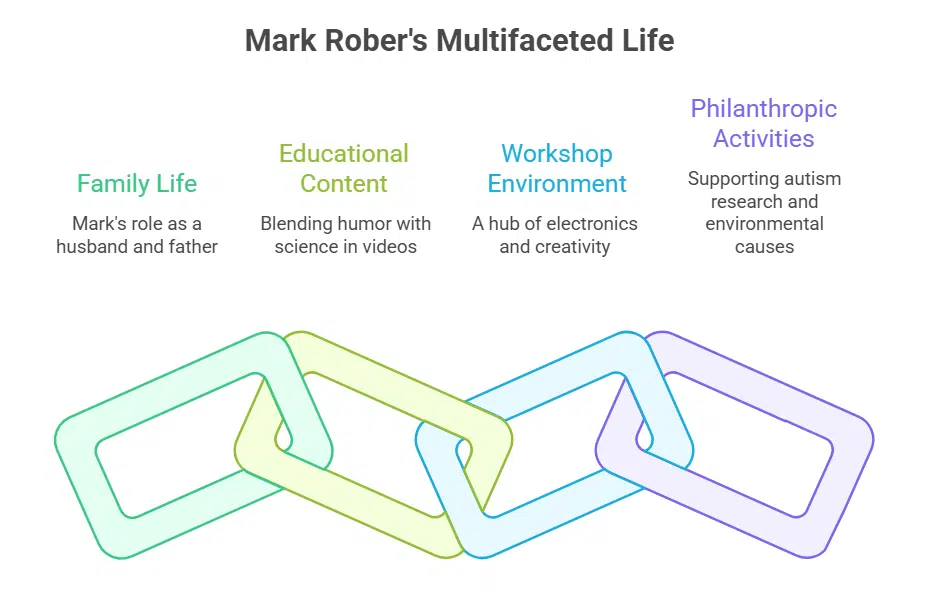
Mark Rober lives with his wife and their son, who has autism. He shares videos that blend goofy humor with clear science. Fans see his playful style and genuine care.
His workshop glows with solder fumes, 3D printers and microcontroller boards. He tests recipes for DIY electronics and shoots scenes with multiple action cameras. Rober funds autism research groups and joins beach cleanups, mixing his love for gadgets and green living.
Does Mark Rober Have Kids??
He has one son, who sparked his push for autism awareness. The boy joined him in campaigns that drove funds for support. Rober describes his child as curious, creative, and always ready to tinker.
The engineer turned creator brings real life into his videos and fundraisers, mixing STEM ideas with heart. His public appearances with his son highlight the need for inclusive education.
The projects blend science kits, gadgets, and a father’s hope for a bright future.
Awards and Recognitions
Awards have poured in for his inventive science work. His interactive videos earned top honors across industry events.
- 2021, Engineering Institute named him STEM Personality of the Year and made him an Honorary Fellow.
- 2022, internet awards labeled him Film and Video Person of the Year for his engaging science videos and new video editing tools.
- Four video awards went to him in 2019 at the ninth show, Learning and Education in 2020, Science and Engineering in 2021 and 2022.
- robotics contest gave him the Founder’s Award in 2024 for his work with robotics platforms and STEM outreach, inspiring young builders.
- A college graduation speech featured him at Massachusetts school in 2023, where he spoke on science, creativity and video gear.
Mark Rober’s Influence on STEM Education
Mark Rober gave kids a front row seat to real science. He co-led #TeamTrees with MrBeast in 2019, raising 20 million dollars for the Arbor Day Foundation by 2020. Each donation turned into a planted tree.
Students logged the data and saw how math can grow forests. That live project taught them about data analysis in a big way.
Rober kicked off #TeamSeas in 2021, pulling in 34 million dollars to help The Ocean Cleanup haul trash. Every dollar swept one pound of debris out of oceans. He wrote for Men’s Health and spoke at TEDx events to share simple experiments.
Arduino boards, Raspberry Pi kits, and 3D printers helped spark fun with coding. Young builders saw that a microcontroller can be as handy as a paintbrush.
Takeaways
Readers feel the spark as they see how Rober mixes engineering and fun. His time at the space agency and at the tech company fed his curiosity. He made a glitter bomb trap that taught viewers about creativity.
CrunchLabs kits let kids handle real STEM tools. That blend of play and science can move mountains.
FAQs
1. Who is Mark Rober?
He makes science videos on YouTube. He once worked as an engineer at a space agency and a tech company. He uses fun experiments to teach science.
2. How did Mark become a YouTube science sensation?
He left his engineer job and started a channel. He used a glitter bomb trap video to catch package thieves. That clip went viral, and fans spread it fast. He became a YouTube science sensation.
3. What sets his videos apart?
He blends real science with jokes. He makes big ideas feel like a backyard game. He builds cool gadgets you can relate to. He uses clear talk and bright visuals to guide you.
4. What achievements define his life and career?
He helped build tools for planetary missions at a space agency. He then worked on camera tech at a tech company. On YouTube, he won awards and raised millions for science education. He passed four billion views and set a pumpkin drop record.