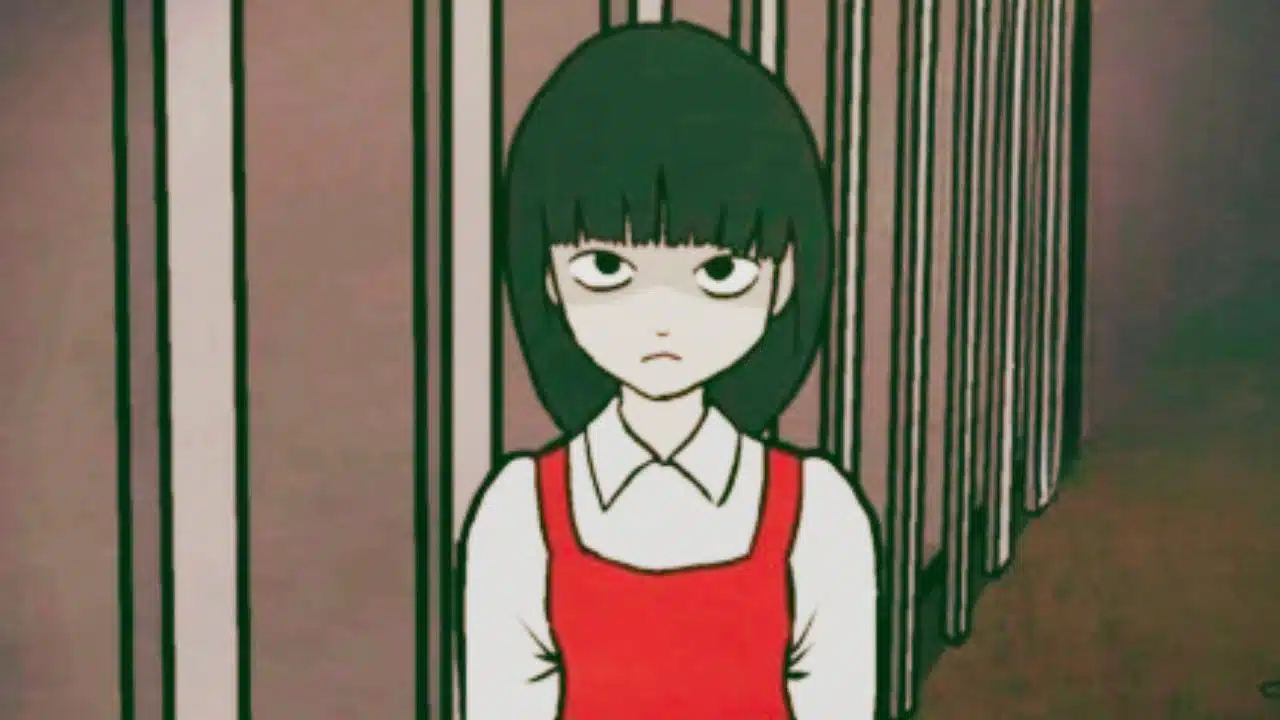
Urban legends can send chills down your spine. You might have heard whispers about a ghost in the school bathroom. You might still wonder what is the story of hanako san, and if it holds any truth.
This haunting tale began in the 1950s, in Japanese folklore. It blends ghost story traditions and schoolyard dares. This post breaks down her origin, the ritual you need to summon her, and why she appears in anime and horror games.
It unravels facts and fun. Curious?
Key Takeaways
- The Hanako-san legend began in 1950s Japan and ties back to a 1945 World War II air-raid story. It holds no proof but has haunted schools for about 70 years.
- Students summon her by entering the third-floor girls’ restroom, knocking 3 (or 22) times on the third stall door, and asking, “Hanako-san, are you there?”
- Folklore scholars Michael Dylan Foster and Matthew Meyer call Hanako-san a key school-based urban legend. NPR noted her 70-year run in a 2014 report.
- She stars in films like 1995’s Toire no Hanako-san, the 1998 sequel, the 2013 CGI reboot, and in the 2020 anime Toilet-Bound Hanako-kun.
- Hanako-san symbolizes school trauma, bullying, and isolation. She links modern fears to yokai lore and other restroom ghosts like Aka Manto.
The Origin of Hanako-san’s Legend
Some claim she perished in a flooded school stall, after a janitor’s leaky pipe filled a container seconds too late. Folklore, yokai tales, and whispered ghost stories buffed those scraps into a legend that still haunts every cubicle.
What are the different versions of Hanako-san’s backstory?
Urban legends swirl around a ghost girl in school toilets. Each tale ends in tragedy.
- Urban legend version says a World War II air raid struck in 1945 as she hid in a bathroom stall playing hide-and-seek. Her spirit now haunts tiled walls.
- Ghost story claims a parent or stranger dragged her into a toilet, killed her, and left her trapped as a supernatural figure. Students warn each other about the haunted stall.
- Folklore ties her death to severe bullying, saying she committed suicide in a school lavatory to escape torment. She returned as a spirit in a red skirt with bobbed hair.
- School horror mythology in Japanese culture fixes her in a single place, a toilet stall, as a tragic ghost. She wears an old-fashioned uniform and startles anyone who calls her name.
How did these variations of the legend develop over time?
Scholars traced Hanako-san’s tale to school myths that sprang up in the 1950s. Folklore study shows oral tradition fueled variant versions across regions. Some students described her as a shy schoolgirl who died in a bathroom.
Other accounts turned her into a supernatural anomaly lurking in stalls. This shift grew as kids swapped retellings between classes and lunch breaks. Researchers link each twist to local cultural narrative and tradition.
Michael Dylan Foster labeled her a key example of Japanese school-based urban legend in The Book of Yokai. Matthew Meyer chronicled fresh plot points in folklore studies and journals.
NPR noted in 2014 that the tale had haunted schools for about 70 years. Students then passed ghost story bits through whispers under desks. Scholars spotted new twists in each region, mixing local tradition with spook lore.
Researchers saw the shifts as part of Japanese culture’s appetite for eerie tales. This mix shows how oral tradition turns a simple myth into a lasting cultural narrative.
The Ritual to Summon Hanako-san
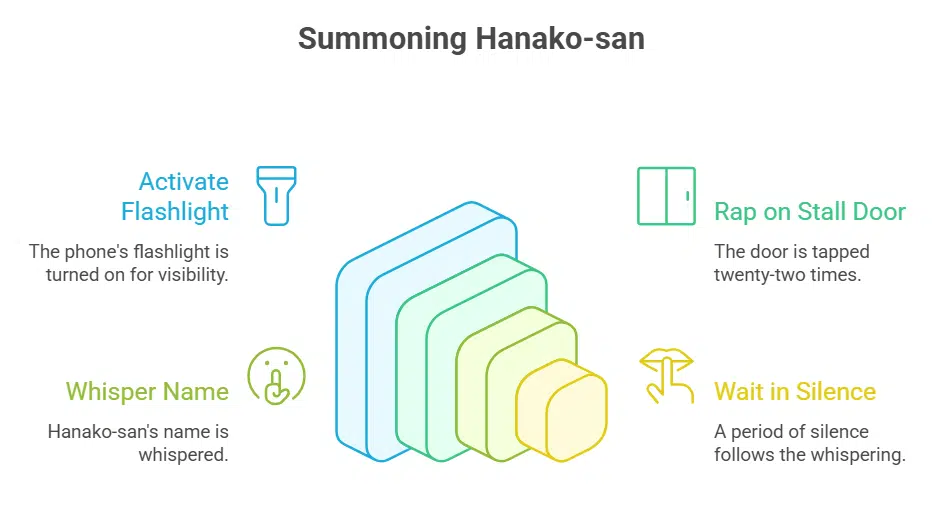
You step into the empty restroom, switch on your phone’s flashlight, and rap on the third stall door twenty-two times. You whisper her name, then wait in silence as the tiled walls soak up your fear, and some say a pale apparition peers back.
What are the steps to summon Hanako-san?
A group of classmates pauses by the ladies’ restroom on the third floor. They plan a spooky ritual to call out Hanako-san.
- Head into the empty ladies’ restroom on the third floor of the school.
- Pick the third cubicle from the hallway side and stand close to its doorway; this spot features in a popular urban legend.
- Tap on the wooden frame three times in a slow, steady beat to start the ritual.
- Speak in a clear voice, ask, “Hanako-san, are you there?”
- Stay quiet and listen for a faint, chilling reply like, “Yes, I am,” which marks the ghostly spirit’s presence.
What happens if Hanako-san appears after the ritual?
Kids shout her name in a dark stall, seeking a ghost during the summoning ritual. A bloody hand can creep from the bowl. It drips onto the tile. This supernatural sight can freeze blood in your veins.
A three-headed lizard may slither in behind her. It warns you that you broke a sacred privacy rule. Each encounter feels like a new twist in an urban legend.
Suddenly, a cold pull yanks you toward the toilet, some say to Hell. Folklore warns against such a fall. Spirits swirl in the cramped bowl area. The stall door slams shut behind you.
The outcomes vary wildly by version. This myth fuels haunting whispers and modern mythology around every school.
Is Hanako-san Real? What Evidence Supports the Legend?
Folklorists study the question: Is Hanako-san Real? No documented case proves her existence, and researchers like Matthew Meyer and Michael Dylan Foster tag her legend as an urban legend.
Schoolchildren dare each other to summon her in empty bathroom stalls. That game keeps the myth alive.
Observers link the story to other supernatural folklore. They call it an urban legend of ghost stories, not history. Cultural belief holds its sway in schoolyards. Anomalous bathroom noises get blamed on her spirit but no solid proof exists.
Interpretations of Hanako-san in Japanese Culture
Her apparition warns students of hidden grief and unhealed trauma. Culture buffs spot links between paranormal ritual and haunted school folklore.
What does Hanako-san symbolize in Japanese society?
Hanako-san serves as a mirror for school anxiety and hidden trauma. She stands in a bathroom stall, a spot that speaks to isolation in childhood. Some view this yokai as a signpost for bullying and violence in corridors.
Kids whisper her name, hoping to wake a restless spirit.
Folklore buffs see Hanako-san as a sign of societal wounds. This urban legend waves the flag of neglected youth mental health. The legend urges communities to face trauma. It warns of scars that linger in empty halls.
How does Hanako-san reflect common societal fears?
Children whisper this urban legend in the echo of empty halls. They picture a girl ghost behind the third bathroom stall. She carries the weight of death, violence, and invasion of privacy.
That vision taps a deep fear of being alone in a tight cell. It also mirrors worries about bullying and school violence in Japan.
This tale blends folklore with modern dread. The ghost acts like a spirit from yokai stories, stalking ordinary school life. She warns against cruelty and isolation. Teachers post bathroom monitors to ease that fear.
Yet the haunting stays a sharp reminder of real threats to student safety.
Hanako-san in Popular Media
She springs into life in cult horror flicks, and she stares out from the panels of the comic book Toilet-Bound Hanako-kun. Fans still debate if her eerie school visit feels spookier on screen or in the old folklore scrolls.
How is Hanako-san portrayed in movies and anime?
Hanako-san ranks high in Japan’s urban legend list. Films and anime paint her as a ghost girl, both eerie and cute.
- 1995 film Toire no Hanako-san highlights her bobbed cut and red skirt in a grimy stall.
- 1998 sequel Shinsei Toire no Hanako-san layers in vengeful spirit moods and drip sounds.
- 2013 reboot Toire no Hanako-san: Shin Gekijban uses CGI splashes, it stamps her pale face on mirrors.
- 2013 mock doc Senritsu Kaiki File Kowasugi! File 04 casts students, it frames Hanako-san as campus folklore.
- 2020 anime adaptation Toilet-Bound Hanako-kun by Lerche swaps fear for charm, it turns her into a teen boy ghost.
- Long runner series Kyoukai no Rinne weaves her tale with shinigami; it blends ghost and detective work.
- Classic show Ghost Stories drops her into school mysteries; it leans on sudden scares.
- Legendary anime GeGeGe no Kitarou pairs her with yokai; it spotlights her role as a wandering spirit.
What role does Hanako-san play in Japanese literature?
Folklore fans spot her in many texts. She haunts Japanese literature with spooky flair. Writers use her in manga like Hanako and the Terror of Allegory, and in Toilet-Bound Hanako-kun which debuted in 2014.
The 2013 Uncle John’s bathroom reader and the 2015 Book of Yokai both cite her. The 2009 Flowers from Hell movie and the 2013 Yokai Attack survival guide also dig into her mystery.
Scholars treat her as a lively bridge between urban legend and horror. She pops up in stories, like a prankster ghost that chills and intrigues. Many tales cast her as a supernatural yokai from old mythology.
Authors spin her myth into modern manga plots, sparking fresh ghost stories.
The Connection Between Hanako-san and Japanese Folklore
Hanako-san links to old ghost tales and the ways spirits hide in school bathrooms. She echoes the power of an amulet and invites you to trace her path through folklore.
Folklore scholars label Hanako-san as a modern yokai in Japanese folklore. She appears in school bathrooms and triggers eerie tales, much like Aka Manto or Akaname. Matthew Meyer and Michael Dylan Foster include her in spirits research and cultural studies.
Her haunting taps into classic ghost mythology. Folklore roots extend to old bathroom spirits. Teens dare friends to summon her by knocking thrice on a stall door.
What are the traditional Japanese beliefs connected to Hanako-san?
Spirits haunt school restrooms in Japanese lore. People see Hanako-san as a yūrei, the ghost of a lost girl. They call her onryo when she feels vengeful after a tragic death. Students whisper her name at toilet stalls, hoping she stays silent.
Kannushi once used purification rites at a jinja to clear haunted spots.
Families carry omamori and ofuda to ward off supernatural threats. Some villages still host simple Buddhist ceremonies to calm yūrei. Tales of ghostly laughter behind bathroom doors spring from old cultural beliefs.
They show how Japan links violent ends to haunting souls.
Takeaways
Kids still tap on the third stall door, testing a famous urban legend by daring Hanako-san to show herself. Her tale blends World War II ruin with school fears. It chills even the bravest.
Japanese lore makes her a phantom yokai. Modern fans find her in comic tales like Toilet-Bound Hanako-kun and in video adventure Spirit Hunter: Death Mark II. She stands with other restroom ghosts like Aka Manto or Bloody Mary.
Each knock at that hidden cubicle opens sorrow and bravado; it shows how myths shape our fears and courage.
FAQs
1. What is the story of Hanako-san?
It is an old ghost tale from Japan, about a child named Hanako-san who haunts a school restroom. Kids say if you knock three times on the door and call her name, she might answer back.
2. Why is it a haunting legend?
It still sends shivers down spines, it lives on in school corridors, it feels like a whisper in the dark. Each time someone tells the tale, the chill grows.
3. Where did this legend start?
It began many years ago, perhaps during hard times in Japan, no one knows the exact date. It spread fast among students, then hopped over to other lands.
4. How do people encounter Hanako-san?
You go alone to the restroom, knock three times, then call her name. You might hear a soft voice or see a hand slip under the door, or you might hear nothing at all.