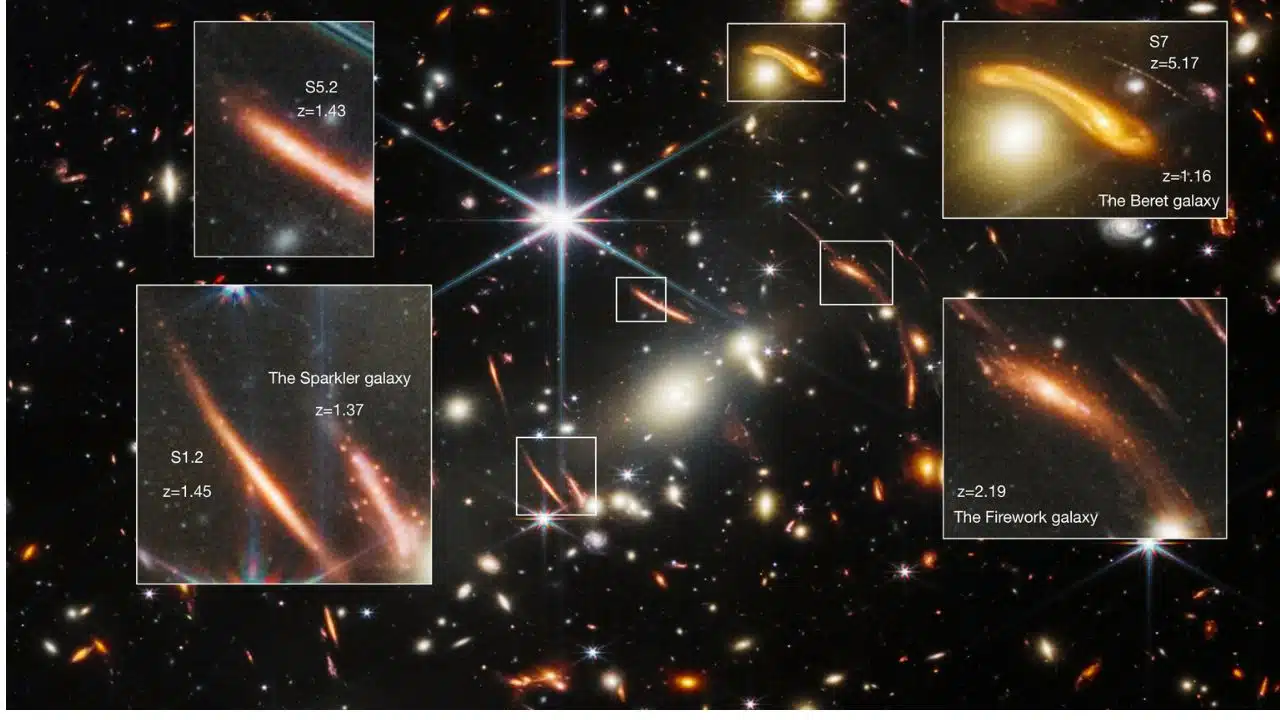
Astronomers analyzing data from NASA’s James Webb Space Telescope (JWST) have found compelling evidence of supermassive stars from the early universe. These stars, thought to be part of the first generation known as Population III stars, may have masses ranging from 1,000 to 10,000 times that of our Sun. This discovery offers new insight into the early phases of cosmic evolution, revealing a brief but intense period of star formation about one billion years after the Big Bang.
Details of the Galaxy GS-NDG-9422 and Its Star Formation
The focal point of this discovery is the distant galaxy GS-NDG-9422, observed approximately one billion years post-Big Bang. In this galaxy, the nebular gas appears much brighter than its stars due to intense heating by these extraordinarily massive and hot stars. Spectroscopic data from JWST show the presence of highly ionized gas, indicating that these stars are stripping electrons from atoms and causing rapid nebular emission around a compact region. This intense star formation phase could represent a missing link in understanding how the earliest and most massive stars influenced their cosmic neighborhood.
The Significance of Population III Stars
Population III stars are theorized to be the universe’s first generation of stars, formed directly from primordial hydrogen and helium, unpolluted by heavier elements. If these supermassive primordial stars existed, they could help explain the rapid growth of supermassive black holes in the early universe, whose presence has long puzzled astronomers. The JWST observations align with theoretical models suggesting such stars’ existence and potential influence on subsequent galaxy evolution.
Connection to Supermassive Black Holes
In parallel research using JWST, astronomers have also uncovered a rapidly growing supermassive black hole in an early galaxy. This black hole, with a mass estimated to be around 100 million times that of the Sun, challenges previous understandings of black hole and galaxy growth in the infant universe. The interplay between these supermassive stars and black holes could illuminate pathways of cosmic evolution in the first billion years after the Big Bang.
Future Observations and Research Directions
The researchers plan to continue observations using both JWST and other instruments like the Atacama Large Millimeter/submillimeter Array (ALMA) to explore the cold gas in these early galaxies further. These studies aim to refine our understanding of the formation of Population III stars, the growth of early supermassive black holes, and their collective role in shaping the universe’s earliest structures. This new era of discovery heralded by JWST promises to deepen humanity’s understanding of its cosmic origins.
This groundbreaking detection by JWST thus marks an exciting milestone in astronomy, revealing clues about the universe’s formative years and the colossal stars that shaped its destiny.