Have you ever tried to sell a product from the US to a customer in France, only to get completely lost in a maze of international taxes? You are definitely not the only one feeling confused. Running a global online store is exciting, but figuring out international taxes can quickly turn that excitement into pure frustration. You sell products to customers in different countries, and suddenly you face multiple tax rates, registration requirements, and strict compliance deadlines.
Many US-based online sellers feel completely lost when they first tackle this topic. They constantly worry if they are making mistakes that could trigger massive penalties. The European Union completely transformed its rules for distance sales in July 2021. These changes affected millions of American businesses selling across borders. The new system simplified some processes, but it also created fresh hurdles for sellers who were entirely unprepared.
We are going to walk you through the exact steps you need to take. This guide explains exactly how VAT for e-commerce business in Europe works.
What is VAT and Why is it Important?
Value Added Tax, or VAT, is a consumption tax that governments collect at each stage of production and sales. Businesses add this tax to the price of goods and digital products. They then pass that collected money along to the local tax authorities.
Think of it like a relay race. Each runner collects the baton and hands it forward to the next person. Online sellers operating from the United States must understand this tax system because it directly impacts their pricing strategy, their profit margins, and their legal standing.
Without proper tax management, your business faces audits, heavy fines, and operational headaches that can sink even the most promising global ventures.
“A major 2024 regulatory update introduced CESOP, the Central Electronic System of Payment Information. This digital hub tracks cross-border payments, meaning EU tax authorities now actively monitor US sellers.”
The rules for e-commerce changed dramatically in July 2021. The EU introduced strict new regulations for cross-border transactions. Today, online retailers must collect taxes on low-value physical goods, digital products, and subscription services sold to EU customers.
This strict requirement applies regardless of where the seller actually operates. This shift levels the competitive field. It prevents large multinational corporations from gaining unfair advantages over smaller online businesses.
Your tax liabilities depend entirely on your customer’s location, rather than your own corporate address. A seller in Texas must follow the exact same rules as a local seller in Poland when selling a digital product to a French customer.
Here are the primary reasons why getting this right is crucial for your business:
- Audit Prevention: As of 2024, if a US seller makes more than 25 sales per quarter in Europe, payment processors automatically report those transactions to the EU.
- Customer Trust: Shoppers abandon carts when hit with unexpected import taxes at their doorstep.
- Brand Reputation: Full compliance keeps your business legitimate and prevents your shipments from getting seized at customs.
Overview of the VAT For E-commerce Business In Europe Package
The EU VAT E-Commerce Package arrived in July 2021 and changed the tax game for online sellers across Europe and the US. These reforms targeted one major goal. They aimed to make it simpler for businesses to sell across borders while keeping tax collection fair and transparent.
Purpose of the EU VAT package
Europe faced a massive problem before 2021. Online sellers from outside the EU were frequently dodging taxes, while local brick-and-mortar stores had to play by the rules. Small European businesses got crushed under confusing tax laws that varied from country to country.
Large international companies exploited loopholes and paid almost nothing. This unfair situation hurt honest retailers and drained governments of needed tax revenue. The EU VAT E-Commerce Package arrived in July 2021 to permanently fix this mess.
Here are the core reasons why the EU implemented these changes:
- Level Playing Field: It ensures non-EU businesses cannot undercut local EU sellers.
- Tax Transparency: Collection is automated, preventing sellers from hiding behind complex registration loopholes.
- Consumer Protection: Shoppers now pay the exact right tax at checkout, completely eliminating hidden delivery fees.
The package targets distance sales, digital products, and low-value goods with strict compliance standards. Governments wanted fair competition, requiring global businesses to pay their fair share, just like traditional local stores do.
This shift meant that consumption tax collection became automatic and highly transparent. Sellers could no longer hide behind complicated registration processes or exploit customs gaps.
“Before 2021, packages valued under €22 entered the EU tax-free. The new package completely eliminated this exemption, forcing US sellers to collect tax on every single physical item.”
Tax thresholds got clearer, too, making life easier for online retailers who actually wanted to follow the law. The system protects consumers by making sure they pay the right tax on every purchase.
Import duties and tax collection now happen smoothly through the One Stop Shop and Import One Stop Shop systems. Digital services received the exact same treatment as physical goods, completely eliminating confusion about what tax rate applies.
Key changes introduced in July 2021
The EU VAT E-Commerce Package rolled out major changes that transformed how US and global businesses handle their taxes. July 2021 marked the exact date when these significant reforms took effect.
Here are the most critical updates that reshaped the landscape for distance sales and digital products:
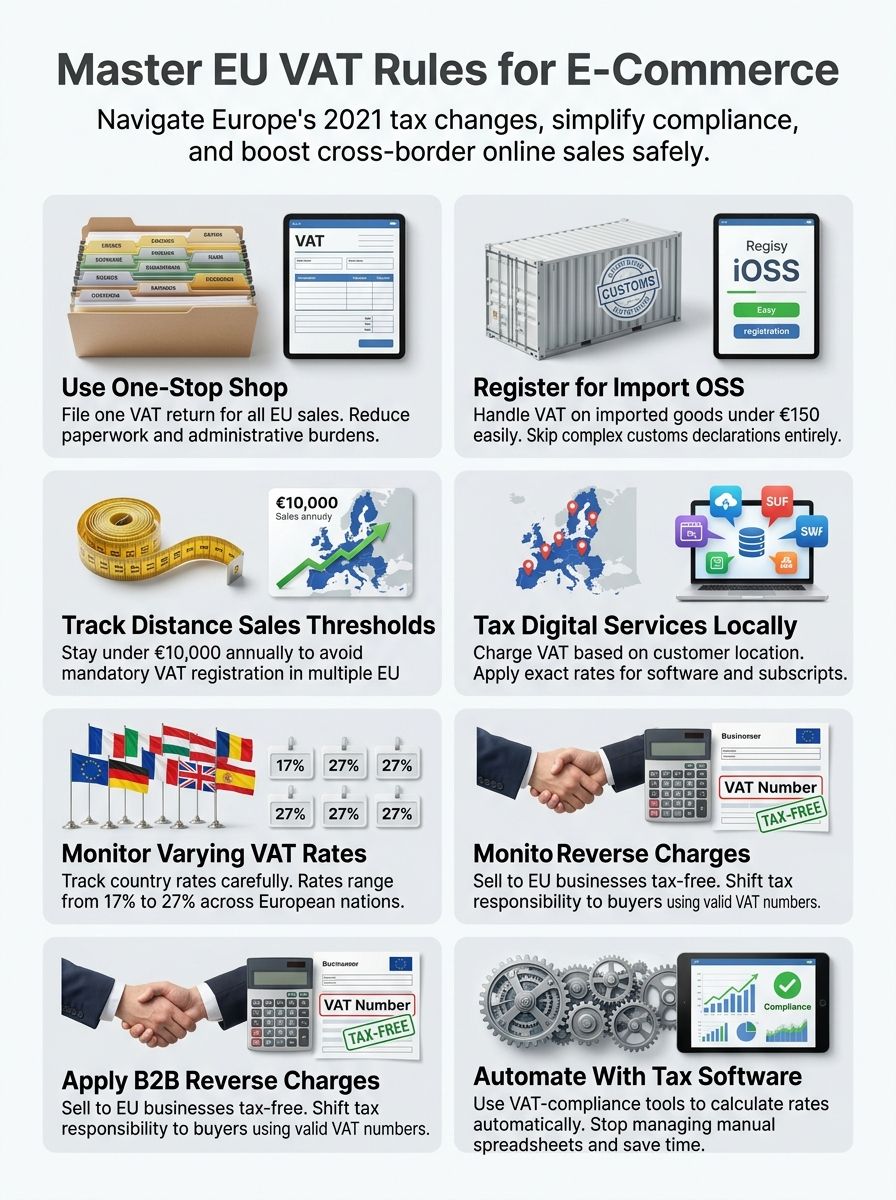
- The One-Stop Shop system was launched, allowing online sellers to register in a single EU country rather than multiple nations.
- Digital services now face tax collection at the point of consumption, meaning businesses must charge tax based on where customers live.
- Low-value goods under €150 imported from outside the EU no longer qualify for import duty exemptions.
- The Import One-Stop Shop emerged as a brand new mechanism for non-EU businesses to register for tax purposes easily.
- Tax thresholds changed significantly, officially eliminating the previous distance selling exemption that allowed some businesses to avoid registration.
- Subscription services and digital goods became subject to stricter rules, requiring sellers to track customer location data carefully.
- Business registration requirements tightened across the board, actively forcing global retailers to comply with local tax authorities.
- Customs regulations shifted to place more direct responsibility on online sellers for collecting and remitting consumption tax on imports.
- Tax compliance software became practically essential to handle varying rates across 27 different EU countries.
- The introduction of CESOP in 2024 added a new layer of enforcement, requiring payment providers to report cross-border seller data directly to tax authorities.
Who is Affected by EU VAT Rules?
EU tax rules affect a massive range of sellers, from small boutiques operating in one country to huge US retailers shipping across the entire European continent. Your business faces these strict rules whether you are based inside the EU or selling from outside it to European consumers.
Businesses within the EU
EU-based businesses face specific tax obligations that shape how they operate across borders. These companies must register for taxes in every member state where they sell goods or services. This means handling multiple tax registrations and complex compliance requirements.
A business selling products from Germany to customers in France, Italy, and Spain must track sales in each country and file separate returns. The tax rates vary significantly across Europe. A company selling digital products or low-value goods needs to perfectly apply the correct rate for each destination.
Here is how EU businesses manage their cross-border requirements:
- Distance Sales Thresholds: Smaller online retailers can avoid registering in other member states until their cross-border sales reach €10,000 per year.
- Mandatory Registration: Once a business exceeds this threshold, tax liabilities increase, and registration becomes mandatory in the destination countries.
- The OSS Advantage: The One Stop Shop system simplifies this heavy burden by allowing businesses to file one single return covering all their EU sales.
Companies selling subscription services or offering consumption tax on goods must stay highly informed about changing EU regulations. Business registration processes differ widely by country, making it essential for online sellers to fully understand their obligations in every single market.
Non-EU businesses selling to EU customers
Non-EU businesses selling to the European Union face a completely different ball game regarding tax obligations. If your American company operates entirely outside the EU but sells goods or digital products to customers inside EU borders, you must register and collect taxes.
The EU regulations treat non-EU sellers the exact same way they treat local European businesses. You simply cannot skip out on these legal responsibilities. Your business needs to understand that distance sales, cross-border sales, and online retail all immediately trigger tax collection duties.
“For a US software business selling digital goods, there is absolutely zero minimum sales threshold. You must collect and remit European taxes from your very first transaction.”
The good news is that the Non-Union One Stop Shop system simplifies this process for digital goods. Instead of registering in every single EU country where you have customers, you register in just one chosen country and file one consolidated return. This streamlined approach cuts through the massive red tape that once made international e-commerce feel impossible.
Here are the primary ways non-EU businesses handle these taxes:
- Digital Goods: Use the Non-Union OSS to file one consolidated return for all software and digital sales.
- Physical Goods: Use the IOSS to collect taxes at checkout for shipments valued under €150.
- Direct Payment: Send the collected tax directly to the EU country where your customer lives, not to the IRS.
Digital products, subscription services, and physical items all fall under these precise compliance requirements. Understanding how VAT thresholds work shapes your entire international strategy as a non-EU seller.
Key Components of the VAT System for E-Commerce
The VAT system for online sales relies on several moving parts that work together to keep things fair and legal across Europe. These parts strictly help businesses collect the exact right tax amounts and send them to the correct countries where their customers actually live.
One-Stop Shop (OSS)
Online sellers operating across Europe face a real headache with tax compliance. The One-Stop Shop, or OSS, cuts through this mess by letting businesses file tax returns in just one country instead of 27 different ones.
You simply pick a single EU member state to report all your sales. This means less paperwork, fewer filing deadlines to track, and way less administrative burden. This system perfectly applies to distance sales of goods and digital products sold to consumers throughout the European Union.
Basically, OSS lets you handle your international tax compliance in one convenient place. This makes online retail operations significantly simpler.
Here are the main benefits of using the OSS system:
- Single Return: You submit one consolidated return covering all your EU consumer sales.
- Automatic Distribution: Your chosen registration country distributes the collected tax to the other member states where your customers live.
- Resource Savings: It completely eliminates the need to hire local accountants in every single European nation.
This approach heavily reduces the need to register separately in each country where you make sales. Many online sellers find this system an absolute game-changer, especially those handling cross-border transactions every single day.
Import One-Stop Shop (IOSS)
The Import One-Stop Shop, or IOSS, serves as a vital tax compliance tool for non-EU sellers shipping low-value goods into the European Union. This system lets American sellers register in a single EU country and handle tax obligations from that one location.
IOSS strictly applies to goods valued under €150, making it ideal for distance sales of physical products like clothing, electronics, or cosmetics. Sellers using IOSS collect the tax right at the point of sale on their website and remit it directly to tax authorities. This entirely eliminates the need for annoying customs declarations on every single shipment.
The system fundamentally changed how cross-border sales work for online sellers operating outside Europe.
To use the IOSS system as a US business, you must follow these specific rules:
- Appoint an Intermediary: Non-EU sellers must hire an EU-based IOSS intermediary to represent them and handle their filings.
- Understand the Costs: Intermediaries typically charge a setup fee between €200 and €500, plus ongoing monthly filing fees of €100 to €300.
- File Monthly: Sellers must report their exact sales and remit the tax collected every single month, even if they had zero sales.
This approach completely reduces the administrative burden and cuts costs significantly for small and medium-sized US enterprises. Understanding IOSS requirements perfectly sets the foundation for managing your tax liabilities effectively.
VAT thresholds and exemptions
While IOSS simplifies cross-border sales for non-EU sellers, European businesses and those crossing certain sales limits face a different set of rules. VAT thresholds create natural breakpoints where compliance requirements shift dramatically.
Understanding these specific thresholds perfectly separates smooth operations from costly legal mistakes.
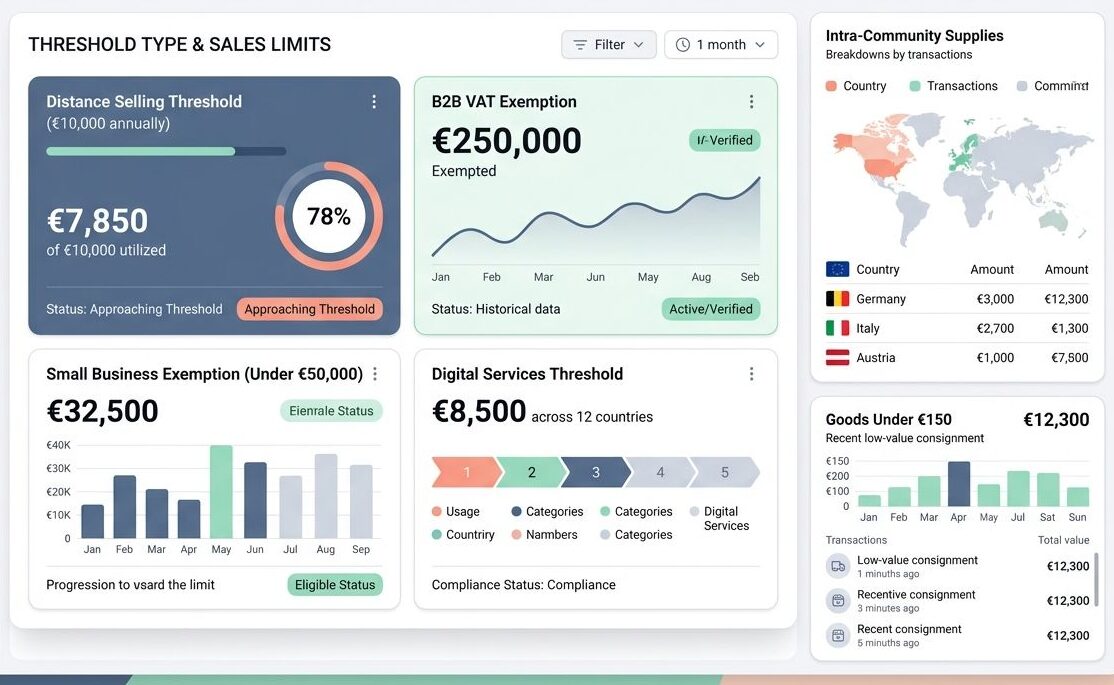
| Threshold Type | Sales Limit | Key Details |
|---|---|---|
| Goods Under €150 | Below €150 per item | Customers pay the tax at import if the seller does not use IOSS. Using IOSS allows the seller to collect it clearly at checkout. |
| Distance Selling Threshold | €10,000 annually (per country) | Small EU sellers stay exempt from registration in specific countries until they hit this mark. Once crossed, registration becomes mandatory. |
| B2B VAT Exemption | Business-to-business sales | Companies selling to other businesses in different EU countries can reverse charge the tax. The buyer’s country handles the tax instead. |
| Small Business Exemption | Under €50,000 (varies by country) | Micro-businesses may skip registration entirely in certain member states. Revenue limits differ across Europe. |
| Digital Services Threshold | No minimum threshold applies | All digital services face this tax, regardless of seller size or sales volume. Streaming, software, and apps all instantly qualify. |
| Intra-Community Supplies | No quantity restrictions | Goods moving between EU countries qualify for zero-rating when B2B with valid identification numbers. |
Crossing thresholds completely flips your entire tax situation on its head. A European seller earning €9,999 stays exempt, but hitting €10,001 instantly triggers full registration requirements. That single euro difference creates substantial administrative work for growing companies.
Digital products bypass most of these exemptions entirely. You absolutely cannot hide behind small business status when selling software or e-books from the United States. Those international sales clock toward your totals immediately.
Reverse charging heavily saves money for legitimate B2B operations. Your customer simply becomes the taxpayer instead of you. Valid tax identification numbers make reverse charging totally legal and simple to execute. Without the proper documentation, you pay the full amount yourself and have to chase reimbursement later.
How to Collect and Pay VAT
Collecting and paying your taxes involves entirely different rules depending on whether you sell physical goods under €150 or digital services.
VAT on goods under €150
Low-value goods under €150 get very special treatment in the EU tax system. If a US seller uses the Import One-Stop Shop, they collect the tax directly at checkout on their website. This greatly speeds up the buying and shipping process.
When the package arrives in Europe, it gets processed through a special customs Green Lane. The customer receives their package straight to their door without paying any extra surprise fees to the delivery driver.
If a non-EU business chooses not to use IOSS, the process gets much worse for the buyer. The postal service stops the package at the border. They force the European customer to pay the tax, plus a hefty carrier handling fee, before handing over the goods.
Here are the major benefits of getting this process right:
- The Green Lane: Packages using IOSS clear customs incredibly fast.
- No Doorstep Fees: Customers receive their items without paying extra carrier handling charges.
- Simplified Tracking: Sellers use software to automatically flag which items fall under the €150 threshold.
VAT on digital services
Digital services fall into a completely different tax category than physical goods, and this strict distinction matters heavily for your business. Online sellers offering software, streaming subscriptions, cloud storage, or digital content must collect taxes from EU customers. You base this collection strictly on where those customers actually live, not where your US business operates.
The tax rate heavily varies by country. For example, Luxembourg charges a low rate of 17%, while Hungary charges a massive rate of 27%. You will collect very different amounts depending on your customer’s exact location.
Here is how you securely handle digital service taxes:
- Instant Liability: Digital products trigger tax obligations immediately upon sale. There is no grace period or minimum sales threshold.
- Location Tracking: You must collect two pieces of non-conflicting evidence, like an IP address and a billing address, to prove your customer’s location.
- Consolidated Filing: Your business collects the tax and remits it entirely through the Non-Union One Stop Shop system.
This consumption tax approach simply means customers pay the tax rate of their home country, and you remit those funds to your chosen tax authority. Digital goods sold to other businesses follow different rules than those sold to consumers, so verify your customer type before calculating the rate.
Benefits of the EU VAT E-Commerce Package
The EU VAT E-Commerce Package makes selling across borders simpler, fairer, and highly profitable for online businesses.
Simplified compliance for businesses
Online sellers across Europe and the US face significantly less paperwork with the One-Stop Shop system. Instead of formally registering in every single EU country where they sell goods, businesses file just one return.
This entirely cuts through red tape and saves massive amounts of time. Companies no longer juggle 27 multiple tax filings, completely different deadlines, or separate, confusing payment schedules. The system securely lets online retailers focus on growing their business rather than drowning in compliance paperwork.
Digital products and low-value goods safely follow the same streamlined approach. Businesses selling subscription services or items under the threshold totally benefit from clearer rules.
Here are the core benefits of this simplified approach:
- One Return: File a single return instead of juggling 27 different deadlines.
- Clear Rules: Subscription services and low-value items follow highly predictable paths.
- Lower Costs: Spend far less money on international accountants and confusing paperwork.
Fair competition across the EU
Before July 2021, massive global companies had a totally unfair edge over small sellers. Large international businesses could easily ship goods into the EU and completely avoid collecting taxes, while smaller online retailers had to pay taxes on every single sale.
This created a highly lopsided playing field. The EU VAT E-Commerce Package permanently leveled things out by making all global sellers follow the exact same tax rules, regardless of their size or where they operate.
Now, a small boutique in Portugal competes on an equal footing with a massive seller in New York. Everyone securely collects taxes the same way, everyone pays their taxes fairly, and customers easily get honest pricing across all EU countries.
“Transparent pricing at checkout builds immediate trust. When US sellers include the full landed cost, European shoppers abandon their carts far less frequently.”
This fairness matters greatly because it securely keeps the market healthy and completely trustworthy. Sellers who follow the rules do not lose loyal customers to competitors who cut corners. The One Stop Shop system simply lets companies file returns in one place rather than registering everywhere.
Cross-border sales now happily happen on a level playing field where the best businesses win based on quality and exceptional service, not tricky tax loopholes.
Challenges of VAT Compliance for Online Businesses
VAT compliance constantly throws curveballs at online sellers, from tangled registration processes to juggling completely different tax rates across 27 EU countries.

Complex registration processes
Registering your online business across multiple EU countries feels exactly like solving a puzzle with constantly shifting pieces. If you decide not to use the OSS or IOSS simplifications, each country forces its own registration rules, massive paperwork requirements, and strict deadlines.
You might desperately need to register in Germany, France, Spain, and Italy all at once if you hold inventory in those specific places. The forms arrive in completely different languages, ask for totally different financial information, and demand highly specific supporting documents.
Tax authorities in each specific nation fully expect you to submit data in their uniquely preferred format. This scattered, manual approach drains your valuable time and resources much faster than you would ever expect.
Here are the biggest hurdles in manual registration:
- Language Barriers: Translating official government tax forms often requires hiring a specialized legal translator.
- Inconsistent Deadlines: One country might strictly require monthly returns, while another asks for quarterly submissions.
- Format Clashes: Software systems often completely fail to sync across these different foreign registration portals.
Many US online sellers simply hire expensive tax professionals just to handle the paperwork side of things. Getting your registration process completely right from the start saves you from devastatingly costly mistakes later on.
Varying VAT rates across EU countries
Europe definitely does not play by one single rulebook for tax rates, and this harsh reality impacts US online sellers directly. Each EU country independently sets its own rates, which completely changes your final product price depending on where your customer lives.
Luxembourg charges a low 17%, Germany charges 19%, and Hungary charges a massive 27%. Selling across borders strictly requires you to track multiple different tax percentages at the exact same time. This confusing patchwork of rates turns online sales into a massive compliance challenge.
Your tax liabilities instantly shift the moment a European customer clicks buy from a different country. Digital products heavily face their own rate variations too, so a software subscription priced at $100 easily generates completely different tax amounts in each member state.
Here is why you must pay close attention to varying rates:
- Location-Based Rates: Your tax liability changes instantly based on the buyer’s home country.
- Product Variations: Digital products face different rates than physical clothing or electronics.
- Strict Rules: You absolutely must calculate the correct rate for each distinct transaction to avoid severe audits.
Tips for Managing VAT in E-Commerce
Smart automated tools and simply staying current with international tax laws make tax management much easier for your growing online business.
Use VAT-compliance software
VAT-compliance software completely takes the dangerous guesswork out of tax calculations for US businesses. These advanced tools automatically calculate the correct tax rates for each EU country, flawlessly track your sales across borders, and instantly generate reports.
For US e-commerce sellers, adopting the right technology is absolutely critical.
- Quaderno: This platform is highly praised for real-time tax application and custom invoicing, making it perfect for agile e-commerce and SaaS businesses.
- TaxJar: Known for effortless digital tax filings, it seamlessly connects to major platforms like Shopify and WooCommerce in just a few simple clicks.
- Avalara: Geared toward larger organizations, it offers comprehensive ERP integrations and heavy multi-jurisdictional support.
Software platforms perfectly handle distance sales, digital products, and low-value goods with equal ease. Your business registration details stay current, and the system instantly flags any compliance gaps before they become massive problems.
Filing returns completely transforms from a painful headache into a highly straightforward process. The software compiles your international e-commerce transactions, neatly organizes them by country, and perfectly prepares your tax return in the exact format each EU nation strictly requires.
Stay updated on VAT regulations
Tax laws shift extremely fast, so US online sellers absolutely must keep their finger on the pulse of regulation changes. EU regulations get updated regularly, and missing a strict deadline or entirely misunderstanding a new rule can easily cost your business real money.
You should closely subscribe to official government tax websites, actively join industry groups focused on global online retail, and eagerly follow tax compliance newsletters.
“With the 2024 implementation of CESOP, tax authorities actively share data across borders to spot discrepancies. You must maintain perfect electronic transaction records for exactly 10 years to survive an audit.”
Your specific tax liabilities depend highly on staying strictly informed about consumption tax shifts across totally different EU countries. Each individual nation constantly tweaks its rates and rules, so what works perfectly in one place might entirely fail in another.
Talk to specialized tax professionals who deeply understand cross-border sales, happily attend webinars about e-commerce tax changes, and securely bookmark the official EU tax authority pages. Businesses that actively build this smart habit into their weekly routine smoothly catch problems before they spiral into compliance nightmares.
The Closing Thoughts
How VAT Works For European Online Businesses is a critical topic that shapes how global sellers safely operate across Europe. Your US-based business grows much stronger when you fully master these strict tax rules.
Digital products, subscription services, and low-value physical goods all securely follow totally different paths through the system. Smart online retailers heavily invest in tax-compliance software to track absolutely everything correctly from day one.
This brilliant move securely saves time, drastically cuts errors, and firmly keeps your business on totally solid ground. The One Stop Shop and Import One Stop Shop systems exist specifically to make your daily life easier.
You gain massive real advantages by strictly staying current with EU regulations and fully understanding your tax liabilities. The dedicated effort you gladly put into learning these systems perfectly pays off through highly smooth operations and far fewer headaches down the very long road.
FAQs on How VAT For E-commerce Business In Europe Works
1. What is VAT, and why do European online businesses need to care?
Value Added Tax is a European consumption tax, and you need to care because platforms like Shopify require US sellers to collect it right at checkout. If you ship a package from the States without handling this tax through the Import One-Stop Shop system, European customs will simply freeze your shipment and charge your buyer extra fees.
2. How does VAT registration work for online sellers in Europe?
You can easily skip registering in every individual country by signing up for the Non-Union One-Stop Shop portal in a single member state like Ireland. This streamlined registration lets US-based businesses report all their European sales on one quarterly return. Handling it this way saves you the headache of managing multiple international tax filings and keeps your accounting costs low.
3. Do I charge the same VAT rate on all products sold across Europe?
No, every European country sets its own specific rate, ranging from 17 percent in Luxembourg to a steep 27 percent in Hungary. You also have to check your specific product categories because items like children’s clothing or digital downloads often qualify for a significantly reduced rate. Using an automated tool like Stripe Tax is the easiest way to guarantee you apply the exact right percentage for each customer.
4. What happens if my business ignores VAT rules when selling online in Europe?
Ignoring these strict tax laws will result in heavy financial penalties from foreign governments and the immediate suspension of your seller accounts on major global marketplaces like Amazon Europe.