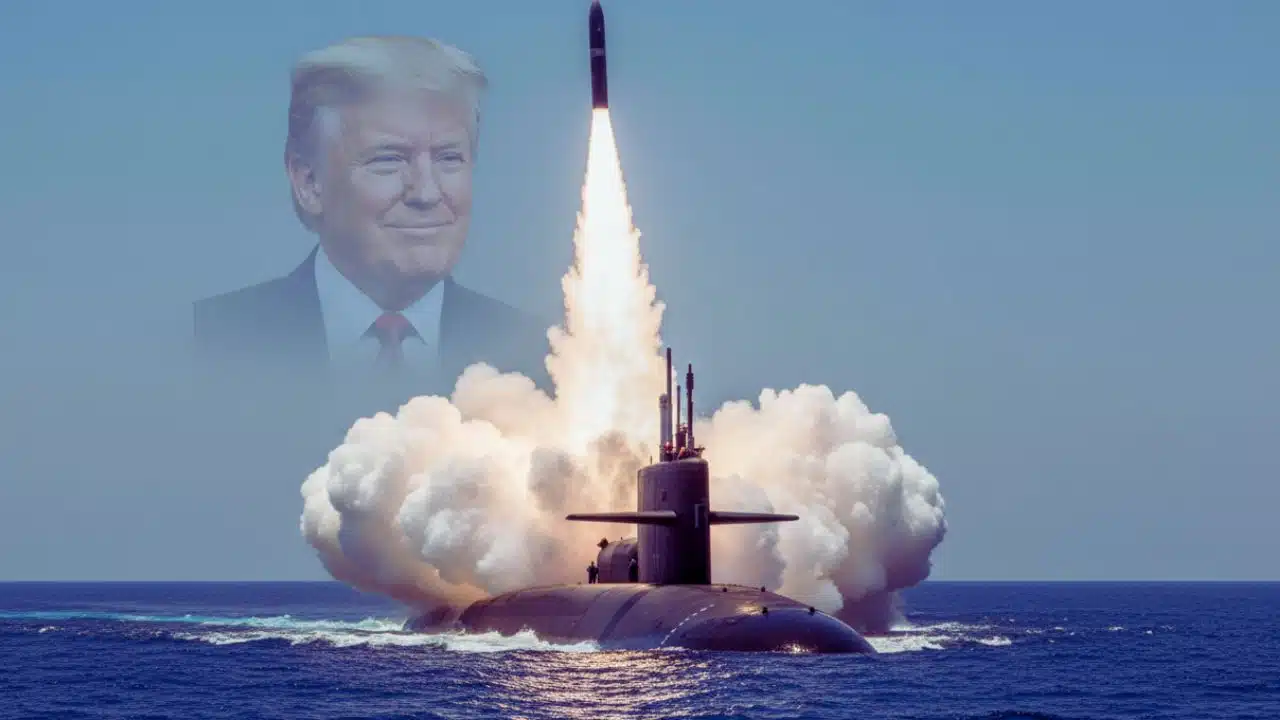
The United States Navy has carried out a powerful demonstration of its nuclear deterrence capability by successfully launching four Trident II D5LE submarine-launched ballistic missiles (SLBMs) from an Ohio-class submarine in the Atlantic Ocean. The tests took place between September 17 and September 21, 2025, off the east coast of Florida, and were confirmed by the Navy’s Strategic Systems Programs command.
Although the missiles carried no warheads, their flight across thousands of miles of ocean immediately drew international attention, coming at a time when U.S. relations with both Russia and China remain strained.
How the Test Was Conducted
The launch was part of a routine series of evaluations the Navy conducts to verify the performance and reliability of its strategic weapons. Each missile was launched from a submerged Ohio-class submarine and flew over the Atlantic toward pre-designated impact zones.
The Navy issued advanced navigational hazard warnings to ships and aircraft, noting that the missiles had the potential to travel across the Atlantic and reach as far as the waters off southwestern Africa. During the tests, the missiles struck their assigned targets precisely, confirming the accuracy of the system.
Residents of Puerto Rico and other regions reported seeing a bright object streaking across the night sky during one of the launches. Images and videos shared widely on social media quickly fueled speculation before the Navy confirmed that what people had witnessed was part of the scheduled Trident missile test sequence.
The Trident II D5LE Missile System
The Trident II D5 has long been the backbone of the U.S. sea-based nuclear deterrent. First deployed in 1990, it is a three-stage, solid-fuel missile capable of carrying multiple independently targetable reentry vehicles (MIRVs). Its operational range exceeds 7,400 miles (11,900 kilometers), allowing it to strike targets across continents when launched from virtually anywhere in the world’s oceans.
The missiles tested this month were of the Life Extension (LE) version, known as D5LE. This program upgrades critical components, including the guidance system and electronic hardware, extending the missile’s service life into the 2040s. The D5LE ensures the U.S. can maintain an effective nuclear deterrent until a successor missile system is developed.
The Ohio-Class Submarine Platform
The tests were launched from one of the Navy’s Ohio-class ballistic missile submarines (SSBNs). The U.S. operates 14 of these submarines, with 6 assigned to the Atlantic fleet and 8 to the Pacific.
Each submarine is capable of carrying up to 20 Trident II missiles, giving them immense destructive potential. Their ability to remain hidden beneath the ocean’s surface for months at a time makes them the most survivable leg of the U.S. nuclear triad, which also includes land-based intercontinental ballistic missiles (ICBMs) and strategic bombers.
The Ohio-class submarines, first introduced in the 1980s, are being gradually replaced by the next-generation Columbia-class SSBNs, scheduled to enter service in the early 2030s. However, until then, the Ohio fleet remains at the heart of U.S. strategic deterrence.
Why the Missile Tests Matter
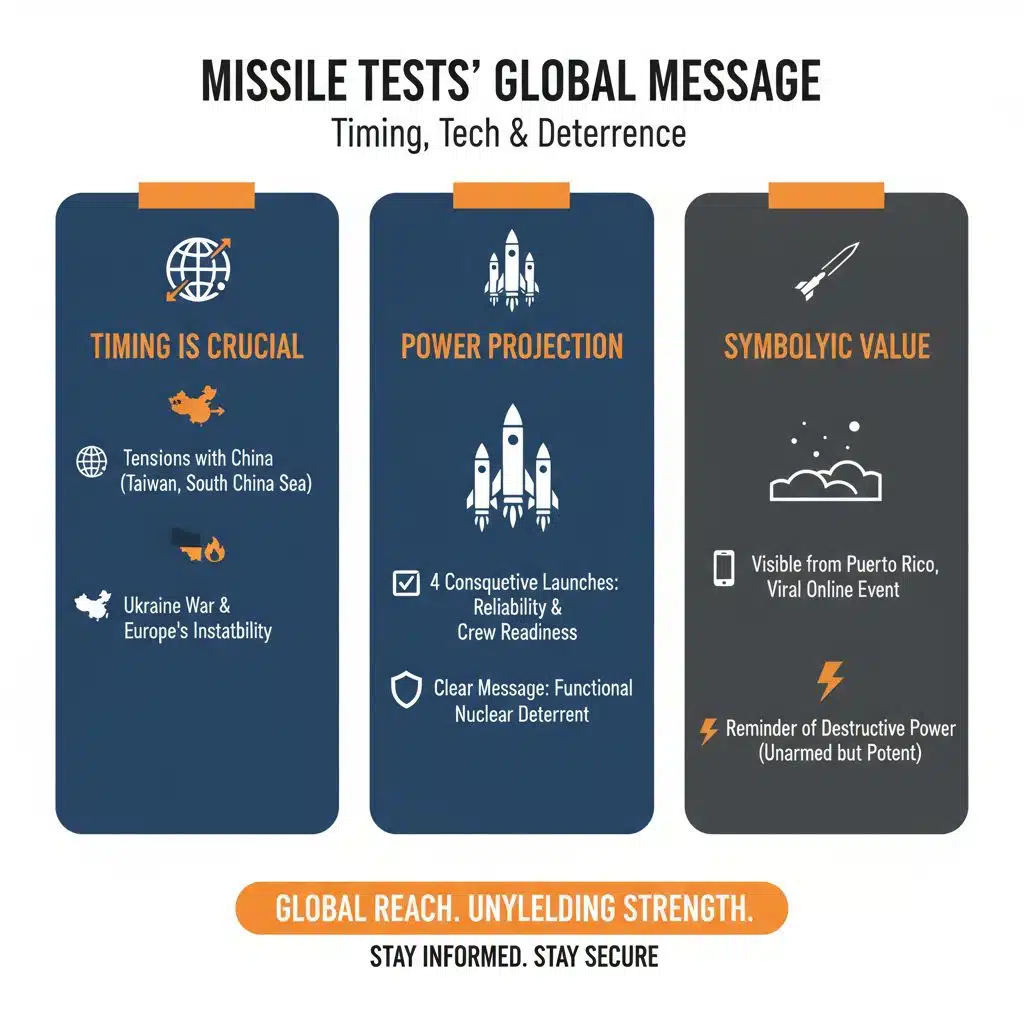
Although the Navy emphasized that these launches were part of long-planned evaluations and not tied to any specific global event, their timing is significant. The U.S. is engaged in ongoing tensions with China, particularly over Taiwan and the South China Sea, and with Russia, whose war in Ukraine continues to fuel instability in Europe.
By conducting four consecutive launches, rather than the more common single or dual test, the Navy showcased both the reliability of the missile system and the readiness of the crews who operate them. Analysts believe this sends a clear message to adversaries that the U.S. nuclear arsenal remains fully functional and capable of deterring any aggression.
The visibility of the launch from Puerto Rico, and the fact that it became a widely discussed event online, also amplified its symbolic value. Even though the missiles were unarmed, the sight of them cutting across the night sky served as a reminder of the destructive power these systems hold when deployed in their operational capacity.
Broader Strategic Context
The United States has made clear in its defense posture reviews that maintaining a credible and modern nuclear deterrent is a national priority. The D5LE program is a critical part of that effort, ensuring that the Navy’s sea-based nuclear force remains effective until at least 2042.
The tests also underline the importance of the Navy’s deterrence patrols, which are carried out continuously around the world. At any given time, multiple Ohio-class submarines are at sea, undetected, providing the U.S. with a guaranteed second-strike capability in the event of nuclear conflict.
Meanwhile, both Russia and China are modernizing their own nuclear arsenals. Russia continues to expand its arsenal of ICBMs and strategic submarines, while China is rapidly building new missile silos and upgrading its submarine fleet. Against this backdrop, the U.S. demonstration of Trident II’s effectiveness underscores its commitment to maintaining strategic balance.
Looking Toward the Future
The U.S. Navy’s successful Trident launches this September mark the 197th, 198th, 199th, and 200th successful flight tests of the missile system since its introduction. This track record has made the Trident II D5 one of the most tested and reliable strategic missile systems in history.
The upcoming Columbia-class submarine fleet, each designed to carry 16 Trident missiles, will take over the strategic deterrent role in the coming decades. These submarines will incorporate advanced stealth technologies and be designed to operate for decades with reduced maintenance.
For now, the combination of Ohio-class SSBNs and the modernized Trident II missiles continues to anchor U.S. nuclear strategy, reassuring allies and warning adversaries alike that the United States retains a formidable and survivable deterrent force.