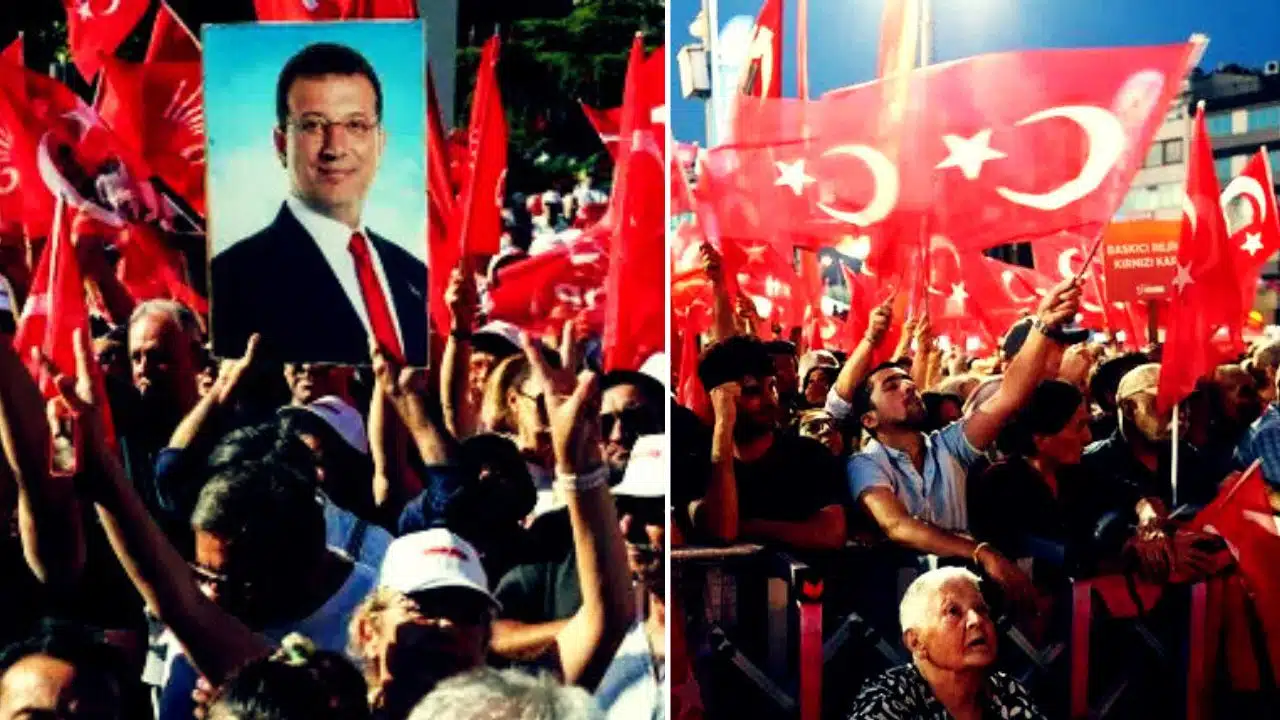
On Sunday, the Turkish capital Ankara witnessed one of the largest opposition-led protests in recent months. Tandogan Square filled with tens of thousands of demonstrators—estimates from CHP officials placed the crowd at nearly 50,000 people. Protesters carried Turkish national flags and Republican People’s Party (CHP) banners, while slogans against the government echoed through the square. Many in the crowd demanded the resignation of President Recep Tayyip Erdoğan, reflecting growing frustration with what they see as state-backed repression of democratic forces.
The gathering was organized by the Republican People’s Party (CHP), Turkey’s oldest political party and the main opposition force to Erdoğan’s Justice and Development Party (AKP). The immediate cause of the demonstration was a scheduled court hearing on Monday that could decide the fate of CHP leader Ozgur Özel. The case challenges the validity of the CHP’s internal congress held in November 2023, where Özel was elected as leader after defeating long-time chairman Kemal Kılıçdaroğlu.
The Legal Case Against the CHP
The Ankara court is set to examine claims of vote rigging and procedural violations during the 2023 party congress. If the court annuls the outcome, several scenarios are possible:
-
Özel could be removed as party leader.
-
Kılıçdaroğlu, who led the CHP for over a decade, might be reinstated.
-
Alternatively, a court-appointed trustee could be installed to oversee the party’s operations.
Any of these outcomes would throw the CHP into internal turmoil and disrupt the momentum it has built since its landmark victory in the 2024 local elections, where the opposition dealt Erdoğan’s party one of its biggest electoral defeats in two decades. Critics argue that the case is not about internal party democracy but part of a broader political strategy to weaken the opposition ahead of the next general elections scheduled for 2028.
Wider Crackdown on the Opposition
The protests also tapped into a broader anger over a year-long legal crackdown on the CHP. Reports from rights groups and Turkish media highlight that hundreds of CHP members have been detained or prosecuted. These include at least 500 party officials and 17 mayors, many of them charged with corruption, abuse of office, or terrorism links. The CHP leadership insists that the charges are fabricated and politically motivated.
The crackdown intensified in March 2025, when Ekrem İmamoğlu, the popular mayor of Istanbul and one of Erdoğan’s most serious political rivals, was arrested. His detention sparked the largest wave of unrest in Turkey in a decade, with hundreds of thousands taking to the streets nationwide. The government accused İmamoğlu of financial misconduct and links to outlawed groups, while his supporters say his arrest was aimed at removing him from politics before the 2028 elections.
Political Stakes for Erdoğan and the AKP
The timing of Monday’s hearing has raised questions about judicial independence in Turkey. Analysts note that the judiciary has increasingly become a battleground where political conflicts are played out. By targeting the CHP through legal processes, the ruling AKP may be trying to neutralize its most dangerous opponent at a time when economic struggles and public discontent are eroding Erdoğan’s popularity.
The CHP’s victories in the 2024 local elections, particularly in major cities such as Istanbul, Ankara, and Izmir, showed that the opposition is capable of challenging Erdoğan’s dominance when united. Özel’s leadership has been credited with injecting new energy into the party, appealing to both traditional CHP supporters and younger voters. Removing him through a court order would not only destabilize the opposition but also reinforce perceptions that Turkey’s institutions are being weaponized for political purposes.
Protest Demands and Public Sentiment
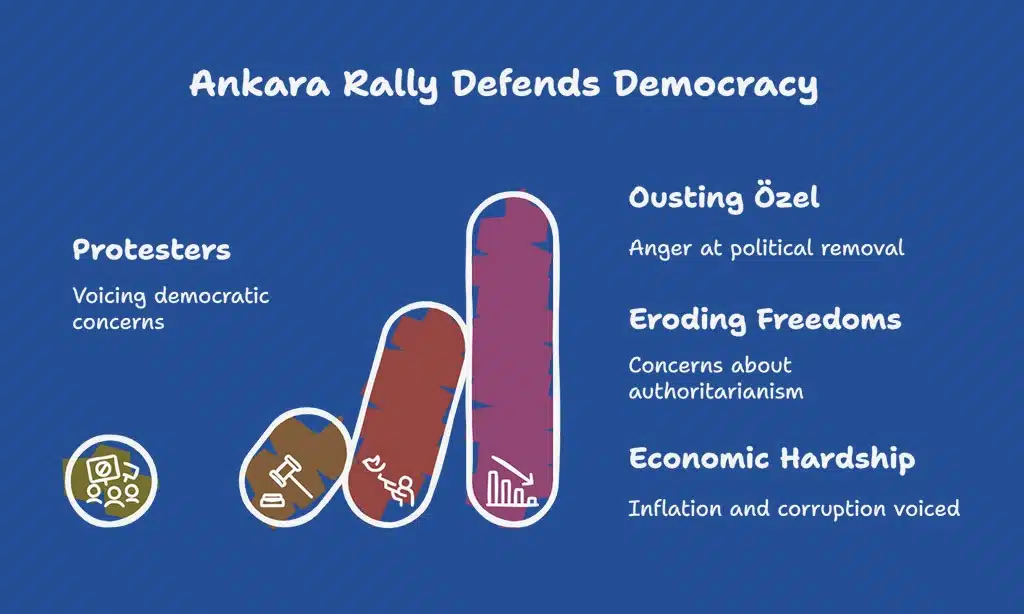
The rally in Ankara served as a show of strength by the opposition. Protesters expressed anger not only at the possibility of Özel being ousted but also at the broader erosion of democratic freedoms in Turkey. Many participants framed the hearing as part of a “judicial coup” against the opposition. Demonstrators also voiced concerns about economic hardship, inflation, and corruption scandals that have plagued the government in recent years.
For many, the protest was about more than the future of one party—it was about defending Turkey’s democratic system. The heavy turnout indicated that significant segments of the population remain committed to resisting what they see as authoritarian tendencies under Erdoğan’s rule.
International Concerns
The unfolding events have drawn attention outside Turkey. International observers, including human rights groups and European Union officials, have expressed concern over the ongoing crackdown on the opposition. Turkey, which has long aspired to join the EU, faces renewed criticism over judicial independence, rule of law, and human rights protections. The outcome of Monday’s hearing could further strain relations with Western partners, particularly if the court annuls the CHP congress results.
What Happens Next
The court’s ruling is expected to be announced on Monday, September 15, 2025. Possible outcomes include:
-
Annulment of the 2023 congress and removal of Ozgur Özel.
-
Reinstatement of Kemal Kılıçdaroğlu as CHP leader.
-
Appointment of a judicial trustee to run the party temporarily.
-
A dismissal of the case, which would allow Özel to remain in office.
Whatever the decision, the political consequences are likely to be far-reaching. A ruling against Özel could spark further protests across Turkey, deepen polarization, and intensify debates about the erosion of democracy. On the other hand, if the court dismisses the case, it may embolden the opposition but also increase the government’s use of alternative methods to curb dissent.
The massive protests in Ankara ahead of the CHP court case mark a critical moment in Turkey’s political landscape. At stake is not only the leadership of the country’s main opposition party but also the future of democratic institutions. With a government accused of using courts to silence rivals and an opposition struggling to protect its gains, the outcome of the hearing could shape the trajectory of Turkish politics for years to come.